
JEE Main · Physics ↓ Falling

Kinematics appeared 38 times across 3 years — 4.4% of Physics. This question is from One-Dimensional Motion Curves.

Year 2026 2025 2024 Total
Questions 8 16 14 38

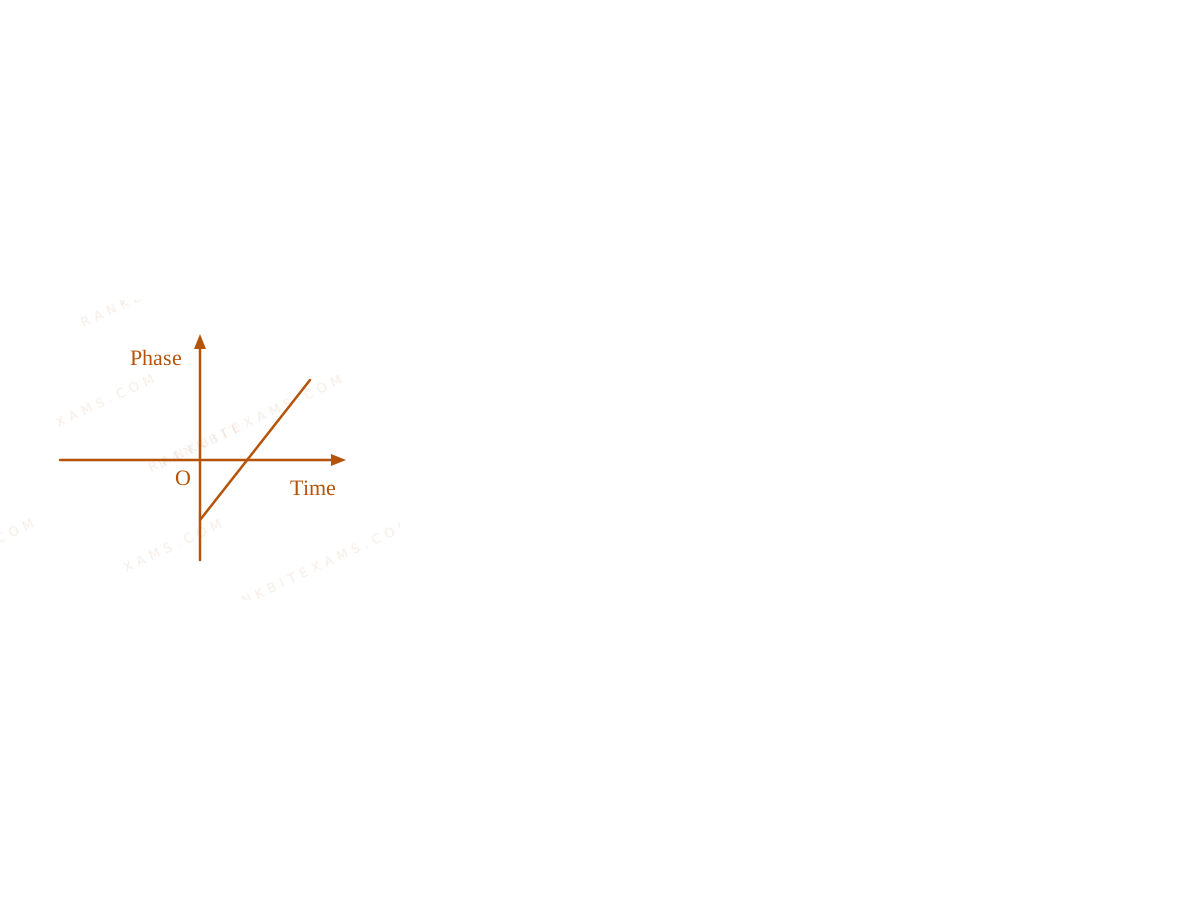
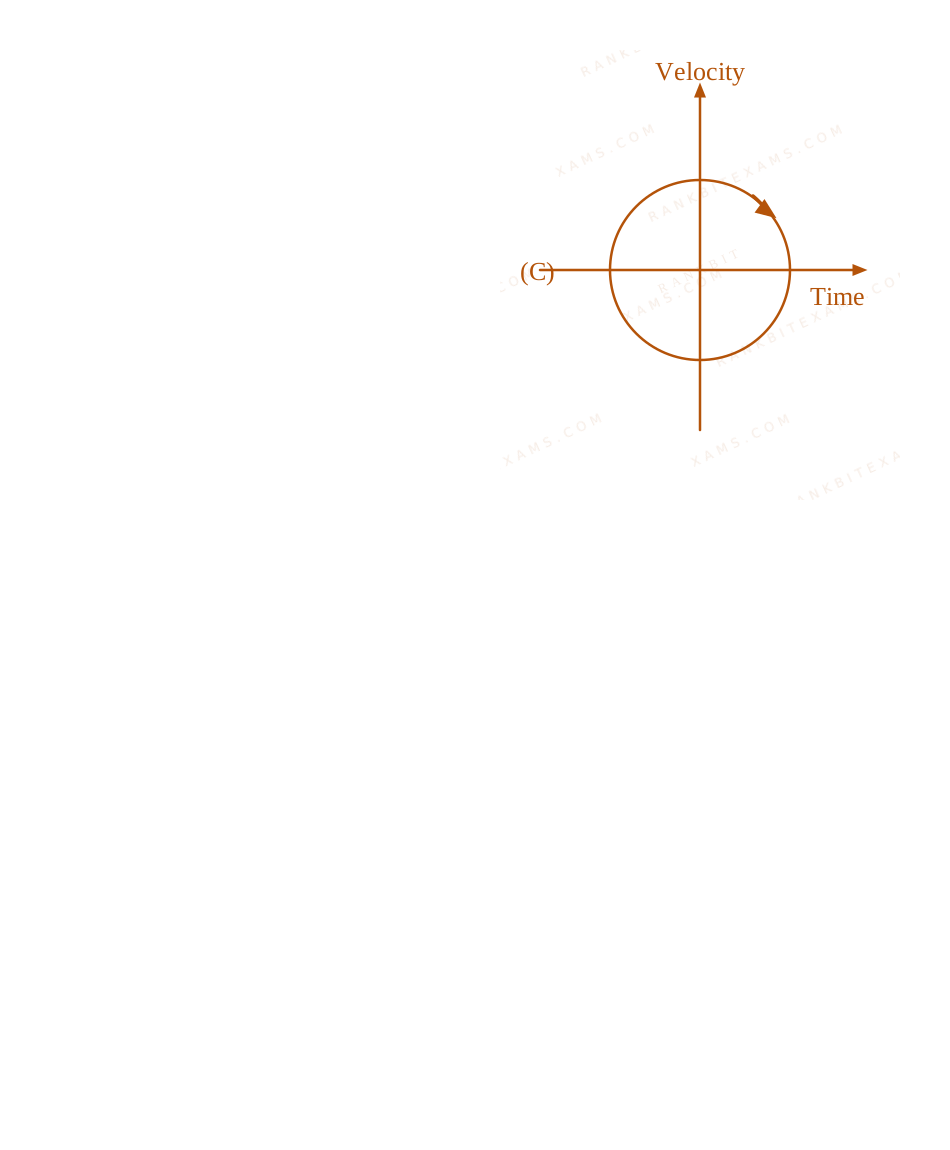
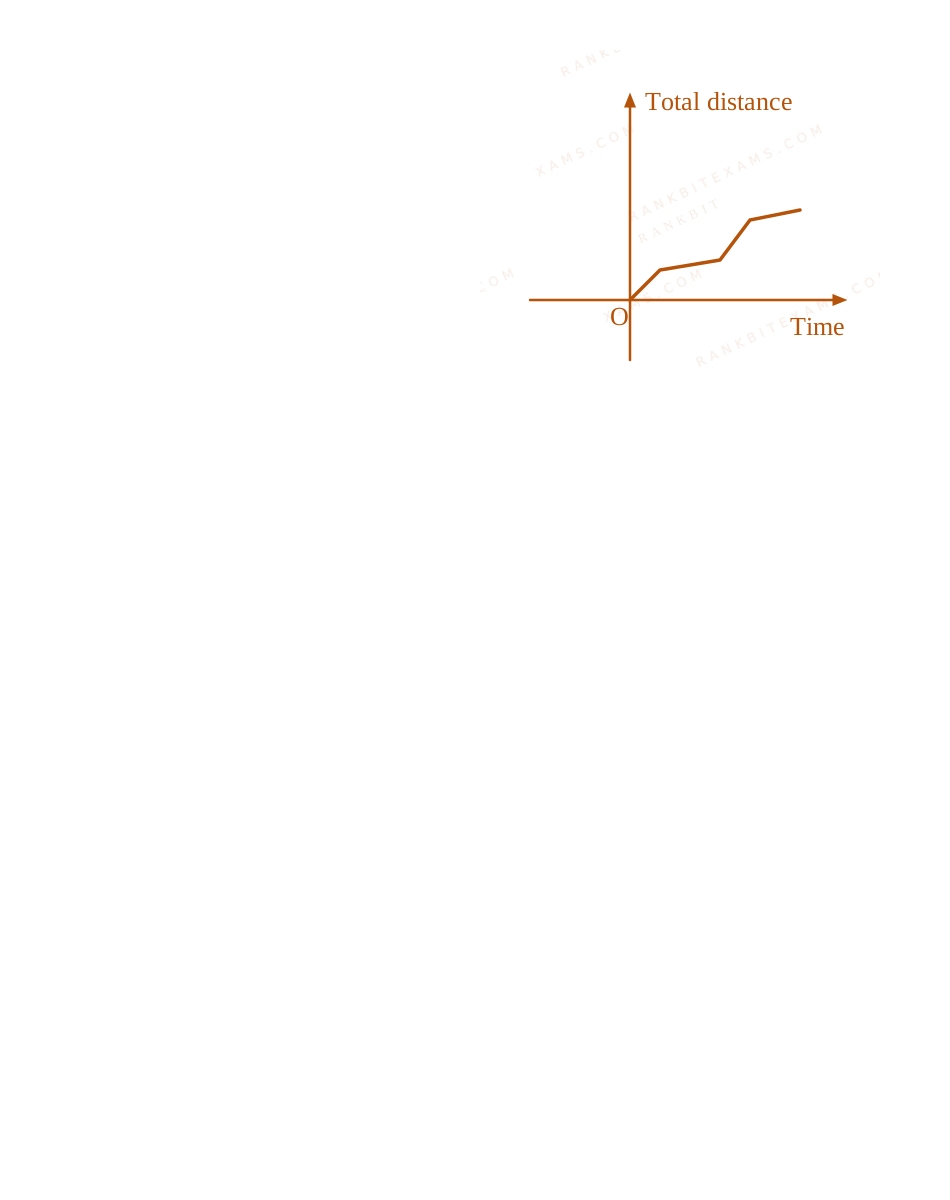
Which of the following curves possibly represent one-dimensional motion of a particle? (A)
Phase vs time plot for Q7 (A)
Displays graph A showing phase varying over time, graph B showing velocity versus displacement, graph C showing velocity versus negative time, and graph D showing distance versus time.
(B)
Phase vs time plot for Q7 (A)
Displays graph A showing phase varying over time, graph B showing velocity versus displacement, graph C showing velocity versus negative time, and graph D showing distance versus time.
(C)
Phase vs time plot for Q7 (A)
Displays graph A showing phase varying over time, graph B showing velocity versus displacement, graph C showing velocity versus negative time, and graph D showing distance versus time.
(D)
Phase vs time plot for Q7 (A)
Displays graph A showing phase varying over time, graph B showing velocity versus displacement, graph C showing velocity versus negative time, and graph D showing distance versus time.
Choose the correct answer from the options given below:

Solution & Explanation

Related Formula

For realistic physical motion in one dimension:

  • Time t can never be negative during a normal positive time sequence, and cannot flow backwards.
  • Total distance covered can never decrease over time.
  • A particle cannot have two different values of position or velocity at the exact same instant of time.
Core Logic

Let us analyze each curve:

  • Curve (A) (Phase φ vs Time t): Represents φ = kt + C, which is a valid linear relationship of phase over time (e.g., in Simple Harmonic Motion x = A (kt + C)). (Valid)
  • Curve (B) (Velocity v vs Displacement x): A closed loop, which represents symmetric harmonic-type oscillation. For example, v² + ω² x² = const (ellipse) is a perfectly physically valid 1D SHM velocity-displacement phase portrait. (Valid)
  • Curve (C) (Velocity vs Time): The curve enters into the negative time quadrant. Time cannot go backwards or exist in negative values relative to starting sequence in standard physical scenarios. (Invalid)
  • Curve (D) (Total Distance vs Time): Represents total distance increasing over time. Total distance is a non-decreasing function of time (d(d)/dt ≥ 0). Thus, this curve is physically valid. (Valid)
Step 1: Conclusion

Therefore, curves A, B, and D possibly represent physical one-dimensional motion. The correct option is (1).

Pattern Recognition

Quick check for graph validity:

  • Time cannot run backwards (ruling out C).
  • Total distance can never decrease (D is valid because it strictly goes upwards).
  • v vs x can be circular/elliptical in SHM (B is valid).
Chapter Mix

Class 11 Physics: Motion in a Straight Line

More Kinematics Previous-Year Questions — Page 8

Q44 jee_main_2024_31_jan_evening Vector Algebra
If two vectors A and B having equal magnitude R are inclined at an angle θ, then
  • A. | A - B| = √(2)R ((θ)/(2))
  • B. | A + B| = 2R ((θ)/(2))
  • C. | A + B| = 2R ((θ)/(2))
  • D. | A - B| = 2R ((θ)/(2))

Solution

Related Formula

The magnitude of the resultant vector is given by:

| Rᵣₑₛ| = √(A² + B² + 2AB θ)
Core Logic

Let | A| = | B| = R. Then for vector addition:

| A + B| = √(R² + R² + 2R² θ)
Step 1: Simplify Addition Form
| A + B| = √(2R² (1 + θ))

Using the trigonometric identity 1 + θ = 2 ² ((θ)/(2)):

| A + B| = √(2R² × 2 ² ((θ)/(2))) = 2R ((θ)/(2))
Step 2: Cross-check Subtraction Form

For subtraction:

| A - B| = √(R² + R² - 2R² θ) | A - B| = √(2R² (1 - θ)) = √(2R² × 2 ² ((θ)/(2))) = 2R ((θ)/(2))

Checking options, only | A + B| = 2R ((θ)/(2)) is correctly paired in the choice list.

Pattern Recognition

Standard geometry shortcut: Addition of two equal vectors yields a cosine half-angle dependency. Subtraction yields a sine half-angle dependency. (+ → ), (- → ).

Chapter Mix

Class 11 Physics: Motion in a Plane
Q jee_main_2024_31_jan_morning Projectile Motion
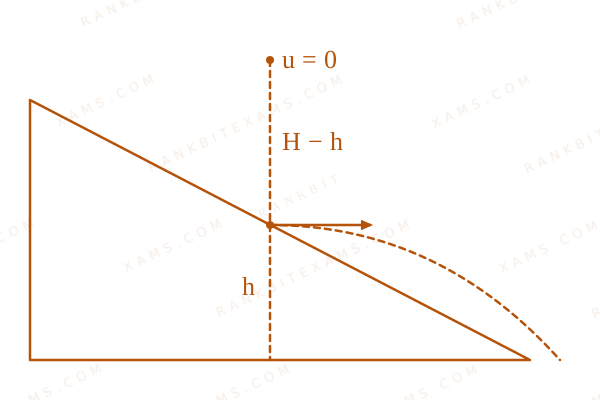
A body starts falling freely from height H hits an inclined plane in its path at height h. As a result of this perfectly elastic impact, the direction of the velocity of the body becomes horizontal. The value of (H)/(h) for which the body will take the maximum time to reach the ground is
Numerical Answer. Answer: 2 to 2

Solution

Related Formula
t = √((2d)/(g))
Core Logic

Projectile Motion diagram for Q55 - JEE Main 2024 Morning

The body falls freely from height H to height h. The distance fallen is (H - h). Time taken to fall this distance:

t₁ = √((2(H - h))/(g))

After elastic impact, the vertical velocity becomes zero (the entire velocity is directed horizontally). From height h, it now acts as a horizontal projectile. The time taken to reach the ground vertically from height h is:

t₂ = √((2h)/(g))

Total time of flight T = t₁ + t₂:

T = √((2(H - h))/(g)) + √((2h)/(g))
Step 2: Maximizing Time

To find the maximum time T, differentiate T with respect to h and equate to zero:

(dT)/(dh) = √((2)/(g)) ( -12√(H - h) + 12√(h) ) = 0 12√(h) = 12√(H - h) √(H - h) = √(h)

Squaring both sides: H - h = h H = 2h

(H)/(h) = 2
Chapter Mix

Class 11 Physics: Kinematics

Q33 jee_main_2024_31_jan_morning Differentiation In Kinematics
The relation between time 't' and distance 'x' is t = α x² + β x, where α and β are constants. The relation between acceleration (a) and velocity (v) is:
  • A. a = -2α v³
  • B. a = -5α v⁵
  • C. a = -3α v²
  • D. a = -4α v⁴

Solution

Related Formula
v = (dx)/(dt) a = (dv)/(dt) = v(dv)/(dx)
Step 1: Differentiate with respect to time

Given the equation:

t = α x² + β x

Differentiating with respect to time t:

(dt)/(dt) = (d)/(dt)(α x² + β x) 1 = 2α x (dx)/(dt) + β (dx)/(dt) 1 = (2α x + β) v v = (2α x + β)⁻¹
Step 2: Calculate Acceleration

Now, acceleration a = (dv)/(dt). Differentiating v with respect to time t:

a = (d)/(dt) [ (2α x + β)⁻¹ ] a = -1(2α x + β)⁻² · (d)/(dt)(2α x + β) a = -(2α x + β)⁻² · (2α) (dx)/(dt)

Substitute v and (2α x + β)⁻² = v²:

a = -(v²) · (2α) · v a = -2α v³
Pattern Recognition

Standard kinematic shortcut: Whenever t = Ax² + Bx, v = (2Ax+B)⁻¹ and a = -2A v³. Memorizing this directly saves derivation time during the exam.

Chapter Mix

Class 11 Physics: Kinematics

More Kinematics Questions — jee_main_2025_03_april_morning

Practice all Kinematics previous-year questions →

Rankbit System
JEE Physics: Waves (+15.5%) | Electrostatics: Concentric Shells (-29.7%) | Modern Physics: Photoelectric Clones (+34.2%) | Mathematics: Definite Integrals (+18.1%) | Chemistry: Coordination Splitting (-11.4%) | JEE Physics: Waves (+15.5%) | Electrostatics: Concentric Shells (-29.7%) | Modern Physics: Photoelectric Clones (+34.2%) | Mathematics: Definite Integrals (+18.1%) | Chemistry: Coordination Splitting (-11.4%)
