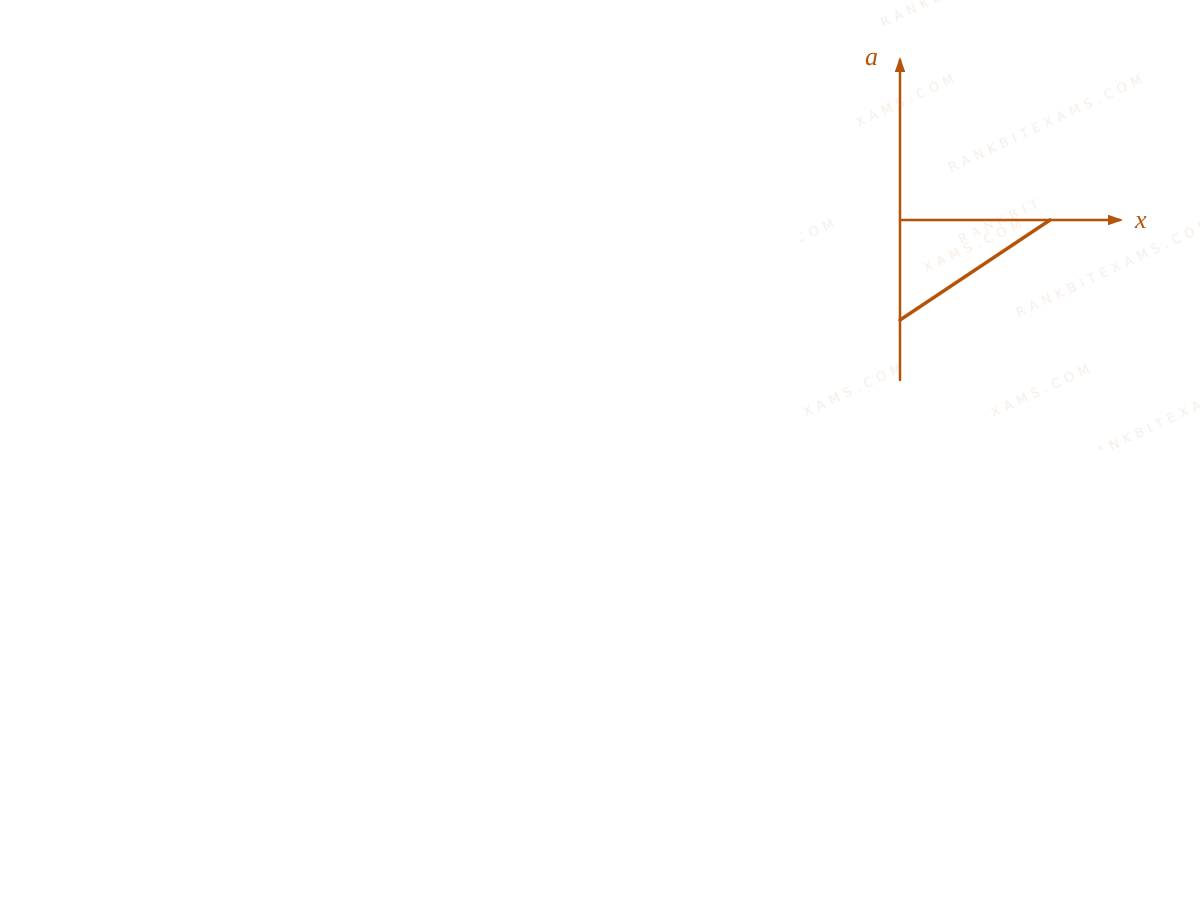
A particle starts moving from time t = 0$t = 0$ and its coordinate is given as x(t) = 4t^3 - 3t$x(t) = 4t^{3} - 3t$ .
A. The particle returns to its original position (origin) 0.866$0.866$ units later
B. The particle is 1 unit away from origin at its turning point.
C. Acceleration of the particle is non-negative.
D. The particle is 0.5 units away from origin at its turning point.
E. Particle never turns back as acceleration is non-negative.
Choose the correct answer from the options given below:
A.textA,C,D only$\text{A,C,D only}$
B.textA,B,C only$\text{A,B,C only}$
C.textC,E only$\text{C,E only}$
D.textA,C only$\text{A,C only}$
Solution & Explanation
### Related Formula
v = fracdxdt$$v = \frac{dx}{dt}$$a = fracdvdt$$a = \frac{dv}{dt}$$
### Core Logic
Given x(t) = 4t^3 - 3t$x(t) = 4t^3 - 3t$.
The particle returns to origin when x = 0$x = 0$:
4t^3 - 3t = 0 Rightarrow t(4t^2 - 3) = 0$$4t^3 - 3t = 0 \Rightarrow t(4t^2 - 3) = 0$$t = 0$t = 0$ (start) and t = sqrtfrac34 = fracsqrt32 approx 0.866 text s$t = \sqrt{\frac{3}{4}} = \frac{\sqrt{3}}{2} \approx 0.866 \text{ s}$. Thus, statement A is correct.
### Step 1: Velocity and Turning Point
Velocity is v = fracdxdt = 12t^2 - 3$v = \frac{dx}{dt} = 12t^2 - 3$.
At turning point, velocity becomes zero:
12t^2 - 3 = 0 Rightarrow t^2 = frac14 Rightarrow t = frac12 text s$$12t^2 - 3 = 0 \Rightarrow t^2 = \frac{1}{4} \Rightarrow t = \frac{1}{2} \text{ s}$$
(We take t > 0$t > 0$ since motion starts at t=0$t=0$).
### Step 2: Position at Turning Point
Substitute t = 1/2$t = 1/2$ into x(t)$x(t)$:
xleft(frac12right) = 4left(frac18right) - 3left(frac12right) = frac12 - frac32 = -1$$x\left(\frac{1}{2}\right) = 4\left(\frac{1}{8}\right) - 3\left(\frac{1}{2}\right) = \frac{1}{2} - \frac{3}{2} = -1$$
The particle is |-1| = 1$|-1| = 1$ unit away from origin. Statement B is correct, and D is incorrect.
### Step 3: Acceleration check
Acceleration a = fracdvdt = 24t$a = \frac{dv}{dt} = 24t$.
Since t geq 0$t \geq 0$, a geq 0$a \geq 0$, so acceleration is always non-negative. Statement C is correct.
Statement E is incorrect because the particle does turn back (at t = 0.5$t = 0.5$, velocity changes sign from negative to positive).
### Step 4: Final Conclusion
Statements A, B, and C are correct.
### Pattern Recognition
To analyze 1D motion, simply find roots of x(t)=0$x(t)=0$ (origin passes), v(t)=0$v(t)=0$ (turning points), and check the sign of a(t)$a(t)$ over the given domain t geq 0$t \geq 0$.
### Evaluation Rubric / Model Answer
null
### Chapter Mix
Class 11 Physics: Kinematics
Keywords:#coordinate is given as x(t)#JEE Main 2026 Evening Q33#Kinematics JEE Main 2026#Motion in a Straight Line JEE Main 2026
More Kinematics Previous-Year Questions
Q39jee_main_2026_21_jan_eveningRelative Motion in 2D
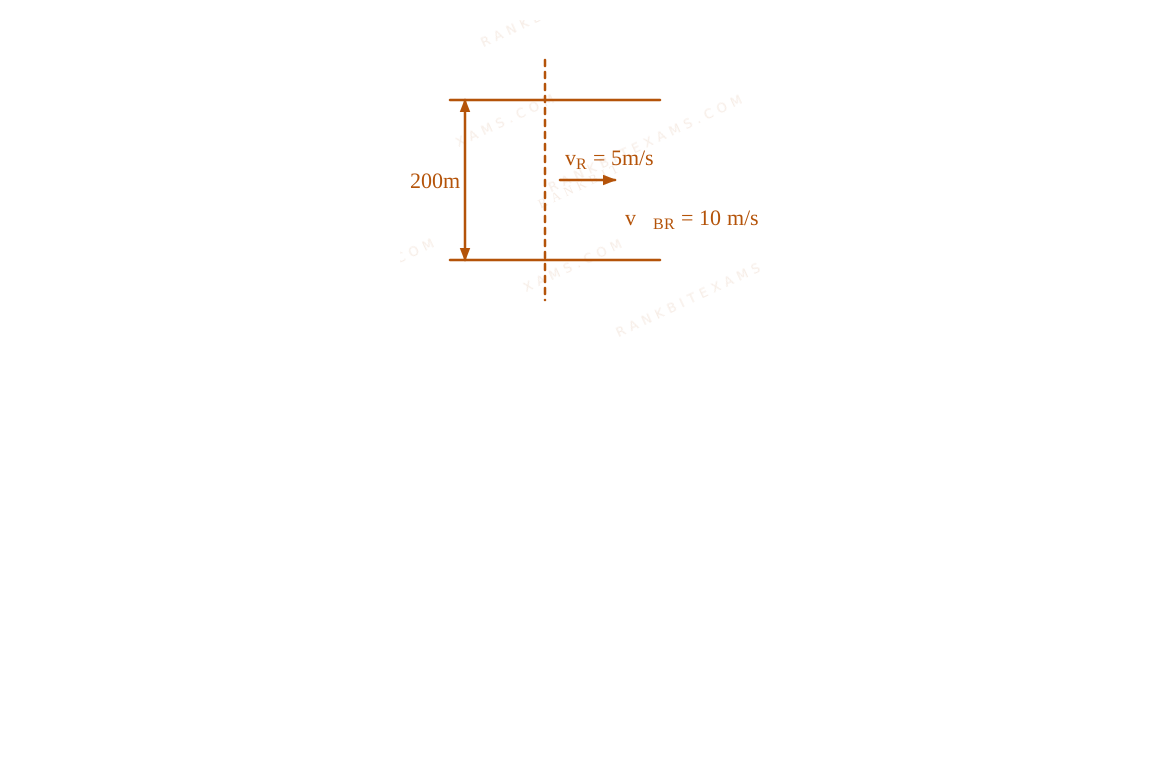
A river of width 200 text m$200 \text{ m}$ is flowing from west to east with a speed of 18 text km/h$18 \text{ km/h}$. A boat, moving with speed of 36 text km/h$36 \text{ km/h}$ in still water, is made to travel one-round trip (bank to bank of the river). Minimum time taken by the boat for this journey and also the displacement along the river bank are ________ and ________ respectively.
A.20 text s and 100 text m$20 \text{ s and } 100 \text{ m}$
B.40 text s and 0 text m$40 \text{ s and } 0 \text{ m}$
C.40 text s and 200 text m$40 \text{ s and } 200 \text{ m}$
D.40 text s and 100 text m$40 \text{ s and } 100 \text{ m}$
Solution
### Related Formula
t_textmin = fracdv_br$$t_{\text{min}} = \frac{d}{v_{br}}$$textDrift (displacement along bank) = v_r times t_texttotal$$\text{Drift (displacement along bank)} = v_r \times t_{\text{total}}$$
### Core Logic
First, convert speeds to m/s.
River speed v_R = 18 times frac518 = 5 text m/s$v_R = 18 \times \frac{5}{18} = 5 \text{ m/s}$.
Boat speed in still water v_BR = 36 times frac518 = 10 text m/s$v_{BR} = 36 \times \frac{5}{18} = 10 \text{ m/s}$.
River width d = 200 text m$d = 200 \text{ m}$.
River boat vector diagram for Q39 - JEE Main 2026 Evening
For minimum time across the river, the boat must head exactly perpendicular to the river flow.
### Step 1: Calculating Minimum Time
Time taken for one crossing (bank to bank):
t_textone-way = fracdv_BR = frac20010 = 20 text s$$t_{\text{one-way}} = \frac{d}{v_{BR}} = \frac{200}{10} = 20 \text{ s}$$
Since it is a round trip (bank to bank and back), total minimum time is:
t_texttotal = 2 times 20 = 40 text s$$t_{\text{total}} = 2 \times 20 = 40 \text{ s}$$
### Step 2: Calculating Displacement along Bank
Displacement along the river bank (drift) happens exclusively due to the river's flow during this total time:
textDisplacement = v_R times t_texttotal = 5 times 40 = 200 text m$$\text{Displacement} = v_R \times t_{\text{total}} = 5 \times 40 = 200 \text{ m}$$
### Pattern Recognition
Minimum time always ignores drift and maxes out the perpendicular velocity vector. Drift simply becomes V_textriver times T_texttotal$V_{\text{river}} \times T_{\text{total}}$.
### Evaluation Rubric / Model Answer
null
### Chapter Mix
Class 11 Physics: Kinematics
Q30jee_main_2026_23_january_eveningMotion under Gravity
A paratrooper jumps from an aeroplane and opens a parachute after 2 s of free fall and starts deaccelerating with 3 \, mathrmm/s^2$3 \, \mathrm{m/s}^{2}$ . At 10 m height from ground, while descending with the help of parachute, the speed of paratrooper is 5 m/s. The initial height of the aeroplane is ____ m.
(g = 10 m/s ^2$^{2}$ )
A.62.5$62.5$
B.92.5$92.5$
C.20$20$
D.82.5$82.5$
Solution
### Related Formula
s = ut + frac12at^2$$s = ut + \frac{1}{2}at^2$$v = u + at$v = u + at$v^2 = u^2 + 2as$v^2 = u^2 + 2as$
### Core Logic
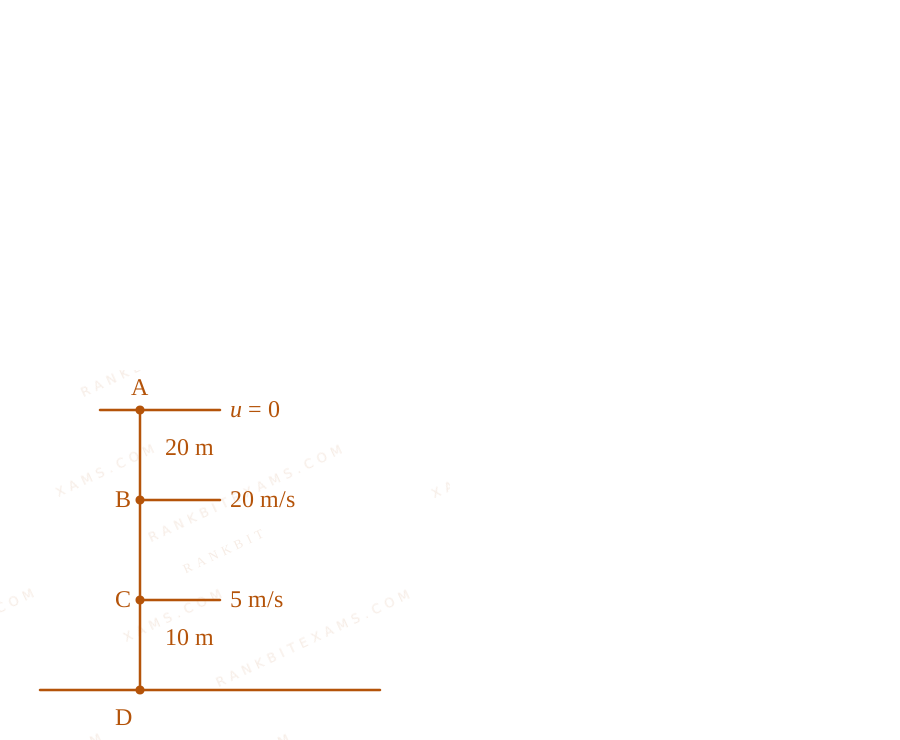
The motion is divided into three distinct vertical sections:
Motion under Gravity diagram for Q30 - JEE Main 2026 EveningMotion under Gravity diagram for Q30 - JEE Main 2026 Evening
1) Free fall phase (A to B$A \to B$)
2) Deceleration phase with parachute (B to C$B \to C$)
3) Final descent phase to the ground (C to D$C \to D$)
### Step 1: Free Fall (A to B)
Initial velocity u = 0$u = 0$, t = 2 \, mathrms$t = 2 \, \mathrm{s}$, g = 10 \, mathrmm/s^2$g = 10 \, \mathrm{m/s^2}$.
x_1 = frac12 times 10 times 2^2 = 20 \, mathrmm$$x_1 = \frac{1}{2} \times 10 \times 2^2 = 20 \, \mathrm{m}$$
Velocity at B:
V_B = 0 + 10 times 2 = 20 \, mathrmm/s$$V_B = 0 + 10 \times 2 = 20 \, \mathrm{m/s}$$
### Step 2: Deceleration Phase (B to C)
Starts with V_B = 20 \, mathrmm/s$V_B = 20 \, \mathrm{m/s}$, decelerates at 3 \, mathrmm/s^2$3 \, \mathrm{m/s^2}$ (a = -3 \, mathrmm/s^2$a = -3 \, \mathrm{m/s^2}$), and reaches V_C = 5 \, mathrmm/s$V_C = 5 \, \mathrm{m/s}$.
V_C^2 = V_B^2 + 2a x_2$$V_C^2 = V_B^2 + 2a x_2$$5^2 = 20^2 - 2(3)x_2$$5^2 = 20^2 - 2(3)x_2$$25 = 400 - 6x_2$25 = 400 - 6x_2$6x_2 = 375 implies x_2 = frac3756 = 62.5 \, mathrmm$$6x_2 = 375 \implies x_2 = \frac{375}{6} = 62.5 \, \mathrm{m}$$
### Step 3: Final Phase and Total Height
The last phase x_3$x_3$ is given as 10 \, mathrmm$10 \, \mathrm{m}$ above the ground.
H = x_1 + x_2 + x_3$$H = x_1 + x_2 + x_3$$H = 20 + 62.5 + 10 = 92.5 \, mathrmm$$H = 20 + 62.5 + 10 = 92.5 \, \mathrm{m}$$
### Pattern Recognition
Split multi-stage motion problems into clear intervals. The final velocity of interval N becomes the initial velocity of interval N+1. Calculate displacement for each interval independently and sum them up.
### Evaluation Rubric / Model Answer
null
### Chapter Mix
Class 11 Physics: Kinematics
Q44jee_main_2026_24_january_eveningMotion Graphs
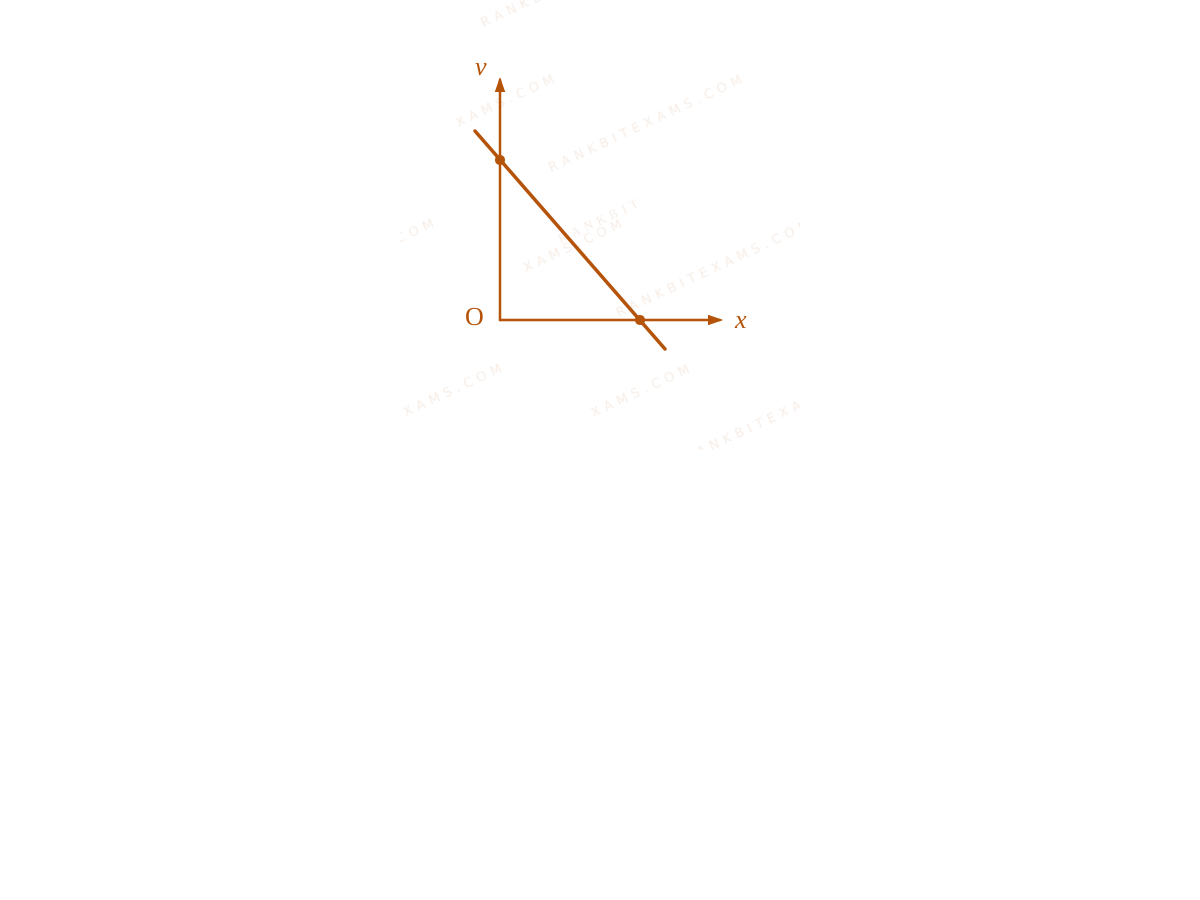
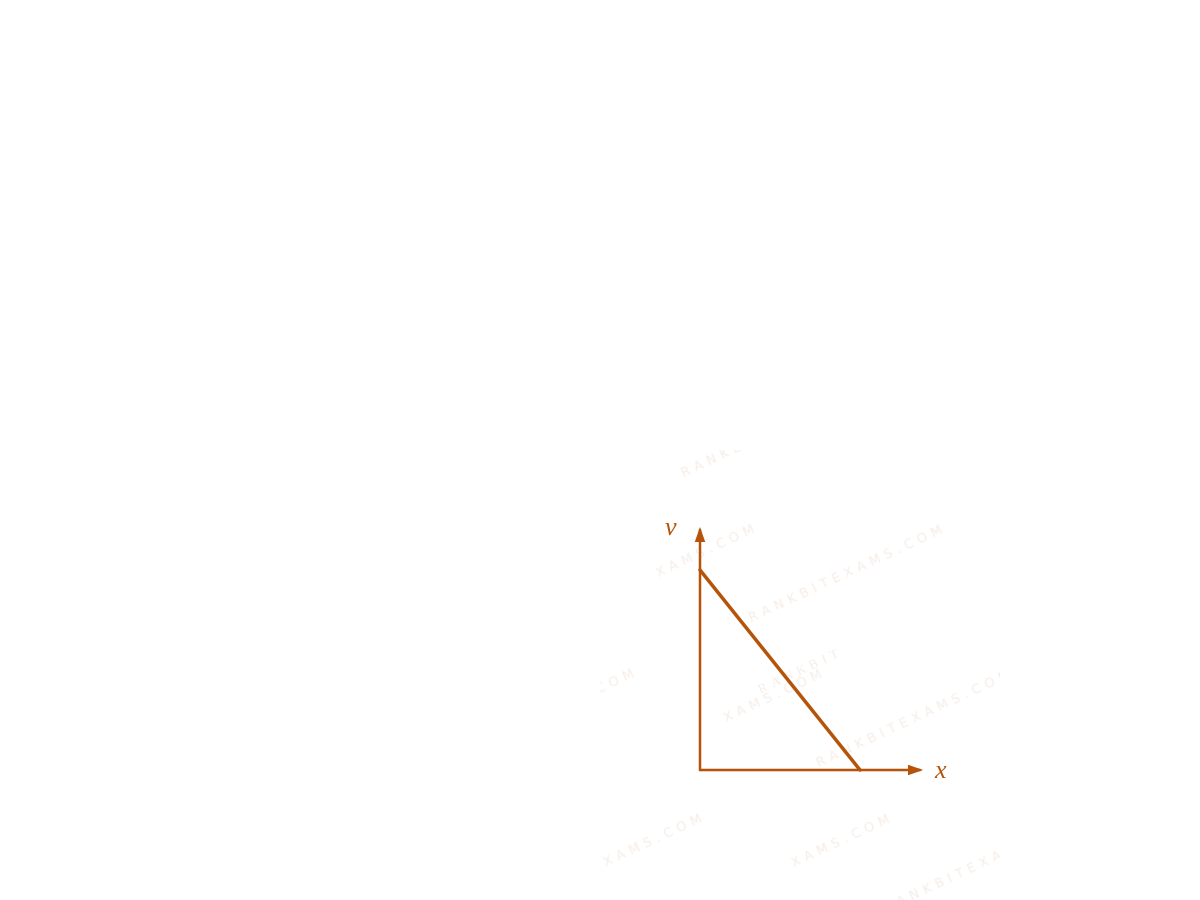
The velocity (v) - Distance (x) graph is shown in figure. Which graph represents acceleration (a) versus distance (x) variation of this system?
A linear descending velocity versus distance graph.
A. Option 1
B. Option 2
C. Option 3
D. Option 4
Solution
### Related Formula
a = v fracdvdx$$a = v \frac{dv}{dx}$$
### Core Logic
A linear descending velocity versus distance graph.
Equation of V$V$ vs x$x$ from the provided graph is a straight line with a negative slope:
V = C_1 - C_2 x$V = C_1 - C_2 x$
(where C_1, C_2 > 0$C_1, C_2 > 0$).
### Step 1: Calculate Acceleration
Differentiate V$V$ with respect to x$x$:
fracdVdx = -C_2$$\frac{dV}{dx} = -C_2$$
Substitute into the acceleration formula:
a = (C_1 - C_2 x) times (-C_2)$$a = (C_1 - C_2 x) \times (-C_2)$$a = C_2^2 x - C_1 C_2$$a = C_2^2 x - C_1 C_2$$
### Step 2: Analyze Graph Profile
The equation a = C_2^2 x - C_1 C_2$a = C_2^2 x - C_1 C_2$ represents a straight line with a **positive slope** (C_2^2$C_2^2$) and a **negative y-intercept** (-C_1 C_2$-C_1 C_2$).
A linear descending velocity versus distance graph.
Therefore, the graph is a straight line intercepting the negative a-axis and moving positively.
### Pattern Recognition
A linear negative v-x$v-x$ graph always yields an a-x$a-x$ graph which is linear with a positive slope and negative intercept. Memorizing a = v(dv/dx)$a = v(dv/dx)$ maps graphical traits instantly.
### Evaluation Rubric / Model Answer
null
### Chapter Mix
Class 11 Physics: Kinematics
Qjee_main_2025_02_april_morningMotion in Two Dimensions
A river is flowing from west to east direction with speed of 9mathrm~km~h^-1$9\mathrm{~km~h}^{-1}$. If a boat capable of moving at a maximum speed of 27mathrm~km~h^-1$27\mathrm{~km~h}^{-1}$ in still water, crosses the river in half a minute, while moving with maximum speed at an angle of 150^circ$150^{\circ}$ to direction of river flow, then the width of the river is:
### Related Formula
v_perp = v_br sintheta$$v_{\perp} = v_{br} \sin\theta$$w = v_perp cdot t$$w = v_{\perp} \cdot t$$
### Core Logic
Let the West-to-East river flow direction be along the positive x$x$-axis.
The boat's velocity relative to water is v_br = 27mathrm~km/h$v_{br} = 27\mathrm{~km/h}$ at an angle of 150^circ$150^{\circ}$ with respect to the river flow (which is 30^circ$30^{\circ}$ upstream from the perpendicular crossing line).
To find the width of the river, we only need the component of the boat's velocity perpendicular to the river bank (y$y$-axis):
v_perp = v_br sin(150^circ) = 27 sin(150^circ) = 27 times frac12 = 13.5mathrm~km/h$$v_{\perp} = v_{br} \sin(150^{\circ}) = 27 \sin(150^{\circ}) = 27 \times \frac{1}{2} = 13.5\mathrm{~km/h}$$
Convert this velocity to SI units:
v_perp = 13.5 times frac518mathrm~m/s = 3.75mathrm~m/s$$v_{\perp} = 13.5 \times \frac{5}{18}\mathrm{~m/s} = 3.75\mathrm{~m/s}$$
Given the crossing time is half a minute (t = 30mathrm~s$t = 30\mathrm{~s}$):
w = v_perp cdot t = 3.75 times 30 = 112.5mathrm~m$$w = v_{\perp} \cdot t = 3.75 \times 30 = 112.5\mathrm{~m}$$
### Step 1: Final Conclusion
The width of the river is 112.5mathrm~m$112.5\mathrm{~m}$.
### Pattern Recognition
In river-boat crossing problems, river velocity (v_r$v_r$) only causes drift along the bank; it has zero impact on crossing time or the crossing width calculations when the angle is defined relative to the flow. Use the vertical velocity component exclusively.
### Evaluation Rubric / Model Answer
null
### Chapter Mix
Class 11 Physics: Kinematics
More Kinematics Questions — jee_main_2026_28_january_evening
We Map Every Repeating Question in Competitive Exams.
Say goodbye to generic mock test fatigue. RankBit uses smart analysis to group past exam questions into their foundational Repeating Question Types. Find chapter weightage, track repeating questions, and score higher with targeted practice.
Select Your Target Exam
Choose an exam track below to find formulas per chapter and patterns.
Syncing Exam Intelligence
Mapping formulas and patterns across all tracks…
PATH A — FULL LENGTH PRACTICE
Full Mock Test Hub
Simulate real NTA exam conditions with fully tracked mocks. Time yourself against past papers.
Practice past-year questions one chapter at a time. Pick an exam → subject → chapter and get every PYQ for that topic — pulled together from all past papers — with the chapter's key formulas alongside.