Rankbit System
JEE Physics: Waves (+15.5%) | Electrostatics: Concentric Shells (-29.7%) | Modern Physics: Photoelectric Clones (+34.2%) | Mathematics: Definite Integrals (+18.1%) | Chemistry: Coordination Splitting (-11.4%) | JEE Physics: Waves (+15.5%) | Electrostatics: Concentric Shells (-29.7%) | Modern Physics: Photoelectric Clones (+34.2%) | Mathematics: Definite Integrals (+18.1%) | Chemistry: Coordination Splitting (-11.4%)

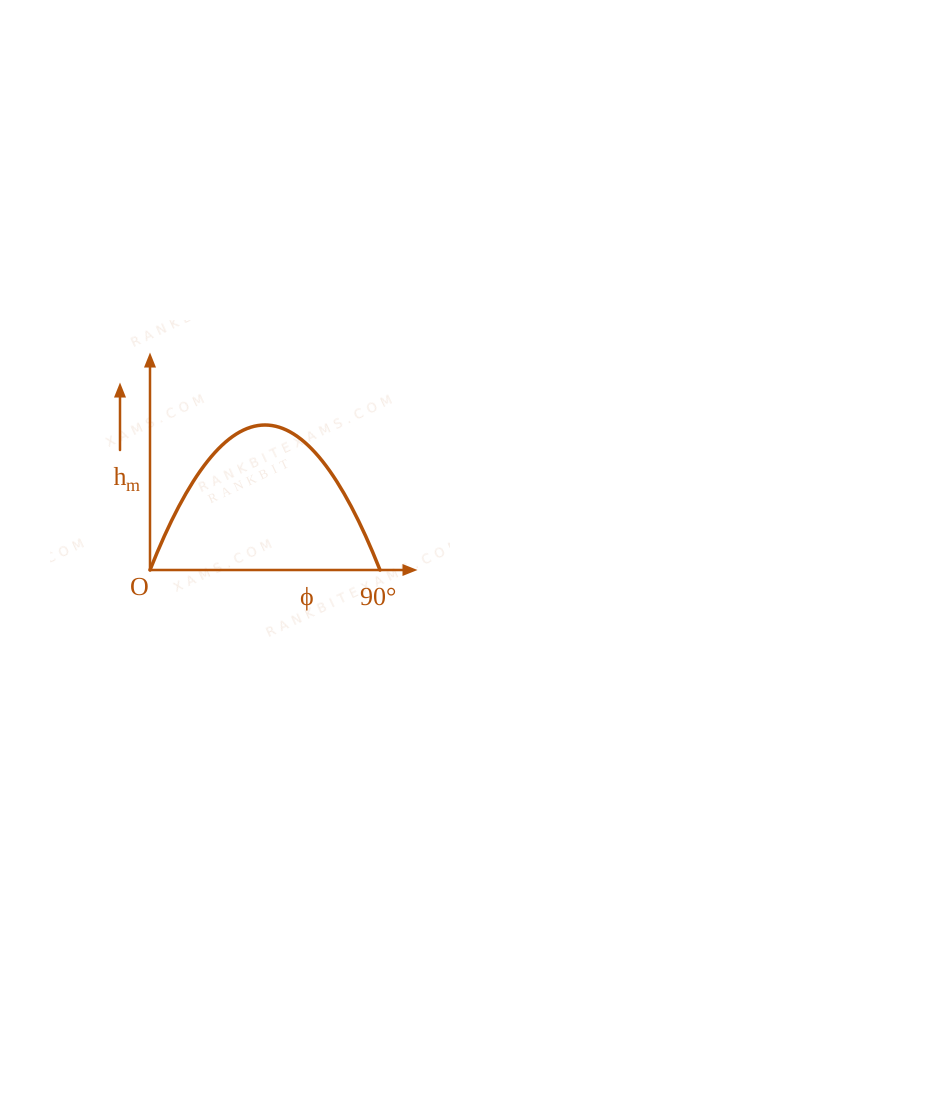
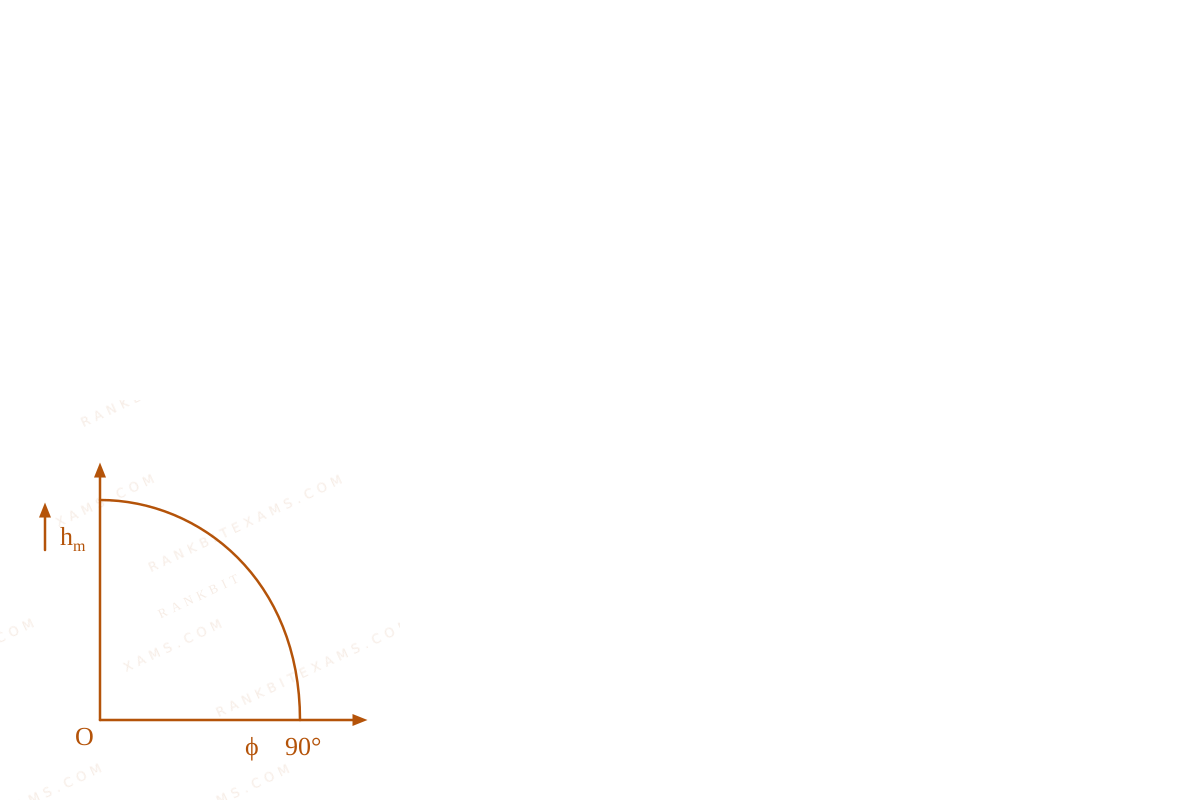
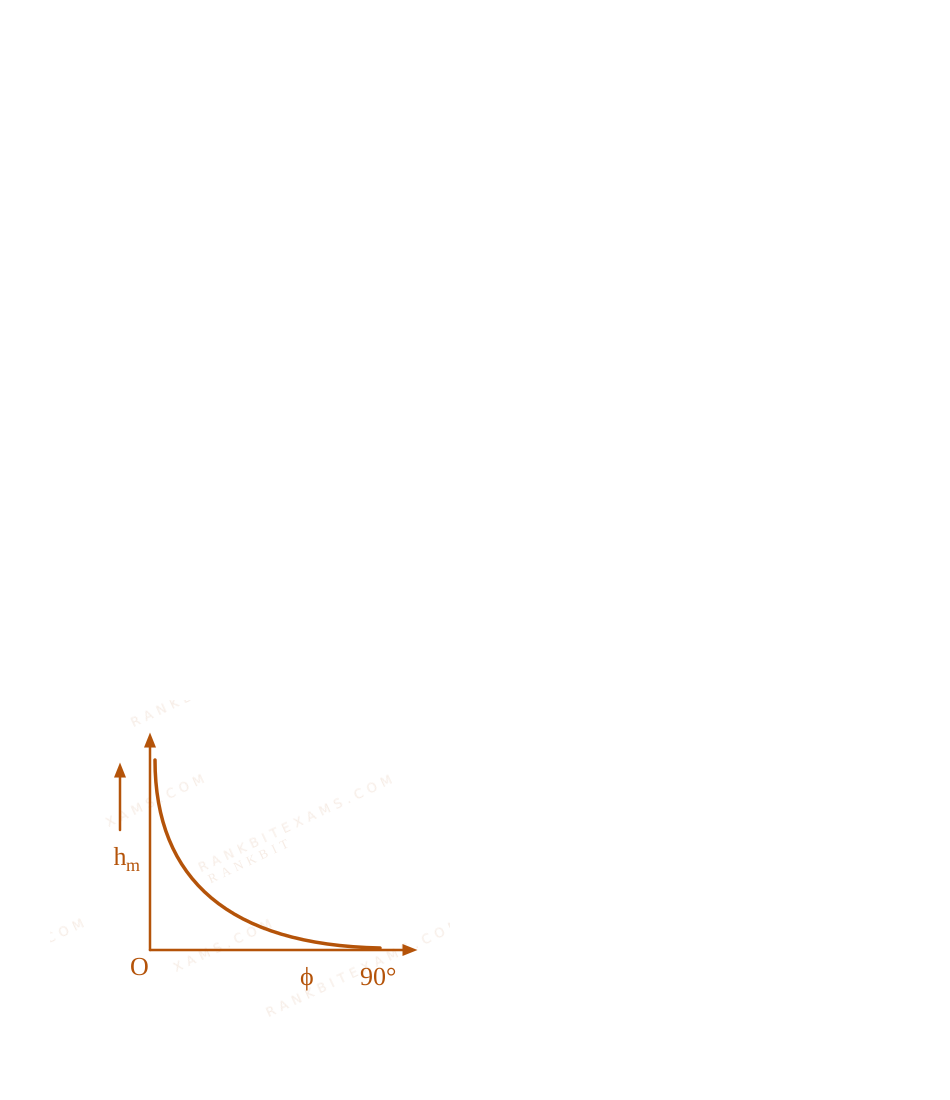
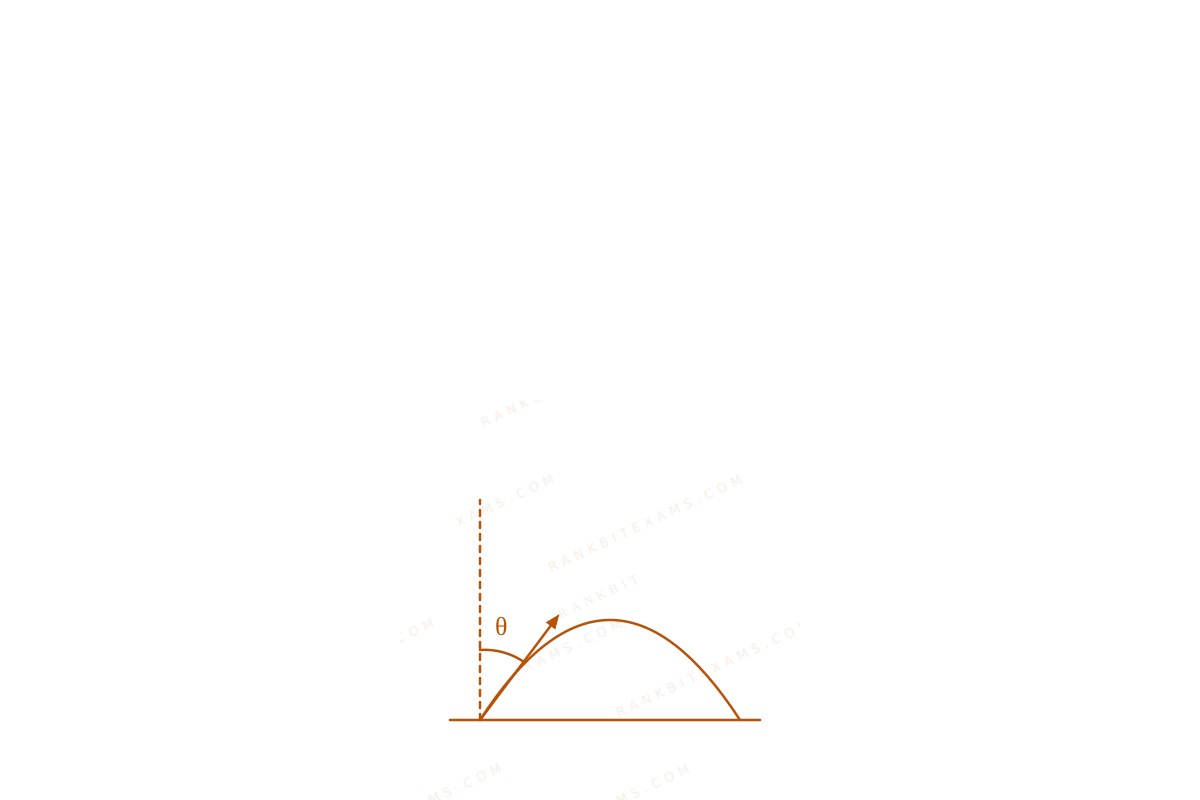
The angle of projection of a particle is measured from the vertical axis as phi and the maximum height reached by the particle is h_m. Here h_m as function of phi can be presented as:

Solution & Explanation

### Related Formula Maximum height of a projectile: H_textmax = fracu^2 sin^2 theta2g where theta is the angle of projection measured from the horizontal ground. ### Core Logic The angle of projection in this question is measured from the **vertical axis** as phi. This relates to the horizontal projection angle theta as: theta = 90^circ - phi Substitute this into the maximum height formula: h_m = fracu^2 sin^2 (90^circ - phi)2g = fracu^2 cos^2 phi2g h_m(phi) propto cos^2 phi ### Step 1: Analyzing Boundary Conditions Let's check the boundary values of h_m for phi in [0, 90^circ]: - At phi = 0^circ (fired straight up vertically): h_m(0) = fracu^22g = textMaximum height - At phi = 90^circ (fired horizontally along the ground): h_m(90^circ) = 0 Let's evaluate the behavior of h_m(phi): - At small angles phi approx 0, the slope fracd h_mdphi = -fracu^22g sin(2phi) approx 0. This means the curve starts with a horizontal slope (flat top). - As phi increases towards 90^circ, h_m falls smoothly, reaching 0 at 90^circ with flat slope again. This sinusoidal falloff perfectly matches **Curve (3)**.
Curve plot of vertical height hm versus launch angle phi for Q19
### Pattern Recognition Always read the coordinate origin carefully! Measuring angle from the vertical instead of the horizontal turns sin^2theta into cos^2phi. Checking extremes: vertical shot (0^circ) yields maximum height, while flat shot (90^circ) yields zero height. ### Evaluation Rubric / Model Answer null ### Chapter Mix Class 11 Physics: Motion in a Plane: Projectile Motion

Reference Study Guides

More Kinematics Previous-Year Questions

Q6 2025 Motion in Two Dimensions
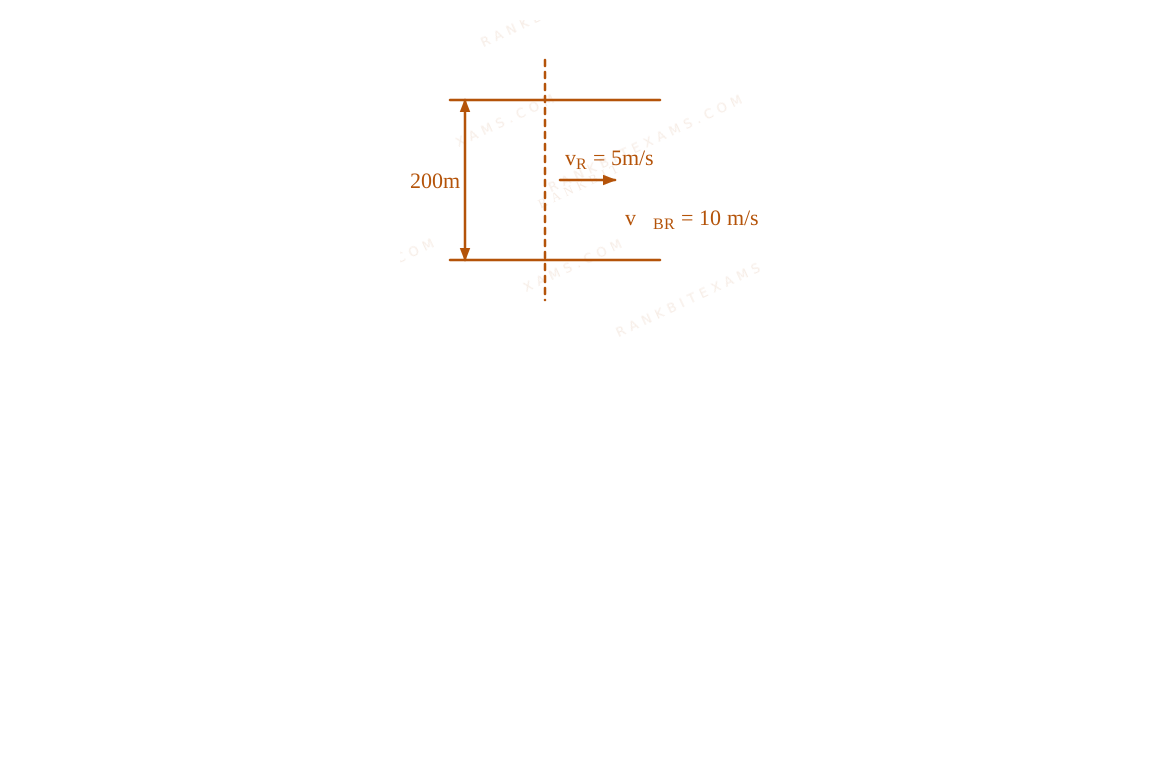
A river is flowing from west to east direction with speed of 9mathrm~km~h^-1. If a boat capable of moving at a maximum speed of 27mathrm~km~h^-1 in still water, crosses the river in half a minute, while moving with maximum speed at an angle of 150^circ to direction of river flow, then the width of the river is:
  • A. 300mathrm~m
  • B. 112.5mathrm~m
  • C. 75mathrm~m
  • D. 112.5times sqrt3mathrm~m

Solution

### Related Formula v_perp = v_br sintheta w = v_perp cdot t ### Core Logic Let the West-to-East river flow direction be along the positive x-axis. The boat's velocity relative to water is v_br = 27mathrm~km/h at an angle of 150^circ with respect to the river flow (which is 30^circ upstream from the perpendicular crossing line). To find the width of the river, we only need the component of the boat's velocity perpendicular to the river bank (y-axis): v_perp = v_br sin(150^circ) = 27 sin(150^circ) = 27 times frac12 = 13.5mathrm~km/h Convert this velocity to SI units: v_perp = 13.5 times frac518mathrm~m/s = 3.75mathrm~m/s Given the crossing time is half a minute (t = 30mathrm~s): w = v_perp cdot t = 3.75 times 30 = 112.5mathrm~m ### Step 1: Final Conclusion The width of the river is 112.5\mathrm{~m}. ### Pattern Recognition In river-boat crossing problems, river velocity (v_r$) only causes drift along the bank; it has zero impact on crossing time or the crossing width calculations when the angle is defined relative to the flow. Use the vertical velocity component exclusively. ### Evaluation Rubric / Model Answer null ### Chapter Mix Class 11 Physics: Kinematics
Q25 2025 Motion in a Straight Line
A person travelling on a straight line moves with a uniform velocity v_1 for a distance x and with a uniform velocity v_2 for the next frac32x distance. The average velocity in this motion is frac507mathrm~m/s. If v_1 is 5mathrm~m/s then v_2 = ____ mathrmm/s.
Numerical Answer. Answer: 10 to 10

Solution

### Related Formula v_textavg = fractextTotal DistancetextTotal Time ### Core Logic Let's find the time taken for each section of the motion: - First section of distance x with velocity v_1 = 5mathrm~m/s: t_1 = fracxv_1 = fracx5 - Second section of distance frac32x with velocity v_2: t_2 = frac3x/2v_2 = frac3x2v_2 Total distance is: d_texttotal = x + frac32x = frac52x Average velocity is: v_textavg = fracd_texttotalt_1 + t_2 = fracfrac52xfracx5 + frac3x2v_2 We are given v_textavg = frac507mathrm~m/s. Equating the two values (noting x cancels out): frac507 = fracfrac52frac15 + frac32v_2 Divide both sides by 5: frac107 = fracfrac12frac15 + frac32v_2 implies 10 left(frac15 + frac32v_2right) = frac72 2 + frac15v_2 = 3.5 implies frac15v_2 = 1.5 implies v_2 = frac151.5 = 10mathrm~m/s ### Step 1: Final Conclusion The velocity v_2 is 10mathrm~m/s. ### Pattern Recognition Never take simple arithmetic averages of velocities! Average velocity must always be calculated as fractextTotal DistancetextTotal Time. Because total distance and time intervals are proportional to x, x cleanly cancels out. ### Evaluation Rubric / Model Answer null ### Chapter Mix Class 11 Physics: Kinematics
Q16 2025 Projectile Motion
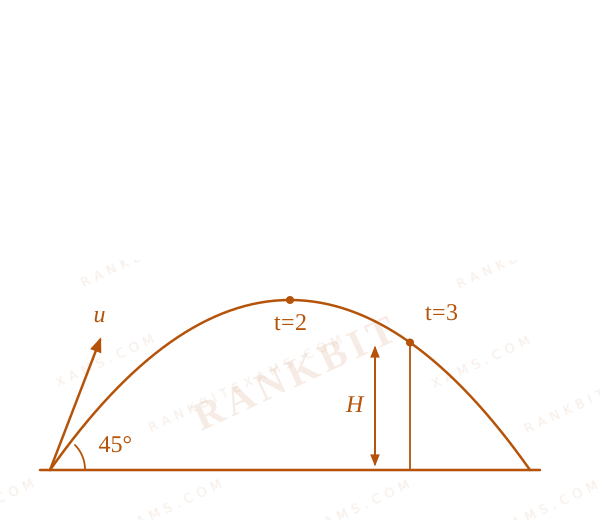
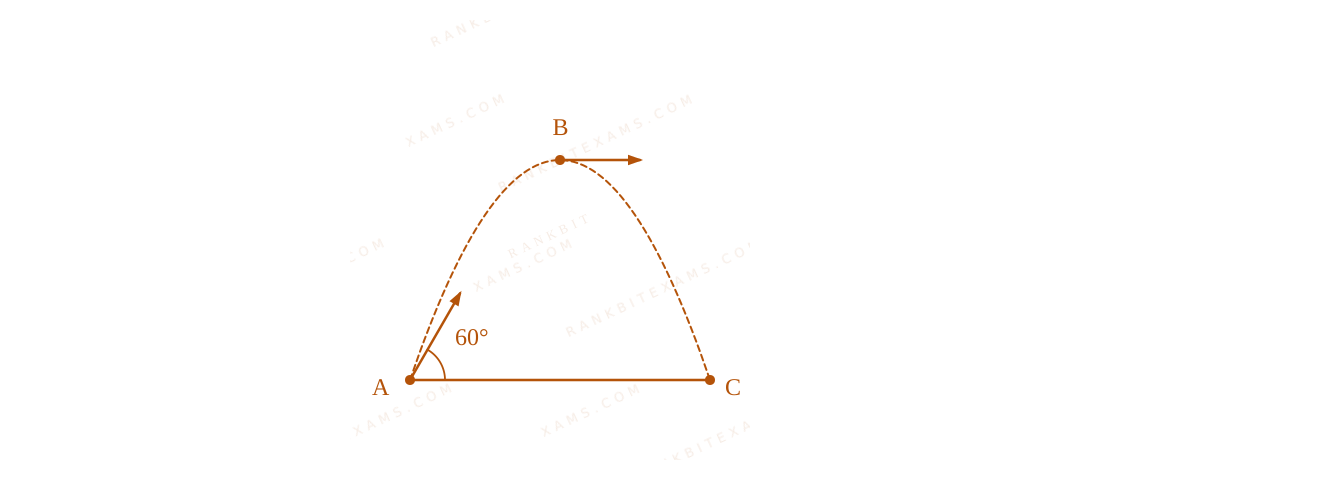
Two balls with same mass and initial velocity, are projected at different angles in such a way that maximum height reached by first ball is 8 times higher than that of the second ball. T_1 and T_2 are the total flying times of first and second ball, respectively, then the ratio of T_1 and T_2 is:
  • A. 2sqrt2 : 1
  • B. 2 : 1
  • C. sqrt2 : 1
  • D. 4 : 1

Solution

### Related Formula H = fracu^2 sin^2theta2g quad textand quad T = frac2u sinthetag where, H = maximum height reached T = total time of flight u = initial projection velocity theta = angle of projection ### Core Logic From the formulas, we see that: H propto sin^2theta quad textand quad T propto sintheta Thus, we can directly link time of flight to the square root of the maximum height: T propto sqrtH implies fracT_1T_2 = sqrtfracH_1H_2 ### Step 1: Compute Ratio Given: H_1 = 8 H_2 implies fracH_1H_2 = 8 Substitute this ratio: fracT_1T_2 = sqrt8 = 2sqrt2 Thus, the ratio is 2sqrt2 : 1. ### Pattern Recognition Sees: Projectile heights ratio → Time of flight ratio. Shortcut: Since H propto u_y^2 and T propto u_y, we have T propto sqrtH. If the height is 8 times larger, the flying time is sqrt8 = 2sqrt2 times larger. ✓ ### Evaluation Rubric / Model Answer null ### Chapter Mix Class 11 Physics: Kinematics
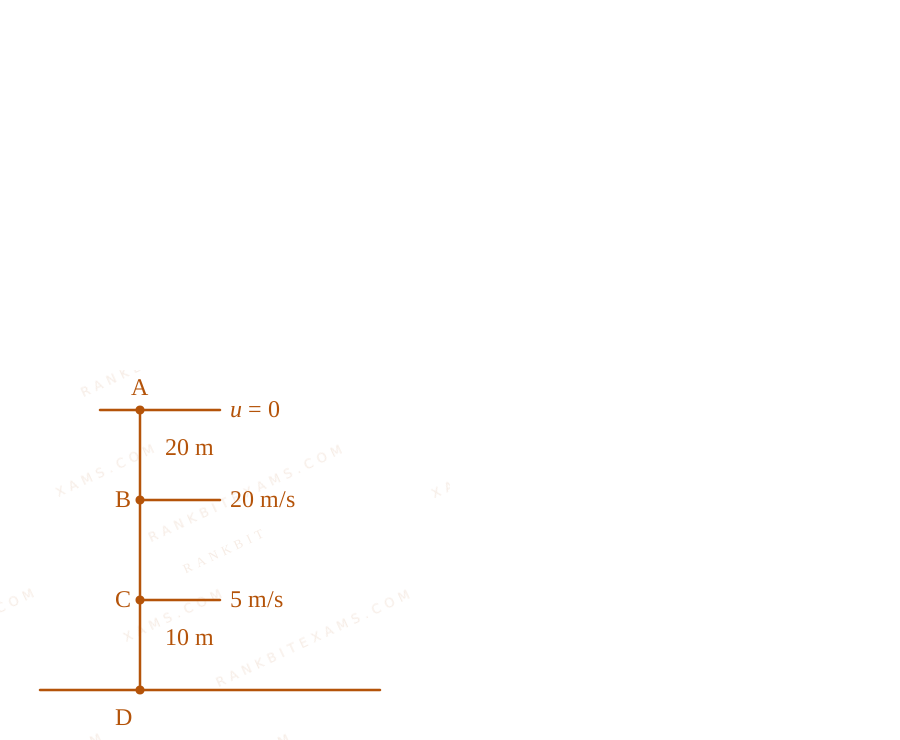
Q25 2025 Relative Motion in One Dimension
Two cars P and Q are moving on a road in the same direction. Acceleration of car P increases linearly with time whereas car Q moves with a glass constant acceleration. Both cars cross each other at time t = 0 , for the first time. The maximum possible number of crossing(s) (including the crossing at t = 0 ) is ______.
Numerical Answer. Answer: 3 to 3

Solution

### Related Formula a_P = kt implies v_P = frac12kt^2 + v_0P implies x_P = frac16kt^3 + v_0Pt + x_0 a_Q = a implies v_Q = at + v_0Q implies x_Q = frac12at^2 + v_0Qt + x_0 ### Core Logic To find the relative crossings, set the position functions equal: x_P(t) = x_Q(t). frac16kt^3 + v_0Pt = frac12at^2 + v_0Qt frac16kt^3 - frac12at^2 + (v_0P - v_0Q)t = 0 This is a cubic polynomial equation in terms of time t. A cubic function can yield a maximum of 3 distinct real roots.
Relative Crossings Case 1 Curve diagram for Q25 - JEE Main 2025 Evening
Depending on the initial velocity profiles (v_0P, v_0Q), the curves can intersect at t=0 and potentially create up to two additional crossing paths downstream as acceleration profiles cross over. Thus, the maximum possible number of total crossings is exactly 3. ### Pattern Recognition Crossings correspond mathematically to intersections of relative displacement polynomials. A linear acceleration profile produces a cubic position curve (t^3), which can cross a quadratic curve (t^2) at up to 3 distinct coordinate points. ### Evaluation Rubric / Model Answer null ### Chapter Mix Class 11 Physics: Kinematics
Q7 2025 One-Dimensional Motion Curves
Which of the following curves possibly represent one-dimensional motion of a particle? (A)
Phase vs time plot for Q7 (A)
Displays graph A showing phase varying over time, graph B showing velocity versus displacement, graph C showing velocity versus negative time, and graph D showing distance versus time.
(B)
Phase vs time plot for Q7 (A)
Displays graph A showing phase varying over time, graph B showing velocity versus displacement, graph C showing velocity versus negative time, and graph D showing distance versus time.
(C)
Phase vs time plot for Q7 (A)
Displays graph A showing phase varying over time, graph B showing velocity versus displacement, graph C showing velocity versus negative time, and graph D showing distance versus time.
(D)
Phase vs time plot for Q7 (A)
Displays graph A showing phase varying over time, graph B showing velocity versus displacement, graph C showing velocity versus negative time, and graph D showing distance versus time.
Choose the correct answer from the options given below:
  • A. A, B and D only
  • B. A, B and C only
  • C. A and B only
  • D. A, C and D only

Solution

### Related Formula For realistic physical motion in one dimension: 1. Time t can never be negative during a normal positive time sequence, and cannot flow backwards. 2. Total distance covered can never decrease over time. 3. A particle cannot have two different values of position or velocity at the exact same instant of time. ### Core Logic Let us analyze each curve: - **Curve (A)** (Phase phi vs Time t): Represents phi = kt + C, which is a valid linear relationship of phase over time (e.g., in Simple Harmonic Motion x = Asin(kt + C)). (Valid) - **Curve (B)** (Velocity v vs Displacement x): A closed loop, which represents symmetric harmonic-type oscillation. For example, v^2 + omega^2 x^2 = textconst (ellipse) is a perfectly physically valid 1D SHM velocity-displacement phase portrait. (Valid) - **Curve (C)** (Velocity vs Time): The curve enters into the negative time quadrant. Time cannot go backwards or exist in negative values relative to starting sequence in standard physical scenarios. (Invalid) - **Curve (D)** (Total Distance vs Time): Represents total distance increasing over time. Total distance is a non-decreasing function of time (d(d)/dt ge 0). Thus, this curve is physically valid. (Valid) ### Step 1: Conclusion Therefore, curves A, B, and D possibly represent physical one-dimensional motion. The correct option is (1). ### Pattern Recognition Quick check for graph validity: 1. Time cannot run backwards (ruling out C). 2. Total distance can never decrease (D is valid because it strictly goes upwards). 3. v vs x can be circular/elliptical in SHM (B is valid). ### Evaluation Rubric / Model Answer null ### Chapter Mix Class 11 Physics: Motion in a Straight Line

More Kinematics Questions — jee_main_2025_03_april_morning

Practice all Kinematics previous-year questions →

YOUR FIRST PREP STEP STARTS HERE

We Map Every Repeating Question in Competitive Exams.

Say goodbye to generic mock test fatigue. RankBit uses smart analysis to group past exam questions into their foundational Repeating Question Types. Find chapter weightage, track repeating questions, and score higher with targeted practice.

Select Your Target Exam

Choose an exam track below to find formulas per chapter and patterns.

Syncing Exam Intelligence

Mapping formulas and patterns across all tracks…

PATH A — FULL LENGTH PRACTICE

Full Mock Test Hub

Simulate real NTA exam conditions with fully tracked mocks. Time yourself against past papers.

Under Development
PATH B — TARGETED PRACTICE

Topic-wise Practice Hub

Practice past-year questions one chapter at a time. Pick an exam → subject → chapter and get every PYQ for that topic — pulled together from all past papers — with the chapter's key formulas alongside.

Loading Questions... Browse Topics
Latest from the Blog
View all →

Loading articles...