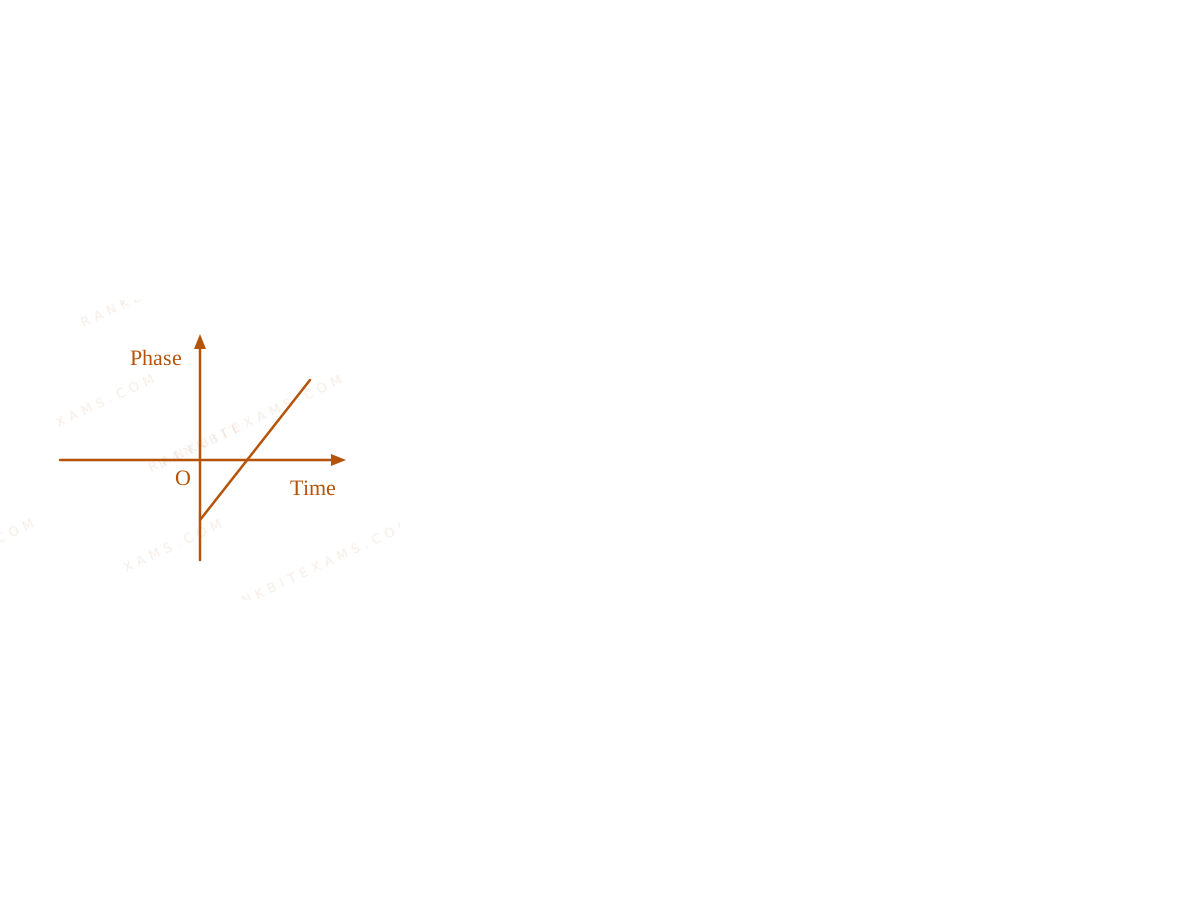

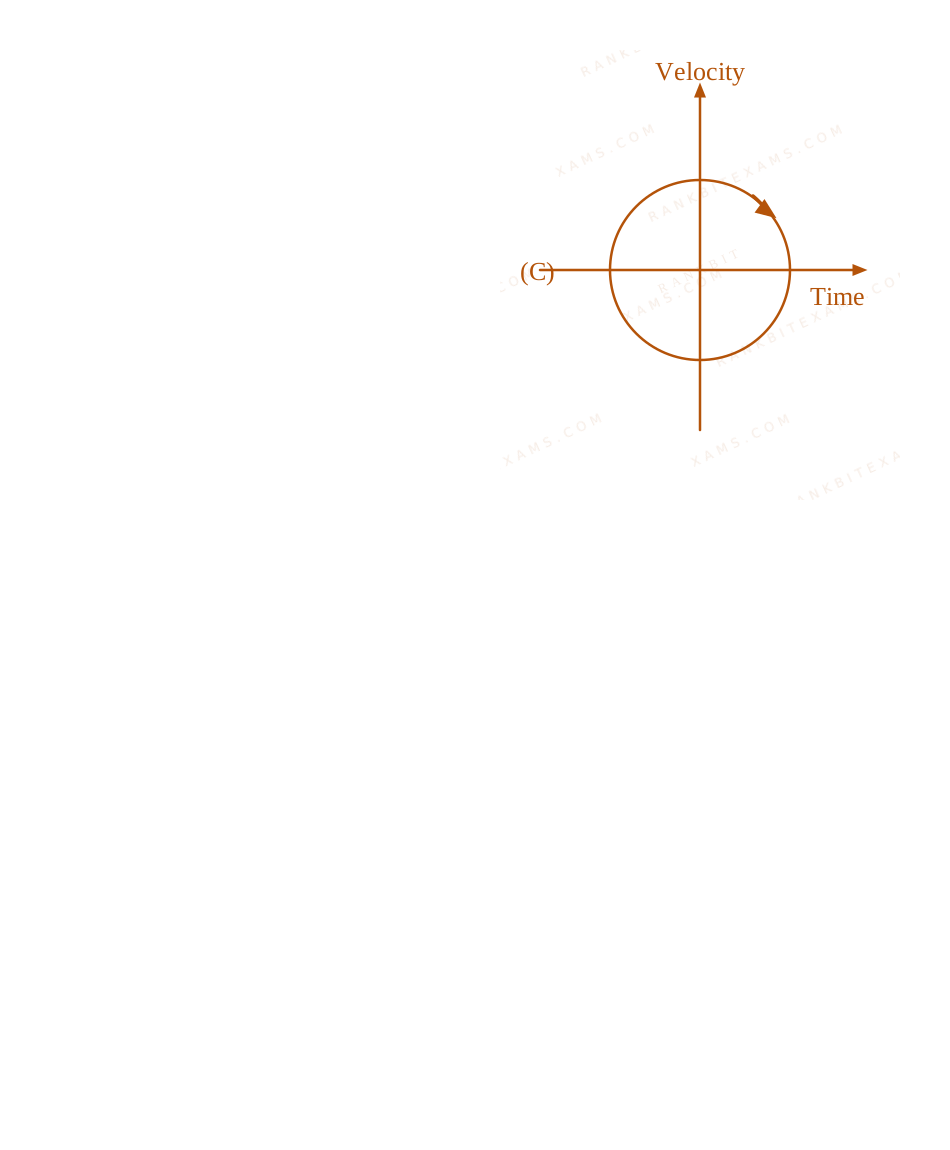
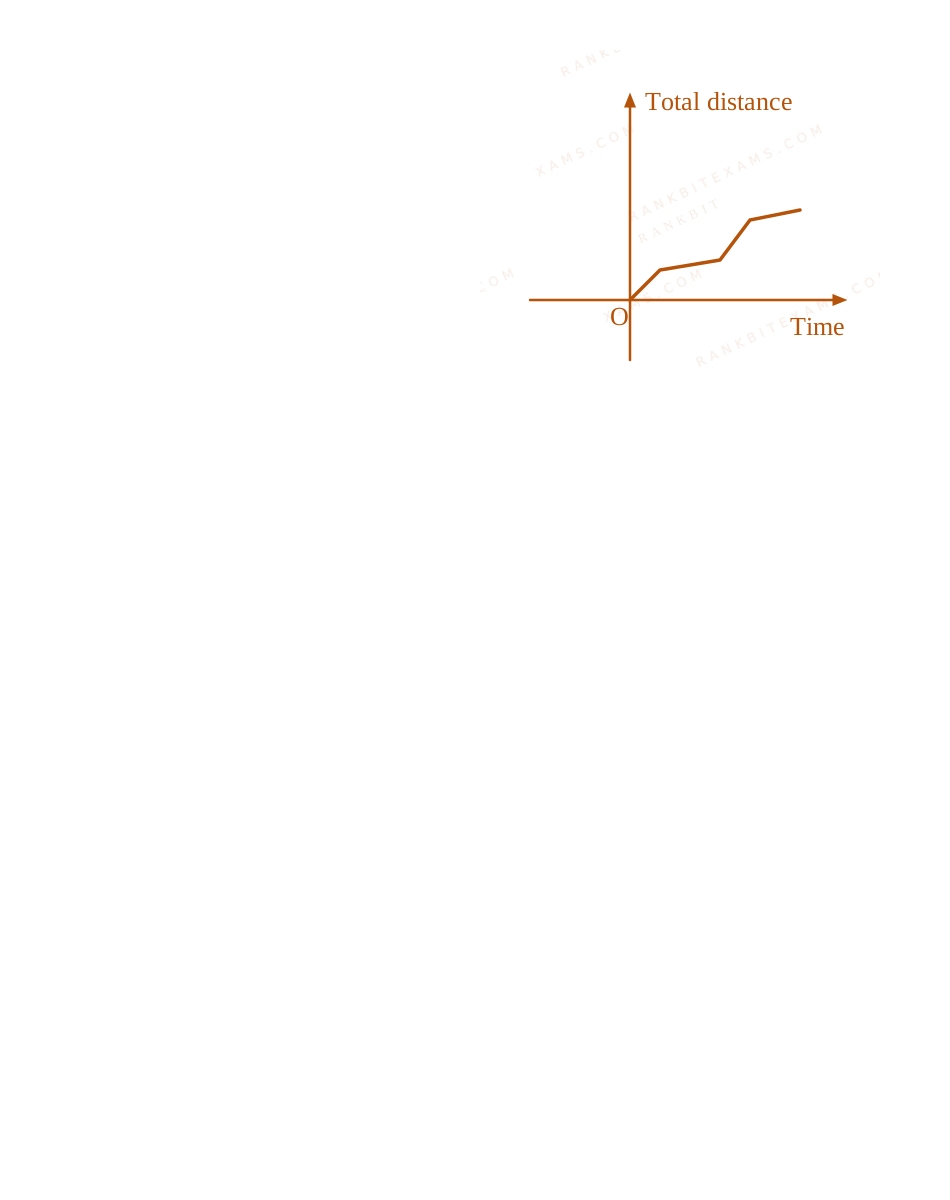
Which of the following curves possibly represent one-dimensional motion of a particle?
(A)
Displays graph A showing phase varying over time, graph B showing velocity versus displacement, graph C showing velocity versus negative time, and graph D showing distance versus time.
(B)
Displays graph A showing phase varying over time, graph B showing velocity versus displacement, graph C showing velocity versus negative time, and graph D showing distance versus time.
(C)
Displays graph A showing phase varying over time, graph B showing velocity versus displacement, graph C showing velocity versus negative time, and graph D showing distance versus time.
(D)
Displays graph A showing phase varying over time, graph B showing velocity versus displacement, graph C showing velocity versus negative time, and graph D showing distance versus time.
Choose the correct answer from the options given below:
A.A, B and D only
B.A, B and C only
C.A and B only
D.A, C and D only
Solution & Explanation
Related Formula
For realistic physical motion in one dimension:
Time t$t$ can never be negative during a normal positive time sequence, and cannot flow backwards.
Total distance covered can never decrease over time.
A particle cannot have two different values of position or velocity at the exact same instant of time.
Core Logic
Let us analyze each curve:
Curve (A) (Phase φ$\phi$ vs Time t$t$): Represents φ = kt + C$\phi = kt + C$, which is a valid linear relationship of phase over time (e.g., in Simple Harmonic Motion x = A (kt + C)$x = A\sin(kt + C)$). (Valid)
Curve (B) (Velocity v$v$ vs Displacement x$x$): A closed loop, which represents symmetric harmonic-type oscillation. For example, v² + ω² x² = const$v^2 + \omega^2 x^2 = \text{const}$ (ellipse) is a perfectly physically valid 1D SHM velocity-displacement phase portrait. (Valid)
Curve (C) (Velocity vs Time): The curve enters into the negative time quadrant. Time cannot go backwards or exist in negative values relative to starting sequence in standard physical scenarios. (Invalid)
Curve (D) (Total Distance vs Time): Represents total distance increasing over time. Total distance is a non-decreasing function of time (d(d)/dt ≥ 0$d(d)/dt \ge 0$). Thus, this curve is physically valid. (Valid)
Step 1: Conclusion
Therefore, curves A, B, and D possibly represent physical one-dimensional motion. The correct option is (1).
Pattern Recognition
Quick check for graph validity:
Time cannot run backwards (ruling out C).
Total distance can never decrease (D is valid because it strictly goes upwards).
v$v$ vs x$x$ can be circular/elliptical in SHM (B is valid).
Chapter Mix
Class 11 Physics: Motion in a Straight Line
Keywords:#1D motion graphs#velocity position plots#kinematic curves
A body starts moving from rest with constant acceleration covers displacement S₁$S_{1}$ in first (p - 1)$(p - 1)$ seconds and S₂$S_{2}$ in first p seconds. The displacement S₁ + S₂$S_{1} + S_{2}$ will be made in time:
When dealing with equations of motion from rest, notice that displacement scales quadratically with time (S ∝ t²$S \propto t^2$). This means if displacement sums up (Sₜ = S₁ + S₂$S_t = S_1 + S_2$), the corresponding times will add in quadrature: t = √(t₁² + t₂²)$t = \sqrt{t_1^2 + t_2^2}$.
Therefore, the ratio of their velocities is √(3):2$\sqrt{3}:2$.
Pattern Recognition
For problems involving steady values under constraint variations, establish the proportionality relation first. Here, F ∝ (v²)/(r) v ∝ √(r)$F \propto \frac{v^2}{r} \implies v \propto \sqrt{r}$ when F$F$ and m$m$ are held constant.
Chapter Mix
Class 11 Physics: Motion in a Plane
Qjee_main_2024_30_january_eveningProjectile Motion from a Tower
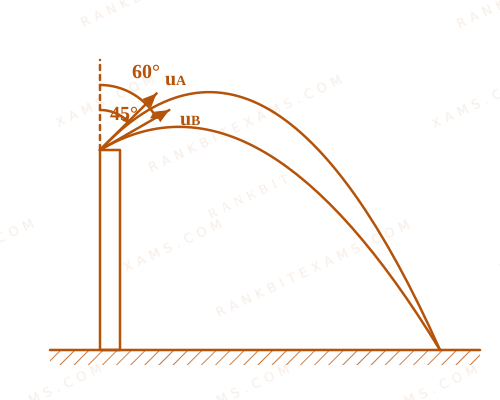
Projectiles A$\mathrm{A}$ and B$\mathrm{B}$ are thrown at angles of 45°$45^{\circ}$ and 60°$60^{\circ}$ with vertical respectively from top of a 400 ~m$400 \mathrm{~m}$ high tower. If their ranges and times of flight are same, the ratio of their speeds of projection vA: vB$\mathrm{v_A}: \mathrm{v_B}$ is:
A.1: √(3)$1: \sqrt{3}$
B.√(2):1$\sqrt{2}:1$
C.1:2$1:2$
D.1:√(2)$1:\sqrt{2}$
Solution
Core Logic
Projectile Motion from a Tower diagram for Q50 - JEE Main 2024 Evening
For two projectiles launched from the same height to have the same time of flight (T$T$), their vertical components of velocity must be equal.
Since the angles given are with the vertical, the vertical components are vA (45°)$v_A \cos(45^{\circ})$ and vB (60°)$v_B \cos(60^{\circ})$.
If TA = TB$T_A = T_B$, then vAy = vBy$v_{Ay} = v_{By}$.
For the ranges to be the same while having the same time of flight, their horizontal components of velocity must also be equal: vAx = vBx$v_{Ax} = v_{Bx}$.
This yields a contradiction. It is impossible for both the ranges and the times of flight to be simultaneously equal for different angles of projection from a tower.
Step 2: Conclusion
The question contains inconsistent data and is technically a Bonus question. However, if one arbitrarily equates only the time of flight (or if NTA intended a different scenario), the ratio (vA)/(vB) = 1√(2)$\frac{v_A}{v_B} = \frac{1}{\sqrt{2}}$ matches option (4), which was the officially provided key before corrections.
Pattern Recognition
Be wary of over-constrained physics problems. If a question specifies both range AND time of flight are identical for two different angles, check if the math yields a contradiction. NTA often accepts the result of one partial constraint
By NTA 4
BY Rankbit (Bonus).
A vector has magnitude same as that of A = 3 i + 4 j$\vec{\mathrm{A}} = 3\hat{\mathrm{i}} + 4\hat{\mathrm{j}}$ and is parallel to B = 4 i + 3 j$\vec{\mathrm{B}} = 4\hat{\mathrm{i}} + 3\hat{\mathrm{j}}$. The x$x$ and y$y$ components of this vector in first quadrant are x$x$ and 3$3$ respectively where x =$x = $ ________
We need to find a new vector N$\vec{N}$ that has the magnitude of A$\vec{A}$ and the direction of B$\vec{B}$.
Magnitude of A$\vec{A}$: | A| = √(3² + 4²) = √(25) = 5$|\vec{A}| = \sqrt{3^2 + 4^2} = \sqrt{25} = 5$.
Unit vector in the direction of B$\vec{B}$: B = B| B| = 4 i + 3 j√(4² + 3²) = 4 i + 3 j5$\hat{B} = \frac{\vec{B}}{|\vec{B}|} = \frac{4\hat{i} + 3\hat{j}}{\sqrt{4^2 + 3^2}} = \frac{4\hat{i} + 3\hat{j}}{5}$.
Step 1: Construct the Vector
N = | A| B = 5 ( 4 i + 3 j5 )$$\vec{N} = |\vec{A}| \hat{B} = 5 \left( \frac{4\hat{i} + 3\hat{j}}{5} \right)$$N = 4 i + 3 j$$\vec{N} = 4\hat{i} + 3\hat{j}$$
Step 2: Match Components
The x$x$ and y$y$ components are given as x$x$ and 3$3$.
From N = 4 i + 3 j$\vec{N} = 4\hat{i} + 3\hat{j}$, we see the x$x$-component is 4$4$.
Therefore, x = 4$x = 4$.
Pattern Recognition
Constructing a vector matching magnitude and direction is a simple scalar multiplication of the desired magnitude by the target direction's unit vector.
Chapter Mix
Class 11 Physics: Motion in a Plane
Q56jee_main_2024_30_jan_morningEquations of Motion
The displacement and the increase in the velocity of a moving particle in the time interval of t$t$ to (t + 1) ~s$(t + 1) \mathrm{~s}$ are 125 ~m$125 \mathrm{~m}$ and 50 ~m / s$50 \mathrm{~m / s}$, respectively. The distance travelled by the particle in (t + 2)th ~s$(t + 2)^{\mathrm{th}} \mathrm{~s}$ is _ _ _ _ _ m$\_ \_ \_ \_ \_ \mathrm{m}$.
Numerical Answer.Answer: 175 to 175
Solution
Related Formula
v = u + at$v = u + at$
s = ut + (1)/(2)at²$$s = ut + \frac{1}{2}at^2$$Snth = u + (a)/(2)(2n - 1)$$S_{n^{\text{th}}} = u + \frac{a}{2}(2n - 1)$$
Core Logic
Let the velocity at time t$t$ be u$u$. The time interval Δ t = (t+1) - t = 1 ~s$\Delta t = (t+1) - t = 1 \mathrm{~s}$. The increase in velocity over 1 second is exactly the acceleration a$a$. The displacement in that 1-second interval acts as the (t+1)th$(t+1)^{\text{th}}$ second displacement equation.
Step 1: Determine Acceleration
Increase in velocity Δ v = 50 ~m/s$\Delta v = 50 \mathrm{~m/s}$ in 1 ~s$1 \mathrm{~s}$.
v = u + at$v = u + at$
u + 50 = u + a(1) ⇒ a = 50 ~m/s²$$u + 50 = u + a(1) \Rightarrow a = 50 \mathrm{~m/s^2}$$
Step 2: Determine Velocity 'u' at time t
Displacement in the 1-second interval from t$t$ to t+1$t+1$ is 125 ~m$125 \mathrm{~m}$.
Using s = ut' + (1)/(2)at'²$s = ut' + \frac{1}{2}at'^2$ where t' = 1 ~s$t' = 1 \mathrm{~s}$:
125 = u(1) + (1)/(2)a(1)²$$125 = u(1) + \frac{1}{2}a(1)^2$$125 = u + (50)/(2)$$125 = u + \frac{50}{2}$$125 = u + 25 ⇒ u = 100 ~m/s$$125 = u + 25 \Rightarrow u = 100 \mathrm{~m/s}$$
Step 3: Distance in the next second
We need the distance travelled in the (t+2)th$(t+2)^{\text{th}}$ second, which corresponds to the 1-second interval starting with an initial velocity equal to the velocity at t+1$t+1$.
Alternatively, we can use the nth$n^{\text{th}}$ second formula directly by re-indexing. The velocity at start of this interval is unew = u + a = 100 + 50 = 150 ~m/s$u_{new} = u + a = 100 + 50 = 150 \mathrm{~m/s}$.
Distance S₁ₛₜ$S_{1\text{st}}$ using new parameters:
Practice past-year questions one chapter at a time. Pick an exam → subject → chapter and get every PYQ for that topic — pulled together from all past papers — with the chapter's key formulas alongside.
