JEE Main · Physics ↓ Falling

Gravitation appeared 22 times across 3 years — 2.5% of Physics. This question is from Gravitational Interaction and Scaling.

Year 2026 2025 2024 Total
Questions 5 9 8 22

Three identical spheres of mass m, are placed at the vertices of an equilateral triangle of length a. When released, they interact only through gravitational force and collide after a time T=4 seconds. If the sides of the triangle are increased to length 2a and also the masses of the spheres are made 2m, then they will collide after ________ seconds.

Numerical Answer Type:
Enter a numerical value Answer: 8 to 8 +4 marks

Solution & Explanation

Related Formula

By Dimensional Analysis or Scaling of Kepler's Third Law:

T ∝ m^x G^y a^z
Core Logic

Let's perform a dimensional matching to express the collision time T in terms of physical scaling variables m, G, and a:

[T] = [M]^x [M⁻¹L³T⁻²]^y [L]^z

Equating dimensions on both sides:

  • Mass (M): x - y = 0 x = y
  • Length (L): 3y + z = 0 z = -3y
  • Time (T): -2y = 1 y = -1/2
  • Solving these equations:

x = -1/2, y = -1/2, z = 3/2
Step 1: Scaling Formula of Time

Therefore, the scaling relationship for time T is:

T ∝ m-1/2 G-1/2 a3/2 T ∝ √((a³)/(m))

Let's write the ratio for two cases:

(T₂)/(T₁) = √(((a₂)/(a₁))³ · ((m₁)/(m₂)))
Step 2: Calculating Final Time

Given values:

  • a₁ = a, a₂ = 2a
  • m₁ = m, m₂ = 2m
  • T₁ = 4~s
(T₂)/(4) = √(((2a)/(a))³ · ((m)/(2m))) = √(2³ · (1)/(2)) = √(4) = 2 T₂ = 4 × 2 = 8~seconds
Pattern Recognition

Kepler's Third Law / free-fall collapse scaling: whenever a orbit or a direct gravitational collapse scale is involved, the time scales as T ∝ √((R³)/(GM)). Thus doubling R multiplies time by √(8) and doubling M divides time by √(2). The combination results in a clean doubling of time: √(8)/√(2) = 2.

Chapter Mix

Class 11 Physics: Gravitation Class 11 Physics: Units and Measurements: Dimensional Analysis

Reference Study Guides

More Gravitation Previous-Year Questions — Page 5

Q46 jee_main_2024_31_jan_evening Escape Velocity
The mass of the moon is 1/144 times the mass of a planet and its diameter 1/16 times the diameter of a planet. If the escape velocity on the planet is v, the escape velocity on the moon will be:
  • A. (v)/(3)
  • B. (v)/(4)
  • C. (v)/(12)
  • D. (v)/(6)

Solution

Related Formula
vescape = √((2GM)/(R))
Core Logic

For the planet: v = √((2GMₚ)/(Rₚ)) For the moon: Mm = (Mₚ)/(144) and Rm = (Rₚ)/(16).

Step 1: Setup the Ratio
vm = √((2G Mm)/(Rm)) vm = √((2G ((Mₚ)/(144)))/(((Rₚ)/(16)))) vm = √((2G Mₚ)/(Rₚ) × (16)/(144))
Step 2: Simplification
vm = √((2G Mₚ)/(Rₚ)) × √((1)/(9)) vm = v × (1)/(3) = (v)/(3)
Pattern Recognition

Escape velocity scales as √(M/R). If M scales by x and R scales by y, velocity scales by √(x/y). Here, √((1/144)/(1/16)) = √(16/144) = √(1/9) = 1/3.

Chapter Mix

Class 11 Physics: Gravitation
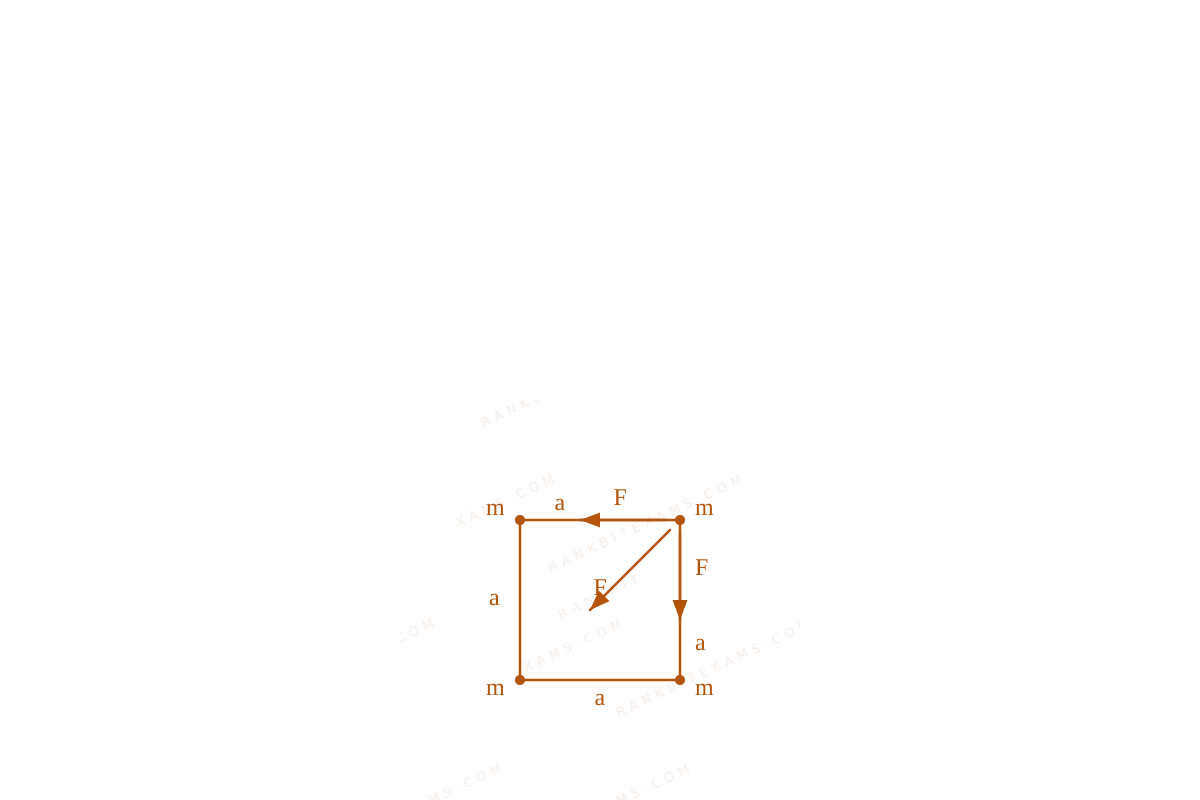
Q jee_main_2024_31_jan_morning Superposition Principle
Four identical particles of mass m are kept at the four corners of a square. If the gravitational force exerted on one of the masses by the other masses is ( 2√(2) + 132) Gm²L², the length of the sides of the square is
  • A. L2
  • B. 4 L
  • C. 3L
  • D. 2 L

Solution

Related Formula
F = (G m₁ m₂)/(r²)
Core Logic

Superposition Principle diagram for Q37 - JEE Main 2024 Morning

Let the side length of the square be a. Considering one corner mass, it experiences forces from the adjacent two masses (distance a) and the diagonally opposite mass (distance √(2)a).

The forces from the two adjacent masses are at 90^° to each other:

F = (Gm²)/(a²)

The resultant of these two is √(2)F = √(2) (Gm²)/(a²), directed along the diagonal.

Step 2: Total Force Equation

The force from the diagonal mass is:

F' = Gm²(√(2)a)² = (Gm²)/(2a²)

Total resultant force Fₙₑₜ = √(2)F + F':

Fₙₑₜ = √(2) (Gm²)/(a²) + (Gm²)/(2a²) = (Gm²)/(a²) ( √(2) + (1)/(2) ) Fₙₑₜ = (Gm²)/(a²) ( 2√(2) + 12 )

Equating this to the given force value:

( 2√(2) + 132)(Gm²)/(L²) = (Gm²)/(a²) ( 2√(2) + 12 ) (1)/(32 L²) = (1)/(2 a²)

a² = 16 L² a = 4L

Chapter Mix

Class 11 Physics: Gravitation

More Gravitation Questions — jee_main_2025_03_april_morning

Practice all Gravitation previous-year questions →

Rankbit System
JEE Physics: Waves (+15.5%) | Electrostatics: Concentric Shells (-29.7%) | Modern Physics: Photoelectric Clones (+34.2%) | Mathematics: Definite Integrals (+18.1%) | Chemistry: Coordination Splitting (-11.4%) | JEE Physics: Waves (+15.5%) | Electrostatics: Concentric Shells (-29.7%) | Modern Physics: Photoelectric Clones (+34.2%) | Mathematics: Definite Integrals (+18.1%) | Chemistry: Coordination Splitting (-11.4%)