JEE Main · Physics ↓ Falling

Gravitation appeared 22 times across 3 years — 2.5% of Physics. This question is from Gravitational Interaction and Scaling.

Year 2026 2025 2024 Total
Questions 5 9 8 22

Three identical spheres of mass m, are placed at the vertices of an equilateral triangle of length a. When released, they interact only through gravitational force and collide after a time T=4 seconds. If the sides of the triangle are increased to length 2a and also the masses of the spheres are made 2m, then they will collide after ________ seconds.

Numerical Answer Type:
Enter a numerical value Answer: 8 to 8 +4 marks

Solution & Explanation

Related Formula

By Dimensional Analysis or Scaling of Kepler's Third Law:

T ∝ m^x G^y a^z
Core Logic

Let's perform a dimensional matching to express the collision time T in terms of physical scaling variables m, G, and a:

[T] = [M]^x [M⁻¹L³T⁻²]^y [L]^z

Equating dimensions on both sides:

  • Mass (M): x - y = 0 x = y
  • Length (L): 3y + z = 0 z = -3y
  • Time (T): -2y = 1 y = -1/2
  • Solving these equations:

x = -1/2, y = -1/2, z = 3/2
Step 1: Scaling Formula of Time

Therefore, the scaling relationship for time T is:

T ∝ m-1/2 G-1/2 a3/2 T ∝ √((a³)/(m))

Let's write the ratio for two cases:

(T₂)/(T₁) = √(((a₂)/(a₁))³ · ((m₁)/(m₂)))
Step 2: Calculating Final Time

Given values:

  • a₁ = a, a₂ = 2a
  • m₁ = m, m₂ = 2m
  • T₁ = 4~s
(T₂)/(4) = √(((2a)/(a))³ · ((m)/(2m))) = √(2³ · (1)/(2)) = √(4) = 2 T₂ = 4 × 2 = 8~seconds
Pattern Recognition

Kepler's Third Law / free-fall collapse scaling: whenever a orbit or a direct gravitational collapse scale is involved, the time scales as T ∝ √((R³)/(GM)). Thus doubling R multiplies time by √(8) and doubling M divides time by √(2). The combination results in a clean doubling of time: √(8)/√(2) = 2.

Chapter Mix

Class 11 Physics: Gravitation Class 11 Physics: Units and Measurements: Dimensional Analysis

Reference Study Guides

More Gravitation Previous-Year Questions — Page 2

Q25 jee_main_2025_02_april_evening Satellite Motion and Orbital Energy
A satellite of mass 1000kg is launched to revolve around the earth in an orbit at a height of 270km from the earth's surface. Kinetic energy of the satellite in this orbit is \_ \times 10^{10}\mathrm{J}. (Mass of earth= 6\times 10^{24}\mathrm{kg},Radius of earth= 6.4 \times 10^{6} \mathrm{~m}, Gravitational constant= 6.67 \times 10^{-11} \mathrm{Nm}^2 \mathrm{kg}^{-2}$)
Numerical Answer. Answer: 3 to 3

Solution

Related Formula
  • Orbital speed (v₀) of a satellite at distance r from earth's center:
v₀ = √((G Mₑ)/(r))
  • Orbital Radius:
  • r = Rₑ + h

  • Kinetic Energy of the orbiting satellite:
KE = (1)/(2) m v₀² = (G Mₑ m)/(2(Rₑ + h))
Core Logic

Given parameters:

  • Mass of satellite m = 1000 kg = 10³ kg
  • Orbit altitude h = 270 km = 0.27 × 10⁶ m
  • Earth Radius Rₑ = 6.4 × 10⁶ m
  • Earth Mass Mₑ = 6 × 10²⁴ kg
  • Gravitational constant G = 6.67 × 10⁻¹¹ N · m² / kg²
Step 1: Calculate kinetic energy

First, compute the orbital radius r:

r = Rₑ + h = 6.4 × 10⁶ m + 0.27 × 10⁶ m = 6.67 × 10⁶ m

Substitute r = 6.67 × 10⁶ m into the kinetic energy equation:

KE = (G Mₑ m)/(2 r) KE = 6.67 × 10⁻¹¹ × 6 × 10²⁴ × 10³2 × 6.67 × 10⁶

Notice that the value 6.67 cancels out directly:

KE = 6 × 10¹⁶2 × 10⁶ = 3 × 10¹⁰ J

Thus, the kinetic energy coefficient is 3.

Pattern Recognition

Sees: Kinetic energy of a satellite orbiting at an altitude above earth's surface. Trap: Doing long division calculation for 6.67/2. Check for clean cancellations in formulas first! Shortcut: Notice that Rₑ + h = 6.4 × 10⁶ + 0.27 × 10⁶ = 6.67 × 10⁶, which matches the value of the Gravitational constant G = 6.67 × 10⁻¹¹ perfectly. This clean cancellation leaves behind simple integer math to give 3 × 10¹⁰ ~J immediately.

Chapter Mix

Class 11 Physics: Gravitation
Q24 jee_main_2025_29_jan_evening Kepler's Laws and Planetary Motion
Two planets, A and B are orbiting a common star in circular orbits of radii RA and RB , respectively, with RB = 2RA . The planet B is 4√(2) times more massive than planet A. The ratio ( LBLA) of angular momentum (LB) of planet B to that of planet A(LA) is closest to integer ______.
Numerical Answer. Answer: 8 to 8

Solution

Related Formula
v₀ = GMₛₜₐᵣR L = m v₀ R = m G Mₛₜₐᵣ R
Core Logic

The orbital angular momentum scales as L ∝ m √(R), where m is the mass of the orbiting planet and R is its orbital radius.

Setting up the ratio for planet B to planet A:

(LB)/(LA) = ((mB)/(mA)) · √((RB)/(RA))

Substitute the relative constraints provided by the text:

  • mB = 4√(2) mA
  • RB = 2 RA
(LB)/(LA) = (4√(2)) × √(2) = 4 × 2 = 8
Pattern Recognition

Orbital velocity goes down as 1/√(R), but angular momentum features an explicit distance product multiplier (m v R), shifting the baseline radius factor to a clean numerator scaling profile: √(R).

Chapter Mix

Class 11 Physics: Gravitation

Q9 jee_main_2025_04_april_evening Escape Velocity
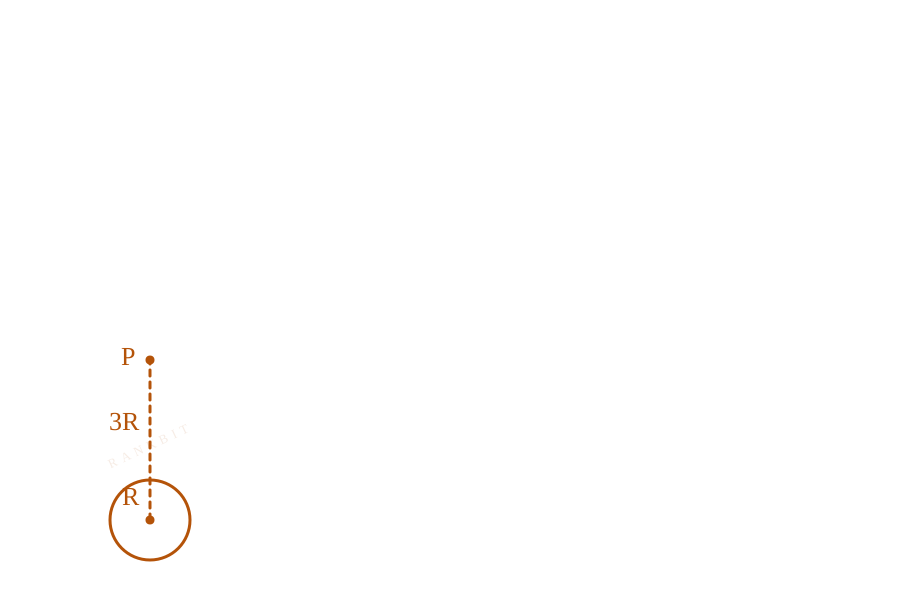
An object is kept at rest at a distance of 3R above the earth's surface where R is earth's radius. The minimum speed with which it must be projected so that it does not return to earth is: (Assume M= mass of earth, G= Universal gravitational constant)
  • A. √((GM)/(2R))
  • B. √((GM)/(R))
  • C. √((3GM)/(R))
  • D. √((2GM)/(R))

Solution

Related Formula

Conservation of Total Mechanical Energy: Eᵢ = Ef

Uᵢ + Kᵢ = Uf + Kf
Core Logic

The initial distance from the center of the earth is r = R + 3R = 4R. Initial mechanical energy:

Eᵢ = -(GMm)/(4R) + (1)/(2)mv²

To just escape to infinity, the final mechanical energy at infinity must be at least zero: Ef = 0

Step 1: Apply Energy Conservation

Setting initial energy equal to zero:

-(GMm)/(4R) + (1)/(2)mv² = 0

(1)/(2)v² = (GM)/(4R) v = √((GM)/(2R))

Escape projection trajectory from height 3R

Pattern Recognition

Be extremely careful with the phrase 'above the earth's surface'. Distance from center r = R + h. Escape condition always sets net mechanical energy ≥ 0.

Chapter Mix

Class 11 Physics: Gravitation

Q jee_main_2025_04_april_morning Escape Velocity and Potential Energy
Given below are two statements: one is labelled as Assertion A and the other is labelled as Reason R. Assertion A: The kinetic energy needed to project a body of mass m from earth surface to infinity is (1)/(2)mgR, where R is the radius of earth. Reason R: The maximum potential energy of a body is zero when it is projected to infinity from earth surface. In the light of the above statements, choose the correct answer from the option given below
  • A. A is False but R is true
  • B. Both A and R are true and R is the correct explanation of A
  • C. A is true but R is false
  • D. Both A and R are true but R is NOT the correct explanation of A

Solution

Related Formula

Escape kinetic energy requirement formulation:

KEescape = (GMm)/(R) = mgR

Gravitational potential energy field definition:

U = -(GMm)/(r)

At r → ∞, Umax = 0.

Core Logic
  • Assertion Check: The minimum work required to project an object from Earth's surface (r = R) to infinity (r → ∞) equals the change in gravitational potential energy:
Δ U = U(∞) - U(R) = 0 - (-(GMm)/(R)) = (GMm)/(R) = mgR

Therefore, the required kinetic energy is mgR. The statement asserts it is (1)/(2)mgR (which corresponds to orbital kinetic energy near Earth's surface). Hence, Assertion A is false.

  • Reason Check: Since the gravitational force is attractive, potential energy is negative everywhere in the field and reaches its maximum value asymptotically at infinity (Umax = 0). Hence, Reason R is true.
Pattern Recognition

Escape energy from the surface is mgR, while circular orbital kinetic energy near the surface is (1)/(2)mgR. Because gravitational potential energy is defined with zero at infinity, every bound state has U < 0, making zero the absolute maximum potential energy.

Evaluation Rubric / Model Answer

Option A: A is false but R is true

Chapter Mix

Class 11 Physics: Gravitation

More Gravitation Questions — jee_main_2025_03_april_morning

Practice all Gravitation previous-year questions →

Rankbit System
JEE Physics: Waves (+15.5%) | Electrostatics: Concentric Shells (-29.7%) | Modern Physics: Photoelectric Clones (+34.2%) | Mathematics: Definite Integrals (+18.1%) | Chemistry: Coordination Splitting (-11.4%) | JEE Physics: Waves (+15.5%) | Electrostatics: Concentric Shells (-29.7%) | Modern Physics: Photoelectric Clones (+34.2%) | Mathematics: Definite Integrals (+18.1%) | Chemistry: Coordination Splitting (-11.4%)