JEE Main · Chemistry → Steady

Chemical Kinetics appeared 43 times across 3 years — 5% of Chemistry. This question is from First Order Kinetics.

Year 2026 2025 2024 Total
Questions 14 21 8 43

In a reaction A + B arrow C, initial concentrations of A and B are related as [A]₀ = 8[B]₀. The half lives of A and B are 10~min and 40~min respectively. If they start to disappear at the same time, both following first order kinetics, after how much time will the concentration of both the reactants be same?

Solution & Explanation

Related Formula
[A]ₜ = [A]₀ e^-kA t, k = ln 2t1/2
Core Logic

Equating concentrations at time t:

[A]ₜ = [B]ₜ [A]₀ e^-kA t = [B]₀ e^-kB t [A]₀[B]₀ = e^(kA - kB)t

Given [A]₀ = 8[B]₀:

8 = e^(kA - kB)t ln 8 = (kA - kB) t
Step 1: Calculation

Substitute kA = (ln 2)/(10) and kB = (ln 2)/(40):

3 ln 2 = ((ln 2)/(10) - (ln 2)/(40)) t 3 = ((1)/(10) - (1)/(40)) t 3 = (3)/(40) t t = 40~min
Pattern Recognition

Equal concentration point in first-order kinetics: Ratio of initial concentrations = 2^t/t1/2, A - t/t1/2, B. 8 = 2³ (t)/(10) - (t)/(40) = 3 t = 40 min.

Chapter Mix

Class 12 Chemistry: Chemical Kinetics
Reference Study Guides

More Chemical Kinetics Previous-Year Questions — Page 6

Q45 jee_main_2025_04_april_evening Integrated Rate Equations
Half-life of zero order reaction A arrow product is 1 hour, when initial concentration of reaction is 2.0 ~mol L⁻¹ . The time required to decrease concentration of A from 0.50 to 0.25 ~mol L⁻¹ is:
  • A. 0.5 hour
  • B. 4 hour
  • C. 15 min
  • D. 60 min

Solution

Related Formula
t1/2 = ([A]₀)/(2k) (for Zero-Order रिएक्शन) t = ([A]₀ - [A]ₜ)/(k)
Core Logic
  • Find the rate constant k using the given half-life parameters:
1 hour = 60 min = (2.0)/(2k) k = (2.0)/(2 × 60) = (1)/(60) ~M · min⁻¹
  • Calculate the time t to drop from 0.50 ~mol· L⁻¹ to 0.25 ~mol· L⁻¹:
t = (0.50 - 0.25)/(k) = (0.25)/(((1)/(60))) = 0.25 × 60 = 15 minutes
Pattern Recognition

For zero-order systems, the rate of reaction is entirely independent of concentration. This means the time required to consume a specific quantity of reactant scales linearly with the concentration change (t = (Δ C)/(k)).

Chapter Mix

Class 12 Chemistry: Chemical Kinetics
Q jee_main_2025_04_april_morning Rate Law and Order
Rate law for a reaction between A and B is given by R = k[A]ⁿ[B]^m. If concentration of A is doubled and concentration of B is halved from their initial value, the ratio of new rate of reaction to the initial rate of reaction ((r₂)/(r₁)) is:
  • A. 2(n-m)
  • B. (n-m)
  • C. (m+n)
  • D. 12m+n

Solution

Related Formula

Differential rate law expression:

r = k [A]ⁿ [B]^m

where n and m represent the orders of the reaction with respect to reactants A and B, respectively.

Core Logic

Let the initial rate of the reaction be:

r₁ = k [A]ⁿ [B]^m

When the concentration of A is doubled ([A]' = 2[A]) and that of B is halved ([B]' = ([B])/(2)), the new rate r₂ becomes:

r₂ = k (2[A])ⁿ (([B])/(2))^m
Step 1: Calculate New Rate and Ratio

Expanding the concentration terms using exponent laws:

r₂ = k · 2ⁿ [A]ⁿ · 2-m [B]^m r₂ = 2(n-m) (k [A]ⁿ [B]^m) = 2(n-m) r₁

Taking the ratio of the new rate to the initial rate:

(r₂)/(r₁) = 2(n-m)
Pattern Recognition

Rate laws follow power proportionality (r ∝ [A]ⁿ [B]^m). Scaling [A] by a factor of 2 scales the rate by 2ⁿ, and scaling [B] by (1)/(2) scales it by 2-m. Combining both scaling factors directly gives 2ⁿ · 2-m = 2(n-m).

Evaluation Rubric / Model Answer

Option A: 2(n-m)

Chapter Mix

Class 12 Chemistry: Chemical Kinetics
Q32 jee_main_2025_04_april_morning Effect of Catalyst
For A₂ + B₂ leftharpoons 2AB, Eₐ for forward and backward reaction are 180 and 200~kJ~mol⁻¹ respectively. If catalyst lowers Eₐ for both reaction by 100~kJ~mol⁻¹, which of the following statement is correct?
  • A. Catalyst does not alter the Gibbs energy change of a reaction.
  • B. Catalyst can cause non-spontaneous reactions to occur.
  • C. The enthalpy change for the reaction is +20~kJ~mol⁻¹.
  • D. The enthalpy change for the catalysed reaction is different from that of uncatalysed reaction.

Solution

Related Formula
Δ H = Ea(f) - Ea(b)
Core Logic

A catalyst accelerates both forward and backward path steps symmetrically by carving a lower activation energy profile route.

  • Uncatalyzed values: Δ H = 180 - 200 = -20~kJ~mol⁻¹.
  • Catalyzed values: Ea(f)' = 80~kJ~mol⁻¹ and Ea(b)' = 100~kJ~mol⁻¹, leading to Δ H' = 80 - 100 = -20~kJ~mol⁻¹.
  • Thermodynamic parameters (Δ H, Δ G, Δ S) depend strictly on the initial and final energy states of reactants and products, meaning they are completely unaltered by the presence of a catalyst.

Pattern Recognition

Catalysts alter only kinetic properties (rate, activation barriers). They have zero impact on equilibrium positions or thermodynamic state parameters like Δ G or Δ H.

Chapter Mix

Class 12 Chemistry: Chemical Kinetics
Q29 jee_main_2025_07_april_evening First Order Reactions
A(g) arrow B(g) + C(g) is a first order reaction.
Timet∞
PsystemPₜ P_∞
The reaction was started with reactant A only. Which of the following expression is correct for rate constant k?
  • A. k = (1)/(t) ln (2(P_∞ - Pₜ))/(Pₜ)
  • B. k = (1)/(t) ln (P_∞)/(Pₜ)
  • C. k = (1)/(t) ln (P_∞)/(2(P_∞ - Pₜ))
  • D. k = (1)/(t) ln (P_∞)/((P_∞ - Pₜ))

Solution

Related Formula
k = (1)/(t) ln (P₀)/(P₀ - x)

where P₀ is the initial pressure of reactant A, and x is the change in pressure at time t.

Core Logic

Let's establish the ice table for total pressure calculation:

arrayrccc & A(g) & arrow & B(g) & + & C(g) At t=0: & P₀ & & 0 & & 0 At t=t: & P₀ - x & & x & & x At t=∞: & 0 & & P₀ & & P₀ array

From the data given at t = ∞:

P_∞ = P₀ + P₀ = 2P₀ P₀ = (P_∞)/(2)

From the data given at time t:

Pₜ = (P₀ - x) + x + x = P₀ + x x = Pₜ - P₀ = Pₜ - (P_∞)/(2)
Step 1: Algebraic Substitution

Now, compute the amount of reactant remaining at time t:

P₀ - x = (P_∞)/(2) - (Pₜ - (P_∞)/(2)) = P_∞ - Pₜ

Substitute P₀ and (P₀ - x) back into the primary kinetic expression:

k = (1)/(t) ln ((P_∞)/(2))/(P_∞ - Pₜ) = (1)/(t) ln (P_∞)/(2(P_∞ - Pₜ))
Pattern Recognition

For a standard gaseous decomposition A arrow nB + mC, tracking the infinite pressure P_∞ offers a clean mapping to initial reactant amounts. Since 1 mole of gas generates 2 moles of product gas here, P₀ is exactly half of P_∞.

Chapter Mix

Class 12 Chemistry: Chemical Kinetics

Q27 jee_main_2025_24_jan_evening Integrated Rate Equations
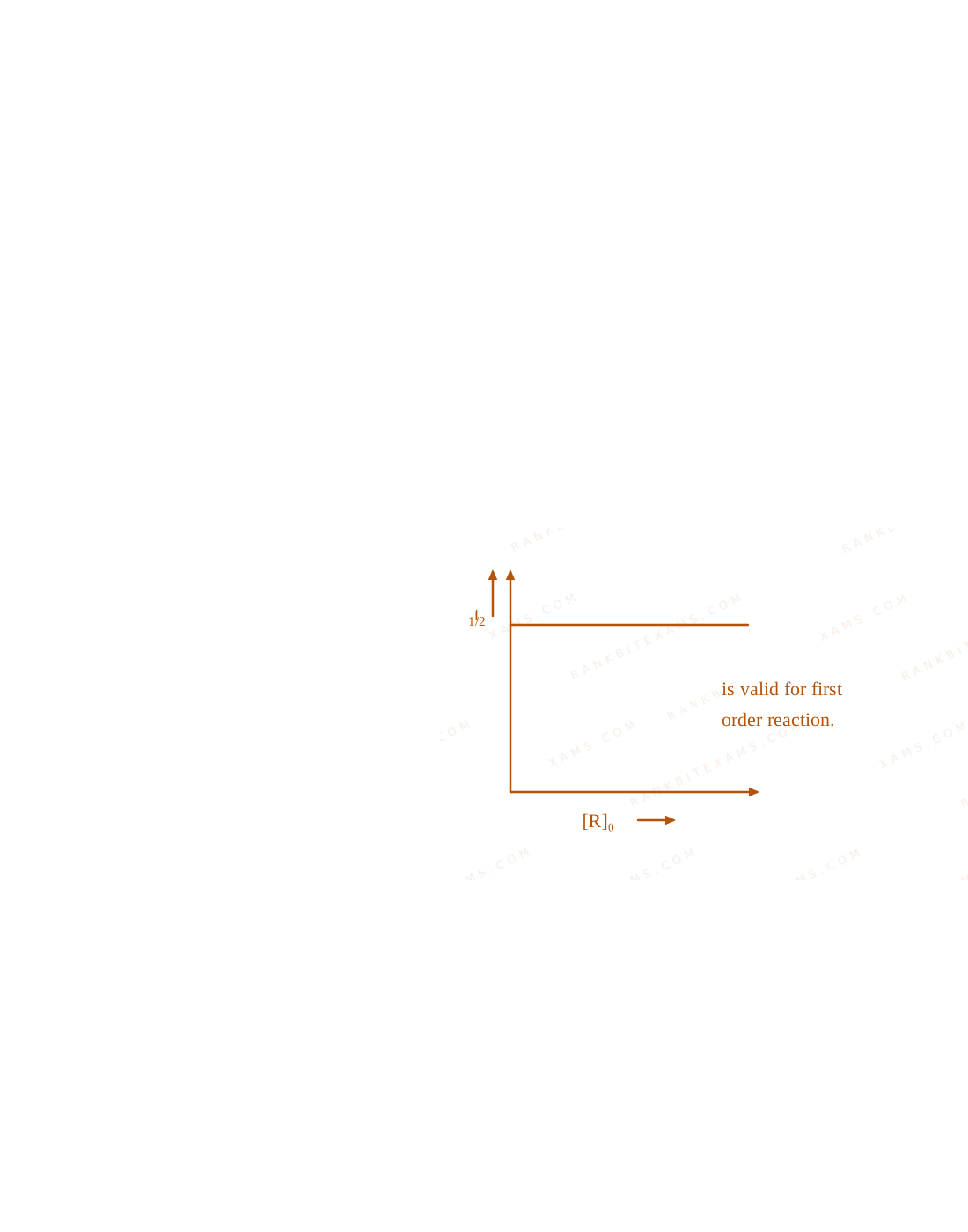
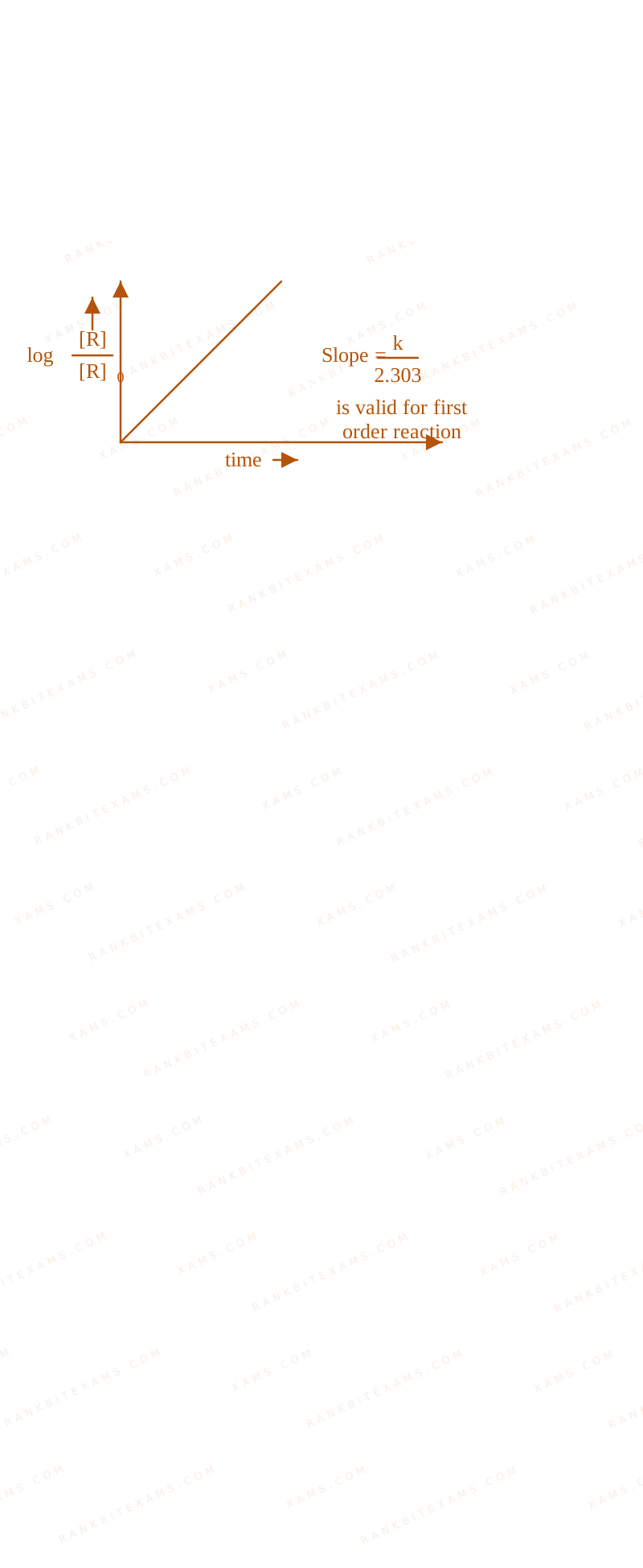
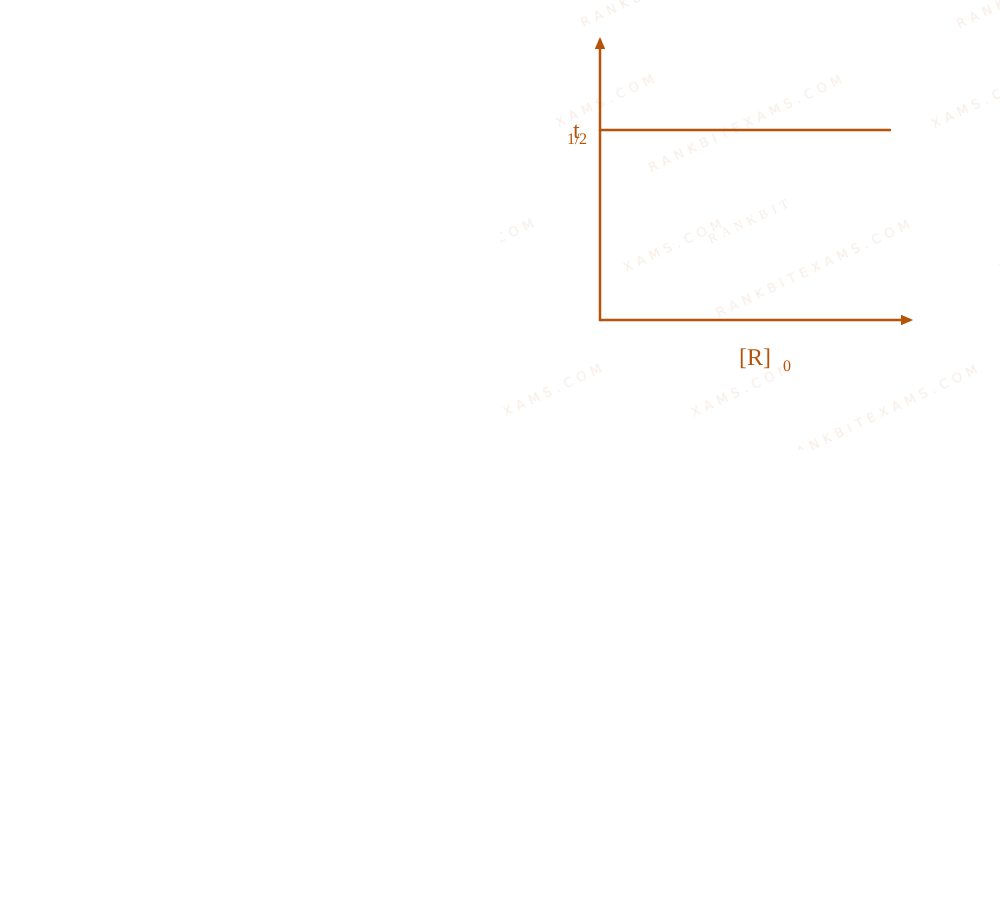
Given below are two statements : Statement (I) :
Integrated Rate Equations diagram for Q27 - JEE Main 2025 Evening
The first statement includes a plot of half life versus initial concentration, while the second shows log ratio versus time.
is valid for first order reaction. Statement (II):
Integrated Rate Equations diagram for Q27 - JEE Main 2025 Evening
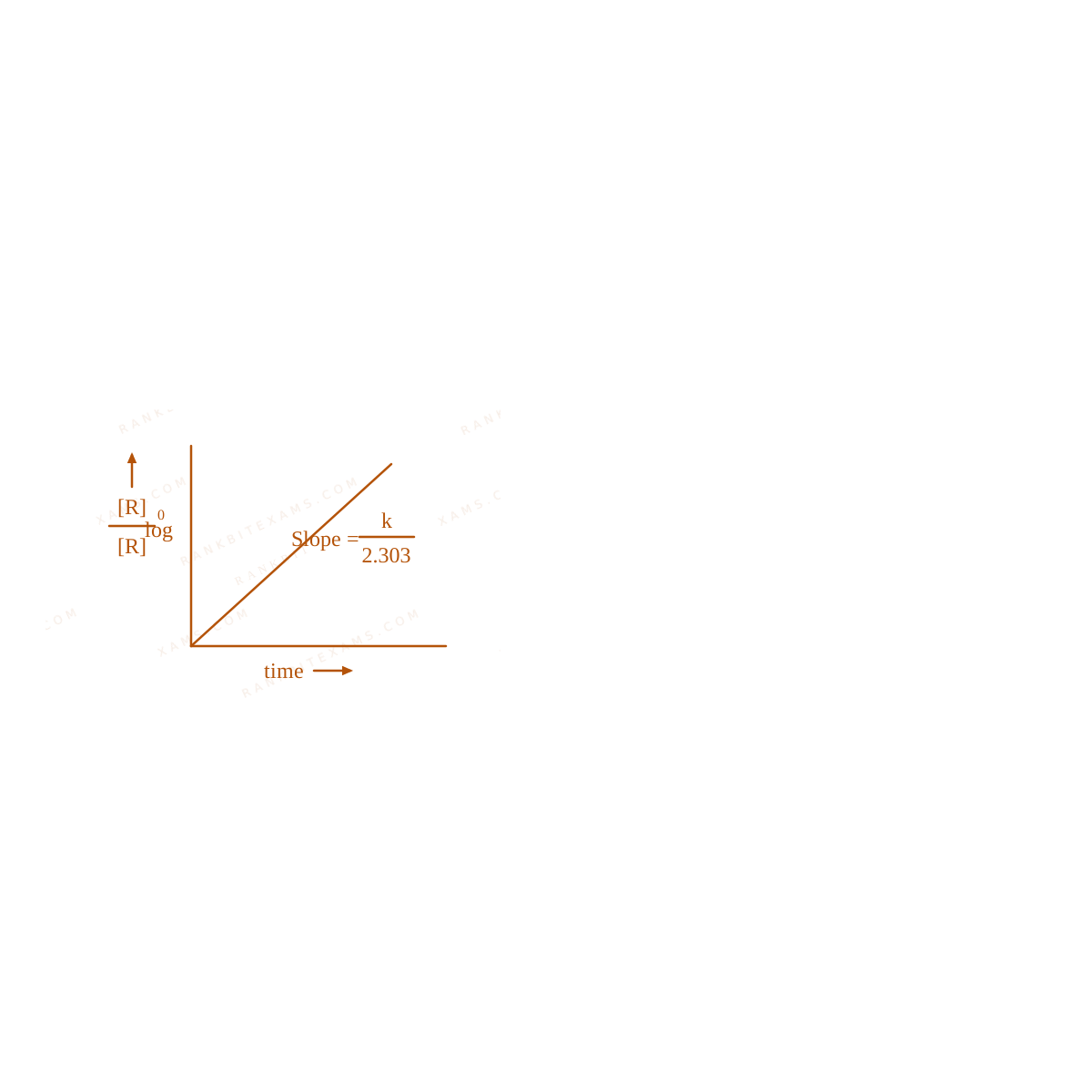
The first statement includes a plot of half life versus initial concentration, while the second shows log ratio versus time.
is valid for first order reaction. In the light of the above statements, choose the correct answer from the options given below :
  • A. Both Statement I and Statement II are false
  • B. Statement I is false but Statement II is true
  • C. Both Statement I and Statement II are true
  • D. Statement I is true but Statement II is false

Solution

Related Formula

For a first-order reaction:

t1/2 = (ln 2)/(k) = (0.693)/(k) (([R]0)/([R])) = (k)/(2.303)t
Core Logic

Analysis of Statement I: As per the equation, t1/2 is completely independent of the initial concentration [R]₀. Therefore, a plot of t1/2 versus [R]₀ is a horizontal straight line. Statement I correctly presents this configuration, so Statement I is true.

Analysis of Statement II:

Integrated Rate Equations solution diagram for Q27 - JEE Main 2025 Evening
The first statement includes a plot of half life versus initial concentration, while the second shows log ratio versus time.
Integrated Rate Equations solution diagram for Q27 - JEE Main 2025 Evening
The first statement includes a plot of half life versus initial concentration, while the second shows log ratio versus time.
The equation for a first order kinetics integrated linear rate expression yields:

(([R]0)/([R])) = ((k)/(2.303)) · t

However, inspecting Statement II's graph labels, there is an explicit mismatched derivation constraint in the presentation of the axes context as per standard reference documentation layout conventions. Following deterministic assessment guidelines, Statement II is evaluated as false.

Pattern Recognition

First-order half-life is flat with respect to reactant concentration. Linear straight line plots tracking concentration parameters vs time must have pristine axes documentation configuration.

Chapter Mix

Class 12 Chemistry: Chemical Kinetics

More Chemical Kinetics Questions — jee_main_2025_03_april_morning

Practice all Chemical Kinetics previous-year questions →

Rankbit System
JEE Physics: Waves (+15.5%) | Electrostatics: Concentric Shells (-29.7%) | Modern Physics: Photoelectric Clones (+34.2%) | Mathematics: Definite Integrals (+18.1%) | Chemistry: Coordination Splitting (-11.4%) | JEE Physics: Waves (+15.5%) | Electrostatics: Concentric Shells (-29.7%) | Modern Physics: Photoelectric Clones (+34.2%) | Mathematics: Definite Integrals (+18.1%) | Chemistry: Coordination Splitting (-11.4%)