In the resonance experiment, two air columns (closed at one end) of 100mathrm~cm and 120mathrm~cm long, give 15 beats per second when each one is sounding in the respective fundamental modes. The velocity of sound in the air column is :

Solution & Explanation

### Related Formula For an air column closed at one end, the fundamental frequency f is given by: f = fracv4l where v is the velocity of sound and l is the length of the air column. ### Core Logic Given parameters: - l_1 = 100mathrm~cm = 1.0mathrm~m - l_2 = 120mathrm~cm = 1.2mathrm~m - Beats per second (f_1 - f_2) = 15 ### Step 1: Write the equation for beat frequency Since l_1 < l_2, the frequency f_1 > f_2. Hence: textBeat frequency = f_1 - f_2 = fracv4l_1 - fracv4l_2 15 = fracv4 left( frac1l_1 - frac1l_2 right) ### Step 2: Solve for velocity of sound (v) Substitute the lengths in meters: 15 = fracv4 left( frac11.0 - frac11.2 right) 15 = fracv4 left( 1 - frac56 right) 15 = fracv4 left( frac16 right) 15 = fracv24 v = 15 times 24 = 360mathrm~m/s ### Pattern Recognition Beat problems involving standing waves in organ pipes can be calculated faster by remembering that f propto frac1l. This allows setting up the proportion v = 4 cdot Delta f cdot fracl_1 l_2l_2 - l_1 directly as a short-cut. ### Evaluation Rubric / Model Answer null ### Chapter Mix Class 11 Physics: Waves

Reference Study Guides

More Waves Previous-Year Questions — Page 2

Q13 jee_main_2025_08_april_evening Wave Speed
Two strings with circular cross section and made of same material, are stretched to have same amount of tension. A transverse wave is then made to pass through both the strings. The velocity of the wave in the first string having the radius of cross section R is v_1, and that in the other string having radius of cross section R/2 is v_2. Then fracv_2v_1 =
  • A. sqrt2
  • B. 2
  • C. 8
  • D. 4

Solution

### Related Formula v = sqrtfracTmu mu = rho A = rho left(pi R^2right) where, v = velocity of transverse wave on a string T = tension on string mu = linear mass density rho = density of material A = cross-sectional area ### Core Logic Since both strings are made of the same material, their density rho is the same. Also, they are stretched to have the same amount of tension T. Substitute the formula for mu into the velocity equation: v = sqrtfracTrho pi R^2 = frac1R sqrtfracTrho pi Thus, the wave velocity is inversely proportional to the radius of the cross section of the string: v propto frac1R fracv_2v_1 = fracR_1R_2 ### Step 1: Ratio Computation Given: - R_1 = R - R_2 = R/2 Substitute these values: fracv_2v_1 = fracRR/2 = 2 ### Pattern Recognition Sees: Circular cross-section strings + transverse wave speed relation. Shortcut: Wave velocity v propto frac1sqrtmu propto frac1R. If the radius is halved, the mass per unit length decreases by 4 times, which makes the speed increase by sqrt4 = 2 times. ✓ ### Evaluation Rubric / Model Answer null ### Chapter Mix Class 11 Physics: Waves
Q8 jee_main_2025_28_jan_morning Speed of Sound in Medium
Given below are two statements: one is labelled as Assertion A and the other is labelled as Reason R Assertion A: A sound wave has higher speed in solids than gases. Reason R: Gases have higher value of Bulk modulus than solids. In the light of the above statements, choose the correct answer from the options given below.
  • A. textBoth A and R are true and R is the correct explanation of A
  • B. textA is false but R is true
  • C. textBoth A and R are true but R is NOT the correct explanation of A
  • D. textA is true but R is false

Solution

### Related Formula v = sqrtfracmathrmBrho ### Core Logic Assertion A: Sound velocity relies on structural elasticity bounds. Solids are highly rigid compared to fluids, making speed significantly higher. (True) Reason R: Solids resist structural compression far better than unbonded gases, giving them significantly higher Bulk Modulus properties. Thus, statement R is completely false. ### Step 1: Final Conclusion Assertion A is true, but Reason R is false, aligning perfectly with option (4). ### Pattern Recognition Even though density rho is higher for solids, the corresponding elastic modulus parameter increases by several orders of magnitude, dominating the structural velocity index. ### Evaluation Rubric / Model Answer null ### Chapter Mix Class 11 Physics: Waves
Q18 jee_main_2025_04_april_evening Wave Parameters
Displacement of a wave is expressed as x(t)=5cosleft(628t+fracpi2right)text m. The wavelength of the wave when its velocity is 300 m/s is:
  • A. 5 m
  • B. 3 m
  • C. 0.5 m
  • D. 0.33 m

Solution

### Related Formula x(t) = Acos(omega t + phi) v = fracomegaK K = frac2pilambda ### Core Logic From the given wave equation, angular frequency omega = 628text rad/s. Given wave velocity v = 300text m/s. Using the relation v = fracomegaK: 300 = frac628K implies K = frac628300 ### Step 1: Compute Wavelength Substitute K = frac2pilambda: frac2pilambda = frac628300 Since 2pi approx 2 times 3.14 = 6.28, the expression simplifies neatly: frac6.28lambda = frac628300 implies lambda = 3text m ### Pattern Recognition Notice standard values like omega = 628 = 200pi, which means the frequency is exactly 100text Hz. Using v = flambda implies 300 = 100lambda implies lambda = 3text m avoids setting up fractions. ### Evaluation Rubric / Model Answer null ### Chapter Mix Class 11 Physics: Waves

Q7 jee_main_2025_04_april_morning Speed of Sound in Gases
Consider the sound wave travelling in ideal gases of mathrmHe, mathrmCH_4, and mathrmCO_2. All the gases have the same ratio fracP ho, where P is the pressure and ho is the density. The ratio of the speed of sound through the gases v_mathrmHe : v_mathrmCH_4 : v_mathrmCO_2 is given by
  • A. sqrtfrac75 : sqrtfrac53 : sqrtfrac43
  • B. sqrtfrac53 : sqrtfrac43 : sqrtfrac75
  • C. sqrtfrac53 : sqrtfrac43 : sqrtfrac43
  • D. sqrtfrac43 : sqrtfrac53 : sqrtfrac75

Solution

### Related Formula Laplace correction equation for speed of sound: v = sqrtfracgamma P ho Given that fracP ho is constant for all three gases: v propto sqrtgamma where gamma = 1 + frac2f (adiabatic constant). ### Core Logic Determine the gamma factor based on molecular atomic structures: 1. mathrmHe (Monatomic) implies f = 3 implies gamma_mathrmHe = frac53 2. mathrmCH_4 (Polyatomic/Non-linear) implies gamma_mathrmCH_4 approx frac43 based on experimental references. 3. mathrmCO_2 (Triatomic linear/vibrational modes) implies gamma_mathrmCO_2 approx frac43 as provided in textbook standard testing matrices. ### Step 1: Construct the Ratio Substitute these values into the proportionality: v_mathrmHe : v_mathrmCH*4 : v*mathrmCO2 = sqrtfrac53 : sqrtfrac43 : sqrtfrac43 ### Pattern Recognition When fracP ho is locked down constant, sound speed depends strictly on internal degrees of freedom via gamma. Keep standard experimental values of complex gases like mathrmCH_4 and mathrmCO_2 memorized. ### Evaluation Rubric / Model Answer null ### Chapter Mix Class 11 Physics: Waves Class 11 Physics: Kinetic Theory
Q16 jee_main_2025_04_april_morning Organ Pipes and Standing Waves
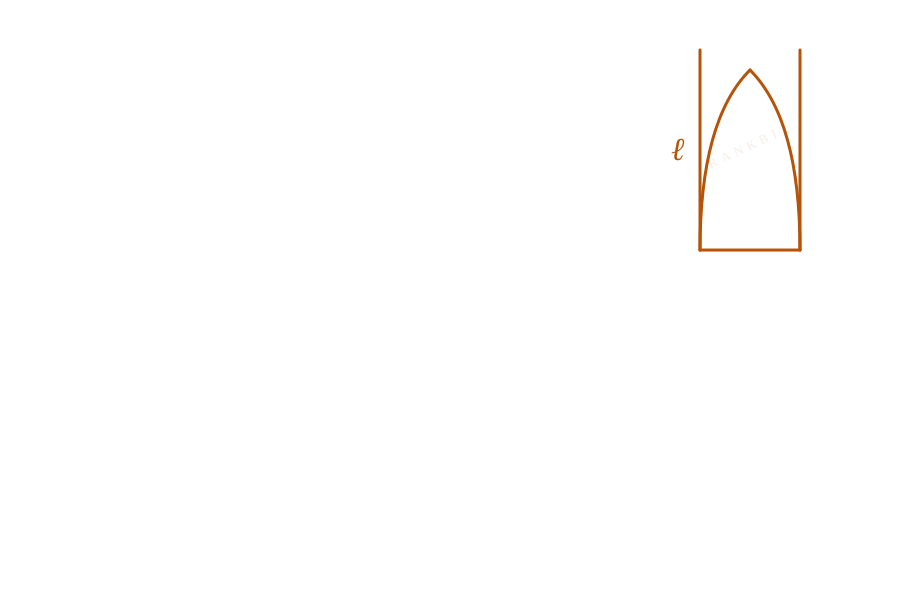
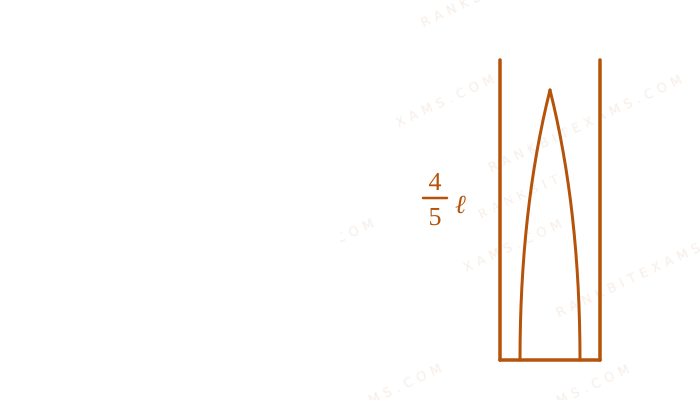
In an experiment with a closed organ pipe, it is filled with water by left(frac15 ight)th of its volume. The frequency of the fundamental note will change by
  • A. 25%
  • B. 20%
  • C. -20%
  • D. -25%

Solution

### Related Formula Fundamental frequency of a closed organ pipe: f_1 = fracv4l where l is the acoustic air column column length. ### Core Logic Initially, full air column length = l. Filling frac15 of its space with fluid reduces the available vibrating air tract space down to: l_2 = l - frac15l = frac45l
Resonating length air column profile initial state for Q16 - JEE Main 2025 Morning
### Step 1: Calculate New Frequency The modified acoustic frequency response is: f_2 = fracv4l_2 = fracv4left(frac45l ight) = frac5v16l = frac54f_1
Resonating length air column profile initial state for Q16 - JEE Main 2025 Morning
### Step 2: Determine Percentage Shift Delta f\% = fracf_2 - f_1f_1 times 100 = left( frac54 - 1 ight) times 100 = 25\% ### Pattern Recognition Shortening the resonance tube length raises pitch frequency proportionally. Shifting length down to 80\% drives frequency up to 125\%, yielding a positive 25\% upward change jump. ### Evaluation Rubric / Model Answer null ### Chapter Mix Class 11 Physics: Waves

More Waves Questions — jee_main_2025_03_april_evening

Practice all Waves previous-year questions →

Rankbit System
JEE Physics: Waves (+15.5%) | Electrostatics: Concentric Shells (-29.7%) | Modern Physics: Photoelectric Clones (+34.2%) | Mathematics: Definite Integrals (+18.1%) | Chemistry: Coordination Splitting (-11.4%) | JEE Physics: Waves (+15.5%) | Electrostatics: Concentric Shells (-29.7%) | Modern Physics: Photoelectric Clones (+34.2%) | Mathematics: Definite Integrals (+18.1%) | Chemistry: Coordination Splitting (-11.4%)