JEE Main · Physics → Steady

Waves appeared 22 times across 3 years — 2.5% of Physics. This question is from Organ Pipes and Standing Waves.

Year 2026 2025 2024 Total
Questions 7 10 5 22

In an experiment with a closed organ pipe, it is filled with water by ((1)/(5))^th of its volume. The frequency of the fundamental note will change by:

Solution & Explanation

Related Formula

Fundamental frequency of a closed organ pipe:

f₁ = (v)/(4l)

where l is the length of the resonating air column.

Core Logic

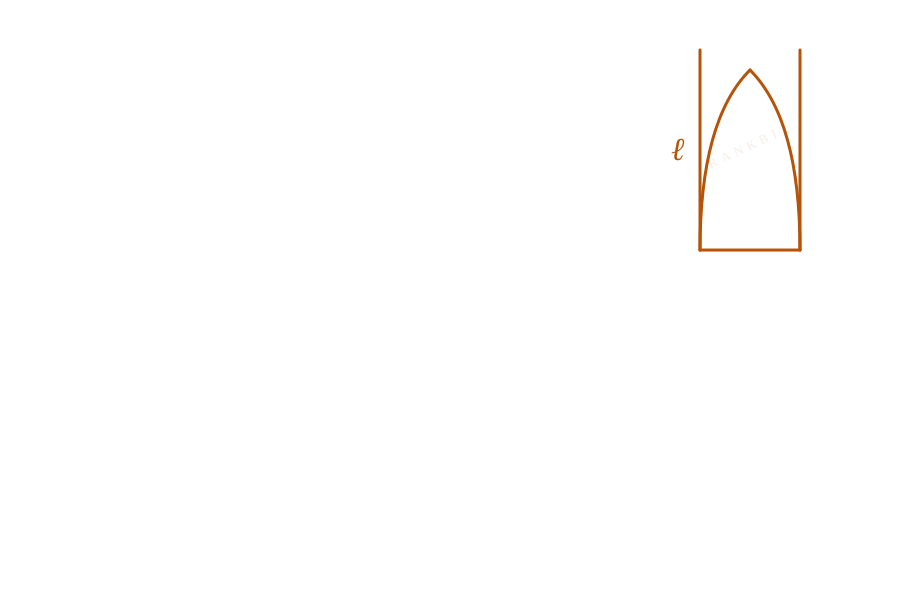
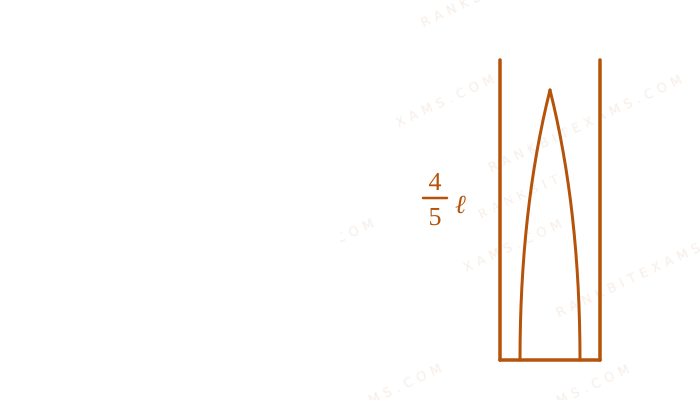
Initially, the full air column length is l. Filling (1)/(5) of its space with fluid reduces the available vibrating air column length to:

l₂ = l - (1)/(5)l = (4)/(5)l

Resonating length air column profile initial state for Q16 - JEE Main 2025 Morning

Step 1: Calculate New Frequency

The modified acoustic frequency response is:

f₂ = (v)/(4l₂) = (v)/(4((4)/(5)l)) = (5v)/(16l) = (5)/(4)f₁

Resonating length air column profile initial state for Q16 - JEE Main 2025 Morning

Step 2: Determine Percentage Shift
Δ f% = (f₂ - f₁)/(f₁) × 100 = ((5)/(4) - 1) × 100 = 25%
Pattern Recognition

Shortening the resonance tube length raises pitch frequency inversely (f ∝ (1)/(l)). Reducing the air column length to 80% of its original value drives the frequency up to 125%, yielding a positive 25% increase.

Evaluation Rubric / Model Answer

Option A: 25%

Chapter Mix

Class 11 Physics: Waves

More Waves Previous-Year Questions

Q43 jee_main_2026_21_jan_morning Wave on a String
Two strings (A, B) having linear densities μA = 2 × 10⁻⁴ kg/m and μB = 4 × 10⁻⁴ kg/m and lengths LA = 2.5 m and LB = 1.5 m respectively are joined. Free ends of A and B are tied to two rigid supports C and D, respectively creating a tension of 500 N in the wire. Two identical pulses, sent from C and D ends, take time t₁ and t₂ , respectively, to reach the joint. The ratio t₁/t₂ is :
  • A. 1.08
  • B. 1.90
  • C. 1.67
  • D. 1.18

Solution

Related Formula
v = √((T)/(μ)) t = (L)/(v)
Core Logic

Given LA = 2.5 m, LB = 1.5 m, T = 500 N. Velocity in string A:

vA = √((T)/(μA)) = 5002 × 10⁻⁴ = √(2500000) = 5 √(10) × 10² m/s

Velocity in string B:

vB = √((T)/(μB)) = 5004 × 10⁻⁴ = √(1250000) = 5 √(5) × 10² m/s
Step 1: Calculate Ratio of Times

Time taken to reach joint:

t₁ = LAvA = 2.55 √(10) × 10² t₂ = LBvB = 1.55 √(5) × 10²

Ratio:

t₁t₂ = 2.55√(10) × 5√(5)1.5 = (2.5)/(1.5) × √(5)√(10) = (5)/(3) × 1√(2) t₁t₂ = (1.666)/(1.414) ≈ 1.18
Pattern Recognition

Time ratio is proportional to L√(T/μ) = L √(μ/T). Thus t₁/t₂ = (L₁/L₂) √(μ₁/μ₂) directly.

Chapter Mix

Class 11 Physics: Waves
Q46 jee_main_2026_22_january_morning Interference of Sound Waves
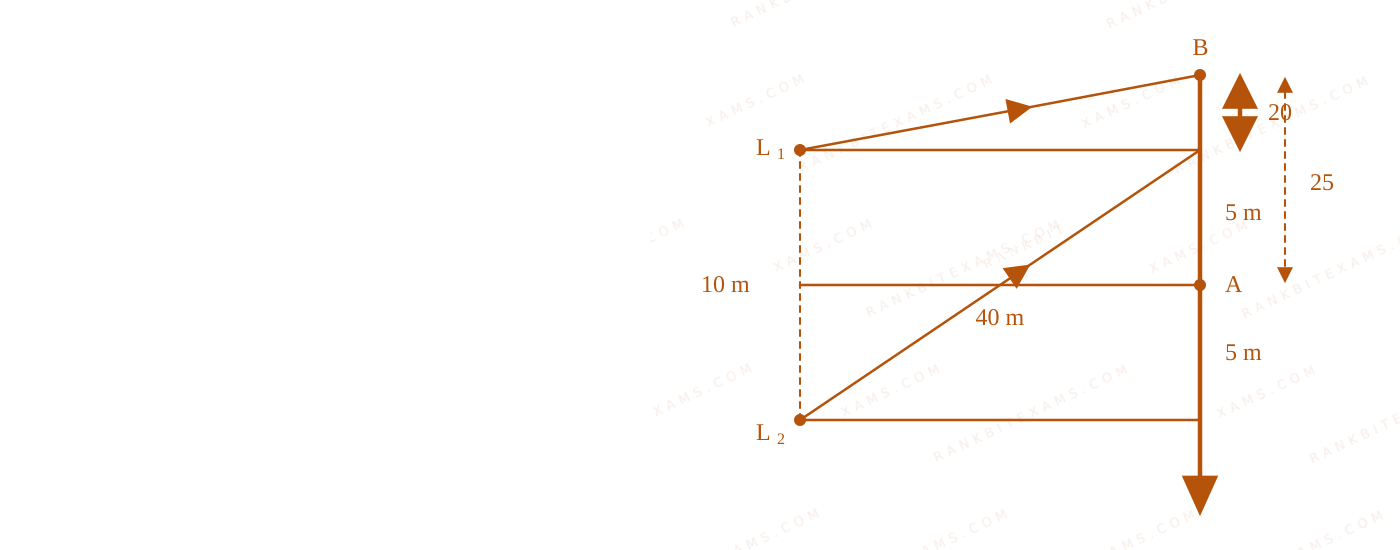
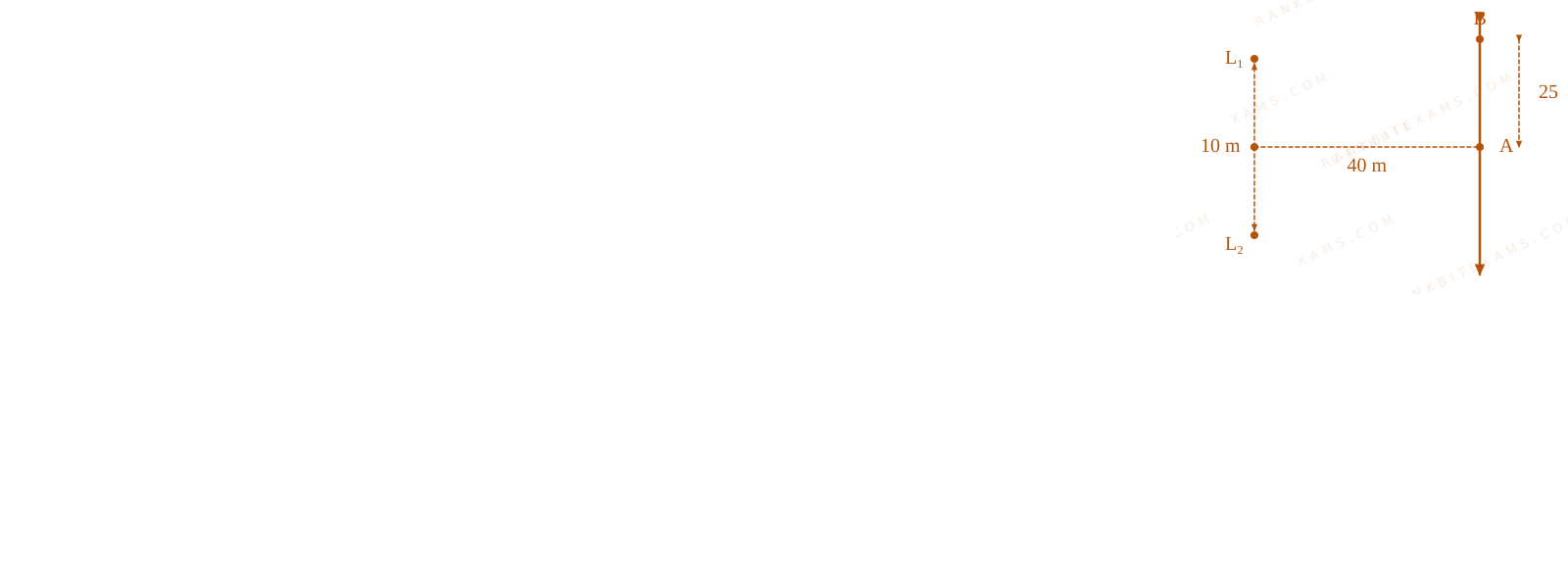
Two loudspeakers L₁ and L₂ are placed with a separation of 10 m, as shown in figure. Both speakers are fed with an audio input signal of same frequency with constant volume. A voice recorder, initially at point A, at equidistance to both loud speakers, is moved by 25 m along the line AB while monitoring the audio signal. The measured signal was found to undergo 10 cycles of minima and maxima during the movement. The frequency of the input signal is \_\_\_\_ Hz (Speed of sound in air is 324~m/s and √(5)=2.23)
Waves and Sound diagram for Q46 - JEE Main 2026 January Morning
Two loudspeakers setup with path difference for sound interference.
Numerical Answer. Answer: 600 to 600

Solution

Related Formula
Δ x = nλ, v = fλ
Core Logic

Solution geometry diagram for Q46 - JEE Main 2026 Morning
Two loudspeakers setup with path difference for sound interference.

Path difference at point B:

L₁ B = √(20² + 40²) = 20√(5) m = 44.6 m L₂ B = √(40² + 30²) = 50 m Δ x = 50 - 44.6 = 5.4 m Δ x = nλ 5.4 = 10 × λ λ = 0.54 m f = (v)/(λ) = (324)/(0.54) = 600 Hz
Pattern Recognition

Sees: Loudspeaker interference cycles along displacement line. Shortcut: Compute path difference at endpoint B, relate to total interference cycles to find wavelength, then frequency. Check: Numerical answer is 600 Hz. ✓

Chapter Mix

Class 11 Physics: Waves and Sound

Q33 jee_main_2026_22_january_evening Organ Pipe Harmonics
In an open organ pipe v₃ and v₆ are 3rd and 6th harmonic frequencies, respectively. If v₆ - v₃ = 2200 Hz then length of the pipe is ____ mm. (Take velocity of sound in air is 330 m/s.)
  • A. 275
  • B. 225
  • C. 200
  • D. 250

Solution

Related Formula
fₙ = n ((v)/(2L))
Core Logic

For an open organ pipe, harmonic frequency vₙ = n · f₀ = n ((v)/(2L)).

Given v₆ - v₃ = 2200 Hz:

(6v)/(2L) - (3v)/(2L) = 2200 (3v)/(2L) = 2200

Substituting speed of sound v = 330 ~m/s:

(3 × 330)/(2L) = 2200 L = (990)/(4400) = 0.225 ~m = 225 ~mm
Step 1: Final Conclusion

The length of the pipe is 225 ~mm.

Pattern Recognition

Open organ pipe: Frequency difference Δ f = (6-3)f₀ = 3 f₀ = 2200 f₀ = 2200/3. Since f₀ = v/(2L), solve directly for L.

Chapter Mix

Class 11 Physics: Waves

Q50 jee_main_2026_23_january_evening Speed of Sound
The velocity of sound in air is doubled when the temperature is raised from 0° C to α° C. The value of α is ____.
Numerical Answer. Answer: 819 to 819

Solution

Related Formula
V = √((γ RT)/(M)) (V₁)/(V₂) = √((T₁)/(T₂))
Core Logic

The speed of sound in an ideal gas is directly proportional to the square root of its absolute temperature in Kelvin. Initial state: T₁ = 0°C = 273 K, V₁ = V₀ Final state: T₂ = α°C = (α + 273) K, V₂ = 2V₀

Step 1: Apply Ratio Equation
(V₀)/(2V₀) = √((273)/(T₂)) (1)/(4) = (273)/(T₂) T₂ = 4 × 273 = 1092 K
Step 2: Convert to Celsius
T₂ = α + 273 = 1092 α = 1092 - 273 = 819°C
Pattern Recognition

If velocity doubles, absolute temperature must quadruple (2² = 4). 4 × 273 = 1092 K, which translates perfectly to 819°C.

Chapter Mix

Class 11 Physics: Waves Class 11 Physics: Kinetic Theory of Gases

Q34 jee_main_2026_24_january_evening Organ Pipes and Resonance
The fifth harmonic of a closed organ pipe is found to be in unison with the first harmonic of an open pipe. The ratio of lengths of closed pipe to that of the open pipe is 5/x. The value of x is ____.
  • A. 4
  • B. 2
  • C. 1
  • D. 3

Solution

Related Formula

fn, closed = n v4Lclosed (where n is an odd integer) fn, open = n v2Lₒₚₑₙ (where n is any integer)

Core Logic

We are given that the fifth harmonic of the closed organ pipe equals the first harmonic of the open pipe:

f5, closed = f1, open 5v4Lclosed = v2Lₒₚₑₙ
Step 1: Simplify Ratio

Isolating the length ratio:

LclosedLₒₚₑₙ = (5)/(4) × 2 = (10)/(4) = (5)/(2)

Equating this to 5/x gives x = 2.

Pattern Recognition

For a closed pipe, the fundamental is v/4L. For an open pipe, it's v/2L. If an odd harmonic n of a closed pipe matches the m-th harmonic of an open pipe, Lc / Lₒ = n/2m.

Chapter Mix

Class 11 Physics: Waves

More Waves Questions — jee_main_2025_04_april_morning

Practice all Waves previous-year questions →

Rankbit System
JEE Physics: Waves (+15.5%) | Electrostatics: Concentric Shells (-29.7%) | Modern Physics: Photoelectric Clones (+34.2%) | Mathematics: Definite Integrals (+18.1%) | Chemistry: Coordination Splitting (-11.4%) | JEE Physics: Waves (+15.5%) | Electrostatics: Concentric Shells (-29.7%) | Modern Physics: Photoelectric Clones (+34.2%) | Mathematics: Definite Integrals (+18.1%) | Chemistry: Coordination Splitting (-11.4%)