The standard cell potential left(E_mathrmcell^ominusright)$\left(E_{\mathrm{cell}}^{\ominus}\right)$ of a fuel cell based on the oxidation of methanol in air that has been used to power television relay station is measured as 1.21mathrm~V$1.21\mathrm{~V}$. The standard half cell reduction potential for mathrmO_2$\mathrm{O}_2$left(E_mathrmO_2/mathrmH_2mathrmO^circright)$\left(E_{\mathrm{O}_2/\mathrm{H}_2\mathrm{O}}^{\circ}\right)$ is 1.229mathrm~V$1.229\mathrm{~V}$. Choose the correct statement:
A.The standard half cell reduction potential for the reduction of mathrmCO_2$\mathrm{CO}_2$left(E_mathrmCO_2/mathrmCH_3mathrmOH^circright)$\left(E_{\mathrm{CO}_2/\mathrm{CH}_3\mathrm{OH}}^{\circ}\right)$ is 19mathrm~mV$19\mathrm{~mV}$
B.Oxygen is formed at the anode.
C.Reactants are fed at one go to each electrode.
D.Reduction of methanol takes place at the cathode.
Solution & Explanation
### Related Formula
Standard cell EMF is related to standard reduction potentials:
E_mathrmcell^circ = E_mathrmcathode^circ - E_mathrmanode^circ$$E_{\mathrm{cell}}^{\circ} = E_{\mathrm{cathode}}^{\circ} - E_{\mathrm{anode}}^{\circ}$$
### Core Logic
In a methanol-oxygen fuel cell:
- Anode reaction (Oxidation): Methanol is oxidized to carbon dioxide:
mathrmCH_3mathrmOH + mathrmH_2mathrmO rightarrow mathrmCO_2 + 6mathrmH^+ + 6e^-$$\mathrm{CH}_3\mathrm{OH} + \mathrm{H}_2\mathrm{O} \rightarrow \mathrm{CO}_2 + 6\mathrm{H}^+ + 6e^-$$
- Cathode reaction (Reduction): Oxygen is reduced to water:
mathrmO_2 + 4mathrmH^+ + 4e^- rightarrow 2mathrmH_2mathrmO$$\mathrm{O}_2 + 4\mathrm{H}^+ + 4e^- \rightarrow 2\mathrm{H}_2\mathrm{O}$$
Hence, cathode is the oxygen electrode, and anode is the methanol electrode.
### Step 1: Calculate Standard Reduction Potential of Anode
Using the EMF equation:
1.21mathrm~V = 1.229mathrm~V - E_mathrmanode^circ$$1.21\mathrm{~V} = 1.229\mathrm{~V} - E_{\mathrm{anode}}^{\circ}$$E_mathrmanode^circ = 1.229 - 1.21 = 0.019mathrm~V = 19mathrm~mV$$E_{\mathrm{anode}}^{\circ} = 1.229 - 1.21 = 0.019\mathrm{~V} = 19\mathrm{~mV}$$
The standard half-cell reduction potential for the mathrmCO_2/mathrmCH_3mathrmOH$\mathrm{CO}_2/\mathrm{CH}_3\mathrm{OH}$ couple is 19mathrm~mV$19\mathrm{~mV}$, matching Option (1).
### Pattern Recognition
Fuel cells are galvanic cells where reactants (like fuels and oxidants) are fed continuously to the electrodes, not at one go. Oxidation always occurs at the anode (methanol) and reduction at the cathode (oxygen).
### Evaluation Rubric / Model Answer
null
### Chapter Mix
Class 12 Chemistry: Electrochemistry
Keywords:#methanol fuel cell standard cell potential anode reduction#JEE Main 2025 Evening Q34#Electrochemistry fuel cells#reduction potential oxygen electrode
More Electrochemistry Previous-Year Questions — Page 4
Q26jee_main_2025_24_jan_morningGalvanic Cells and Standard Cell Potential
For the given cell:
Fe^2+(aq) + Ag^+(aq) rightarrow Fe^3+(aq) + Ag(s)$$Fe^{2+}(aq) + Ag^{+}(aq) \rightarrow Fe^{3+}(aq) + Ag(s)$$
The standard cell potential of the above reaction is given by:
Ag^+ + e^- rightarrow Ag quad E^0 = xtext V$$Ag^{+} + e^{-} \rightarrow Ag \quad E^{0} = x\text{ V}$$Fe^2+ + 2e^- rightarrow Fe quad E^0 = ytext V$$Fe^{2+} + 2e^{-} \rightarrow Fe \quad E^{0} = y\text{ V}$$Fe^3+ + 3e^- rightarrow Fe quad E^0 = ztext V$$Fe^{3+} + 3e^{-} \rightarrow Fe \quad E^{0} = z\text{ V}$$
A.x + y - z$x + y - z$
B.x + 2y - 3z$x + 2y - 3z$
C.y - 2x$y - 2x$
D.x + 2y$x + 2y$
Solution
### Related Formula
Delta G^0 = -nFE^0$$\Delta G^{0} = -nFE^{0}$$
### Core Logic
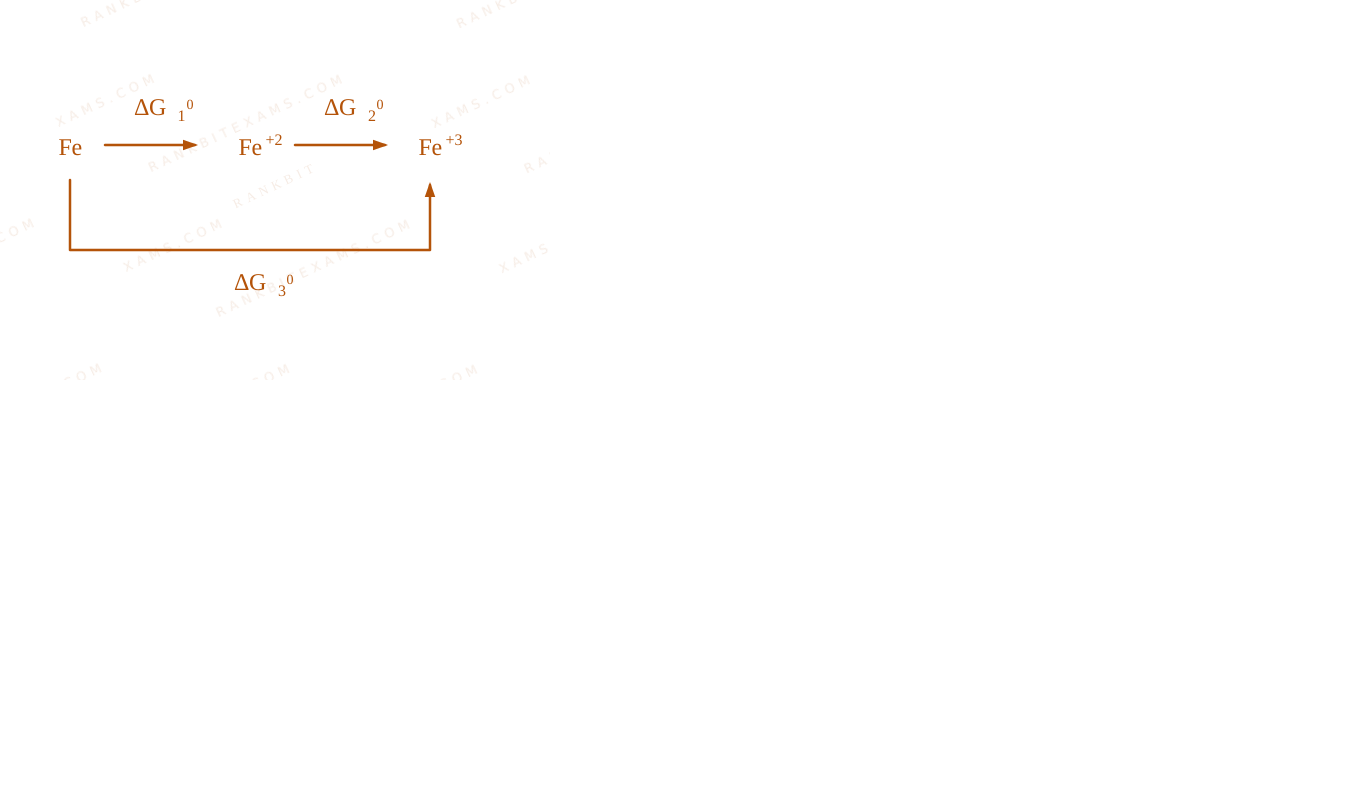
Using Gibbs free energy changes for individual steps to find the target reduction potential:
1. Ag^+ + e^- rightarrow Ag quad Delta G_1^0 = -1Fx$$Ag^{+} + e^{-} \rightarrow Ag \quad \Delta G_1^0 = -1Fx$$
2. Fe^2+ + 2e^- rightarrow Fe quad Delta G_2^0 = -2Fy$$Fe^{2+} + 2e^{-} \rightarrow Fe \quad \Delta G_2^0 = -2Fy$$
3. Fe^3+ + 3e^- rightarrow Fe quad Delta G_3^0 = -3Fz$$Fe^{3+} + 3e^{-} \rightarrow Fe \quad \Delta G_3^0 = -3Fz$$
For the conversion of Fe^2+ rightarrow Fe^3+ + e^-$$Fe^{2+} \rightarrow Fe^{3+} + e^{-}$$, we compute the free energy change as:
Delta G^0 = Delta G_2^0 - Delta G_3^0 = -2Fy - (-3Fz) = 3Fz - 2Fy$$\Delta G^0 = \Delta G_2^0 - \Delta G_3^0 = -2Fy - (-3Fz) = 3Fz - 2Fy$$
Thus, E^0_Fe^2+/Fe^3+ = 2y - 3z$$E^{0}_{Fe^{2+}/Fe^{3+}} = 2y - 3z$$
Combining with silver reduction:
E^0_cell = E^0_Ag^+/Ag + E^0_Fe^2+/Fe^3+ = x + 2y - 3z$$E^{0}_{cell} = E^{0}_{Ag^{+}/Ag} + E^{0}_{Fe^{2+}/Fe^{3+}} = x + 2y - 3z$$
### Step 1: Final Calculation
The overall potential equals x + 2y - 3z$x + 2y - 3z$. Galvanic Cells and Standard Cell Potential diagram for Q26 - JEE Main 2025 Morning
### Pattern Recognition
Direct application of Delta G^0$\Delta G^0$ summation. Remember that standard cell potentials cannot be added directly unless the number of electrons involved is identical.
### Evaluation Rubric / Model Answer
null
### Chapter Mix
Class 12 Chemistry: Electrochemistry
Q48jee_main_2025_28_jan_eveningFaraday's Laws of Electrolysis
Electrolysis of 600mathrm~mL$600\mathrm{~mL}$ aqueous solution of NaCl for 5mathrm\ min$5\mathrm{\ \min}$ changes the mathrmpH$\mathrm{pH}$ of the solution to 12. The current in Amperes used for the given electrolysis is ______ (Nearest integer).
Numerical Answer.Answer: 2 to 2
Solution
### Related Formula
Faraday's law of electrolysis equation:
textMoles of electrons (equivalents) = fracI cdot tF$$\text{Moles of electrons (equivalents)} = \frac{I \cdot t}{F}$$
Water ion product relation:
textpH + textpOH = 14$$\text{pH} + \text{pOH} = 14$$
### Core Logic
During the electrolysis of brine (NaCl(aq)$NaCl(aq)$), hydroxide ions (OH^-$OH^-$) are generated at the cathode:
2H_2O + 2e^- rightarrow H_2 + 2OH^-$$2H_2O + 2e^- \rightarrow H_2 + 2OH^-$$
Given metrics:
- Final textpH = 12 implies textpOH = 14 - 12 = 2$\text{pH} = 12 \implies \text{pOH} = 14 - 12 = 2$
- [OH^-] = 10^-2mathrm\ M$[OH^-] = 10^{-2}\mathrm{\ M}$
- textVolume = 600mathrm\ mL = 0.6mathrm\ L$\text{Volume} = 600\mathrm{\ mL} = 0.6\mathrm{\ L}$
- textTime = 5mathrm\ min = 300mathrm\ s$\text{Time} = 5\mathrm{\ \min} = 300\mathrm{\ s}$
### Step 1: Calculate Moles of Hydroxide Produced
Find the absolute moles of OH^-$OH^-$ ions generated:
textMoles = textMolarity times textVolume (L) = 10^-2 times 0.6 = 6 times 10^-3text moles$$\text{Moles} = \text{Molarity} \times \text{Volume (L)} = 10^{-2} \times 0.6 = 6 \times 10^{-3}\text{ moles}$$
### Step 2: Relate to Electrical Current
Since 1$1$ mole of electrons produces 1$1$ mole of OH^-$OH^-$, the moles of charge equals 6 times 10^-3$6 \times 10^{-3}$. Applying Faraday's equation:
6 times 10^-3 = fracI times 30096500$$6 \times 10^{-3} = \frac{I \times 300}{96500}$$I = frac6 times 10^-3 times 96500300 = 1.93mathrm\ A$$I = \frac{6 \times 10^{-3} \times 96500}{300} = 1.93\mathrm{\ A}$$
Rounding to the nearest integer gives 2$2$.
### Pattern Recognition
Always convert a given textpH$\text{pH}$ value into [OH^-]$[OH^-]$ concentration when dealing with cathodic water reduction. Tracking the relationship where 1\ e^- equiv 1\ OH^-$1\ e^- \equiv 1\ OH^-$ provides a direct shortcut to link textpH$\text{pH}$ changes to current flow.
### Evaluation Rubric / Model Answer
null
### Chapter Mix
Class 12 Chemistry: Electrochemistry
Qjee_main_2025_29_jan_morningStandard Reduction Potential and Oxidising Power
The standard reduction potential values of some of the p-block ions are given below. Predict the one with the strongest oxidising capacity.
### Related Formula
textOxidising Capacity propto textStandard Reduction Potential (E^ominus)$$\text{Oxidising Capacity} \propto \text{Standard Reduction Potential } (E^{\ominus})$$
### Core Logic
A higher positive value of standard reduction potential (E^ominus$E^{\ominus}$) indicates a stronger tendency to undergo reduction, hence behaving as a stronger oxidising agent. Comparing the given values:
* mathrmE_mathrmSn^4+/mathrmSn^2+^ominus = +1.15mathrmV$\mathrm{E}_{\mathrm{Sn}^{4+}/\mathrm{Sn}^{2+}}^{\ominus} = +1.15\mathrm{V}$
* mathrmE_mathrmTl^3+/mathrmTl^ominus = +1.26mathrmV$\mathrm{E}_{\mathrm{T}l^{3+}/\mathrm{T}l}^{\ominus} = +1.26\mathrm{V}$
* mathrmE_mathrmAl^3+/mathrmAl^ominus = -1.66mathrmV$\mathrm{E}_{\mathrm{Al}^{3+}/\mathrm{Al}}^{\ominus} = -1.66\mathrm{V}$
* mathrmE_mathrmPb^4+/mathrmPb^2+^ominus = +1.67mathrmV$\mathrm{E}_{\mathrm{Pb}^{4+}/\mathrm{Pb}^{2+}}^{\ominus} = +1.67\mathrm{V}$
Since +1.67mathrmV$+1.67\mathrm{V}$ is the highest value, mathrmPb^4+$\mathrm{Pb}^{4+}$ possesses the strongest oxidising capacity.
### Pattern Recognition
Strongest oxidising agent = Most positive reduction potential. Weakest oxidising agent = Most negative reduction potential.
### Evaluation Rubric / Model Answer
null
### Chapter Mix
Class 12 Chemistry: Electrochemistry
Class 12 Chemistry: p-Block Elements
Qjee_main_2025_29_jan_morningVariation of Molar Conductivity with Concentration
The molar conductivity of a weak electrolyte when plotted against the square root of its concentration, which of the following is expected to be observed?
A. A small decrease in molar conductivity is observed at infinite dilution.
B. A small increase in molar conductivity is observed at infinite dilution.
C. Molar conductivity increases sharply with increase in concentration.
D. Molar conductivity decreases sharply with increase in concentration.
Solution
### Related Formula
For weak electrolytes, the degree of dissociation alpha$\alpha$ increases sharply near infinite dilution according to Ostwald's Dilution Law:
alpha = sqrtfracK_aC$$\alpha = \sqrt{\frac{K_a}{C}}$$
### Core Logic
When a weak electrolyte is diluted (concentration C rightarrow 0$C \rightarrow 0$), its molar conductivity increases steeply. Conversely, when plotted against sqrtC$\sqrt{C}$, as concentration increases, the degree of dissociation drops rapidly, causing a sharp decrease in molar conductivity. This matches the curve given below:
Variation of Molar Conductivity with Concentration diagram for Q28 - JEE Main 2025 Morning
### Pattern Recognition
Weak electrolyte plots feature a steep asymptotic exponential-like rise towards the y-axis as C rightarrow 0$C \rightarrow 0$, meaning a sharp decrease occurs with increasing concentration.
### Evaluation Rubric / Model Answer
null
### Chapter Mix
Class 12 Chemistry: Electrochemistry
Qjee_main_2025_29_jan_morningNernst Equation
For a mathrmMg mid mathrmMg^2+$\mathrm{Mg} \mid \mathrm{Mg}^{2+}$ (aq) parallel mathrmAg^+(mathrmaq) mid mathrmAg$\parallel \mathrm{Ag}^{+}(\mathrm{aq}) \mid \mathrm{Ag}$ the correct Nernst Equation is :
We Map Every Repeating Question in Competitive Exams.
Say goodbye to generic mock test fatigue. RankBit uses smart analysis to group past exam questions into their foundational Repeating Question Types. Find chapter weightage, track repeating questions, and score higher with targeted practice.
Select Your Target Exam
Choose an exam track below to find formulas per chapter and patterns.
Syncing Exam Intelligence
Mapping formulas and patterns across all tracks…
PATH A — FULL LENGTH PRACTICE
Full Mock Test Hub
Simulate real NTA exam conditions with fully tracked mocks. Time yourself against past papers.
Practice past-year questions one chapter at a time. Pick an exam → subject → chapter and get every PYQ for that topic — pulled together from all past papers — with the chapter's key formulas alongside.
)
