The standard cell potential left(E_mathrmcell^ominusright)$\left(E_{\mathrm{cell}}^{\ominus}\right)$ of a fuel cell based on the oxidation of methanol in air that has been used to power television relay station is measured as 1.21mathrm~V$1.21\mathrm{~V}$. The standard half cell reduction potential for mathrmO_2$\mathrm{O}_2$left(E_mathrmO_2/mathrmH_2mathrmO^circright)$\left(E_{\mathrm{O}_2/\mathrm{H}_2\mathrm{O}}^{\circ}\right)$ is 1.229mathrm~V$1.229\mathrm{~V}$. Choose the correct statement:
A.The standard half cell reduction potential for the reduction of mathrmCO_2$\mathrm{CO}_2$left(E_mathrmCO_2/mathrmCH_3mathrmOH^circright)$\left(E_{\mathrm{CO}_2/\mathrm{CH}_3\mathrm{OH}}^{\circ}\right)$ is 19mathrm~mV$19\mathrm{~mV}$
B.Oxygen is formed at the anode.
C.Reactants are fed at one go to each electrode.
D.Reduction of methanol takes place at the cathode.
Solution & Explanation
### Related Formula
Standard cell EMF is related to standard reduction potentials:
E_mathrmcell^circ = E_mathrmcathode^circ - E_mathrmanode^circ$$E_{\mathrm{cell}}^{\circ} = E_{\mathrm{cathode}}^{\circ} - E_{\mathrm{anode}}^{\circ}$$
### Core Logic
In a methanol-oxygen fuel cell:
- Anode reaction (Oxidation): Methanol is oxidized to carbon dioxide:
mathrmCH_3mathrmOH + mathrmH_2mathrmO rightarrow mathrmCO_2 + 6mathrmH^+ + 6e^-$$\mathrm{CH}_3\mathrm{OH} + \mathrm{H}_2\mathrm{O} \rightarrow \mathrm{CO}_2 + 6\mathrm{H}^+ + 6e^-$$
- Cathode reaction (Reduction): Oxygen is reduced to water:
mathrmO_2 + 4mathrmH^+ + 4e^- rightarrow 2mathrmH_2mathrmO$$\mathrm{O}_2 + 4\mathrm{H}^+ + 4e^- \rightarrow 2\mathrm{H}_2\mathrm{O}$$
Hence, cathode is the oxygen electrode, and anode is the methanol electrode.
### Step 1: Calculate Standard Reduction Potential of Anode
Using the EMF equation:
1.21mathrm~V = 1.229mathrm~V - E_mathrmanode^circ$$1.21\mathrm{~V} = 1.229\mathrm{~V} - E_{\mathrm{anode}}^{\circ}$$E_mathrmanode^circ = 1.229 - 1.21 = 0.019mathrm~V = 19mathrm~mV$$E_{\mathrm{anode}}^{\circ} = 1.229 - 1.21 = 0.019\mathrm{~V} = 19\mathrm{~mV}$$
The standard half-cell reduction potential for the mathrmCO_2/mathrmCH_3mathrmOH$\mathrm{CO}_2/\mathrm{CH}_3\mathrm{OH}$ couple is 19mathrm~mV$19\mathrm{~mV}$, matching Option (1).
### Pattern Recognition
Fuel cells are galvanic cells where reactants (like fuels and oxidants) are fed continuously to the electrodes, not at one go. Oxidation always occurs at the anode (methanol) and reduction at the cathode (oxygen).
### Evaluation Rubric / Model Answer
null
### Chapter Mix
Class 12 Chemistry: Electrochemistry
Keywords:#methanol fuel cell standard cell potential anode reduction#JEE Main 2025 Evening Q34#Electrochemistry fuel cells#reduction potential oxygen electrode
More Electrochemistry Previous-Year Questions — Page 3
Q46jee_main_2025_28_jan_morningMolar Conductivity and Cell Resistance
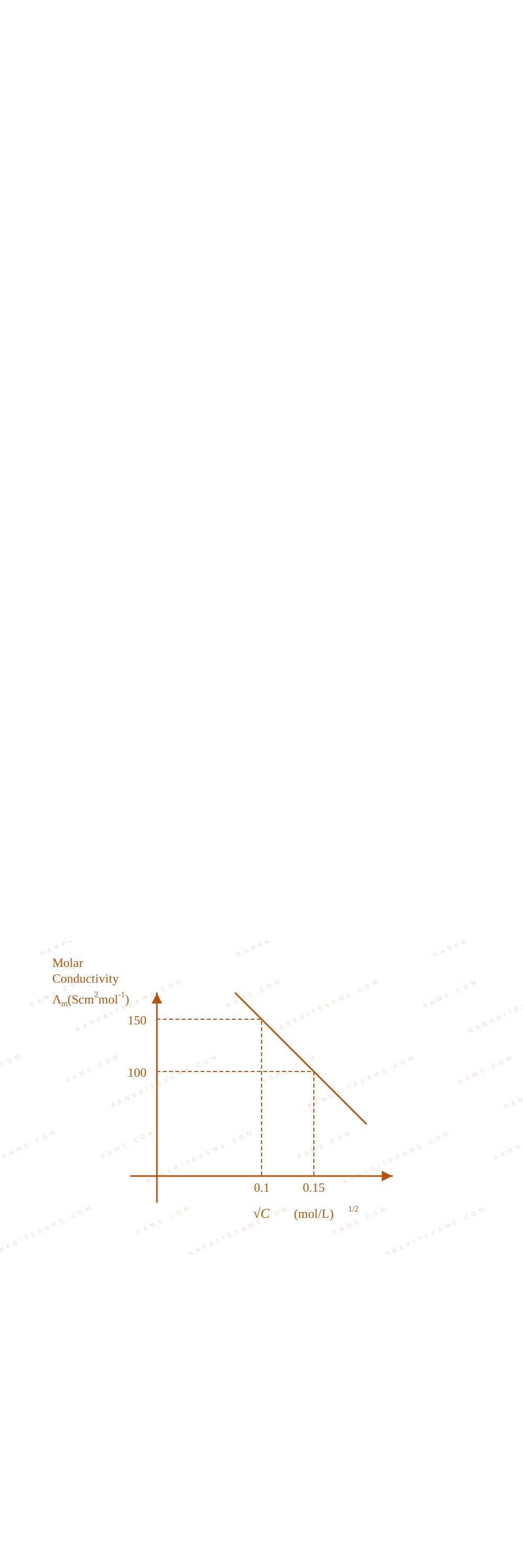
Given below is the plot of the molar conductivity vs sqrttextconcentration$\sqrt{\text{concentration}}$ for KCl in aqueous solution.
The image features a standard linear plot tracing electrolytic molar conductance trends over root concentration variations.
If, for the higher concentration of KCl solution, the resistance of the conductivity cell is 100Omega$100\Omega$ then the resistance of the same cell with the dilute solution is mathrmxOmega$\mathrm{x}\Omega$
The value of mathbfx$\mathbf{x}$ is (Nearest integer)
Numerical Answer.Answer: 150 to 150
Solution
### Related Formula
Conductivity relationship with cell parameters:
kappa = G cdot G^* = fracG^*R$$\kappa = G \cdot G^* = \frac{G^*}{R}$$lambda_m = frackappa times 1000C$$\lambda_m = \frac{\kappa \times 1000}{C}$$
where G^*$G^*$ represents the static cell constant.
### Step 1: Setting Up Ratios
Using concentration subscripts c$c$ (concentrated) and d$d$ (dilute):
frackappa_ckappa_d = fracR_dR_c$$\frac{\kappa_c}{\kappa_d} = \frac{R_d}{R_c}$$
Expressing conductivity through molar conductivity values:
kappa = fraclambda_m cdot C1000$$\kappa = \frac{\lambda_m \cdot C}{1000}$$frac(lambda_m cdot C)_c(lambda_m cdot C)_d = fracR_dR_c$$\frac{(\lambda_m \cdot C)_c}{(\lambda_m \cdot C)_d} = \frac{R_d}{R_c}$$
Substituting the graphical read coordinates (C_c = 0.15^2, C_d = 0.1^2$C_c = 0.15^2, C_d = 0.1^2$ with scaled lambda_m$\lambda_m$ parameters):
frac100 cdot (0.15)^2150 cdot (0.1)^2 = fracR_d100$$\frac{100 \cdot (0.15)^2}{150 \cdot (0.1)^2} = \frac{R_d}{100}$$R_d = 150\,Omega$$R_d = 150\,\Omega$$
### Pattern Recognition
Sees: Resistance correlation across specific graph coordinates.
Shortcut: Equate cell parameters through kappa propto frac1R$\kappa \propto \frac{1}{R}$ and solve for the target resistance directly.
### Evaluation Rubric / Model Answer
null
### Chapter Mix
Class 12 Chemistry: Electrochemistry
### Core Logic
Limiting molar conductivity relies heavily on the charge and hydrodynamic radius of the hydrated ion. Let us verify the standard experimental limiting molar ionic conductivities (lambda^circ$\lambda^{\circ}$) at 298text K$298\text{ K}$:
* H^+: 349.8text S cm^2text mol^-1$H^{+}: 349.8\text{ S cm}^2\text{ mol}^{-1}$ (exhibits Grotthuss proton-hopping conduction mechanism)
* Ca^2+: 119.0text S cm^2text mol^-1$Ca^{2+}: 119.0\text{ S cm}^2\text{ mol}^{-1}$
* Mg^2+: 106.1text S cm^2text mol^-1$Mg^{2+}: 106.1\text{ S cm}^2\text{ mol}^{-1}$
* K^+: 73.5text S cm^2text mol^-1$K^{+}: 73.5\text{ S cm}^2\text{ mol}^{-1}$
* Na^+: 50.1text S cm^2text mol^-1$Na^{+}: 50.1\text{ S cm}^2\text{ mol}^{-1}$
### Step 1: Trend Layout
Arranging these values in descending order yields:
H^+ > Ca^2+ > Mg^2+ > K^+ > Na^+$$H^{+} > Ca^{2+} > Mg^{2+} > K^{+} > Na^{+}$$
### Pattern Recognition
Shortcut: H^+$H^{+}$ always has the absolute highest value due to its unique proton-hopping transport system. For metal ions, a higher ionic charge boosts conductivity (M^2+ > M^+$M^{2+} > M^{+}$), and within a group, a smaller hydrated radius (larger bare ion) increases mobility (K^+ > Na^+$K^{+} > Na^{+}$).
### Evaluation Rubric / Model Answer
null
### Chapter Mix
Class 12 Chemistry: Electrochemistry
Q49jee_main_2025_04_april_eveningConductance of Electrolytic Solutions
The molar conductance of an infinitely dilute solution of ammonium chloride was found to be 185mathrm~S~cm^2mathrmmol^-1$185\mathrm{~S~cm}^2\mathrm{mol}^{-1}$ and the ionic conductance of hydroxyl and chloride ions are 170 and 70mathrm~S~cm^2mathrmmol^-1$70\mathrm{~S~cm}^2\mathrm{mol}^{-1}$ , respectively. If molar conductance of 0.02mathrm~M$0.02\mathrm{~M}$ solution of ammonium hydroxide is 85.5mathrm~S~cm^2mathrmmol^-1$85.5\mathrm{~S~cm}^2\mathrm{mol}^{-1}$ , its degree of dissociation is given by mathbfxtimes 10^-1$\mathbf{x}\times 10^{-1}$ . The value of mathbfx$\mathbf{x}$ is _______. (Nearest integer)
Numerical Answer.Answer: 2.9 to 3.1
Solution
### Related Formula
Lambda_m^circ(NH_4OH) = lambda^circ(NH_4^+) + lambda^circ(OH^-) quad text(Kohlrausch's Law)$$\Lambda_m^\circ(NH_4OH) = \lambda^\circ(NH_4^+) + \lambda^\circ(OH^-) \quad \text{(Kohlrausch's Law)}$$alpha = fracLambda_m^cLambda_m^circ$$\alpha = \frac{\Lambda_m^c}{\Lambda_m^\circ}$$
### Core Logic
1. Find the limiting molar conductance of NH_4^+$NH_4^+$ using the NH_4Cl$NH_4Cl$ data:
Lambda_m^circ(NH_4Cl) = lambda^circ(NH_4^+) + lambda^circ(Cl^-) = 185$$\Lambda_m^\circ(NH_4Cl) = \lambda^\circ(NH_4^+) + \lambda^\circ(Cl^-) = 185$$lambda^circ(NH_4^+) = 185 - 70 = 115 mathrm~S cdot cm^2 cdot mol^-1$$\lambda^\circ(NH_4^+) = 185 - 70 = 115 \mathrm{~S \cdot cm^2 \cdot mol^{-1}}$$
2. Calculate Lambda_m^circ$\Lambda_m^\circ$ for the weak electrolyte ammonium hydroxide (NH_4OH$NH_4OH$):
Lambda_m^circ(NH_4OH) = 115 + 170 = 285 mathrm~S cdot cm^2 cdot mol^-1$$\Lambda_m^\circ(NH_4OH) = 115 + 170 = 285 \mathrm{~S \cdot cm^2 \cdot mol^{-1}}$$
3. Evaluate the degree of dissociation (alpha$\alpha$):
alpha = frac85.5285 = 0.3 = 3 times 10^-1$$\alpha = \frac{85.5}{285} = 0.3 = 3 \times 10^{-1}$$
Comparing with the format mathbfx times 10^-1$\mathbf{x} \times 10^{-1}$, the value of mathbfx$\mathbf{x}$ is **3**.
### Pattern Recognition
Kohlrausch's law allows direct algebraic recombination of ion conductances. Always construct the targeted weak base compound value by filtering out the spectator chloride contribution from the initial salt parameters.
### Evaluation Rubric / Model Answer
null
### Chapter Mix
Class 12 Chemistry: Electrochemistry
Q36jee_main_2025_04_april_morningBatteries and Fuel Cells
On charging the lead storage battery, the oxidation state of lead changes from x_1$x_1$ to y_1$y_1$ at the anode and from x_2$x_2$ to y_2$y_2$ at the cathode. The values of x_1, y_1, x_2, y_2$x_1, y_1, x_2, y_2$ are respectively:
A.+4, +2, 0, +2$+4, +2, 0, +2$
B.+2, 0, +2, +4$+2, 0, +2, +4$
C.0, +2, +4, +2$0, +2, +4, +2$
D.+2, 0, 0, +4$+2, 0, 0, +4$
Solution
### Related Formula
textNet Charging Reaction: 2PbSO_4(s) + 2H_2O(l) rightarrow Pb(s) + PbO_2(s) + 2H_2SO_4(aq)$$\text{Net Charging Reaction: } 2PbSO_4(s) + 2H_2O(l) \rightarrow Pb(s) + PbO_2(s) + 2H_2SO_4(aq)$$
### Core Logic
During the **charging** cycle, the discharge chemical reactions are driven in reverse:
* **At Anode:** Lead sulfate (PbSO_4$PbSO_4$, where Lead is +2$+2$) is reduced back to metallic lead (Pb$Pb$, oxidation state 0$0$):
x_1 = +2 rightarrow y_1 = 0$$x_1 = +2 \rightarrow y_1 = 0$$
* **At Cathode:** Lead sulfate (PbSO_4$PbSO_4$, where Lead is +2$+2$) is oxidized back into lead dioxide (PbO_2$PbO_2$, where Lead is +4$+4$):
x_2 = +2 rightarrow y_2 = +4$$x_2 = +2 \rightarrow y_2 = +4$$
Thus, the values are +2, 0, +2, +4$+2, 0, +2, +4$.
### Pattern Recognition
Be careful with wording! Discharging consumes Pb$Pb$ and PbO_2$PbO_2$ to create PbSO_4$PbSO_4$. **Charging** does the exact opposite, converting PbSO_4$PbSO_4$ (+2$+2$) back into its parent elements (0$0$ and +4$+4$).
### Evaluation Rubric / Model Answer
null
### Chapter Mix
Class 12 Chemistry: Electrochemistry
Q45jee_main_2025_07_april_eveningElectrolysis and Discharge Potential
Given below are two statements:
1text M$1\text{ M}$ aqueous solution of each of textCu(NO_3)_2$\text{Cu(NO}_3)_2$, textAgNO_3$\text{AgNO}_3$, textHg_2(textNO_3)_2$\text{Hg}_2(\text{NO}_3)_2$; textMg(NO_3)_2$\text{Mg(NO}_3)_2$ are electrolysed using inert electrodes,
Given: E_textAg^+/textAg^theta = 0.80textV$E_{\text{Ag}^{+}/\text{Ag}}^{\theta} = 0.80\text{V}$ , E_textHg_2^2+/textHg^theta = 0.79textV$E_{\text{Hg}_2^{2+}/\text{Hg}}^{\theta} = 0.79\text{V}$, E_textCu^2+/textCu^theta = 0.24textV$E_{\text{Cu}^{2+}/\text{Cu}}^{\theta} = 0.24\text{V}$ and E_textMg^2+/textMg^theta = -2.37textV$E_{\text{Mg}^{2+}/\text{Mg}}^{\theta} = -2.37\text{V}$
Statement (I): With increasing voltage, the sequence of deposition of metals on the cathode will be textAg$\text{Ag}$, textHg$\text{Hg}$ and textCu$\text{Cu}$
Statement (II): Magnesium will not be deposited at cathode instead oxygen gas will be evolved at the cathode.
In the light of the above statement, choose the most appropriate answer from the options given below [cite: 426, 427]
A.textBoth statement I and statement II are incorrect$\text{Both statement I and statement II are incorrect}$
B.textStatement I is correct but statement II is incorrect$\text{Statement I is correct but statement II is incorrect}$
C.textBoth statement I and statement II are correct$\text{Both statement I and statement II are correct}$
D.textStatement I is incorrect but statement II is correct$\text{Statement I is incorrect but statement II is correct}$
Solution
### Related Formula
textEase of discharge at Cathode propto textStandard Reduction Potential (E^0)$$\text{Ease of discharge at Cathode} \propto \text{Standard Reduction Potential } (E^0)$$
### Core Logic
- At the cathode, the metal ion with the highest standard reduction potential (E^0$E^0$) gets reduced and deposited first. Arranging the given potentials:
E^0_textAg^+/textAg (0.80textV) > E^0_textHg_2^2+/textHg (0.79textV) > E^0_textCu^2+/textCu (0.24textV) $$E^0_{\text{Ag}^+/\text{Ag}} (0.80\text{V}) > E^0_{\text{Hg}_2^{2+}/\text{Hg}} (0.79\text{V}) > E^0_{\text{Cu}^{2+}/\text{Cu}} (0.24\text{V}) $$
Thus, deposition follows the order textAg
ightarrow textHg
ightarrow textCu$\text{Ag}
ightarrow \text{Hg}
ightarrow \text{Cu}$ as voltage is steadily increased, confirming Statement I.
- For textMg^2+$\text{Mg}^{2+}$, its reduction potential is highly negative (-2.37text V$-2.37\text{ V}$), much lower than that of water (-0.83text V$-0.83\text{ V}$). Consequently, water undergoes reduction at the cathode instead of magnesium:
2textH_2textO + 2e^-
ightarrow textH_2(g) + 2textOH^- $$2\text{H}_2\text{O} + 2e^-
ightarrow \text{H}_2(g) + 2\text{OH}^- $$
This results in the evolution of **Hydrogen gas** at the cathode, not oxygen gas. Oxygen gas is evolved at the *anode* via water oxidation. Thus, Statement II is incorrect. [cite: 1042, 1044]
### Step 1: Conclusion Match
Since Statement I is correct and Statement II is incorrect, we select option (2).
### Pattern Recognition
Cathode vs Anode Gas Trap: During the aqueous electrolysis of highly reactive metals (Groups 1, 2, and textAl$\text{Al}$), textH_2$\text{H}_2$ gas is always discharged at the cathode due to water's easier reduction profile. Oxygen gas (textO_2$\text{O}_2$) is an anodic product generated by water oxidation.
### Evaluation Rubric / Model Answer
null
### Chapter Mix
Class 12 Chemistry: Electrochemistry
More Electrochemistry Questions — jee_main_2025_03_april_evening
We Map Every Repeating Question in Competitive Exams.
Say goodbye to generic mock test fatigue. RankBit uses smart analysis to group past exam questions into their foundational Repeating Question Types. Find chapter weightage, track repeating questions, and score higher with targeted practice.
Select Your Target Exam
Choose an exam track below to find formulas per chapter and patterns.
Syncing Exam Intelligence
Mapping formulas and patterns across all tracks…
PATH A — FULL LENGTH PRACTICE
Full Mock Test Hub
Simulate real NTA exam conditions with fully tracked mocks. Time yourself against past papers.
Practice past-year questions one chapter at a time. Pick an exam → subject → chapter and get every PYQ for that topic — pulled together from all past papers — with the chapter's key formulas alongside.