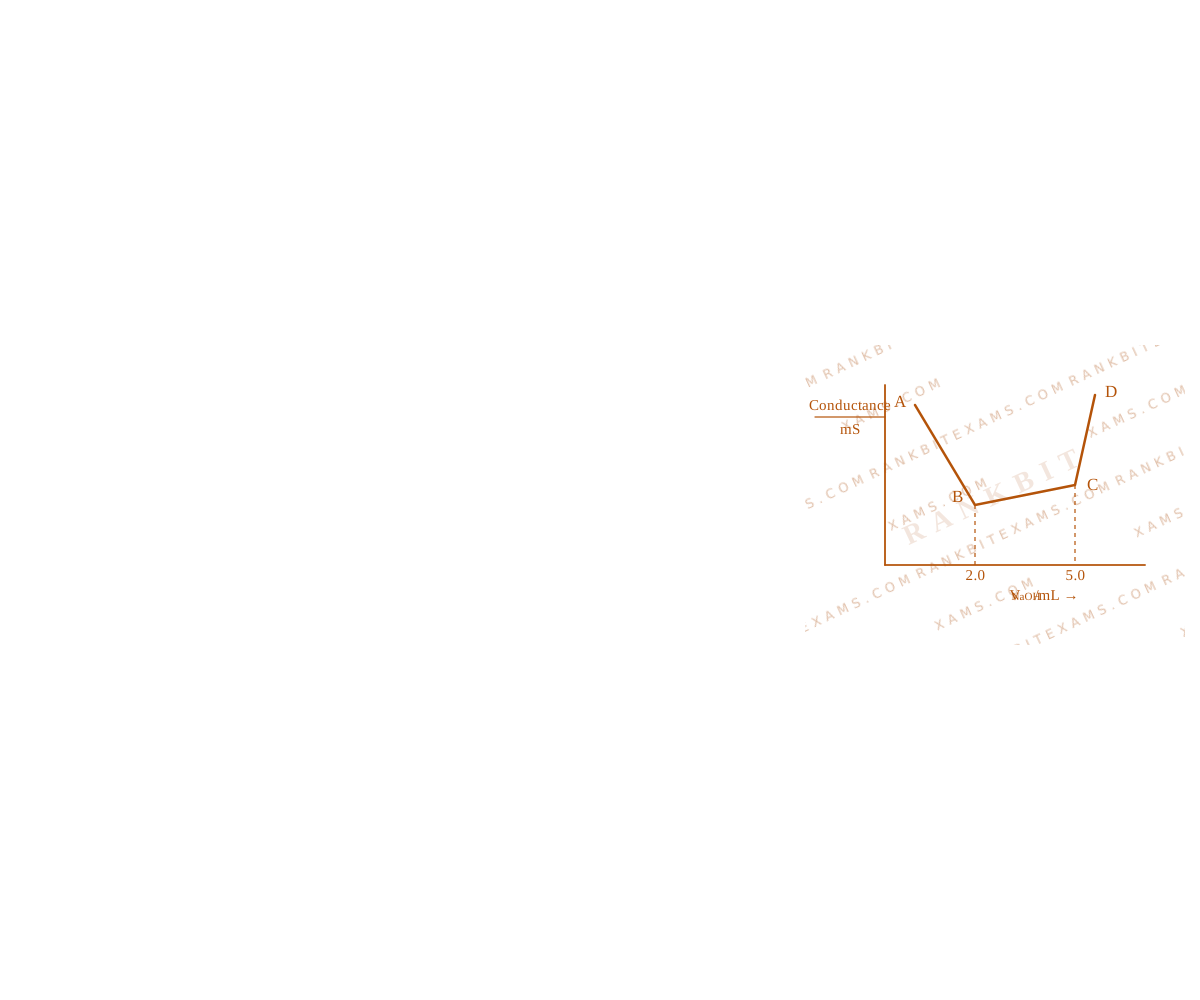
40mathrm~mL of a mixture of mathrmCH_3mathrmCOOH and mathrmHCl (aqueous solution) is titrated against 0.1mathrm~M~NaOH solution conductometrically. Which of the following statements is correct?
Conductometric titration curve for Q26 - JEE Main 2025 Evening
Conductance vs Volume of NaOH added curve showing two equivalence points at 2.0 mL and 5.0 mL.

Solution & Explanation

### Related Formula At the equivalence point during titration: M_textacid V_textacid = M_textbase V_textbase ### Core Logic In a mixture of a strong acid (mathrmHCl) and a weak acid (mathrmCH_3mathrmCOOH): 1. mathrmHCl is a strong acid and is completely ionized. When mathrmNaOH is added, highly mobile mathrmH^+ ions are replaced by less mobile mathrmNa^+ ions, causing a sharp drop in conductance (segment AB). 2. At point B (2.0mathrm~mL), mathrmHCl is completely neutralized. 3. Segment BC represents the neutralization of the weak acid mathrmCH_3mathrmCOOH to form highly conducting sodium acetate, causing a moderate rise in conductance up to point C (5.0mathrm~mL). 4. Beyond point C, excess mathrmOH^- ions cause a rapid rise in conductance (segment CD). ### Step 1: Calculate concentration of mathrmHCl Volume of mathrmNaOH used to neutralize mathrmHCl is V_1 = 2.0mathrm~mL: M_mathrmHCl times 40mathrm~mL = 0.1mathrm~M times 2.0mathrm~mL M_mathrmHCl = frac0.240 = 0.005mathrm~M ### Step 2: Calculate concentration of mathrmCH_3mathrmCOOH Volume of mathrmNaOH used to neutralize mathrmCH_3mathrmCOOH is V_2 = 5.0mathrm~mL - 2.0mathrm~mL = 3.0mathrm~mL: M_mathrmCH_3mathrmCOOH times 40mathrm~mL = 0.1mathrm~M times 3.0mathrm~mL M_mathrmCH_3mathrmCOOH = frac0.340 = 0.0075mathrm~M ### Pattern Recognition Conductometric titration curves are analyzed sequentially: the strongest electrolyte is always neutralized first. A steep drop in conductance always signals the neutralization of a strong acid (mathrmH^+ depletion). A weak acid titration shows a gentle upward slope due to salt formation. ### Evaluation Rubric / Model Answer null ### Chapter Mix Class 12 Chemistry: Electrochemistry Class 11 Chemistry: Equilibrium

Reference Study Guides

More Electrochemistry Previous-Year Questions — Page 6

Q65 jee_main_2024_31_jan_morning Batteries
The metals that are employed in the battery industries are A. Fe B. Mn C. Ni D. Cr E. Cd Choose the correct answer from the options given below:
  • A. textB, C and E only
  • B. textA, B, C, D and E
  • C. textA, B, C and D only
  • D. textB, D and E only

Solution

### Core Logic Mn, Ni, and Cd metals are predominantly used in battery industries. - Mn is used in dry cells (Leclanche cell). - Ni and Cd are used in Nickel-Cadmium (Ni-Cd) rechargeable batteries. ### Evaluation Rubric / Model Answer null ### Chapter Mix Class 12 Chemistry: Electrochemistry

Q67 jee_main_2024_31_jan_morning Electrolytic Conductance
Identify the factor from the following that does not affect electrolytic conductance of a solution.
  • A. textThe nature of the electrolyte added.
  • B. textThe nature of the electrode used.
  • C. textConcentration of the electrolyte.
  • D. textThe nature of solvent used.

Solution

### Core Logic Conductivity of an electrolytic cell is affected by the concentration of the electrolyte, the nature of the electrolyte, and the nature of the solvent. It does not depend on the nature of the electrode used. ### Evaluation Rubric / Model Answer null ### Chapter Mix Class 12 Chemistry: Electrochemistry
Q90 jee_main_2024_31_jan_morning Faraday's Laws of Electrolysis
One Faraday of electricity liberates x times 10^-1 gram atom of copper from copper sulphate, x is
Numerical Answer. Answer: 5 to 5

Solution

### Core Logic The reduction reaction for copper is: Cu^2+ + 2e^- rightarrow Cu This shows that 2 moles of electrons (2 Faraday) are required to deposit 1 mole (or 1 gram atom) of Cu. Therefore, 1 Faraday of electricity will deposit: frac12 = 0.5 text moles of Cu ### Step 1: Finding x 0.5 text mole = 0.5 text gram atom = 5 times 10^-1 text gram atom Hence, x = 5. ### Evaluation Rubric / Model Answer null ### Chapter Mix Class 12 Chemistry: Electrochemistry

More Electrochemistry Questions — jee_main_2025_03_april_evening

Practice all Electrochemistry previous-year questions →

Rankbit System
JEE Physics: Waves (+15.5%) | Electrostatics: Concentric Shells (-29.7%) | Modern Physics: Photoelectric Clones (+34.2%) | Mathematics: Definite Integrals (+18.1%) | Chemistry: Coordination Splitting (-11.4%) | JEE Physics: Waves (+15.5%) | Electrostatics: Concentric Shells (-29.7%) | Modern Physics: Photoelectric Clones (+34.2%) | Mathematics: Definite Integrals (+18.1%) | Chemistry: Coordination Splitting (-11.4%)