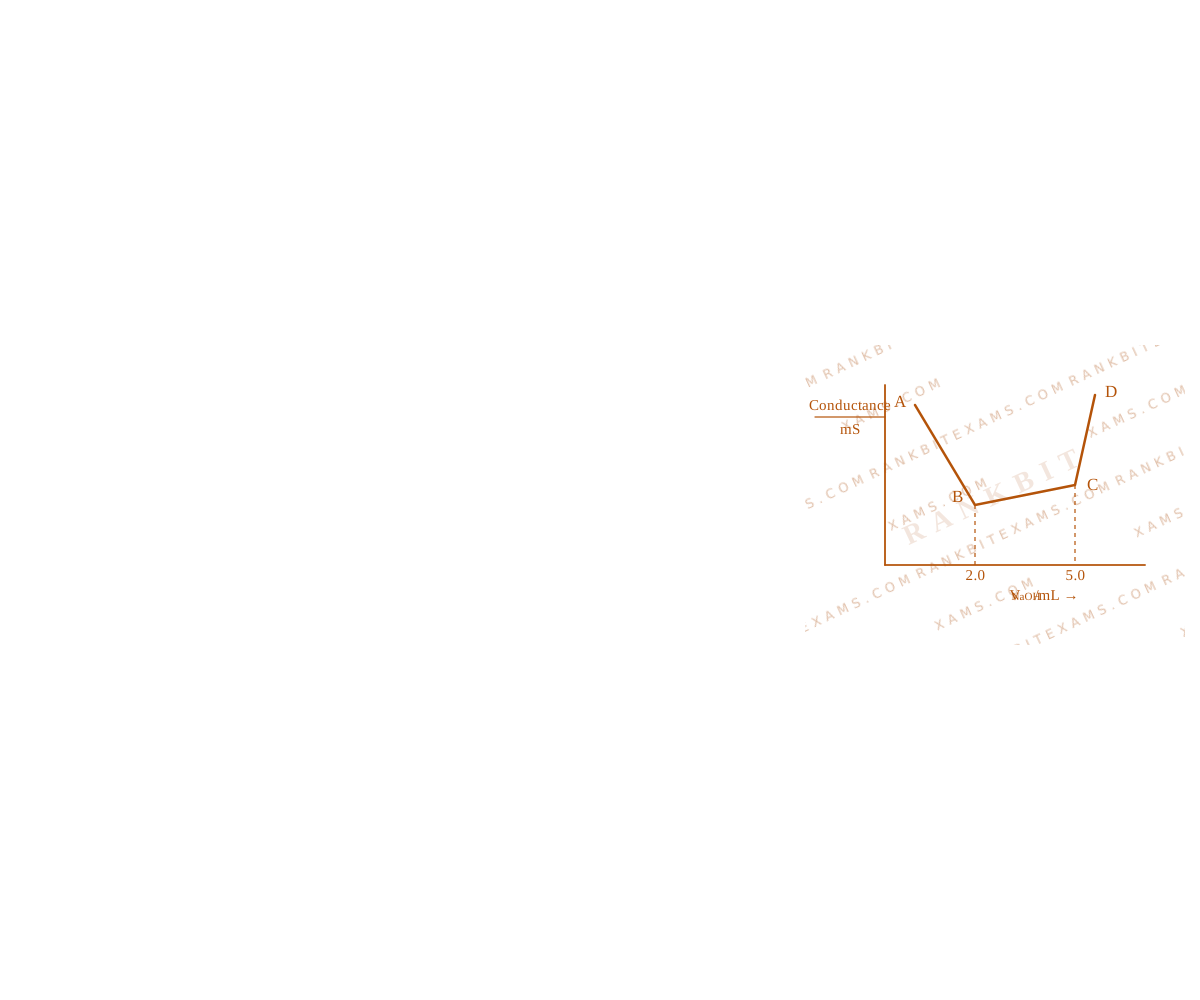
40mathrm~mL of a mixture of mathrmCH_3mathrmCOOH and mathrmHCl (aqueous solution) is titrated against 0.1mathrm~M~NaOH solution conductometrically. Which of the following statements is correct?
Conductometric titration curve for Q26 - JEE Main 2025 Evening
Conductance vs Volume of NaOH added curve showing two equivalence points at 2.0 mL and 5.0 mL.

Solution & Explanation

### Related Formula At the equivalence point during titration: M_textacid V_textacid = M_textbase V_textbase ### Core Logic In a mixture of a strong acid (mathrmHCl) and a weak acid (mathrmCH_3mathrmCOOH): 1. mathrmHCl is a strong acid and is completely ionized. When mathrmNaOH is added, highly mobile mathrmH^+ ions are replaced by less mobile mathrmNa^+ ions, causing a sharp drop in conductance (segment AB). 2. At point B (2.0mathrm~mL), mathrmHCl is completely neutralized. 3. Segment BC represents the neutralization of the weak acid mathrmCH_3mathrmCOOH to form highly conducting sodium acetate, causing a moderate rise in conductance up to point C (5.0mathrm~mL). 4. Beyond point C, excess mathrmOH^- ions cause a rapid rise in conductance (segment CD). ### Step 1: Calculate concentration of mathrmHCl Volume of mathrmNaOH used to neutralize mathrmHCl is V_1 = 2.0mathrm~mL: M_mathrmHCl times 40mathrm~mL = 0.1mathrm~M times 2.0mathrm~mL M_mathrmHCl = frac0.240 = 0.005mathrm~M ### Step 2: Calculate concentration of mathrmCH_3mathrmCOOH Volume of mathrmNaOH used to neutralize mathrmCH_3mathrmCOOH is V_2 = 5.0mathrm~mL - 2.0mathrm~mL = 3.0mathrm~mL: M_mathrmCH_3mathrmCOOH times 40mathrm~mL = 0.1mathrm~M times 3.0mathrm~mL M_mathrmCH_3mathrmCOOH = frac0.340 = 0.0075mathrm~M ### Pattern Recognition Conductometric titration curves are analyzed sequentially: the strongest electrolyte is always neutralized first. A steep drop in conductance always signals the neutralization of a strong acid (mathrmH^+ depletion). A weak acid titration shows a gentle upward slope due to salt formation. ### Evaluation Rubric / Model Answer null ### Chapter Mix Class 12 Chemistry: Electrochemistry Class 11 Chemistry: Equilibrium

Reference Study Guides

More Electrochemistry Previous-Year Questions — Page 5

Q82 jee_main_2024_01_february_morning Nernst Equation
The potential for the given half cell at 298K is (-)dotsdotsdotsdots times 10^-2 mathrm~V. 2mathrmH^+_text(aq) + 2e^- rightarrow mathrmH_2mathrm(g) [mathrmH^+] = 1 mathrmM, P_mathrmH_2 = 2 mathrm~atm Given: 2.303mathrmRT/F = 0.06mathrmV, log 2 = 0.3
Numerical Answer. Answer: 0.9 to 1

Solution

### Related Formula E = E^circ - frac2.303RTnF log Q For the Standard Hydrogen Electrode half-reaction: 2H^+ + 2e^- rightarrow H_2 E_H^+/H_2 = E^circ_H^+/H_2 - frac0.062 log fracP_H_2[H^+]^2 ### Step 1: Substitute the given values E^circ_H^+/H_2 = 0.00 mathrm~V (by definition) [H^+] = 1 mathrm~M P_H_2 = 2 mathrm~atm n = 2 electrons E = 0.00 - frac0.062 log left( frac21^2 right) ### Step 2: Solve the calculation E = -0.03 log 2 Given log 2 = 0.3 E = -0.03 times 0.3 E = -0.009 mathrm~V E = -0.9 times 10^-2 mathrm~V ### Step 3: Match the requested format The question asks for (-) dots times 10^-2 mathrm~V. This gives exactly 0.9. For NAT type with integer expected, 0.9 can be rounded to 1. However, exact calculation yields 0.9. According to official JEE rounding, 0.9 approx 1. ### Pattern Recognition Hydrogen electrode non-standard potential depends strictly on pressure of H_2 and concentration of H^+. If [H^+]=1, increasing H_2 pressure lowers the potential below zero (makes it negative). ### Evaluation Rubric / Model Answer null ### Chapter Mix Class 12 Chemistry: Electrochemistry

Q89 jee_main_2024_29_january_evening Faraday's Laws of Electrolysis
A constant current was passed through a solution of mathrmAuCl_4^- ion between gold electrodes. After a period of 10.0 minutes, the increase in mass of cathode was 1.314mathrmg. The total charge passed through the solution is ________ times 10^-2mathrmF. (Given atomic mass of mathrmAu = 197)
Numerical Answer. Answer: 2 to 2

Solution

### Related Formula textNumber of equivalents deposited = fracW, E = fracQ, F textEquivalent Weight (E) = fractextAtomic Mass, ntext-factor ### Core Logic In the reduction of gold from the tetrachloroaurate(III) complex anion: mathrmAuCl_4^- + 3e^- rightarrow mathrmAu(s) + 4mathrmCl^- implies ntext-factor = 3 Calculate the equivalent weight (E) of Gold: E = frac197, 3 Set up the Faraday equivalence relation to solve for charge (Q in Faradays): frac1.314, left(frac197, 3right) = Q ### Step 1: Arithmetic Resolution Q = frac1.314 times 3, 197 = frac3.942, 197 = 0.02text F = 2 times 10^-2text F Thus, the required integer value is **2**. ### Pattern Recognition Always determine the correct change in oxidation state (+3 to 0) to establish the proper n-factor value for calculations using Faraday's laws. ### Evaluation Rubric / Model Answer null ### Chapter Mix Class 12 Chemistry: Electrochemistry
Q81 jee_main_2024_27_jan_morning Faraday's Laws of Electrolysis
The mass of silver (Molar mass of textAg: 108text g mol^-1) displaced by a quantity of electricity which displaces 5600text mL of O_2 at S.T.P. will be textquadquad g.
Numerical Answer. Answer: 107 to 108

Solution

### Related Formula By Faraday's Second Law of Electrolysis: textEquivalents of Ag = textEquivalents of O_2 textEquivalents = fractextMasstextEquivalent Mass = textMoles times ntext-factor ### Step 1: Calculate equivalents using standard metrics Let x grams of Silver be displaced. Using the older STP molar volume baseline (22.4text L or 22400text mL): textMoles of O_2 = frac560022400 = 0.25text moles Since the n-factor of O_2 is 4 (2textO^2- rightarrow textO_2 + 4texte^-): textEquivalents of O_2 = 0.25 times 4 = 1 ### Step 2: Equating equivalents for silver mass textEquivalents of Ag = fracx108 times 1 = 1 implies x = 108text g ### Step 3: Alternative calculation using current STP metric Using modern STP volume metrics (22.7text L): fracx times 1108 = frac5.622.7 times 4 implies x approx 106.57text g rightarrow 107text g ### Pattern Recognition Equivalents equations bypass complex current/time measurements. Always link volume fractions directly to n-factor equivalents. ### Chapter Mix Class 12 Chemistry: Electrochemistry Class 11 Chemistry: Some Basic Concepts of Chemistry
Q82 jee_main_2024_29_jan_morning Faradays Laws of Electrolysis
The mass of zinc produced by the electrolysis of zinc sulphate solution with a steady current of 0.015 A for 15 minutes is \_\_\_\_\_\_ times 10^-4 g. (Atomic mass of zinc = 65.4 amu)
Numerical Answer. Answer: 45.75 to 46

Solution

### Related Formula W = Z cdot I cdot t = fracMn cdot F cdot I cdot t where, W = mass deposited Z = electrochemical equivalent I = current in amperes t = time in seconds M = molar mass n = n-factor (electrons exchanged) F = Faraday's constant (96500 text C/mol) ### Core Logic The electrolysis of zinc sulphate (ZnSO_4) involves the reduction of zinc ions at the cathode: Zn^+2 + 2e^- rightarrow Zn Here, the n-factor (n) is 2. ### Step 1: Calculation Given values: I = 0.015text A t = 15text minutes = 15 times 60text seconds = 900text s M = 65.4text g/mol F approx 96500text C Plugging the values into Faraday's First Law: W = frac65.42 times 96500 times 0.015 times 15 times 60 W = frac65.4193000 times 13.5 W = 3.3886 times 10^-4 times 13.5 W = 45.746 times 10^-4text g Rounding to two decimal places (or nearest integer depending on convention), we get 45.75 times 10^-4text g. ### Evaluation Rubric / Model Answer null ### Chapter Mix Class 12 Chemistry: Electrochemistry
Q80 jee_main_2024_30_january_evening Standard Electrode Potential
Reduction potential of ions are given below: mathrmClO_4^- quad E^circ = 1.19mathrmV mathrmIO_4^- quad E^circ = 1.65mathrmV mathrmBrO_4^- quad E^circ = 1.74mathrmV The correct order of their oxidising power is:
  • A. mathrmClO_4^- > mathrmIO_4^- > mathrmBrO_4^-
  • B. mathrmBrO_4^- > mathrmIO_4^- > mathrmClO_4^-
  • C. mathrmBrO_4^- > mathrmClO_4^- > mathrmIO_4^-
  • D. mathrmIO_4^- > mathrmBrO_4^- > mathrmClO_4^-

Solution

### Core Logic The Standard Reduction Potential (E^circ) measures a species' tendency to undergo reduction (gain electrons). A higher, more positive E^circ value means the species has a stronger tendency to be reduced, which in turn makes it a stronger oxidizing agent. Comparing the given E^circ values: mathrmBrO_4^-: 1.74mathrmV mathrmIO_4^-: 1.65mathrmV mathrmClO_4^-: 1.19mathrmV The order of oxidizing power follows the magnitude of the reduction potential: mathrmBrO_4^- > mathrmIO_4^- > mathrmClO_4^- ### Pattern Recognition Higher +ve Standard Reduction Potential (SRP) = Stronger Oxidising Agent. ### Evaluation Rubric / Model Answer null ### Chapter Mix Class 12 Chemistry: Electrochemistry Class 12 Chemistry: The p Block Elements

More Electrochemistry Questions — jee_main_2025_03_april_evening

Practice all Electrochemistry previous-year questions →

Rankbit System
JEE Physics: Waves (+15.5%) | Electrostatics: Concentric Shells (-29.7%) | Modern Physics: Photoelectric Clones (+34.2%) | Mathematics: Definite Integrals (+18.1%) | Chemistry: Coordination Splitting (-11.4%) | JEE Physics: Waves (+15.5%) | Electrostatics: Concentric Shells (-29.7%) | Modern Physics: Photoelectric Clones (+34.2%) | Mathematics: Definite Integrals (+18.1%) | Chemistry: Coordination Splitting (-11.4%)