Consider the following statements related to temperature dependence of rate constants. Identify the correct statements, A. The Arrhenius equation holds true only for an elementary homogenous reaction. B. The unit of A is same as that of k in Arrhenius equation. C. At a given temperature, a low activation energy means a fast reaction. D. A and Ea as used in Arrhenius equation depend on temperature. E. When Ea >> RT, A and Ea become interdependent. Choose the correct answer from the options given below:

Solution & Explanation

### Related Formula Arrhenius equation is given by: k = A e^-fracE_aR T where: - k is the rate constant - A is the pre-exponential factor (frequency factor) - E_a is the activation energy ### Core Logic Evaluate each statement: - **A**: Arrhenius equation is an empirical relation that works well for both elementary and complex homogeneous reactions rightarrow *Incorrect*. - **B**: Since the exponential term e^-E_a/RT is dimensionless, the pre-exponential factor A has the exact same unit as the rate constant k rightarrow *Correct*. - **C**: For low E_a, the term e^-E_a/RT is large, giving a high rate constant k and a fast reaction rightarrow *Correct*. - **D**: A and E_a are assumed to be independent of temperature over a narrow range rightarrow *Incorrect*. - **E**: A and E_a remain independent parameters of the system, not interdependent rightarrow *Incorrect*. ### Step 1: Select correct statements Statements B and C are correct, matching Option (3). ### Pattern Recognition The exponential factor e^-E_a/RT represents the fraction of collisions with energy greater than the activation barrier. As E_a decreases, this fraction grows exponentially, explaining why low-activation pathways (like catalyzed reactions) run much faster. ### Evaluation Rubric / Model Answer null ### Chapter Mix Class 12 Chemistry: Chemical Kinetics

Reference Study Guides

More Chemical Kinetics Previous-Year Questions — Page 4

Q29 jee_main_2025_07_april_evening First Order Reactions
textA(g) ightarrow textB(g) + textC(g) is a first order reaction.
Timetinfty
P_textsystemP_t P_infty
The reaction was started with reactant textA only. Which of the following expression is correct for rate constant k?
  • A. k = frac1t ln frac2(P_infty - P_t)P_t
  • B. k = frac1t ln fracP_inftyP_t
  • C. k = frac1t ln fracP_infty2(P_infty - P_t)
  • D. k = frac1t ln fracP_infty(P_infty - P_t)

Solution

### Related Formula k = frac1t ln fracP_0P_0 - x where P_0 is the initial pressure of reactant textA, and x is the change in pressure at time t. ### Core Logic Let's establish the ice table for total pressure calculation: beginarrayrccc & textA(g) & ightarrow & textB(g) & + & textC(g) \ textAt t=0: & P_0 & & 0 & & 0 \ textAt t=t: & P_0 - x & & x & & x \ textAt t=infty: & 0 & & P_0 & & P_0 endarray From the data given at t = infty: P_infty = P_0 + P_0 = 2P_0 implies P_0 = fracP_infty2 From the data given at time t: P_t = (P_0 - x) + x + x = P_0 + x x = P_t - P_0 = P_t - fracP_infty2 ### Step 1: Algebraic Substitution Now, compute the amount of reactant remaining at time t: P_0 - x = fracP_infty2 - left(P_t - fracP_infty2 ight) = P_infty - P_t Substitute P_0 and (P_0 - x) back into the primary kinetic expression: k = frac1t ln fracfracP_infty2P_infty - P_t = frac1t ln fracP_infty2(P_infty - P_t) ### Pattern Recognition For a standard gaseous decomposition textA ightarrow ntextB + mtextC, tracking the infinite pressure P_infty offers a clean mapping to initial reactant amounts. Since 1 mole of gas generates 2 moles of product gas here, P_0 is exactly half of P_infty. ### Evaluation Rubric / Model Answer null ### Chapter Mix Class 12 Chemistry: Chemical Kinetics
Q27 jee_main_2025_24_jan_evening Integrated Rate Equations
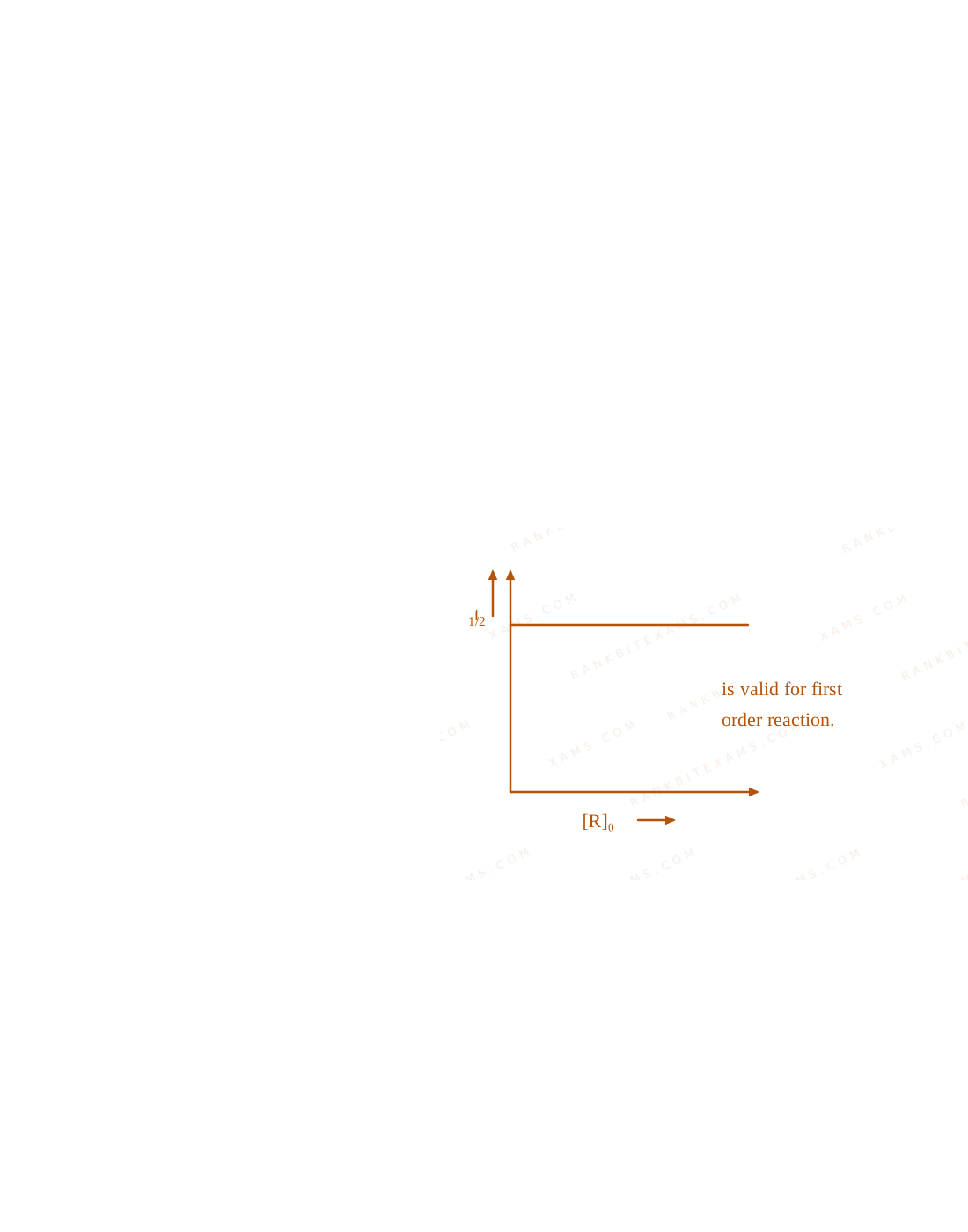
Given below are two statements : Statement (I) :
Integrated Rate Equations diagram for Q27 - JEE Main 2025 Evening
The first statement includes a plot of half life versus initial concentration, while the second shows log ratio versus time.
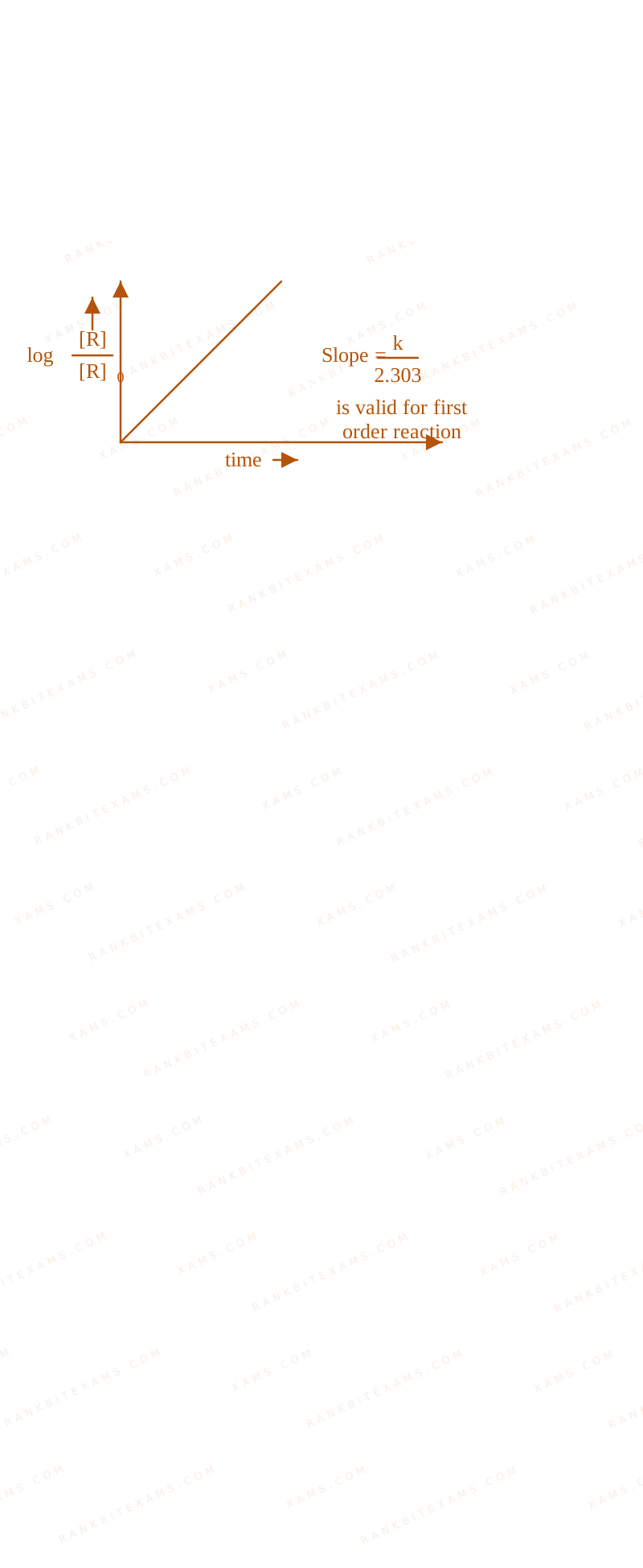
is valid for first order reaction. Statement (II):
Integrated Rate Equations diagram for Q27 - JEE Main 2025 Evening
The first statement includes a plot of half life versus initial concentration, while the second shows log ratio versus time.
is valid for first order reaction. In the light of the above statements, choose the correct answer from the options given below :
  • A. textBoth Statement I and Statement II are false
  • B. textStatement I is false but Statement II is true
  • C. textBoth Statement I and Statement II are true
  • D. textStatement I is true but Statement II is false

Solution

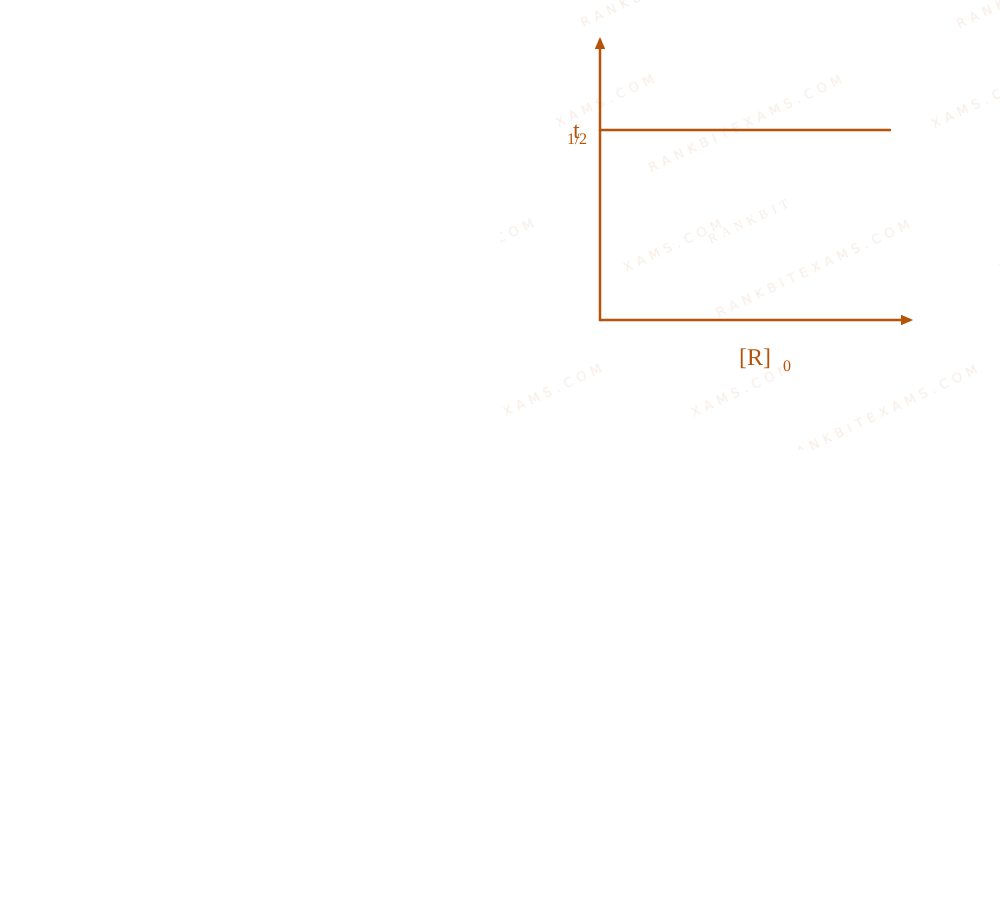
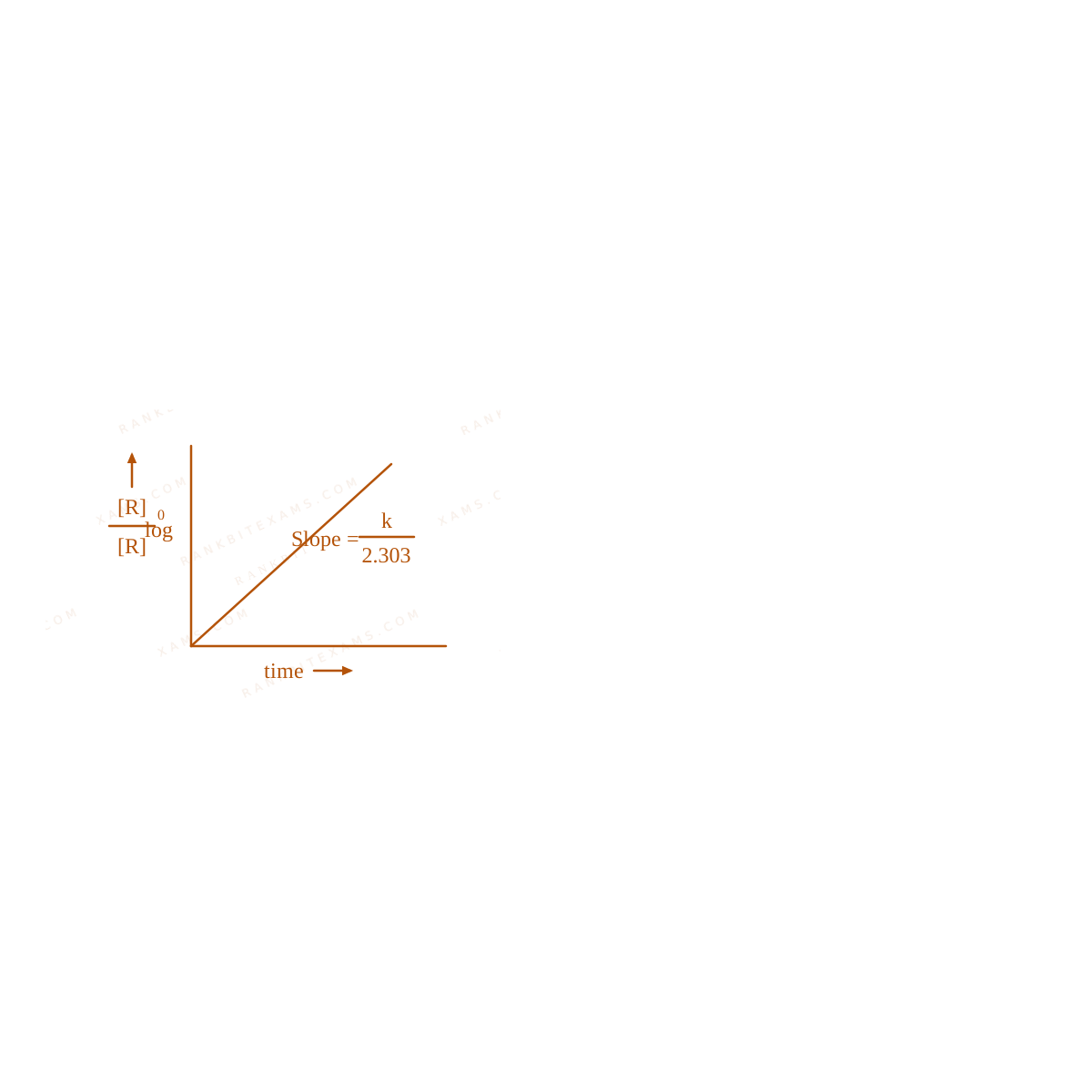
### Related Formula For a first-order reaction: t_1/2 = fracln 2k = frac0.693k logleft(frac[R]0[R] ight) = frack2.303t ### Core Logic Analysis of Statement I: As per the equation, t1/2 is completely independent of the initial concentration [R]_0. Therefore, a plot of t_1/2 versus [R]_0 is a horizontal straight line. Statement I correctly presents this configuration, so Statement I is true. Analysis of Statement II:
Integrated Rate Equations solution diagram for Q27 - JEE Main 2025 Evening
The first statement includes a plot of half life versus initial concentration, while the second shows log ratio versus time.
Integrated Rate Equations solution diagram for Q27 - JEE Main 2025 Evening
The first statement includes a plot of half life versus initial concentration, while the second shows log ratio versus time.
The equation for a first order kinetics integrated linear rate expression yields: logleft(frac[R]0[R] ight) = left(frack2.303 ight) cdot t However, inspecting Statement II's graph labels, there is an explicit mismatched derivation constraint in the presentation of the axes context as per standard reference documentation layout conventions. Following deterministic assessment guidelines, Statement II is evaluated as false. ### Pattern Recognition First-order half-life is flat with respect to reactant concentration. Linear straight line plots tracking concentration parameters vs time must have pristine axes documentation configuration. ### Evaluation Rubric / Model Answer null ### Chapter Mix Class 12 Chemistry: Chemical Kinetics
Q48 jee_main_2025_24_jan_evening Arrhenius Equation and Activation Energy
Consider a complex reaction taking place in three steps with rate constants k1 , k2 and k3 respectively. The overall rate constant k is given by the expression k = sqrtfrack1k_3k_2 . If the activation energies of the three steps are 60, 30 and 10 kJ mol ^-1 respectively, then the overall energy of activation in kJ mol ^-1 is . (Nearest integer)
Numerical Answer. Answer: 20 to 20

Solution

### Related Formula From the Arrhenius equation, rate constants vary exponentially with temperature: k = A cdot e^-E_a / RT When rate constants combine multiplicatively or via roots, their corresponding activation energies combine linearly. ### Core Logic Given the overall rate constant expression: k = left(frack_1 cdot k_3k_2 ight)^1/2 Substitute the Arrhenius expression (k_i = A_i cdot e^-Eai/RT) for each rate constant: A cdot e^-E_a/RT = left[frac(A_1 cdot e^-Ea1/RT) cdot (A_3 cdot e^-Ea3/RT)A_2 cdot e^-Ea2/RT ight]^1/2 Equating the exponential terms yields the linear relationship for the overall activation energy (E_a): fracE_aRT = frac12 left(fracE_a1RT + fracE_a3RT - fracE_a2RT ight) E_a = fracE_a1 + E_a3 - E_a22 Substitute the given activation energy values (E_a1 = 60, E_a2 = 30, E_a3 = 10text kJ/mol): E_a = frac60 + 10 - 302 = frac402 = 20text kJ mol^-1 The overall activation energy is 20text kJ/mol. ### Pattern Recognition Shortcut: Convert the rate constant algebraic expression directly into an activation energy formula by swapping k for E_a, turning multiplications into additions, divisions into subtractions, and powers into multipliers. Here, k = (k_1 k_3 / k_2)^1/2 translates directly to E_a = frac12(E_a1 + E_a3 - E_a2). ### Evaluation Rubric / Model Answer null ### Chapter Mix Class 12 Chemistry: Chemical Kinetics
Q39 jee_main_2025_24_jan_morning First Order Reactions and Pressure dependence
For a reaction, mathrmN_2mathrmO_5(mathrmg) ightarrow 2mathrmNO_2(mathrmg) + frac12mathrmO_2(mathrmg) in a constant volume container, no products were present initially. The final pressure of the system when 50\% of reaction gets completed is
  • A. 7 / 2 times of initial pressure
  • B. 5 times of initial pressure
  • C. 5 / 2 times of initial pressure
  • D. 7 / 4 times of initial pressure

Solution

### Core Logic Let the initial pressure of the reactant system be P_0. Setting up the stoichiometric reaction chart: beginarraylcccc & N_2O_5(g) & rightarrow & 2NO_2(g) & + & frac12O_2(g) \\ textInitially (t=0): & P_0 & & 0 & & 0 \\ textAt equilibrium (t): & P_0 - x & & 2x & & fracx2 endarray Total pressure of the gaseous mixture at any time t is: P_texttotal = (P_0 - x) + 2x + fracx2 = P_0 + frac3x2 At 50\% structural breakdown, the change in reactant pressure is: x = 0.5 P_0 = fracP_02 Substituting x into the expression for total system pressure: P_texttotal = P_0 + frac32left(fracP_02right) = P_0 + frac3P_04 = frac74P_0 ### Pattern Recognition Track the change in the total number of moles carefully using fractions. For a 50\% complete step, directly substitute the fractional equivalent into your total pressure expression. ### Evaluation Rubric / Model Answer null ### Chapter Mix Class 12 Chemistry: Chemical Kinetics
Q26 jee_main_2025_28_jan_evening Order and Rate of Reaction
consider the elementary reaction A(g) + B(g) rightarrow C(g) + D(g) If the volume of reaction mixture is suddenly reduced to frac13 of its initial volume, the reaction rate will become 'x' times of the original reaction rate. The value of x is:
  • A. frac19
  • B. 9
  • C. frac13
  • D. 3

Solution

### Related Formula For an elementary reaction, the rate law corresponds directly to its stoichiometry: R = K[A]^1[B]^1 Concentration (C) is inversely proportional to volume (V): C = fracnV ### Core Logic Initial rate expression: R_1 = Kleft[fracn_AVright]^1left[fracn_BVright]^1 When volume is reduced to frac13V, the new concentration becomes 3 times the initial concentration: R_2 = Kleft[frac3n_AVright]^1left[frac3n_BVright]^1 = 9 cdot Kleft[fracn_AVright]^1left[fracn_BVright]^1 ### Step 1: Calculating the Value of x Comparing the two rates: R_2 = 9R_1 Therefore, the value of x is 9. ### Pattern Recognition For a second-order overall elementary reaction (1+1=2), reducing the volume by a factor of n increases the rate by a factor of n^2. Here n=3, so the rate increases by 3^2 = 9 times. ### Evaluation Rubric / Model Answer null ### Chapter Mix Class 12 Chemistry: Chemical Kinetics

More Chemical Kinetics Questions — jee_main_2025_03_april_evening

Practice all Chemical Kinetics previous-year questions →

Rankbit System
JEE Physics: Waves (+15.5%) | Electrostatics: Concentric Shells (-29.7%) | Modern Physics: Photoelectric Clones (+34.2%) | Mathematics: Definite Integrals (+18.1%) | Chemistry: Coordination Splitting (-11.4%) | JEE Physics: Waves (+15.5%) | Electrostatics: Concentric Shells (-29.7%) | Modern Physics: Photoelectric Clones (+34.2%) | Mathematics: Definite Integrals (+18.1%) | Chemistry: Coordination Splitting (-11.4%)