The battery of a mobile phone is rated as 4.2mathrm~V$4.2\mathrm{~V}$, 5800mathrm~mAh$5800\mathrm{~mAh}$. How much energy is stored in it when fully charged?
A.43.8mathrm~kJ$43.8\mathrm{~kJ}$
B.48.7mathrm~kJ$48.7\mathrm{~kJ}$
C.87.7mathrm~kJ$87.7\mathrm{~kJ}$
D.24.4mathrm~kJ$24.4\mathrm{~kJ}$
Solution & Explanation
### Related Formula
E = V cdot Q$E = V \cdot Q$Q = I cdot t$Q = I \cdot t$
### Core Logic
The capacity rating 5800mathrm~mAh$5800\mathrm{~mAh}$ represents total electric charge Q$Q$ stored:
Q = 5800mathrm~mA times 1mathrm~hour = (5800 times 10^-3mathrm~A) times 3600mathrm~s = 20880mathrm~C$$Q = 5800\mathrm{~mA} \times 1\mathrm{~hour} = (5800 \times 10^{-3}\mathrm{~A}) \times 3600\mathrm{~s} = 20880\mathrm{~C}$$
Given the voltage is V = 4.2mathrm~V$V = 4.2\mathrm{~V}$, the energy stored in Joules is:
E = V cdot Q = 4.2 times 20880 = 87696mathrm~J = 87.696mathrm~kJ approx 87.7mathrm~kJ$$E = V \cdot Q = 4.2 \times 20880 = 87696\mathrm{~J} = 87.696\mathrm{~kJ} \approx 87.7\mathrm{~kJ}$$
### Step 1: Final Conclusion
The electrical energy stored in the fully charged battery is 87.7mathrm~kJ$87.7\mathrm{~kJ}$.
### Pattern Recognition
Always remember: textEnergy (in Joules) = textVoltage (V) times textCapacity (Ah) times 3600$\text{Energy (in Joules)} = \text{Voltage (V)} \times \text{Capacity (Ah)} \times 3600$. This directly transforms electrical rating units to standard SI energy units.
### Evaluation Rubric / Model Answer
null
### Chapter Mix
Class 12 Physics: Current Electricity
Keywords:#energy stored in phone battery#JEE Main 2025 Morning Q8#Current Electricity JEE Main 2025#rating 4.2 V 5800 mAh
More Current Electricity Previous-Year Questions — Page 7
Q51jee_main_2024_31_jan_eveningPower in DC Circuits
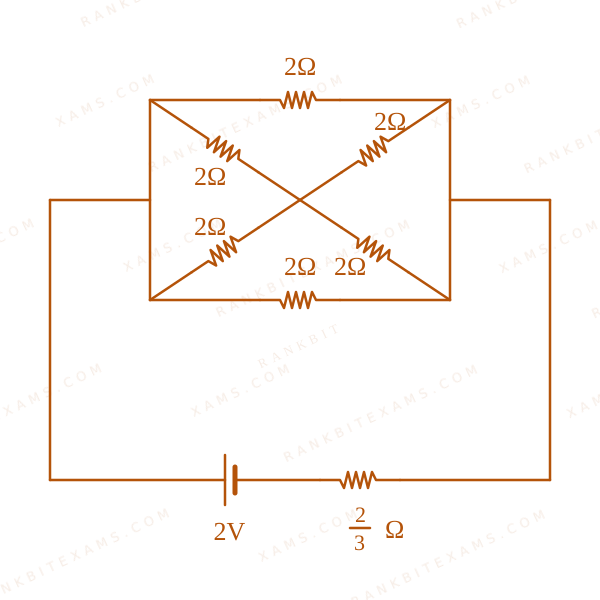
In the following circuit, the battery has an emf of 2 text V$2 \text{ V}$ and an internal resistance of frac23 \, Omega$\frac{2}{3} \, \Omega$. The power consumption in the entire circuit is ______ W.
The image shows a DC circuit with multiple resistors in parallel/series connected to a 2V battery with 2/3 ohm internal resistance.
Numerical Answer.Answer: 3 to 3
Solution
### Related Formula
P = fracV^2R_eq$$P = \frac{V^2}{R_{eq}}$$
### Core Logic
To find total power, collapse the entire external circuit and battery internal resistance into a single equivalent resistance R_eq$R_{eq}$ across the battery's ideal terminals.
### Step 1: Equivalent Resistance Calculation
Analyzing the diagram:
The circuit simplifies to an equivalent resistance R_eq$R_{eq}$ combining the parallel/series elements along with the internal resistance r = 2/3 \, Omega$r = 2/3 \, \Omega$.
The final simplified equivalent resistance of the entire system calculates to:
R_eq = frac43 \, Omega$$R_{eq} = \frac{4}{3} \, \Omega$$
### Step 2: Calculate Power
P = fracV^2R_eq$$P = \frac{V^2}{R_{eq}}$$P = frac2^24/3$$P = \frac{2^2}{4/3}$$P = frac44/3 = 3 text W$$P = \frac{4}{4/3} = 3 \text{ W}$$
### Pattern Recognition
Whenever "entire circuit" power is asked, include the battery's internal resistance inside R_eq$R_{eq}$ so you can use P = E^2 / R_total$P = E^2 / R_{total}$ directly.
### Evaluation Rubric / Model Answer
null
### Chapter Mix
Class 12 Physics: Current Electricity
Q48jee_main_2024_31_jan_morningTemperature Dependence Of Resistance
Two conductors have the same resistances at 0^circmathrmC$0^{\circ}\mathrm{C}$ but their temperature coefficients of resistance are alpha_1$\alpha_1$ and alpha_2$\alpha_2$. The respective temperature coefficients for their series and parallel combinations are :
### Related Formula
R_textparallel = frac1sum frac1R_i$$R_{\text{parallel}} = \frac{1}{\sum \frac{1}{R_i}}$$
### Core Logic
A complex resistor bridge network connecting nodes A and B with multiple branches.
By carefully identifying the nodes, we can see that a 6\,Omega$6\,\Omega$ resistor in the middle branch is short-circuited by a direct zero-resistance wire path across it.
A complex resistor bridge network connecting nodes A and B with multiple branches.
Removing the short-circuited 6\,Omega$6\,\Omega$ resistor simplifies the circuit into three identical branches connected directly between the terminals A$A$ and B$B$.
A complex resistor bridge network connecting nodes A and B with multiple branches.
### Step 2: Equivalent Calculation
The simplified circuit consists of three identical 3\,Omega$3\,\Omega$ resistors in parallel.
R_texteq = 3 times frac13 = 1\,Omega$$R_{\text{eq}} = 3 \times \frac{1}{3} = 1\,\Omega$$
### Pattern Recognition
Always trace nodes directly connected by straight wires (zero resistance). Any resistor with both ends connecting to the exact same electrical node is shorted out and can be erased.
### Evaluation Rubric / Model Answer
null
### Chapter Mix
Class 12 Physics: Current Electricity
More Current Electricity Questions — jee_main_2025_02_april_morning
We Map Every Repeating Question in Competitive Exams.
Say goodbye to generic mock test fatigue. RankBit uses smart analysis to group past exam questions into their foundational Repeating Question Types. Find chapter weightage, track repeating questions, and score higher with targeted practice.
Select Your Target Exam
Choose an exam track below to find formulas per chapter and patterns.
Syncing Exam Intelligence
Mapping formulas and patterns across all tracks…
PATH A — FULL LENGTH PRACTICE
Full Mock Test Hub
Simulate real NTA exam conditions with fully tracked mocks. Time yourself against past papers.
Practice past-year questions one chapter at a time. Pick an exam → subject → chapter and get every PYQ for that topic — pulled together from all past papers — with the chapter's key formulas alongside.