The battery of a mobile phone is rated as 4.2mathrm~V$4.2\mathrm{~V}$, 5800mathrm~mAh$5800\mathrm{~mAh}$. How much energy is stored in it when fully charged?
A.43.8mathrm~kJ$43.8\mathrm{~kJ}$
B.48.7mathrm~kJ$48.7\mathrm{~kJ}$
C.87.7mathrm~kJ$87.7\mathrm{~kJ}$
D.24.4mathrm~kJ$24.4\mathrm{~kJ}$
Solution & Explanation
### Related Formula
E = V cdot Q$E = V \cdot Q$Q = I cdot t$Q = I \cdot t$
### Core Logic
The capacity rating 5800mathrm~mAh$5800\mathrm{~mAh}$ represents total electric charge Q$Q$ stored:
Q = 5800mathrm~mA times 1mathrm~hour = (5800 times 10^-3mathrm~A) times 3600mathrm~s = 20880mathrm~C$$Q = 5800\mathrm{~mA} \times 1\mathrm{~hour} = (5800 \times 10^{-3}\mathrm{~A}) \times 3600\mathrm{~s} = 20880\mathrm{~C}$$
Given the voltage is V = 4.2mathrm~V$V = 4.2\mathrm{~V}$, the energy stored in Joules is:
E = V cdot Q = 4.2 times 20880 = 87696mathrm~J = 87.696mathrm~kJ approx 87.7mathrm~kJ$$E = V \cdot Q = 4.2 \times 20880 = 87696\mathrm{~J} = 87.696\mathrm{~kJ} \approx 87.7\mathrm{~kJ}$$
### Step 1: Final Conclusion
The electrical energy stored in the fully charged battery is 87.7mathrm~kJ$87.7\mathrm{~kJ}$.
### Pattern Recognition
Always remember: textEnergy (in Joules) = textVoltage (V) times textCapacity (Ah) times 3600$\text{Energy (in Joules)} = \text{Voltage (V)} \times \text{Capacity (Ah)} \times 3600$. This directly transforms electrical rating units to standard SI energy units.
### Evaluation Rubric / Model Answer
null
### Chapter Mix
Class 12 Physics: Current Electricity
Keywords:#energy stored in phone battery#JEE Main 2025 Morning Q8#Current Electricity JEE Main 2025#rating 4.2 V 5800 mAh
More Current Electricity Previous-Year Questions — Page 6
Q33jee_main_2024_30_jan_morningResistors in Series and Voltage Dividers
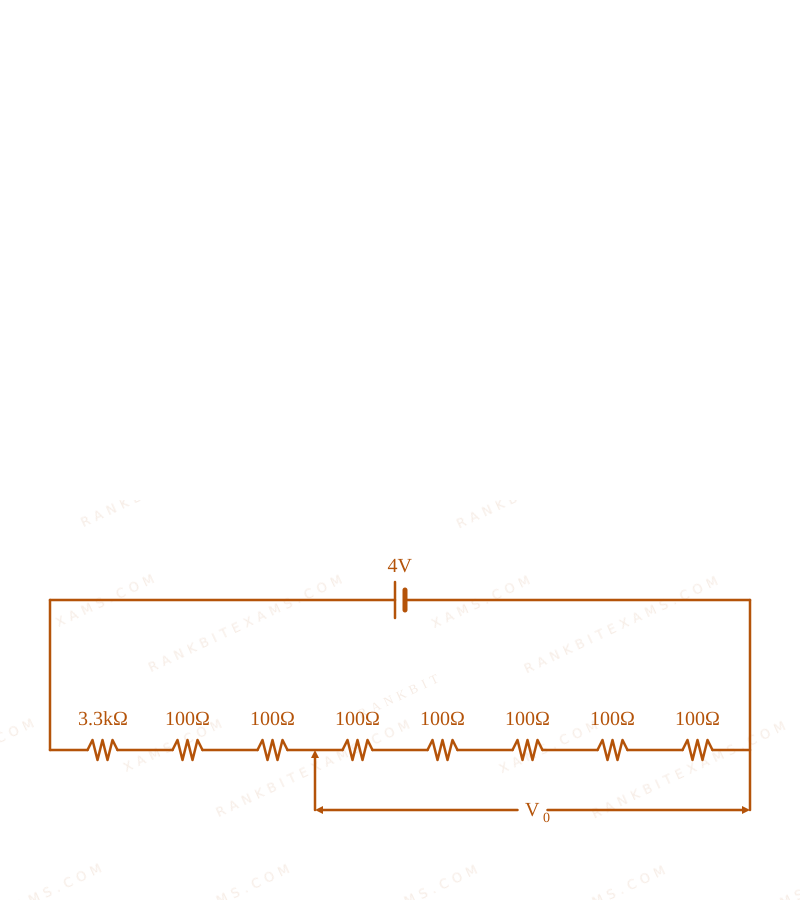
A potential divider circuit is shown in figure. The output voltage V_0$V_0$ is
Circuit containing multiple resistors in series and parallel calculating a specific output voltage.
A.4 mathrm~V$4 \mathrm{~V}$
B.2 mathrm~mV$2 \mathrm{~mV}$
C.0.5 mathrm~V$0.5 \mathrm{~V}$
D.12 mathrm~mV$12 \mathrm{~mV}$
Solution
### Related Formula
V = IR$V = IR$R_texteq = R_1 + R_2 + dots + R_n quad (textfor series)$$R_{\text{eq}} = R_1 + R_2 + \dots + R_n \quad (\text{for series})$$
### Core Logic
Observe the circuit diagram. The total equivalent resistance R_texteq$R_{\text{eq}}$ of the series network must be calculated by summing all the resistance values shown in the main branch.
### Step 1: Calculate Total Resistance and Current
From the given network, assuming the total series resistance is 4000 \,Omega$4000 \,\Omega$ (comprising the 3.3mathrmkOmega$3.3\mathrm{k}\Omega$ resistor and seven 100\,Omega$100\,\Omega$ resistors).
R_texteq = 4000 \,Omega$$R_{\text{eq}} = 4000 \,\Omega$$
The total voltage applied across the network is 4 mathrm~V$4 \mathrm{~V}$.
i = fracVR_texteq = frac44000 = frac11000 mathrm~A$$i = \frac{V}{R_{\text{eq}}} = \frac{4}{4000} = \frac{1}{1000} \mathrm{~A}$$
### Step 2: Calculate Output Voltage
The output voltage V_0$V_0$ is tapped across five 100 \,Omega$100 \,\Omega$ resistors.
R_textout = 5 times 100 \,Omega = 500 \,Omega$$R_{\text{out}} = 5 \times 100 \,\Omega = 500 \,\Omega$$
Thus, the output voltage is:
V_0 = i cdot R_textout = left(frac11000right) times 500 = 0.5 mathrm~V$$V_0 = i \cdot R_{\text{out}} = \left(\frac{1}{1000}\right) \times 500 = 0.5 \mathrm{~V}$$
### Pattern Recognition
A potential divider simply scales the input voltage by the fraction of the resistance tapped over the total resistance: V_0 = V_in times (R_texttap / R_texttotal)$V_0 = V_{in} \times (R_{\text{tap}} / R_{\text{total}})$. Standard DC circuit division.
### Evaluation Rubric / Model Answer
null
### Chapter Mix
Class 12 Physics: Current Electricity
Q43jee_main_2024_30_jan_morningTemperature Dependence of Resistivity
An electric toaster has resistance of 60Omega$60\Omega$ at room temperature (27^circmathrmC)$(27^{\circ}\mathrm{C})$. The toaster is connected to a 220mathrmV$220\mathrm{V}$ supply. If the current flowing through it reaches 2.75mathrmA$2.75\mathrm{A}$, the temperature attained by toaster is around: (if alpha = 2times 10^-4 / ^circmathrmC$\alpha = 2\times 10^{-4} / ^{\circ}\mathrm{C}$)
A.694^circ mathrmC$694^{\circ} \mathrm{C}$
B.1235^circmathrmC$1235^{\circ}\mathrm{C}$
C.1694^circmathrmC$1694^{\circ}\mathrm{C}$
D.1667^circmathrmC$1667^{\circ}\mathrm{C}$
Solution
### Related Formula
R = fracVI$$R = \frac{V}{I}$$R = R_0 (1 + alpha Delta T)$$R = R_0 (1 + \alpha \Delta T)$$
### Core Logic
First, evaluate the final resistance R_T$R_T$ at the operating condition using Ohm's law. Second, plug the final resistance into the linear temperature dependence equation for resistance to solve for final temperature T$T$.
### Step 1: Calculate Final Resistance
Given V = 220 mathrm~V$V = 220 \mathrm{~V}$ and I = 2.75 mathrm~A$I = 2.75 \mathrm{~A}$:
R_T = frac2202.75 = 80 \,Omega$$R_T = \frac{220}{2.75} = 80 \,\Omega$$
### Step 2: Apply Temperature Equation
We know R_27 = 60 \,Omega$R_{27} = 60 \,\Omega$.
R_T = R_27 [1 + alpha (T - 27)]$$R_T = R_{27} [1 + \alpha (T - 27)]$$80 = 60 [1 + 2 times 10^-4 (T - 27)]$$80 = 60 [1 + 2 \times 10^{-4} (T - 27)]$$frac8060 = 1 + 2 times 10^-4 (T - 27)$$\frac{80}{60} = 1 + 2 \times 10^{-4} (T - 27)$$frac43 - 1 = 2 times 10^-4 (T - 27)$$\frac{4}{3} - 1 = 2 \times 10^{-4} (T - 27)$$frac13 = 2 times 10^-4 (T - 27)$$\frac{1}{3} = 2 \times 10^{-4} (T - 27)$$
### Step 3: Solve for T
T - 27 = frac16 times 10^-4$$T - 27 = \frac{1}{6 \times 10^{-4}}$$T - 27 = frac100006 = 1666.67$$T - 27 = \frac{10000}{6} = 1666.67$$T = 1666.67 + 27 approx 1693.67 Rightarrow 1694^circ mathrmC$$T = 1666.67 + 27 \approx 1693.67 \Rightarrow 1694^\circ \mathrm{C}$$
### Pattern Recognition
Always separate the final temperature T$T$ from Delta T$\Delta T$. The most common error is forgetting to add back the initial reference temperature (27^circmathrmC$27^\circ\mathrm{C}$) at the end.
### Evaluation Rubric / Model Answer
null
### Chapter Mix
Class 12 Physics: Current Electricity
Q52jee_main_2024_30_jan_morningCells in Opposition and Terminal Voltage
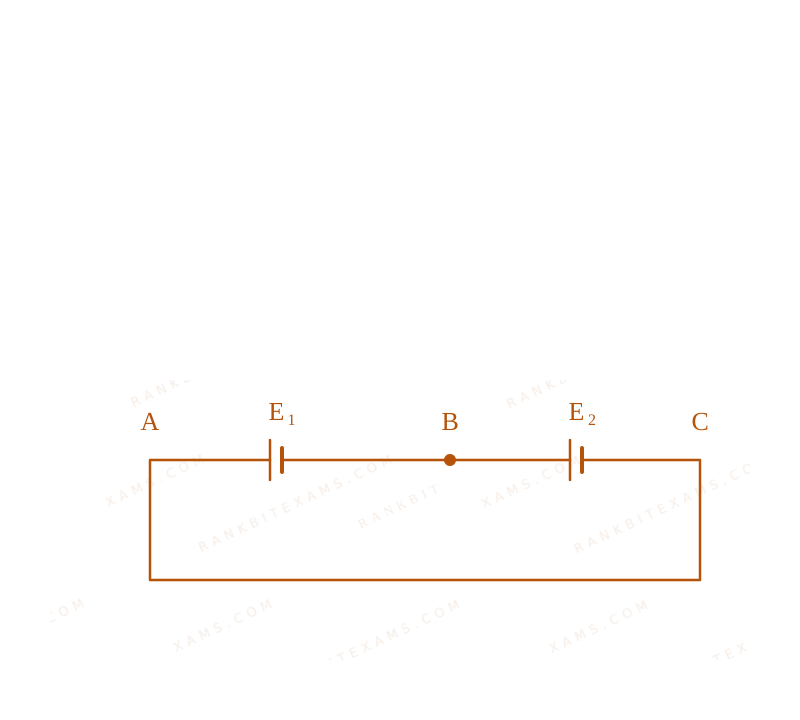
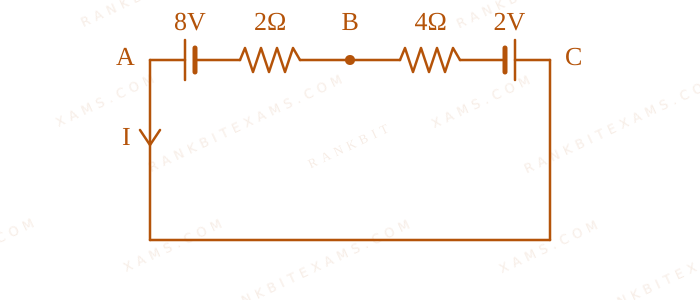
Two cells are connected in opposition as shown. Cell E_1$E_1$ is of 8mathrmV$8\mathrm{V}$ emf and 2Omega$2\Omega$ internal resistance; the cell E_2$E_2$ is of 2mathrmV$2\mathrm{V}$ emf and 4Omega$4\Omega$ internal resistance. The terminal potential difference of cell E_2$E_2$ is:
Two batteries pushing current against each other.
Numerical Answer.Answer: 6 to 6
Solution
### Related Formula
I = fracE_textnetR_texteq$$I = \frac{E_{\text{net}}}{R_{\text{eq}}}$$V = E - Ir quad (textDischarging)$$V = E - Ir \quad (\text{Discharging})$$V = E + Ir quad (textCharging)$$V = E + Ir \quad (\text{Charging})$$
### Core Logic
Two batteries pushing current against each other.
Because the cells are in opposition, the net EMF drives current from the higher potential cell (8mathrmV$8\mathrm{V}$) to the lower potential cell (2mathrmV$2\mathrm{V}$). Thus, the 2mathrmV$2\mathrm{V}$ cell acts as a load and undergoes charging.
### Step 1: Calculate Total Current
I = frac8 - 22 + 4 = frac66 = 1 mathrm~A$$I = \frac{8 - 2}{2 + 4} = \frac{6}{6} = 1 \mathrm{~A}$$
### Step 2: Terminal Potential of Cell 2
Since cell E_2$E_2$ is being charged, its terminal potential difference is:
V_2 = E_2 + I r_2$$V_2 = E_2 + I r_2$$
Applying Kirchhoff's rule across cell E_2$E_2$ (from node C to B):
V_C - V_B = E_2 + I r_2 = 2 + (1)(4) = 6 mathrm~V$$V_C - V_B = E_2 + I r_2 = 2 + (1)(4) = 6 \mathrm{~V}$$
### Pattern Recognition
When a smaller battery is forced backwards by a larger battery, it gets "charged". Consequently, its terminal voltage increases above its nominal EMF: V = E + Ir$V = E + Ir$.
### Evaluation Rubric / Model Answer
null
### Chapter Mix
Class 12 Physics: Current Electricity
Q39jee_main_2024_31_jan_eveningMeter Bridge
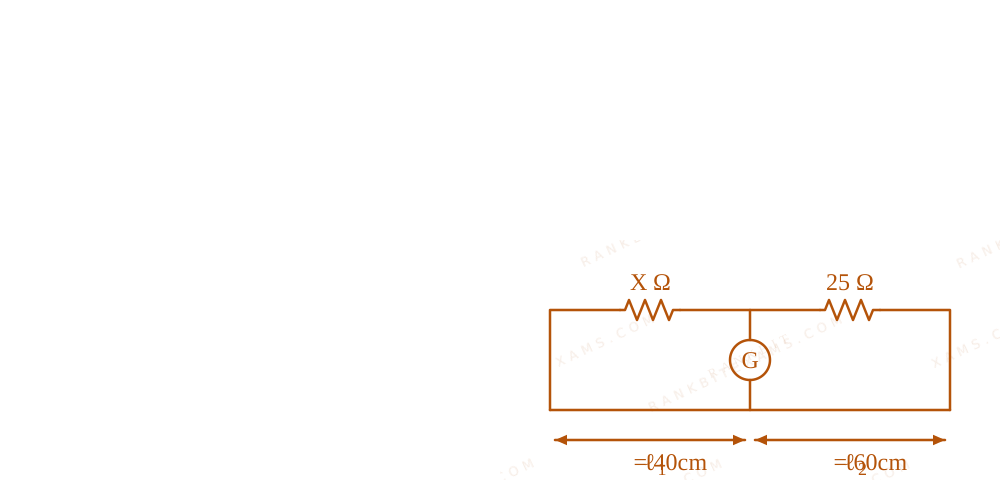
The resistance per centimeter of a meter bridge wire is r$r$, with X \, Omega$X \, \Omega$ resistance in left gap. Balancing length from left end is at 40 text cm$40 \text{ cm}$ with 25 \, Omega$25 \, \Omega$ resistance in right gap. Now the wire is replaced by another wire of 2r$2r$ resistance per centimeter. The new balancing length for same settings will be at
A.20 text cm$20 \text{ cm}$
B.10 text cm$10 \text{ cm}$
C.80 text cm$80 \text{ cm}$
D.40 text cm$40 \text{ cm}$
Solution
### Related Formula
fracR_textleftR_textwire-left = fracR_textrightR_textwire-right$$\frac{R_{\text{left}}}{R_{\text{wire-left}}} = \frac{R_{\text{right}}}{R_{\text{wire-right}}}$$
### Core Logic
For a meter bridge, the balancing condition is independent of the absolute resistance of the bridge wire as long as it is uniform. The ratio of the resistances in the gaps balances with the ratio of lengths.
Meter Bridge diagram for Q39 - JEE Main 2024 Evening
### Step 1: First Condition
fracXr ell_1 = frac25r (100 - ell_1)$$\frac{X}{r \ell_1} = \frac{25}{r (100 - \ell_1)}$$
Given ell_1 = 40 text cm$\ell_1 = 40 \text{ cm}$:
fracXr times 40 = frac25r times 60 implies fracX40 = frac2560$$\frac{X}{r \times 40} = \frac{25}{r \times 60} \implies \frac{X}{40} = \frac{25}{60}$$
### Step 2: Second Condition
When replaced by a wire of 2r$2r$ per cm, the new lengths ell_2$\ell_2$ will satisfy:
fracX2r ell_2 = frac252r (100 - ell_2)$$\frac{X}{2r \ell_2} = \frac{25}{2r (100 - \ell_2)}$$
Notice that the 2r$2r$ terms cancel out entirely from both sides, leaving:
fracXell_2 = frac25100 - ell_2$$\frac{X}{\ell_2} = \frac{25}{100 - \ell_2}$$
### Step 3: Conclusion
Since the ratio X/25$X/25$ remains identical, the balancing length ratio ell / (100-ell)$\ell / (100-\ell)$ also remains identical.
Therefore, ell_2 = ell_1 = 40 text cm$\ell_2 = \ell_1 = 40 \text{ cm}$.
### Pattern Recognition
Meter bridge balance point strictly depends on length ratio, NOT the specific resistivity or thickness of the wire (provided it is uniform). If external resistors don't change, the balance point never changes.
### Evaluation Rubric / Model Answer
null
### Chapter Mix
Class 12 Physics: Current Electricity
Q43jee_main_2024_31_jan_eveningPower Dissipation
By what percentage will the illumination of the lamp decrease if the current drops by 20\%$20\%$?
A.46\%$46\%$
B.26\%$26\%$
C.36\%$36\%$
D.56\%$56\%$
Solution
### Related Formula
Power (Illumination) is proportional to the square of the current for a constant resistance:
P = I^2 R$P = I^2 R$
### Core Logic
Initial power:
P_1 = I_1^2 R$P_1 = I_1^2 R$
If current drops by 20%, the new current is:
I_2 = I_1 - 0.2 I_1 = 0.8 I_1$$I_2 = I_1 - 0.2 I_1 = 0.8 I_1$$
New power:
P_2 = (0.8 I_1)^2 R = 0.64 I_1^2 R = 0.64 P_1$$P_2 = (0.8 I_1)^2 R = 0.64 I_1^2 R = 0.64 P_1$$
### Step 1: Calculate Percentage Change
Delta P \% = fracP_2 - P_1P_1 times 100\%$$\Delta P \% = \frac{P_2 - P_1}{P_1} \times 100\%$$Delta P \% = frac0.64 P_1 - P_1P_1 times 100\%$$\Delta P \% = \frac{0.64 P_1 - P_1}{P_1} \times 100\%$$Delta P \% = (0.64 - 1) times 100\% = -36\%$$\Delta P \% = (0.64 - 1) \times 100\% = -36\%$$
### Step 2: Final Statement
The negative sign indicates a decrease. The illumination drops by 36\%$36\%$.
### Pattern Recognition
For squared relations y = x^2$y = x^2$, if x$x$ changes by a factor k$k$ (0.8$0.8$), y$y$ changes by a factor k^2$k^2$ (0.64$0.64$). 1 - 0.64 = 36\%$1 - 0.64 = 36\%$. This bypasses algebraic limits usually done for small changes (like 2Delta x / x$2\Delta x / x$) since 20% is too large for approximation.
### Evaluation Rubric / Model Answer
null
### Chapter Mix
Class 12 Physics: Current Electricity
More Current Electricity Questions — jee_main_2025_02_april_morning
We Map Every Repeating Question in Competitive Exams.
Say goodbye to generic mock test fatigue. RankBit uses smart analysis to group past exam questions into their foundational Repeating Question Types. Find chapter weightage, track repeating questions, and score higher with targeted practice.
Select Your Target Exam
Choose an exam track below to find formulas per chapter and patterns.
Syncing Exam Intelligence
Mapping formulas and patterns across all tracks…
PATH A — FULL LENGTH PRACTICE
Full Mock Test Hub
Simulate real NTA exam conditions with fully tracked mocks. Time yourself against past papers.
Practice past-year questions one chapter at a time. Pick an exam → subject → chapter and get every PYQ for that topic — pulled together from all past papers — with the chapter's key formulas alongside.