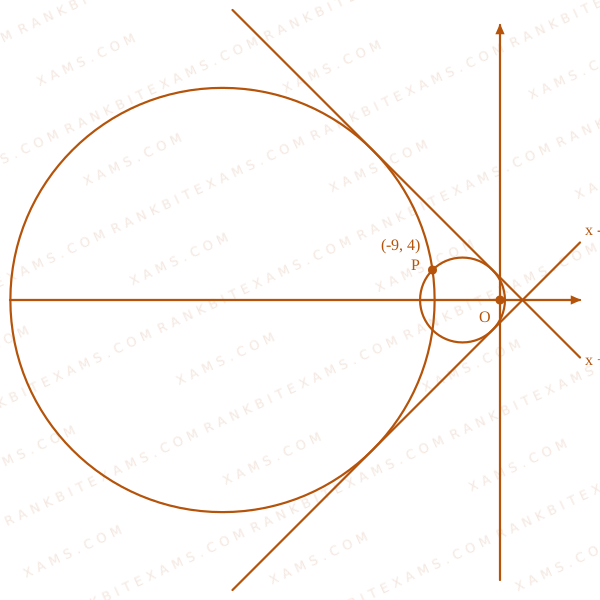
The absolute difference between the squares of the radii of the two circles passing through the point (-9, 4)$(-9, 4)$ and touching the lines x + y = 3$x + y = 3$ and x - y = 3$x - y = 3$, is equal to ________.
Numerical Answer Type:
Enter a numerical valueAnswer: 768 to 768+4 marks
Solution & Explanation
### Related Formula
Perpendicular distance from point (x_0, y_0)$(x_0, y_0)$ to line Ax + By + C = 0$Ax + By + C = 0$:
d = frac|Ax_0 + By_0 + C|sqrtA^2 + B^2$$d = \frac{|Ax_0 + By_0 + C|}{\sqrt{A^2 + B^2}}$$
### Core Logic
Since the circle touches two symmetric intersecting lines, its center must lie on their angle bisector (x$x$-axis). Use this property to find the center parameters. Tangent Properties of Circles diagram for Q75 - JEE Main 2025 Morning
### Step 1: Establish Center and Radius Equations
The lines are x+y-3=0$x+y-3=0$ and x-y-3=0$x-y-3=0$. The intersection point is (3,0)$(3,0)$, and the bisector line is the x$x$-axis.
Let the center be C(a, 0)$C(a, 0)$. The radius r$r$ is the perpendicular distance to either line:
r = frac|a - 0 - 3|sqrt1^2 + 1^2 = frac|a - 3|sqrt2$$r = \frac{|a - 0 - 3|}{\sqrt{1^2 + 1^2}} = \frac{|a - 3|}{\sqrt{2}}$$
### Step 2: Apply Point Passage Constraint
The circle equation is (x - a)^2 + y^2 = r^2$(x - a)^2 + y^2 = r^2$. Substitute the given passage point (-9, 4)$(-9, 4)$:
(-9 - a)^2 + 4^2 = left(fraca - 3sqrt2right)^2$$(-9 - a)^2 + 4^2 = \left(\frac{a - 3}{\sqrt{2}}\right)^2$$2left(a^2 + 18a + 81 + 16right) = a^2 - 6a + 9$$2\left(a^2 + 18a + 81 + 16\right) = a^2 - 6a + 9$$2a^2 + 36a + 194 = a^2 - 6a + 9 implies a^2 + 42a + 185 = 0$$2a^2 + 36a + 194 = a^2 - 6a + 9 \implies a^2 + 42a + 185 = 0$$
### Step 3: Solve for Quadratic Roots
Factor the quadratic equation:
(a + 37)(a + 5) = 0 implies a_1 = -37, quad a_2 = -5$$(a + 37)(a + 5) = 0 \implies a_1 = -37, \quad a_2 = -5$$
### Step 4: Compute Radii Squares Difference
Find the corresponding radius value for each root:
r_1 = frac|-37 - 3|sqrt2 = frac40sqrt2 = 20sqrt2 implies r_1^2 = 800$$r_1 = \frac{|-37 - 3|}{\sqrt{2}} = \frac{40}{\sqrt{2}} = 20\sqrt{2} \implies r_1^2 = 800$$r_2 = frac|-5 - 3|sqrt2 = frac8sqrt2 = 4sqrt2 implies r_2^2 = 32$$r_2 = \frac{|-5 - 3|}{\sqrt{2}} = \frac{8}{\sqrt{2}} = 4\sqrt{2} \implies r_2^2 = 32$$
The absolute difference between their squares is:
left|r_1^2 - r_2^2right| = |800 - 32| = 768$$\left|r_1^2 - r_2^2\right| = |800 - 32| = 768$$
### Pattern Recognition
Recognizing that the center must lie on the line of symmetry (x$x$-axis) eliminates one variable parameter immediately, reducing a difficult geometric system to a simple single-variable quadratic equation.
### Evaluation Rubric / Model Answer
null
### Chapter Mix
Class 11 Mathematics: Circles
Class 11 Mathematics: Straight Lines
Keywords:#circle tangent distance formula#angle bisector circle center#JEE Main 2025 Morning Q75#absolute difference radii squares
More Circles Previous-Year Questions — Page 2
Q65jee_main_2025_24_jan_morningTransformation and Reflection of Circles
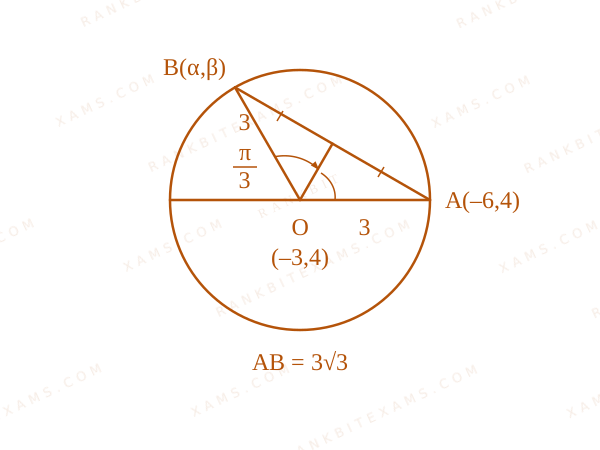
Let circle C$C$ be the image of x^2 + y^2 - 2x + 4y - 4 = 0$x^{2} + y^{2} - 2x + 4y - 4 = 0$ in the line 2x - 3y + 5 = 0$2x - 3y + 5 = 0$ and A$A$ be the point on C$C$ such that OA$OA$ is \parallel to the x-axis and A$A$ lies on the \right hand side of the centre O$O$ of C$C$. If B(alpha,beta)$B(\alpha,\beta)$, with beta < 4$\beta < 4$, lies on C$C$ such that the length of the arc AB$AB$ is (1/6)^textth$(1/6)^{\text{th}}$ of the perimeter of C$C$, then beta - sqrt3alpha$\beta - \sqrt{3}\alpha$ is equal to :
A.3$3$
B.3 + sqrt3$3 + \sqrt{3}$
C.4 - sqrt3$4 - \sqrt{3}$
D.4$4$
Solution
### Related Formula
The coordinates for the reflection image of a point (x_1, y_1)$(x_1, y_1)$ across a standard line ax + by + c = 0$ax + by + c = 0$ are determined using:
fracx - x_1a = fracy - y_1b = frac-2(ax_1 + by_1 + c)a^2 + b^2$$\frac{x - x_1}{a} = \frac{y - y_1}{b} = \frac{-2(ax_1 + by_1 + c)}{a^2 + b^2}$$
### Core Logic
Find the center and radius of the original given circle:
x^2 + y^2 - 2x + 4y - 4 = 0 implies textCenter = (1, -2), \, r = sqrt1^2 + (-2)^2 - (-4) = 3$$x^2 + y^2 - 2x + 4y - 4 = 0 \implies \text{Center} = (1, -2), \, r = \sqrt{1^2 + (-2)^2 - (-4)} = 3$$Transformation and Reflection of Circles
Reflect the center point (1, -2)$(1, -2)$ across the line mirror 2x - 3y + 5 = 0$2x - 3y + 5 = 0$:
fracx - 12 = fracy + 2-3 = frac-2(2(1) - 3(-2) + 5)2^2 + (-3)^2 = frac-2(2 + 6 + 5)13 = -2$$\frac{x - 1}{2} = \frac{y + 2}{-3} = \frac{-2(2(1) - 3(-2) + 5)}{2^2 + (-3)^2} = \frac{-2(2 + 6 + 5)}{13} = -2$$x - 1 = -4 implies x = -3$$x - 1 = -4 \implies x = -3$$y + 2 = 6 implies y = 4$$y + 2 = 6 \implies y = 4$$
Thus, the center O$O$ of the reflected circle C$C$ is (-3, 4)$(-3, 4)$, and its radius is preserved at r = 3$r = 3$.
### Step 1: Locate Point A
We are given that OA$OA$ is \parallel to the x-axis, meaning its y-coordinate matches the center. Since A$A$ lies to the \right of the center O(-3, 4)$O(-3, 4)$:
A = (-3 + r, \, 4) = (-3 + 3, \, 4) = (0, 4)$$A = (-3 + r, \, 4) = (-3 + 3, \, 4) = (0, 4)$$
### Step 2: Determine Angular Position of Point B
The arc length AB$AB$ is given as frac16$\frac{1}{6}$ of the total perimeter:
textArc length = rtheta = frac16(2pi r) implies theta = fracpi3 = 60^circ$$\text{Arc length} = r\theta = \frac{1}{6}(2\pi r) \implies \theta = \frac{\pi}{3} = 60^\circ$$Transformation and Reflection of Circles
Using parametric coordinates relative to center O(-3, 4)$O(-3, 4)$ with radius r = 3$r = 3$:
alpha = -3 + 3costheta, quad beta = 4 + 3sintheta$$\alpha = -3 + 3\cos\theta, \quad \beta = 4 + 3\sin\theta$$
Since beta < 4$\beta < 4$, the \angle theta$\theta$ must point downwards into the negative quadrant relative to A$A$, meaning theta = -60^circ = -fracpi3$\theta = -60^\circ = -\frac{\pi}{3}$:
alpha = -3 + 3cosleft(-fracpi3right) = -3 + 3left(frac12
ight) = -frac32$$\alpha = -3 + 3\cos\left(-\frac{\pi}{3}\right) = -3 + 3\left(\frac{1}{2}
ight) = -\frac{3}{2}$$beta = 4 + 3sinleft(-fracpi3right) = 4 - frac3sqrt32$$\beta = 4 + 3\sin\left(-\frac{\pi}{3}\right) = 4 - \frac{3\sqrt{3}}{2}$$
### Step 3: Evaluate Final Algebraic Value
Substitute the determined coordinates into the target expression:
beta - sqrt3alpha = left(4 - frac3sqrt32right) - sqrt3left(-frac32
ight)$$\beta - \sqrt{3}\alpha = \left(4 - \frac{3\sqrt{3}}{2}\right) - \sqrt{3}\left(-\frac{3}{2}
ight)$$beta - sqrt3alpha = 4 - frac3sqrt32 + frac3sqrt32 = 4$$\beta - \sqrt{3}\alpha = 4 - \frac{3\sqrt{3}}{2} + \frac{3\sqrt{3}}{2} = 4$$
### Pattern Recognition
Whenever parametric configurations on a circle involve radical coordinate multipliers like beta - sqrt3alpha$\beta - \sqrt{3}\alpha$, using angular vectors centered at the origin of the circle avoids setting up and solving long distance equations.
### Evaluation Rubric / Model Answer
null
### Chapter Mix
Class 11 Mathematics: Circles
Qjee_main_2025_29_jan_morningChord of a Circle
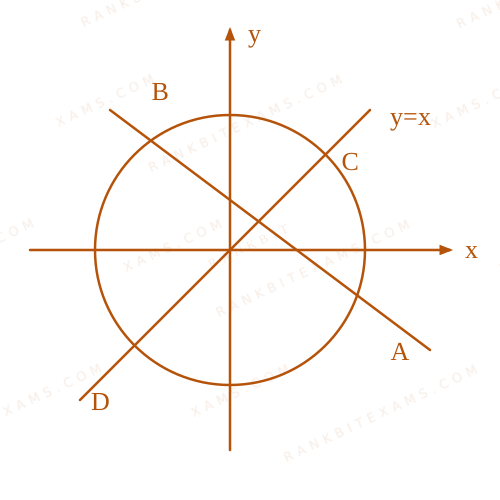
Let the line x + y = 1$x + y = 1$ meet the circle x^2 + y^2 = 4$x^2 + y^2 = 4$ at the points A and B. If the line perpendicular to AB and passing through the mid point of the chord AB intersects the circle at C and D, then the area of the quadrilateral ADBC is equal to
A.3sqrt7$3\sqrt{7}$
B.2sqrt14$2\sqrt{14}$
C.5sqrt7$5\sqrt{7}$
D.sqrt14$\sqrt{14}$
Solution
### Related Formula
textArea of a quadrilateral with perpendicular diagonals d_1 text and d_2 = frac12 d_1 d_2$$\text{Area of a quadrilateral with perpendicular diagonals } d_1 \text{ and } d_2 = \frac{1}{2} d_1 d_2$$
### Core Logic
The line perpendicular to chord AB$AB$ passing through its midpoint is the diameter of the circle because the perpendicular bisector of any chord passes through the center. Thus, CD$CD$ is a diameter, making its length equal to 2R = 4$2R = 4$.
Chord of a Circle diagram for Q51 - JEE Main 2025 Morning
### Step 1: Find Length of Chord AB
The perpendicular distance p$p$ from the center (0,0)$(0,0)$ to the line x + y - 1 = 0$x + y - 1 = 0$ is:
p = frac|0 + 0 - 1|sqrt1^2 + 1^2 = frac1sqrt2$$p = \frac{|0 + 0 - 1|}{\sqrt{1^2 + 1^2}} = \frac{1}{\sqrt{2}}$$
Length of chord AB = 2sqrtR^2 - p^2 = 2sqrt4 - frac12 = 2sqrtfrac72 = sqrt14$AB = 2\sqrt{R^2 - p^2} = 2\sqrt{4 - \frac{1}{2}} = 2\sqrt{\frac{7}{2}} = \sqrt{14}$.
### Step 2: Area Calculation
Since CD$CD$ is the perpendicular bisector of AB$AB$, the diagonals of quadrilateral ADBC$ADBC$ are perpendicular. Therefore, the area is:
textArea = frac12 times AB times CD = frac12 times sqrt14 times 4 = 2sqrt14$$\text{Area} = \frac{1}{2} \times AB \times CD = \frac{1}{2} \times \sqrt{14} \times 4 = 2\sqrt{14}$$
### Pattern Recognition
Whenever a line passes through the midpoint of a chord and is perpendicular to it, recognize instantly that it is a diameter. The area of the quadrilateral formed is then simply the area of two triangles sharing the diameter as a base, or frac12 d_1 d_2$\frac{1}{2} d_1 d_2$.
### Evaluation Rubric / Model Answer
null
### Chapter Mix
Class 11 Mathematics: Circles
Class 11 Mathematics: Straight Lines
Q12jee_main_2024_27_jan_morningEquation of Circle
Four distinct points (2k, 3k)$(2k, 3k)$, (1, 0)$(1, 0)$, (0, 1)$(0, 1)$ and (0, 0)$(0, 0)$ lie on a circle for k$k$ equal to:
A.frac713$$\frac{7}{13}$$
B.frac313$$\frac{3}{13}$$
C.frac513$$\frac{5}{13}$$
D.frac113$$\frac{1}{13}$$
Solution
### Related Formula
(x-x_1)(x-x_2) + (y-y_1)(y-y_2) = 0$$(x-x_1)(x-x_2) + (y-y_1)(y-y_2) = 0$$
This is the equation of a circle passing through diametrically opposite endpoints (x_1, y_1)$(x_1, y_1)$ and (x_2, y_2)$(x_2, y_2)$.
### Core Logic
Look at the three known points: A(1, 0)$A(1, 0)$, B(0, 1)$B(0, 1)$, and O(0, 0)$O(0, 0)$.
The vectors vecOA$\vec{OA}$ and vecOB$\vec{OB}$ align with the x and y axes, meaning angle AOB = 90^circ$\angle AOB = 90^{\circ}$.
Since the angle subtended by AB$AB$ at a point O$O$ on the circle is 90^circ$90^{\circ}$, the segment AB$AB$ must be the diameter of the circle.
### Step 1: Finding the Circle Equation
Using the diametric form for points A(1,0)$A(1,0)$ and B(0,1)$B(0,1)$:
(x-1)(x-0) + (y-0)(y-1) = 0$$(x-1)(x-0) + (y-0)(y-1) = 0$$x^2 - x + y^2 - y = 0$$x^2 - x + y^2 - y = 0$$
### Step 2: Solving for k
Since the point (2k, 3k)$(2k, 3k)$ also lies on this circle, substitute x = 2k$x = 2k$ and y = 3k$y = 3k$ into the equation:
(2k)^2 - (2k) + (3k)^2 - (3k) = 0$$(2k)^2 - (2k) + (3k)^2 - (3k) = 0$$4k^2 - 2k + 9k^2 - 3k = 0$$4k^2 - 2k + 9k^2 - 3k = 0$$13k^2 - 5k = 0$13k^2 - 5k = 0$k(13k - 5) = 0$k(13k - 5) = 0$
### Step 3: Finding valid points
This gives two possible values for k$k$:
k = 0$k = 0$ or k = frac513$k = \frac{5}{13}$.
If k=0$k=0$, the fourth point becomes (0,0)$(0,0)$, which is already listed. The question specifies four *distinct* points.
Thus, k = frac513$k = \frac{5}{13}$.
### Pattern Recognition
Whenever (0,0)$(0,0)$, (a,0)$(a,0)$, and (0,b)$(0,b)$ lie on a circle, they form a right triangle at the origin. The hypotenuse connecting (a,0)$(a,0)$ and (0,b)$(0,b)$ is ALWAYS the diameter. You can immediately write the circle's equation as x^2 + y^2 - ax - by = 0$x^2 + y^2 - ax - by = 0$.
### Evaluation Rubric / Model Answer
null
### Chapter Mix
Class 11 Maths: Circles
Q21jee_main_2024_29_jan_morningTangents and Normal
Equation of two diameters of a circle are 2x-3y=5$2x-3y=5$ and 3x-4y=7$3x-4y=7$. The line joining the points (-frac227,-4)$(-\frac{22}{7},-4)$ and (-frac17,3)$(-\frac{1}{7},3)$intersects the circle at only one pointP(alpha,beta)$P(\alpha,\beta)$. Then 17beta-alpha$17\beta-\alpha$ is equal to
Numerical Answer.Answer: 2 to 2
Solution
### Related Formula
The intersection of any two non-parallel diameters yields the center of the circle.
A line that intersects a circle at exactly one point is a tangent line.
The tangent at the point of contact P$P$ is always perpendicular to the radius CP$CP$, thus m_texttangent times m_textradius = -1$m_{\text{tangent}} \times m_{\text{radius}} = -1$.
### Core Logic
Find the center C$C$ by solving the two diameter equations:
2x - 3y = 5 quad dots (1)$$2x - 3y = 5 \quad \dots (1)$$3x - 4y = 7 quad dots (2)$$3x - 4y = 7 \quad \dots (2)$$
Multiply (1) by 3 and (2) by 2:
6x - 9y = 15$6x - 9y = 15$6x - 8y = 14$6x - 8y = 14$
Subtracting the equations gives -y = 1 Rightarrow y = -1$-y = 1 \Rightarrow y = -1$.
Substitute y = -1$y = -1$ into (1): 2x + 3 = 5 Rightarrow 2x = 2 Rightarrow x = 1$2x + 3 = 5 \Rightarrow 2x = 2 \Rightarrow x = 1$.
Center C$C$ is (1, -1)$(1, -1)$.
Find the equation of the line joining A(-frac227, -4)$A(-\frac{22}{7}, -4)$ and B(-frac17, 3)$B(-\frac{1}{7}, 3)$.
Slope of AB$AB$: m_AB = frac3 - (-4)-1/7 - (-22/7) = frac721/7 = frac73$m_{AB} = \frac{3 - (-4)}{-1/7 - (-22/7)} = \frac{7}{21/7} = \frac{7}{3}$.
Equation of line AB$AB$:
y - 3 = frac73left(x + frac17right)$$y - 3 = \frac{7}{3}\left(x + \frac{1}{7}\right)$$3y - 9 = 7x + 1$3y - 9 = 7x + 1$7x - 3y + 10 = 0 quad dots text(Line AB)$$7x - 3y + 10 = 0 \quad \dots \text{(Line AB)}$$Tangents and Normal
### Step 1: Exploit Tangency Geometry
Since line AB$AB$intersects the circle at only one pointP(alpha, beta)$P(\alpha, \beta)$, line AB$AB$ is a tangent to the circle, and P$P$ is the point of tangency.
The radius line CP$CP$ is perpendicular to tangent AB$AB$.
Slope of CP$CP$ (m_CP$m_{CP}$) must be -frac37$-\frac{3}{7}$.
Equation of the line passing through center C(1, -1)$C(1, -1)$ with slope -frac37$-\frac{3}{7}$:
y - (-1) = -frac37(x - 1)$$y - (-1) = -\frac{3}{7}(x - 1)$$7y + 7 = -3x + 3$$7y + 7 = -3x + 3$$3x + 7y + 4 = 0 quad dots text(Line CP)$$3x + 7y + 4 = 0 \quad \dots \text{(Line CP)}$$
### Step 2: Solve for Intersection P
Point P(alpha, beta)$P(\alpha, \beta)$ is the intersection of Tangent AB$AB$ and Radius CP$CP$. Solve the system:
7x - 3y = -10 quad dots (times 7)$$7x - 3y = -10 \quad \dots (\times 7)$$3x + 7y = -4 quad dots (times 3)$$3x + 7y = -4 \quad \dots (\times 3)$$49x - 21y = -70$49x - 21y = -70$9x + 21y = -12$9x + 21y = -12$
Add them: 58x = -82 Rightarrow x = -frac8258 = -frac4129$58x = -82 \Rightarrow x = -\frac{82}{58} = -\frac{41}{29}$.
So, alpha = -frac4129$\alpha = -\frac{41}{29}$.
Substitute x$x$ into 3x + 7y = -4$3x + 7y = -4$:
3left(-frac4129right) + 7y = -4$$3\left(-\frac{41}{29}\right) + 7y = -4$$-frac12329 + 7y = -frac11629$$-\frac{123}{29} + 7y = -\frac{116}{29}$$7y = frac123 - 11629 = frac729 Rightarrow y = frac129$.
So, $beta = frac129$.
### Step 3: Evaluate Target Expression
Evaluate $17beta - alpha$:
$$7y = \frac{123 - 116}{29} = \frac{7}{29} \Rightarrow y = \frac{1}{29}$.
So, $\beta = \frac{1}{29}$.
### Step 3: Evaluate Target Expression
Evaluate $17\beta - \alpha$:
$$17\left(\frac{1}{29}\right) - \left(-\frac{41}{29}\right) = \frac{17 + 41}{29} = \frac{58}{29} = 2$$
### Pattern Recognition
When a line "intersects a circle at exactly one point", it's a coded cue to stop thinking about quadratics and discriminants, and immediately build a perpendicular geometric radius from the center to find the exact tangency coordinate.
### Evaluation Rubric / Model Answer
null
### Chapter Mix
Class 11 Mathematics: Circles
Class 11 Mathematics: Straight Lines
Q23jee_main_2024_30_january_eveningIntersection of Circles
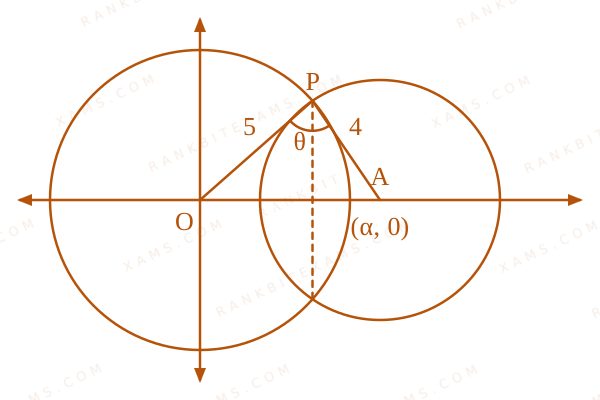
Consider two circles C_1: x^2 + y^2 = 25$C_1: x^2 + y^2 = 25$ and C_2: (x - alpha)^2 + y^2 = 16$C_2: (x - \alpha)^2 + y^2 = 16$ , where alpha in (5, 9)$\alpha \in (5, 9)$ . Let the angle between the two radii (one to each circle) drawn from one of the intersection points of C_1$C_1$ and C_2$C_2$ be sin^-1left(fracsqrt638right)$\sin^{-1}\left(\frac{\sqrt{63}}{8}\right)$ . If the length of common chord of C_1$C_1$ and C_2$C_2$ is beta$\beta$ , then the value of (alphabeta)^2$(\alpha\beta)^2$ equals
Numerical Answer.Answer: 1575 to 1575
Solution
### Related Formula
textArea of triangle OAP: Delta = frac12 a b sin theta$$\text{Area of triangle } OAP: \Delta = \frac{1}{2} a b \sin \theta$$textCommon Chord geometry: Height of triangle acts as half the common chord, so Delta = frac12 times textbase times left(fracbeta2right)$$\text{Common Chord geometry: Height of triangle acts as half the common chord, so } \Delta = \frac{1}{2} \times \text{base} \times \left(\frac{\beta}{2}\right)$$
### Core Logic
Radius of C_1$C_1$ is r_1 = 5$r_1 = 5$ (centered at Origin O(0,0)$O(0,0)$).
Radius of C_2$C_2$ is r_2 = 4$r_2 = 4$ (centered at A(alpha,0)$A(\alpha,0)$ with 5 lt alpha lt 9$5 \lt \alpha \lt 9$).
Let P$P$ be an intersection point. In Delta OAP$\Delta OAP$, the sides are OP = 5$OP = 5$, AP = 4$AP = 4$, and OA = alpha$OA = \alpha$.
The angle between the radii at P$P$ is angle OPA = theta$\angle OPA = \theta$, where sin theta = fracsqrt638$\sin \theta = \frac{\sqrt{63}}{8}$.
### Step 1: Determining Area via the Sine Rule
The area of Delta OAP$\Delta OAP$ can be computed using the two radii and the angle between them:
textArea = frac12 (OP) (AP) sin theta$$\text{Area} = \frac{1}{2} (OP) (AP) \sin \theta$$textArea = frac12 (5) (4) left( fracsqrt638 right) = 10 left( fracsqrt638 right) = frac5sqrt634$$\text{Area} = \frac{1}{2} (5) (4) \left( \frac{\sqrt{63}}{8} \right) = 10 \left( \frac{\sqrt{63}}{8} \right) = \frac{5\sqrt{63}}{4}$$
### Step 2: Linking Area to the Common Chord
Intersection of Circles diagram for Q23 - JEE Main 2024 Evening
The base of Delta OAP$\Delta OAP$ on the x-axis is OA = alpha$OA = \alpha$.
The height of Delta OAP$\Delta OAP$ dropped from P$P$ to OA$OA$ is exactly half the length of the common chord, which is fracbeta2$\frac{\beta}{2}$.
textArea = frac12 times textbase times textheight = frac12 alpha left( fracbeta2 right) = fracalphabeta4$$\text{Area} = \frac{1}{2} \times \text{base} \times \text{height} = \frac{1}{2} \alpha \left( \frac{\beta}{2} \right) = \frac{\alpha\beta}{4}$$
### Step 3: Equating Areas
Equate the two area expressions:
fracalphabeta4 = frac5sqrt634$$\frac{\alpha\beta}{4} = \frac{5\sqrt{63}}{4}$$alphabeta = 5sqrt63$$\alpha\beta = 5\sqrt{63}$$
### Step 4: Final Evaluation
Square the result as requested:
(alphabeta)^2 = (5sqrt63)^2 = 25 times 63 = 1575$$(\alpha\beta)^2 = (5\sqrt{63})^2 = 25 \times 63 = 1575$$
### Pattern Recognition
In intersecting circle problems, the triangle formed by the centers and the intersection point handles both the intersection angle (via cosine/sine area rules) and the common chord (which serves as a perpendicular height doubled).
### Evaluation Rubric / Model Answer
null
### Chapter Mix
Class 11 Maths: Circles
Class 11 Maths: Properties of Triangles
More Circles Questions — jee_main_2025_02_april_morning
We Map Every Repeating Question in Competitive Exams.
Say goodbye to generic mock test fatigue. RankBit uses smart analysis to group past exam questions into their foundational Repeating Question Types. Find chapter weightage, track repeating questions, and score higher with targeted practice.
Select Your Target Exam
Choose an exam track below to find formulas per chapter and patterns.
Syncing Exam Intelligence
Mapping formulas and patterns across all tracks…
PATH A — FULL LENGTH PRACTICE
Full Mock Test Hub
Simulate real NTA exam conditions with fully tracked mocks. Time yourself against past papers.
Practice past-year questions one chapter at a time. Pick an exam → subject → chapter and get every PYQ for that topic — pulled together from all past papers — with the chapter's key formulas alongside.