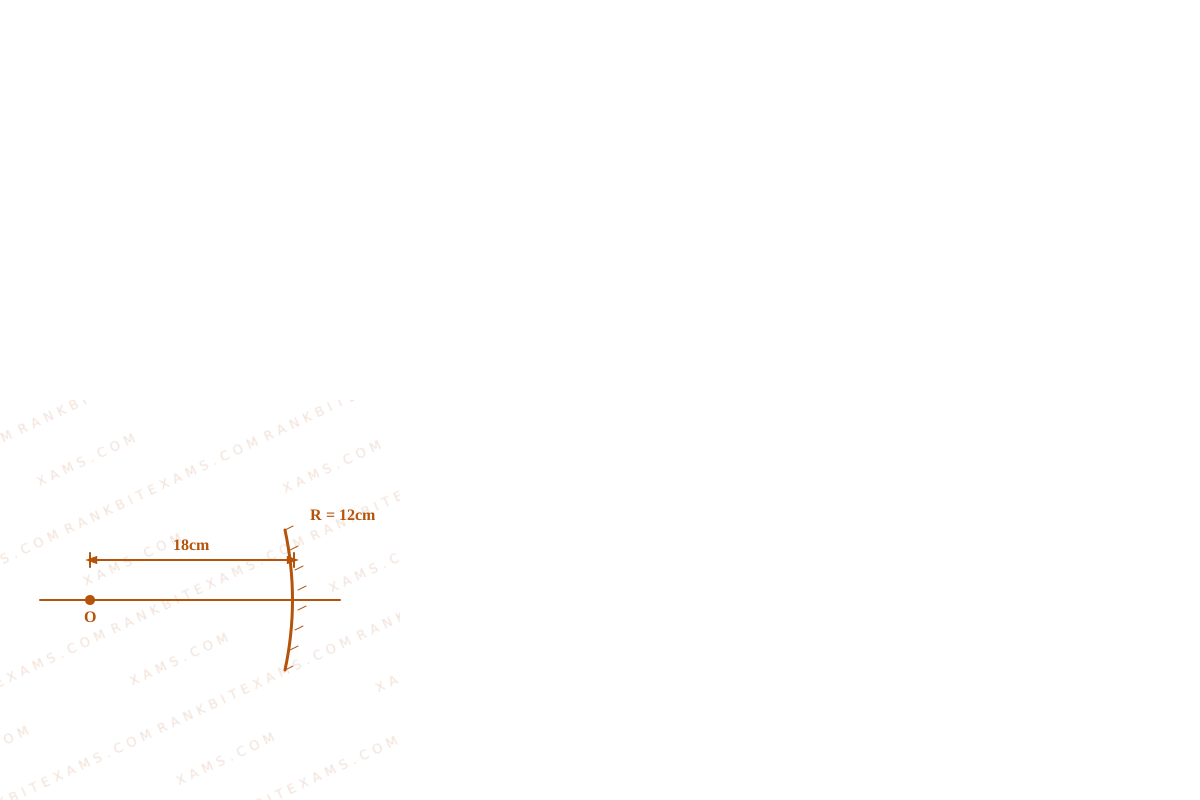
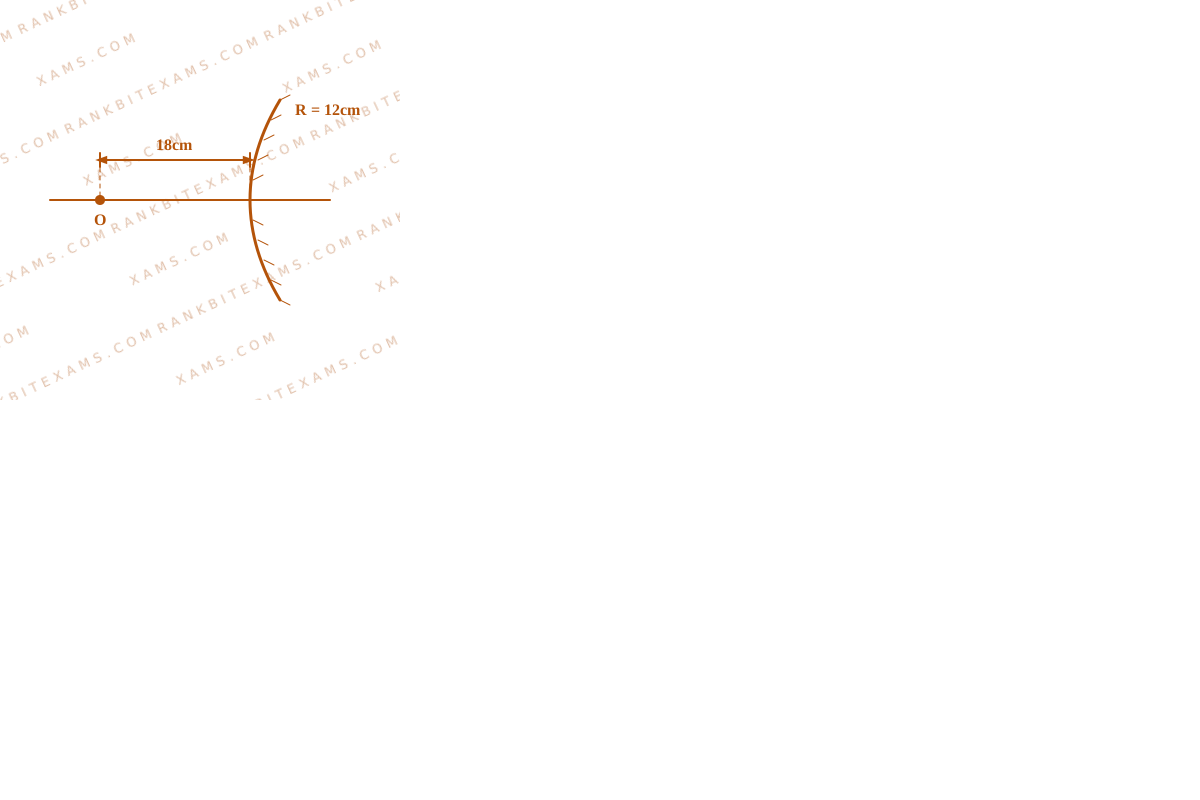
Two identical objects are placed in front of convex mirror and concave mirror having same radii of curvature of 12 \, textcm , at the same distance of 18 \, textcm from the respective mirrors. The ratio of sizes of the images formed by convex mirror and by concave mirror is:

Solution & Explanation

### Related Formula 1. Mirror focal length: f = fracR2 2. Magnification (image size relative to object size): m = frach_ih_o = fracff - u where u is the object distance. ### Core Logic Given parameters: - Radius of curvature R = 12 \ mathrmcm implies |f| = 6 \ mathrmcm - Object distance u = -18 \ mathrmcm Let's calculate magnification for both mirrors: 1. **For Convex Mirror:** - Focal length f_textconvex = +6 \ mathrmcm (using Cartesian sign convention) - Magnification: m_1 = fracf_textconvexf_textconvex - u = frac66 - (-18) = frac624 = frac14 Thus, image size is frac14 h_o. ### Step 1: Calculate magnification of concave mirror 2. **For Concave Mirror:** - Focal length f_textconcave = -6 \ mathrmcm - Magnification:
Convex and concave mirror ray diagram representations
m_2 = fracf_textconcavef_textconcave - u = frac-6-6 - (-18) = frac-612 = -frac12 Thus, image size is frac12 h_o. ### Step 2: Calculate the ratio of image sizes Since the objects are identical (same height h_o), the ratio of the sizes of the images is:
Convex and concave mirror ray diagram representations
textRatio = frac|h_i1||h_i2| = frac|m_1||m_2| = frac1/41/2 = frac12 Thus, the ratio of sizes is 1/2. ### Pattern Recognition Sees: Parallel convex vs concave mirror magnification. Trap: Reversing the signs of focal lengths (Convex focal length is +, Concave is - in standard coordinate systems). Shortcut: Use direct magnification equation m = fracff-u. For convex, m = frac624 = frac14. For concave, m = frac-612 = -frac12. Ratio of absolute values is frac1/41/2 = 1/2. ### Evaluation Rubric / Model Answer null ### Chapter Mix Class 12 Physics: Ray Optics and Optical Instruments
More Ray Optics and Optical Instruments Previous-Year Questions — Page 3

Q8 jee_main_2025_07_april_morning Refraction at Spherical Surfaces and by Lenses
A lens having refractive index 1.6 has focal length of 12mathrmcm , when it is in air. Find the focal length of the lens when it is placed in water. (Take refractive index of water as 1.28)
  • A. 355mathrmmm
  • B. 288mathrmmm
  • C. 555mathrmmm
  • D. 655mathrmmm

Solution

### Related Formula Lens Maker's Formula in a surrounding medium with refractive index mu_m is: frac1f = left( fracmu_Lmu_m - 1 right) left( frac1R_1 - frac1R_2 right) ### Core Logic In air (mu_m = 1): frac112 = (1.6 - 1) left( frac1R_1 - frac1R_2 right) frac112 = 0.6 left( frac1R_1 - frac1R_2 right) implies left( frac1R_1 - frac1R_2 right) = frac112 times 0.6 = frac1072 ### Step 1: Calculate Focal Length in Water In water (mu_m = 1.28): frac1f_w = left( frac1.61.28 - 1 right) left( frac1072 right) Simplify the relative index factor: frac1.61.28 = frac160128 = 1.25 frac1f_w = (1.25 - 1) left( frac1072 right) = 0.25 times frac1072 = frac14 times frac1072 = frac10288 f_w = 28.8 mathrm~cm = 288 mathrm~mm ### Pattern Recognition Sees: Lens index \mu_L = 1.6, focal length in air f_a, and focal length in medium f_m. Shortcut: Use the ratio of focal lengths directly: fracf_mf_a = fracmu_L - 1fracmu_Lmu_m - 1 = frac0.6frac1.61.28 - 1 = frac0.60.25 = 2.4 f_m = 2.4 times 12 = 28.8 mathrm~cm = 288 mathrm~mm$ ### Evaluation Rubric / Model Answer null ### Chapter Mix Class 12 Physics: Ray Optics and Optical Instruments

Q10 jee_main_2025_07_april_morning Refraction at Spherical Surfaces and by Lenses
Two thin convex lenses of focal lengths 30~mathrmcm and 10~mathrmcm are placed coaxially, 10~mathrmcm apart. The power of this combination is :
  • A. 5 mathrmD
  • B. 1 mathrm~D
  • C. 20mathrmD
  • D. 10mathrmD

Solution

### Related Formula The equivalent focal length f_texteq of two thin coaxially aligned lenses separated by distance d is given by: frac1f_texteq = frac1f_1 + frac1f_2 - fracdf_1 f_2 The equivalent power in diopters (D) when focal lengths are in meters is: P = frac1f_texteq ### Core Logic Given parameters: - f_1 = 30 mathrm~cm = 0.3 mathrm~m - f_2 = 10 mathrm~cm = 0.1 mathrm~m - d = 10 mathrm~cm = 0.1 mathrm~m ### Step 1: Calculate Power Substitute parameters into the equivalent focal length equation: frac1f_texteq = frac10.3 + frac10.1 - frac0.10.3 times 0.1 frac1f_texteq = frac10.3 + 10 - frac10.3 frac1f_texteq = 10 mathrm~m^-1 P = 10 mathrm~D ### Pattern Recognition Sees: Lenses separated by distance d where d = f_2. Shortcut: Notice that d = f_2 = 10 mathrm~cm. When the separation distance between two thin lenses equals the focal length of the second lens, the equivalent power simplifies directly to P = P_2 = 1/f_2 = 10 mathrm~D since the terms 1/f_1 and d/(f_1 f_2) cancel out. ### Evaluation Rubric / Model Answer null ### Chapter Mix Class 12 Physics: Ray Optics and Optical Instruments

Q jee_main_2025_08_april_evening Refraction through Lenses
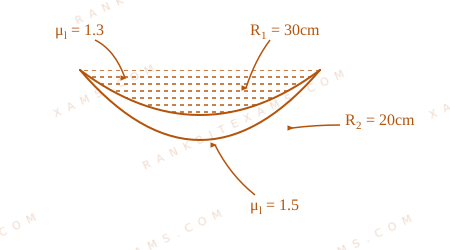
A concave-convex lens of refractive index 1.5 and the radii of curvature of its surfaces are 30mathrm~cm and 20mathrm~cm, respectively. The concave surface is upwards and is filled with a liquid of refractive index 1.3. The focal length of the liquid-glass combination will be
  • A. frac50011mathrm~cm
  • B. frac80011mathrm~cm
  • C. frac70011mathrm~cm
  • D. frac60011mathrm~cm

Solution

### Related Formula frac1f_texteq = frac1f_textliquid + frac1f_textglass frac1f = (mu - 1)left(frac1R_1 - frac1R_2right) ### Core Logic Let's find the focal length of each individual lens in the combination: 1. **Liquid Lens**: - Refractive index, mu_l = 1.3 - The upper surface is flat (exposed to air): R_1 = infty - The lower surface matches the upward concave surface of the glass lens: R_2 = -30mathrm~cm frac1f_textliquid = (1.3 - 1) left(frac1infty - frac1-30right) = 0.3 times frac130 = frac1100mathrm~cm^-1 2. **Glass Lens**: - Refractive index, mu_g = 1.5 - First surface radius (concave upward), R_1 = -30mathrm~cm - Second surface radius (convex downward), R_2 = -20mathrm~cm (following light path downward) frac1f_textglass = (1.5 - 1) left(frac1-30 - frac1-20right) = 0.5 left(-frac130 + frac120right) = 0.5 left(frac160right) = frac1120mathrm~cm^-1
Ray Optics combination diagram
### Step 1: Combination Focal Length Add the powers of both lenses: frac1f_texteq = frac1100 + frac1120 = frac6 + 5600 = frac11600 f_texteq = frac60011mathrm~cm ### Pattern Recognition Sees: Glass lens with liquid poured on top → Think of it as a double lens system (liquid lens + glass lens). Trap: Be extremely careful with sign conventions for radii of curvature of the boundaries! Assume light travels from air through the liquid and then through the glass. This defines a consistent spatial propagation direction. ✓ ### Evaluation Rubric / Model Answer null ### Chapter Mix Class 12 Physics: Ray Optics
Q12 jee_main_2025_08_april_evening Refraction through Lenses
A convex lens of focal length 30mathrm~cm is placed in contact with a concave lens of focal length 20mathrm~cm. An object is placed at 20mathrm~cm to the left of this lens system. The distance of the image from the lens in mathrm~cm is:
  • A. 30
  • B. 45
  • C. frac607
  • D. 15

Solution

### Related Formula $frac1f_texteq = frac1f_1 + frac1f_2 frac1v - frac1u = frac1f where, f_1 = focal length of the convex lens f_2 = focal length of the concave lens u = object distance v = image distance ### Core Logic Given parameters: - Convex lens: f_1 = +30\mathrm{~cm} - Concave lens: f_2 = -20\mathrm{~cm} - Object distance: u = -20\mathrm{~cm} (placed to the left of the lens system) First, find the equivalent focal length of the lens combination in contact: frac1f_texteq = frac130 + frac1-20 = frac2 - 360 = -frac160 implies f_texteq = -60mathrm~cm ### Step 1: Image Distance Calculation Use the thin lens formula: frac1v - frac1u = frac1f_texteq frac1v - frac1-20 = frac1-60 implies frac1v + frac120 = -frac160 frac1v = -frac160 - frac120 = frac-1 - 360 = -frac460 = -frac115 v = -15mathrm~cm ### Pattern Recognition Sees: Lenses in contact + object distance → Combination focal length first, then thin lens formula. Trap: Keep proper sign conventions. An object to the left implies u = -20\mathrm{~cm}. A negative image distance v = -15\mathrm{~cm} means a virtual image formed on the same side as the object. The question asks for "distance", which is the magnitude: |-15| = 15\mathrm{~cm}$. ✓ ### Evaluation Rubric / Model Answer null ### Chapter Mix Class 12 Physics: Ray Optics
Q7 jee_main_2025_29_jan_evening Cutting of Lenses
Two identical symmetric double convex lenses of focal length f are cut into two equal parts L_1, L_2 by AB plane and L_3, L_4 by XY plane as shown in figure respectively. The ratio of focal lengths of lenses L_1 and L_3 is:
Cutting of Lenses diagram for Q7 - JEE Main 2025 Evening
The figure details a convex lens being cut along the horizontal plane AB and vertical plane XY to create components L1, L2, L3, and L4.
  • A. 1:4
  • B. 1:1
  • C. 2:1
  • D. 1:2

Solution

### Related Formula frac1f = (mu - 1)left(frac1R_1 - frac1R_2right) ### Core Logic 1. **Cutting along horizontal plane AB**: When a lens is cut along its principal axis, the radius of curvature of neither surface changes. Thus, the focal length of the split parts L_1 and L_2 remains exactly equal to the initial focal length: f_L_1 = f 2. **Cutting along vertical plane XY**: When a lens is cut perpendicular to the principal axis into two symmetric plano-convex lenses, one surface becomes flat (R_2 = infty). According to Lens Maker's Formula, the focal length of parts L_3 and L_4 doubles: f_L_3 = 2f 3. **Ratio Determination**: fracf_L_1f_L_3 = fracf2f = frac12 Hence, the ratio is 1:2. ### Pattern Recognition Shortcut rule for lens cutting: - Horizontal cut (along axis) rightarrow Focal length stays f. - Vertical cut (perp to axis) rightarrow Focal length doubles to 2f. ### Evaluation Rubric / Model Answer null ### Chapter Mix Class 12 Physics: Ray Optics and Optical Instruments

More Ray Optics and Optical Instruments Questions — jee_main_2025_02_april_evening

Practice all Ray Optics and Optical Instruments previous-year questions →

Rankbit System
JEE Physics: Waves (+15.5%) | Electrostatics: Concentric Shells (-29.7%) | Modern Physics: Photoelectric Clones (+34.2%) | Mathematics: Definite Integrals (+18.1%) | Chemistry: Coordination Splitting (-11.4%) | JEE Physics: Waves (+15.5%) | Electrostatics: Concentric Shells (-29.7%) | Modern Physics: Photoelectric Clones (+34.2%) | Mathematics: Definite Integrals (+18.1%) | Chemistry: Coordination Splitting (-11.4%)