More Vector Algebra Previous-Year Questions — Page 3
Q75jee_main_2025_04_april_eveningProperties of Vectors in Triangles
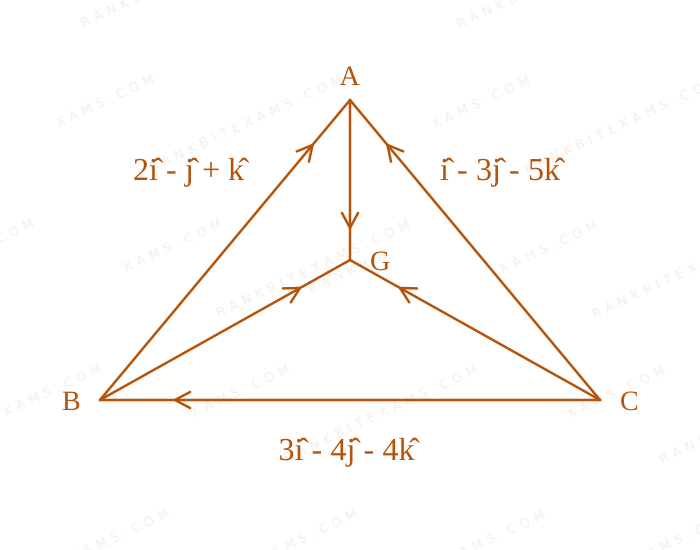
Let the three sides of a triangle ABC be given by the vectors 2hatmathbfi - hatmathbfj + hatmathbfk$2\hat{\mathbf{i}} - \hat{\mathbf{j}} + \hat{\mathbf{k}}$ , hatmathbfi - 3hatmathbfj - 5hatmathbfk$\hat{\mathbf{i}} - 3\hat{\mathbf{j}} - 5\hat{\mathbf{k}}$ and 3hatmathbfi - mathbf4hatmathbfj - mathbf4hatmathbfk$3\hat{\mathbf{i}} - \mathbf{4}\hat{\mathbf{j}} - \mathbf{4}\hat{\mathbf{k}}$ . Let G be the centroid of the triangle ABC. Then 6leftleft|overlineAGright|^2 + left|overlineBGright|^2 + left|overlineCGright|^2right)$6\left\left|\overline{AG}\right|^2 + \left|\overline{BG}\right|^2 + \left|\overline{CG}\right|^2\right)$ is equal to
Q64jee_main_2025_04_april_morningComponents of Vectors
Consider two vectors vecu = 3hati - hatj$\vec{u} = 3\hat{i} - \hat{j}$ and vecv = 2hati + hatj - lambda hatk$\vec{v} = 2\hat{i} + \hat{j} - \lambda \hat{k}$, where lambda > 0$\lambda > 0$. The angle between them is given by cos^-1left(fracsqrt52sqrt7right)$\cos^{-1}\left(\frac{\sqrt{5}}{2sqrt{7}}\right)$. Let vecv = vecv_1 + vecv_2$\vec{v} = \vec{v}_1 + \vec{v}_2$, where vecv_1$\vec{v}_1$ is parallel to vecu$\vec{u}$ and vecv_2$\vec{v}_2$ is perpendicular to vecu$\vec{u}$. Then the value |vecv_1|^2 + |vecv_2|^2$|\vec{v}_1|^2 + |\vec{v}_2|^2$ is equal to
A.frac232$\frac{23}{2}$
B. 14
C.frac252$\frac{25}{2}$
D. 10
Solution
### Related Formula
By orthogonal vector decomposition (Pythagorean property):
|vecv|^2 = |vecv_1|^2 + |vecv_2|^2 quad textwhen vecv_1 cdot vecv_2 = 0$$|\vec{v}|^2 = |\vec{v}_1|^2 + |\vec{v}_2|^2 \quad \text{when } \vec{v}_1 \cdot \vec{v}_2 = 0$$
### Core Logic
Compute lambda$\lambda$ using dot product formula:
costheta = fracvecu cdot vecv|vecu||vecv| implies fracsqrt52sqrt7 = frac3(2) + (-1)(1)sqrt3^2 + (-1)^2 sqrt2^2 + 1^2 + (-lambda)^2$$\cos\theta = \frac{\vec{u} \cdot \vec{v}}{|\vec{u}||\vec{v}|} \implies \frac{\sqrt{5}}{2\sqrt{7}} = \frac{3(2) + (-1)(1)}{\sqrt{3^2 + (-1)^2} \sqrt{2^2 + 1^2 + (-\lambda)^2}}$$fracsqrt52sqrt7 = frac5sqrt10sqrt5 + lambda^2 implies frac12sqrt7 = fracsqrt5sqrt10sqrt5 + lambda^2 = frac1sqrt2sqrt5 + lambda^2$$\frac{\sqrt{5}}{2\sqrt{7}} = \frac{5}{\sqrt{10}\sqrt{5 + \lambda^2}} \implies \frac{1}{2\sqrt{7}} = \frac{\sqrt{5}}{\sqrt{10}\sqrt{5 + \lambda^2}} = \frac{1}{\sqrt{2}\sqrt{5 + \lambda^2}}$$
### Step 1: Solve for lambda
Square both sides of equation:
frac128 = frac12(5 + lambda^2) implies 2(5 + lambda^2) = 28 implies 5 + lambda^2 = 14 implies lambda^2 = 9 implies lambda = 3$$\frac{1}{28} = \frac{1}{2(5 + \lambda^2)} \implies 2(5 + \lambda^2) = 28 \implies 5 + \lambda^2 = 14 \implies \lambda^2 = 9 \implies \lambda = 3$$
Since vecv = 2hati + hatj - 3hatk$\vec{v} = 2\hat{i} + \hat{j} - 3\hat{k}$.
### Step 2: Apply Identity
Since components are orthogonal, direct magnitude squared holds:
|vecv_1|^2 + |vecv_2|^2 = |vecv|^2 = 2^2 + 1^2 + (-3)^2 = 4 + 1 + 9 = 14$$|\vec{v}_1|^2 + |\vec{v}_2|^2 = |\vec{v}|^2 = 2^2 + 1^2 + (-3)^2 = 4 + 1 + 9 = 14$$
### Pattern Recognition
Do not waste time explicitly projecting components vecv_1$\vec{v}_1$ and vecv_2$\vec{v}_2$ if only the sum of their squared magnitudes is requested. The scalar length matches the total vector length invariant under any orthogonal basis change.
### Evaluation Rubric / Model Answer
null
### Chapter Mix
Class 12 Mathematics: Vector Algebra
Q52jee_main_2025_07_april_eveningVector Magnitude and Operations
Let veca$\vec{a}$ and vecb$\vec{b}$ be the vectors of the same magnitude such that frac|veca + vecb| + |veca - vecb||veca + vecb| - |veca - vecb| = sqrt2 + 1$\frac{|\vec{a} + \vec{b}| + |\vec{a} - \vec{b}|}{|\vec{a} + \vec{b}| - |\vec{a} - \vec{b}|} = \sqrt{2} + 1$. Then frac|veca + vecb|^2|veca|^2$\frac{|\vec{a} + \vec{b}|^2}{|\vec{a}|^2}$ is:
Q56jee_main_2025_24_jan_eveningCentroid, Orthocenter, and Circumcenter
Let the position vectors of three vertices of a \triangle be 4vecp+vecq-3vecr$4\vec{p}+\vec{q}-3\vec{r}$, -5vecp+vecq+2vecr$-5\vec{p}+\vec{q}+2\vec{r}$ and 2vecp-vecq+2vecr$2\vec{p}-\vec{q}+2\vec{r}$ If the position vectors of the orthocenter and the circumcenter of the \triangle are fracvecp+vecq+vecr4$\frac{\vec{p}+\vec{q}+\vec{r}}{4}$ and alphavecp+betavecq+gammavecr$\alpha\vec{p}+\beta\vec{q}+\gamma\vec{r}$ respectively, then alpha+2beta+5gamma$\alpha+2\beta+5\gamma$ is equal to: [cite: 3266, 3267, 3268, 3269, 3270, 3271, 3272]
A.3$3$
B.1$1$
C.6$6$
D.4$4$
Solution
### Related Formula
1. Centroid (G$G$) of a \triangle with vertices A, B, C$A, B, C$ is given by:
vecG = fracvecA + vecB + vecC3$$\vec{G} = \frac{\vec{A} + \vec{B} + \vec{C}}{3}$$
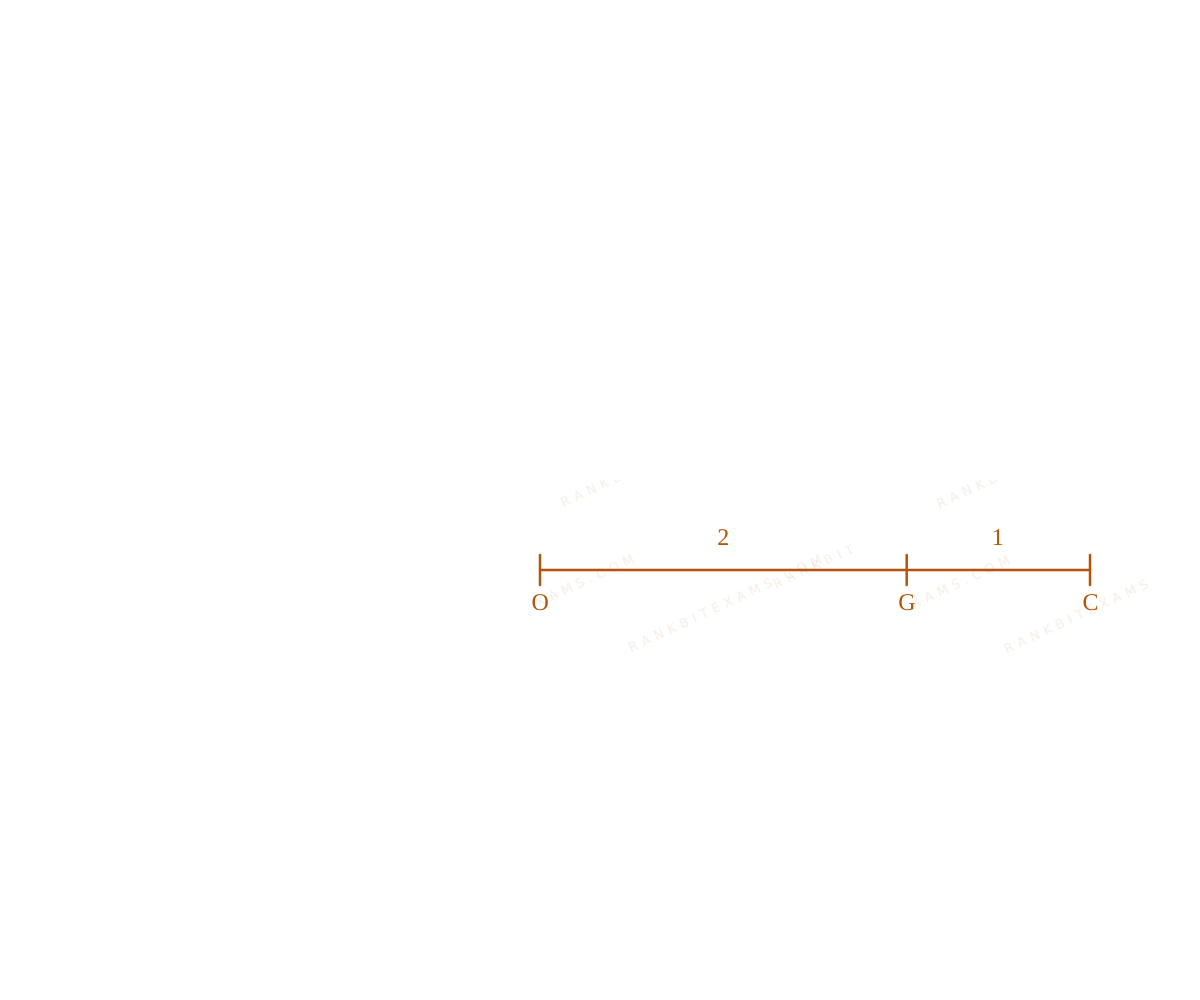
2. Euler\'s line property: The orthocenter (O$O$), centroid (G$G$), and circumcenter (C$C$) are collinear, and G$G$ divides the segment OC$OC$ internally in the ratio 2:1$2:1$.
### Step 1: Compute the Centroid Vector
Sum the vectors of the three given vertices [cite: 3266, 3268]:
vecA = 4vecp+vecq-3vecr$$\vec{A} = 4\vec{p}+\vec{q}-3\vec{r}$$vecB = -5vecp+vecq+2vecr$$\vec{B} = -5\vec{p}+\vec{q}+2\vec{r}$$vecC = 2vecp-vecq+2vecr$$\vec{C} = 2\vec{p}-\vec{q}+2\vec{r}$$vecG = frac(4 - 5 + 2)vecp + (1 + 1 - 1)vecq + (-3 + 2 + 2)vecr3 = fracvecp + vecq + vecr3$$\vec{G} = \frac{(4 - 5 + 2)\vec{p} + (1 + 1 - 1)\vec{q} + (-3 + 2 + 2)\vec{r}}{3} = \frac{\vec{p} + \vec{q} + \vec{r}}{3}$$
### Step 2: Apply Euler Line Section Ratio
Using the section formula ratio O-G-C$O-G-C$ as 2:1$2:1$ [cite: 3931, 3932]:
Euler Line section diagram for Q56 - JEE Main 2025 EveningvecG = frac2vecC + vecO3 Rightarrow 3vecG = 2vecC + vecO$$\vec{G} = \frac{2\vec{C} + \vec{O}}{3} \Rightarrow 3\vec{G} = 2\vec{C} + \vec{O}$$2vecC = 3vecG - vecO = 3left(fracvecp + vecq + vecr3right) - fracvecp + vecq + vecr4$$2\vec{C} = 3\vec{G} - \vec{O} = 3\left(\frac{\vec{p} + \vec{q} + \vec{r}}{3}\right) - \frac{\vec{p} + \vec{q} + \vec{r}}{4}$$2vecC = (vecp + vecq + vecr) - frac14(vecp + vecq + vecr) = frac34(vecp + vecq + vecr)$$2\vec{C} = (\vec{p} + \vec{q} + \vec{r}) - \frac{1}{4}(\vec{p} + \vec{q} + \vec{r}) = \frac{3}{4}(\vec{p} + \vec{q} + \vec{r})$$vecC = frac38vecp + frac38vecq + frac38vecr$$\vec{C} = \frac{3}{8}\vec{p} + \frac{3}{8}\vec{q} + \frac{3}{8}\vec{r}$$
### Step 3: Coefficient Matching
Compare with the given circumcenter format alphavecp + betavecq + gammavecr$\alpha\vec{p} + \beta\vec{q} + \gamma\vec{r}$ [cite: 3270, 3939]:
alpha = frac38, quad beta = frac38, quad gamma = frac38$$\alpha = \frac{3}{8}, \quad \beta = \frac{3}{8}, \quad \gamma = \frac{3}{8}$$
Calculate alpha + 2beta + 5gamma$\alpha + 2\beta + 5\gamma$ [cite: 3272, 3949]:
frac38 + 2left(frac38right) + 5left(frac38right) = frac3 + 6 + 158 = frac248 = 3$$\frac{3}{8} + 2\left(\frac{3}{8}\right) + 5\left(\frac{3}{8}\right) = \frac{3 + 6 + 15}{8} = \frac{24}{8} = 3$$
### Pattern Recognition
Euler line configuration is universally O-G-C$O-G-C$ in 2:1$2:1$. Remember the mnemonic 'Oil-Gas-Company' or simply 3G = 2C + O$3G = 2C + O$ to prevent swapping structural coefficients under exam stress.
### Evaluation Rubric / Model Answer
null
### Chapter Mix
Class 12 Mathematics: Vector Algebra
Class 11 Mathematics: Properties of Triangles
Q64jee_main_2025_24_jan_eveningVector Triple Product and Projection
Let veca=3hati-hatj+2hatk,$\vec{a}=3\hat{i}-\hat{j}+2\hat{k},$vecb=vecatimes(hati-2hatk)$\vec{b}=\vec{a}\times(\hat{i}-2\hat{k})$ and vecc=vecbtimeshatk$\vec{c}=\vec{b}\times\hat{k}$. Then the projection of vecc-2hatj$\vec{c}-2\hat{j}$ on veca$\vec{a}$ is: [cite: 3358, 3359, 3364]
We Map Every Repeating Question in Competitive Exams.
Say goodbye to generic mock test fatigue. RankBit uses smart analysis to group past exam questions into their foundational Repeating Question Types. Find chapter weightage, track repeating questions, and score higher with targeted practice.
Select Your Target Exam
Choose an exam track below to find formulas per chapter and patterns.
Syncing Exam Intelligence
Mapping formulas and patterns across all tracks…
PATH A — FULL LENGTH PRACTICE
Full Mock Test Hub
Simulate real NTA exam conditions with fully tracked mocks. Time yourself against past papers.
Practice past-year questions one chapter at a time. Pick an exam → subject → chapter and get every PYQ for that topic — pulled together from all past papers — with the chapter's key formulas alongside.