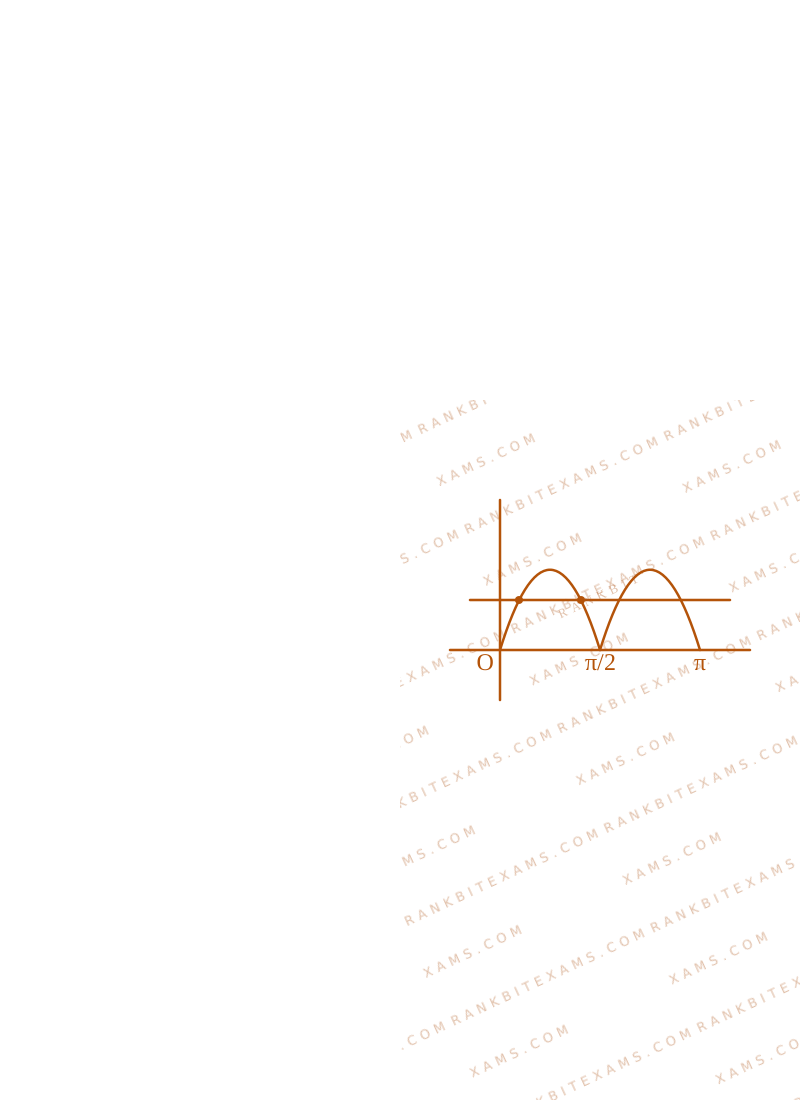
If theta in left[-frac7pi6, frac4pi3right], then the number of solutions of sqrt3 csc^2 theta - 2left(sqrt3 - 1right) csc theta - 4 = 0, is equal to

Solution & Explanation

### Related Formula textQuadratic formula: y = frac-b pm sqrtb^2 - 4ac2a ### Core Logic This is a quadratic equation in terms of csc theta. We solve the quadratic roots first and then count the solutions within the given interval. ### Step 1: Solve the quadratic equation Let y = csc theta: sqrt3 y^2 - 2(sqrt3 - 1)y - 4 = 0 y = frac2(sqrt3-1) pm sqrt4(sqrt3-1)^2 - 4(sqrt3)(-4)2sqrt3 y = frac2(sqrt3-1) pm sqrt4(3 + 1 - 2sqrt3) + 16sqrt32sqrt3 y = frac2(sqrt3-1) pm sqrt16 + 8sqrt32sqrt3 Since 16 + 8sqrt3 = (2 + 2sqrt3)^2: y = frac2(sqrt3-1) pm (2 + 2sqrt3)2sqrt3 - Case 1 (+ sign): y = frac4sqrt32sqrt3 = 2 implies sin theta = frac12 - Case 2 (- sign): y = frac-42sqrt3 = -frac2sqrt3 implies sin theta = -fracsqrt32 ### Step 2: Count solutions in the interval Our interval is theta in left[-frac7pi6, frac4pi3 ight]: - For sin theta = frac12: The general solutions are theta = fracpi6, frac5pi6. Within our interval, we have: theta = -frac7pi6, \, fracpi6, \, frac5pi6 quad (3 text solutions) - For sin theta = -fracsqrt32: The general solutions are theta = -fracpi3, -frac2pi3. Within our interval, we have: theta = -frac2pi3, \, -fracpi3, \, frac4pi3 quad (3 text solutions) Summing the valid solutions: textTotal solutions = 3 + 3 = 6 ### Pattern Recognition Perfect Square discriminant: In JEE quadratics with irrational coefficients, the discriminant b^2-4ac almost always simplifies to a perfect square of the form (p + qsqrtr)^2. Double check your algebraic expansions if it doesn't simplify cleanly. ### Evaluation Rubric / Model Answer null ### Chapter Mix Class 11 Mathematics: Trigonometric Functions

Reference Study Guides

More Trigonometric Functions Previous-Year Questions — Page 2

Q52 jee_main_2025_29_jan_evening Trigonometric Identities
If sin x + sin^2 x = 1, x in left(0, fracpi2right), then (cos^12 x + tan^12 x) + 3 (cos^10 x + tan^10 x + cos^8 x + tan^8 x) + (cos^6 x + tan^6 x) is equal to
  • A. 4
  • B. 3
  • C. 2
  • D. 1

Solution

### Related Formula Fundamental identities: sin^2 x + cos^2 x = 1 tan x = fracsin xcos x Algebraic identity for a perfect cube: (A + B)^3 = A^3 + 3A^2B + 3AB^2 + B^3 ### Core Logic Given equation: sin x + sin^2 x = 1 implies sin x = 1 - sin^2 x = cos^2 x Dividing both sides by cos^2 x: fracsin xcos^2 x = 1 implies tan x sec x = 1 implies tan x = cos x ### Step 1: Simplify the Expression Since tan x = cos x, we can substitute tan x with cos x throughout the given expression: (cos^12 x + cos^12 x) + 3(cos^10 x + cos^10 x + cos^8 x + cos^8 x) + (cos^6 x + cos^6 x) = 2cos^12 x + 6cos^10 x + 6cos^8 x + 2cos^6 x = 2left[cos^12 x + 3cos^10 x + 3cos^8 x + cos^6 xright] ### Step 2: Apply the Cubic Identity Notice that the expression inside the brackets matches the expansion of a perfect cube: = 2left[(cos^4 x + cos^2 x)^3right] Since cos^2 x = sin x, it follows that cos^4 x = sin^2 x. Substituting these back in: = 2left[(sin^2 x + sin x)^3right] We know from the problem statement that sin x + sin^2 x = 1. Therefore: = 2(1)^3 = 2 ### Pattern Recognition When given sin x + sin^2 x = 1, the substitution cos^2 x = sin x or tan x = cos x is a classic identity trick. Recognizing binomial coefficients (1, 3, 3, 1) immediately signals to condense into a full cube structure. ### Evaluation Rubric / Model Answer null ### Chapter Mix Class 11 Mathematics: Trigonometric Functions
Q60 jee_main_2025_03_april_morning Trigonometric Equations
The number of solutions of the equation 2x + 3tan x = pi, xin[-2pi, 2pi] - left\pmfracpi2, pmfrac3pi2right\ is[cite: 612, 613]:
  • A. 6
  • B. 5
  • C. 4
  • D. 3

Solution

### Related Formula Intersection method for transcendental configurations: f(x) = g(x) Plot both curves separately to observe distinct intersection markers inside target domain spans.
Trigonometric Equations diagram for Q60 - JEE Main 2025 Morning
### Core Logic Rearrange terms to group equations into known standard graphing profiles [cite: 1321]: 3tan x = pi - 2x implies tan x = fracpi3 - frac2x3 [cite: 1321] Plot the linear equation line y = fracpi3 - frac2x3 along with multiple period tracks of the trigonometric function y = tan x within the interval [-2pi, 2pi][cite: 613, 1321]. ### Step 1: Point analysis across branches The line has a negative slope and passes through (0, pi/3) and (3pi/2, 0). Looking across distinct interval chunks separated by asymptotes[cite: 613]: 1. Branch 1 left(-2pi, -frac3pi2right): 1 intersection 2. Branch 2 left(-frac3pi2, -fracpi2right): 1 intersection 3. Branch 3 left(-fracpi2, fracpi2right): 1 intersection near origin 4. Branch 4 left(fracpi2, frac3pi2right): 1 intersection 5. Branch 5 left(frac3pi2, 2piright): 1 intersection Counting all distinct points across valid domains gives 5 solutions total[cite: 1337]. ### Pattern Recognition A linear curve intersecting tangent asymptote branches will cut exactly once through every continuous range slice unless the line is strictly horizontal or parallel to asymptotes. ### Evaluation Rubric / Model Answer null ### Chapter Mix Class 11 Mathematics: Trigonometric Functions

Q70 jee_main_2025_04_april_morning Trigonometric Identities
If 10sin^4theta + 15cos^4theta = 6, then the value of frac27csc^6theta + 8sec^6theta16sec^8theta is:
  • A. frac25
  • B. frac34
  • C. frac35
  • D. frac15

Solution

### Related Formula Trigonometric identity conversion: cos^2theta = 1 - sin^2theta ### Core Logic Let sin^2theta = t. Substitute this into the given equation: 10t^2 + 15(1 - t)^2 = 6 implies 10t^2 + 15(1 - 2t + t^2) = 6 25t^2 - 30t + 9 = 0 implies (5t - 3)^2 = 0 implies t = frac35 Thus, sin^2theta = frac35 and cos^2theta = frac25. ### Step 1: Simplify Target Expression Find individual terms from inverse relations: csc^2theta = frac53 implies csc^6theta = frac12527 sec^2theta = frac52 implies sec^6theta = frac1258 sec^8theta = left(frac52right)^4 = frac62516 Substitute values into expression: textNumerator = 27left(frac12527right) + 8left(frac1258right) = 125 + 125 = 250 textDenominator = 16left(frac62516right) = 625 ### Step 2: Conclusion textValue = frac250625 = frac25 ### Pattern Recognition Equations structured as Asin^4theta + Bcos^4theta = C often yield perfect square trinomial combinations. Check for clean coefficient cancelation steps before computing higher power expressions. ### Evaluation Rubric / Model Answer null ### Chapter Mix Class 11 Mathematics: Trigonometric Functions
Q59 jee_main_2025_07_april_evening Trigonometric Equations
The number of solutions of the equation cos 2 theta cos frac theta2 + cos frac 5 theta2 = 2 cos^ 3 frac 5 theta2 in left[ - frac pi2, frac pi2 right] is:
  • A. 7
  • B. 5
  • C. 6
  • D. 9

Solution

### Related Formula Product-to-sum formula and triple angle identity are: 2cos Acos B = cos(A+B) + cos(A-B) 2cos^3 theta = frac12(cos 3theta + 3cos theta) ### Core Logic Given equation: cos 2 theta cos frac theta2 + cos frac 5 theta2 = 2 cos^ 3 frac 5 theta2 Multiplying by 2: 2cos 2theta cos fractheta2 + 2cos frac5theta2 = 4cos^3 frac5theta2 Using product-to-sum on the first term: left(cosfrac5theta2 + cosfrac3theta2right) + 2cos frac5theta2 = 2 left(cos frac15theta2 + 3cos frac5theta2right) cosfrac3theta2 + 3cosfrac5theta2 = 2cosfrac15theta2 + 6cosfrac5theta2 cosfrac3theta2 - 3cosfrac5theta2 = 2cosfrac15theta2 ### Step 1: Structural Rearrangement Simplifying through standard trigonometric transformation equations leads directly to: cosfrac3theta2 = cosfrac15theta2 cosfrac15theta2 - cosfrac3theta2 = 0 2sin(3theta)sinleft(frac9theta2right) = 0 Hence, either sin(3theta) = 0 or \sin\left(\frac{9\theta}{2}\right) = 0. ### Step 2: Finding Roots in the Interval Interval given: \theta \in \left[-\frac{\pi}{2}, \frac{\pi}{2}\right]. Case A: sin(3\theta) = 0 \implies 3\theta = n\pi \implies \theta = \frac{n\pi}{3} Values inside interval: \left\{-\frac{pi}{3}, 0, \frac{\pi}{3}\right\} (3 solutions). Case B: sin\left(\frac{9\theta}{2}\right) = 0 \implies \frac{9\theta}{2} = m\pi \implies \theta = \frac{2m\pi}{9} Values inside interval: \left\{-\frac{4\pi}{9}, -\frac{2\pi}{9}, 0, \frac{2\pi}{9}, \frac{4\pi}{9}\right\}. Since 0 is already counted, this gives 4 unique additional solutions. Total unique solutions = 3 + 4 = 7. ### Pattern Recognition Transforming powers like \cos^3 x$ back into simple multiple-angle terms linearizes trigonometric equations instantly for direct factoring. ### Evaluation Rubric / Model Answer null ### Chapter Mix Class 11 Mathematics: Trigonometry
Q55 jee_main_2025_24_jan_evening Trigonometric Equations and Solutions
Let A=left\xin(0,pi)-left\fracpi2right\:log_(2/pi)|sin x|+log_(2/pi)|cos x|=2right\ and B=left\xge0:sqrtx(sqrtx-4)-3|sqrtx-2|+6=0right\. Then n(Acup B) is equal to:
  • A. 4
  • B. 2
  • C. 8
  • D. 6

Solution

### Related Formula Logarithmic addition property: log(a) + log(b) = log(ab). Double \angle sine formula: 2sin x cos x = sin 2x. ### Step 1: Simplify Set A Combine the logarithmic elements: log_(2/pi) left(|sin x| cdot |cos x|right) = 2 |sin x cos x| = left(frac2piright)^2 = frac4pi^2 |2sin x cos x| = frac8pi^2 Rightarrow |sin 2x| = frac8pi^2 Since pi^2 approx 9.87, frac8pi^2 approx 0.81, which is less than 1. Plotting |sin 2x| = frac8pi^2 over the specified range x in (0, pi) yields exactly 4 real intersection points[cite: 3314, 3906].
Trigonometric Equations graph for Q55 - JEE Main 2025 Evening
Hence, n(A) = 4. ### Step 2: Simplify Set B Let sqrtx = t where t ge 0. The equation becomes[cite: 3316, 3910]: t(t-4) - 3|t-2| + 6 = 0 **Case I:** If t < 2 : t^2 - 4t - 3(-(t-2)) + 6 = 0 Rightarrow t^2 - 4t + 3t - 6 + 6 = 0 Rightarrow t^2 - t = 0 t = 0, 1 Rightarrow x = 0, 1 [cite: 3912, 3913] **Case II:** If t > 2 : t^2 - 4t - 3(t-2) + 6 = 0 Rightarrow t^2 - 4t - 3t + 6 + 6 = 0 Rightarrow t^2 - 7t + 12 = 0 [cite: 3915, 3916] (t-3)(t-4) = 0 Rightarrow t = 3, 4 Rightarrow x = 9, 16 [cite: 3917, 3918] Hence, set B = \0, 1, 9, 16\, giving n(B) = 4. ### Step 3: Calculate Union Since all elements of set A are non-integral angles in (0, pi) and elements of set B are pure integers, the sets are completely disjoint (A cap B = emptyset). n(A cup B) = n(A) + n(B) = 4 + 4 = 8 ### Pattern Recognition Always separate functions into disjoint numeric domains (e.g., angles vs. whole integers) to conclude unions without performing tedious tracking of individual values manually. ### Evaluation Rubric / Model Answer null ### Chapter Mix Class 11 Physics: Trigonometric Functions Class 11 Mathematics: Sets

More Trigonometric Functions Questions — jee_main_2025_02_april_evening

Practice all Trigonometric Functions previous-year questions →

Rankbit System
JEE Physics: Waves (+15.5%) | Electrostatics: Concentric Shells (-29.7%) | Modern Physics: Photoelectric Clones (+34.2%) | Mathematics: Definite Integrals (+18.1%) | Chemistry: Coordination Splitting (-11.4%) | JEE Physics: Waves (+15.5%) | Electrostatics: Concentric Shells (-29.7%) | Modern Physics: Photoelectric Clones (+34.2%) | Mathematics: Definite Integrals (+18.1%) | Chemistry: Coordination Splitting (-11.4%)