The number of terms of an A.P. is even; the sum of all the odd terms is 24, the sum of all the even terms is 30 and the last term exceeds the first by frac212$\frac{21}{2}$. Then the number of terms which are integers in the A.P. is :
A.4
B.10
C.6
D.8
Solution & Explanation
### Related Formula
textSum of an A.P.: S_k = frack2 left( 2a + (k-1)d right)$$\text{Sum of an A.P.: } S_k = \frac{k}{2} \left( 2a + (k-1)d \right)$$textGeneral term of an A.P.: a_k = a_1 + (k-1)d$$\text{General term of an A.P.: } a_k = a_1 + (k-1)d$$
### Core Logic
Let the A.P. have n$n$ terms (where n$n$ is even). The terms are divided into n/2$n/2$ odd-indexed terms and n/2$n/2$ even-indexed terms.
### Step 1: Set up the even and odd sums
Sum of even terms:
a_2 + a_4 + dots + a_n = 30 quad text--- (1)$$a_2 + a_4 + \dots + a_n = 30 \quad \text{--- (1)}$$
Sum of odd terms:
a_1 + a_3 + dots + a_n-1 = 24 quad text--- (2)$$a_1 + a_3 + \dots + a_{n-1} = 24 \quad \text{--- (2)}$$
Subtracting equation (2) from (1):
(a_2 - a_1) + (a_4 - a_3) + dots + (a_n - a_n-1) = 30 - 24 = 6$$(a_2 - a_1) + (a_4 - a_3) + \dots + (a_n - a_{n-1}) = 30 - 24 = 6$$
Since there are n/2$n/2$ such pairs, and the difference of adjacent terms is the common difference d$d$:
fracn2 d = 6 implies n d = 12 quad text--- (3)$$\frac{n}{2} d = 6 \implies n d = 12 \quad \text{--- (3)}$$
### Step 2: Solve for n and d
We are given that the last term exceeds the first by frac212$\frac{21}{2}$:
a_n - a_1 = (n-1)d = frac212$$a_n - a_1 = (n-1)d = \frac{21}{2}$$n d - d = 10.5$n d - d = 10.5$
Substitute nd = 12$nd = 12$ from (3):
12 - d = 10.5 implies d = 1.5 = frac32$$12 - d = 10.5 \implies d = 1.5 = \frac{3}{2}$$
Using this in (3):
n left(frac32right) = 12 implies n = 8$$n \left(\frac{3}{2}\right) = 12 \implies n = 8$$
### Step 3: Solve for the first term
The sum of the odd terms is:
S_textodd = frac42 left[ 2a_1 + (4-1)(2d) right] = 24$$S_{\text{odd}} = \frac{4}{2} \left[ 2a_1 + (4-1)(2d) \right] = 24$$2 left[ 2a_1 + 3(3) right] = 24 implies 2a_1 + 9 = 12 implies a_1 = 1.5 = frac32$$2 \left[ 2a_1 + 3(3) \right] = 24 \implies 2a_1 + 9 = 12 \implies a_1 = 1.5 = \frac{3}{2}$$
Thus, the terms are:
frac32, \, 3, \, frac92, \, 6, \, frac152, \, 9, \, frac212, \, 12$$\frac{3}{2}, \, 3, \, \frac{9}{2}, \, 6, \, \frac{15}{2}, \, 9, \, \frac{21}{2}, \, 12$$
The terms that are integers are 3, 6, 9, 12$3, 6, 9, 12$. The total number of integer terms is 4.
### Pattern Recognition
Sum of even terms minus sum of odd terms in any A.P. with an even number of terms n$n$ is always equal to fracn2 d$\frac{n}{2} d$. This is an extremely useful relation to remember.
### Evaluation Rubric / Model Answer
null
### Chapter Mix
Class 11 Mathematics: Sequences and Series
Keywords:#arithmetic progression even odd sums#JEE Main 2025 Evening Q53#common difference term progression#integer terms counting sequences
More Sequences and Series Previous-Year Questions — Page 2
Q70jee_main_2025_03_april_eveningSpecial Series
The sum 1 + frac1+32! + frac1+3+53! + frac1+3+5+74! + dots$1 + \frac{1+3}{2!} + \frac{1+3+5}{3!} + \frac{1+3+5+7}{4!} + \dots$ is equal to
A.6e$6e$
B.4e$4e$
C.3e$3e$
D.2e$2e$
Solution
### Related Formula
Sum of first r$r$ odd natural numbers:
sum_k=1^r (2k-1) = r^2$$\sum_{k=1}^{r} (2k-1) = r^2$$
Exponential series expansion:
sum_r=0^infty frac1r! = e$$\sum_{r=0}^{\infty} \frac{1}{r!} = e$$
### Core Logic
Let's find the general r$r$-th term of the series:
T_r = frac1 + 3 + 5 + dots + (2r-1)r! = fracr^2r! = fracr(r-1)!$$T_r = \frac{1 + 3 + 5 + \dots + (2r-1)}{r!} = \frac{r^2}{r!} = \frac{r}{(r-1)!}$$
### Step 1: Expressing term in terms of sum limits
Let's write r = (r-1) + 1$r = (r-1) + 1$:
T_r = fracr-1+1(r-1)! = frac1(r-2)! + frac1(r-1)!$$T_r = \frac{r-1+1}{(r-1)!} = \frac{1}{(r-2)!} + \frac{1}{(r-1)!}$$
Our infinite sum is:
S = sum_r=1^infty T_r = sum_r=2^infty frac1(r-2)! + sum_r=1^infty frac1(r-1)!$$S = \sum_{r=1}^{\infty} T_r = \sum_{r=2}^{\infty} \frac{1}{(r-2)!} + \sum_{r=1}^{\infty} \frac{1}{(r-1)!}$$
Both sums are standard representations of the exponential expansion.
### Step 2: Summing the parts
- First part: sum_r=2^infty frac1(r-2)! = 1 + frac11! + frac12! + dots = e$\sum_{r=2}^{\infty} \frac{1}{(r-2)!} = 1 + \frac{1}{1!} + \frac{1}{2!} + \dots = e$
- Second part: sum_r=1^infty frac1(r-1)! = 1 + frac11! + frac12! + dots = e$\sum_{r=1}^{\infty} \frac{1}{(r-1)!} = 1 + \frac{1}{1!} + \frac{1}{2!} + \dots = e$textTotal Sum S = e + e = 2e$$\text{Total Sum } S = e + e = 2e$$
### Pattern Recognition
The general term containing r^2$r^2$ in summation with factorials converges to 2e$2e$. Remember the shortcut: sum fracr^2r! = 2e$\sum \frac{r^2}{r!} = 2e$, sum fracr^3r! = 5e$\sum \frac{r^3}{r!} = 5e$. It is extremely useful to memorize these common limits.
### Evaluation Rubric / Model Answer
null
### Chapter Mix
Class 11 Mathematics: Sequences and Series
Class 12 Mathematics: Limits, Continuity and Differentiability
Let mathbfx_1, mathbfx_2, mathbfx_3, mathbfx_4$\mathbf{x}_1, \mathbf{x}_2, \mathbf{x}_3, \mathbf{x}_4$ be in a geometric progression. If 2, 7, 9, 5 are subtracted respectively from mathbfx_1, mathbfx_2, mathbfx_3, mathbfx_4$\mathbf{x}_1, \mathbf{x}_2, \mathbf{x}_3, \mathbf{x}_4$ then the resulting numbers are in an arithmetic progression. Then the value of frac124 (mathbfx_1 mathbfx_2 mathbfx_3 mathbfx_4)$\frac{1}{24} (\mathbf{x}_1 \mathbf{x}_2 \mathbf{x}_3 \mathbf{x}_4)$ is:
A.72$72$
B.18$18$
C.36$36$
D.216$216$
Solution
### Related Formula
For a geometric progression, the terms can be set as a, ar, ar^2, ar^3$a, ar, ar^2, ar^3$.
For three terms A, B, C$A, B, C$ to be in arithmetic progression, they must satisfy:
2B = A + C$2B = A + C$
### Core Logic
Let the elements be x_1 = a, x_2 = ar, x_3 = ar^2, x_4 = ar^3$x_1 = a, x_2 = ar, x_3 = ar^2, x_4 = ar^3$.
After the specified subtractions, the sequence becomes:
a - 2, quad ar - 7, quad ar^2 - 9, quad ar^3 - 5$$a - 2, \quad ar - 7, \quad ar^2 - 9, \quad ar^3 - 5$$
Since this sequence is in AP, we form two separate common difference linear linkages:
2(ar - 7) = (a - 2) + (ar^2 - 9) implies 2ar - 14 = ar^2 + a - 11 implies ar^2 - 2ar + a + 3 = 0 quad dots (1)$$2(ar - 7) = (a - 2) + (ar^2 - 9) \implies 2ar - 14 = ar^2 + a - 11 \implies ar^2 - 2ar + a + 3 = 0 \quad \dots (1)$$2(ar^2 - 9) = (ar - 7) + (ar^3 - 5) implies 2ar^2 - 18 = ar^3 + ar - 12 implies ar^3 - 2ar^2 + ar + 6 = 0 quad dots (2)$$2(ar^2 - 9) = (ar - 7) + (ar^3 - 5) \implies 2ar^2 - 18 = ar^3 + ar - 12 \implies ar^3 - 2ar^2 + ar + 6 = 0 \quad \dots (2)$$
### Step 1: Solve the Simultaneous Polynomials
Multiply equation (1) by r$r$:
ar^3 - 2ar^2 + ar + 3r = 0 quad dots (3)$$ar^3 - 2ar^2 + ar + 3r = 0 \quad \dots (3)$$
Subtract equation (3) from equation (2):
(ar^3 - 2ar^2 + ar + 6) - (ar^3 - 2ar^2 + ar + 3r) = 0$$(ar^3 - 2ar^2 + ar + 6) - (ar^3 - 2ar^2 + ar + 3r) = 0$$6 - 3r = 0 implies 3r = 6 implies r = 2$$6 - 3r = 0 \implies 3r = 6 \implies r = 2$$
Substitute r = 2$r = 2$ back into equation (1):
a(2)^2 - 2a(2) + a + 3 = 0$$a(2)^2 - 2a(2) + a + 3 = 0$$4a - 4a + a + 3 = 0 implies a = -3$$4a - 4a + a + 3 = 0 \implies a = -3$$
### Step 2: Find the Continuous Product Value
The continuous product term is:
mathbfx_1mathbfx_2mathbfx_3mathbfx_4 = a cdot ar cdot ar^2 cdot ar^3 = a^4 r^6$$\mathbf{x}_1\mathbf{x}_2\mathbf{x}_3\mathbf{x}_4 = a \cdot ar \cdot ar^2 \cdot ar^3 = a^4 r^6$$mathbfx_1mathbfx_2mathbfx_3mathbfx_4 = (-3)^4 cdot (2)^6 = 81 times 64 = 5184$$\mathbf{x}_1\mathbf{x}_2\mathbf{x}_3\mathbf{x}_4 = (-3)^4 \cdot (2)^6 = 81 \times 64 = 5184$$
Now divide by 24 as required:
frac124(5184) = 216$$\frac{1}{24}(5184) = 216$$
### Pattern Recognition
Notice that multiplying the first AP condition equation by r$r$ perfectly mimics the structure of the second condition equation except for the absolute scalar value, allowing direct elimination of all polynomial variable indices simultaneously.
### Evaluation Rubric / Model Answer
null
### Chapter Mix
Class 11 Mathematics: Sequences and Series
Let mathbfS = mathbfN cup \0\$\mathbf{S} = \mathbf{N} \cup \{0\}$. Define a relation \mathbf{R} from mathbfS$\mathbf{S}$ to mathbfR$\mathbf{R}$ by:
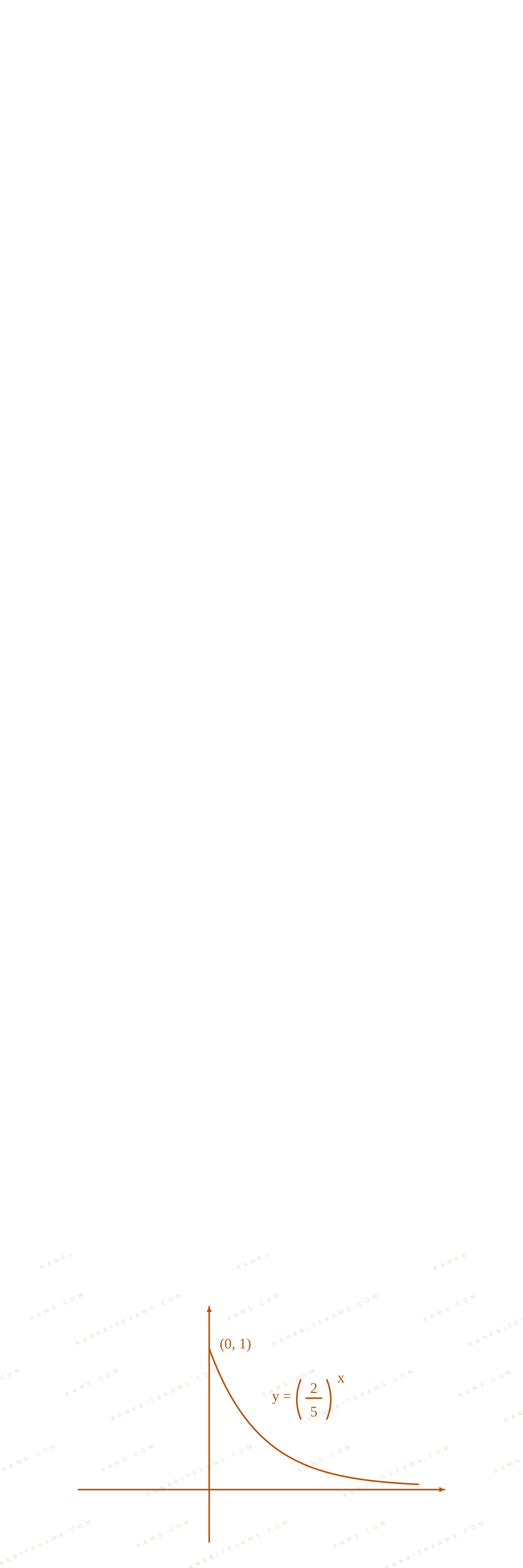
mathbfR = left\left(x, yright): log_e y = x log_e left(frac25right), x in S, y in R right\.$$\mathbf{R} = \left\{\left(x, y\right): \log_{e} y = x \log_{e} \left(\frac{2}{5}\right), x \in S, y \in R \right\}.$$
Then, the sum of all the elements in the range of mathbfR$\mathbf{R}$ is equal to
A.frac32$\frac{3}{2}$
B.frac53$\frac{5}{3}$
C.frac109$\frac{10}{9}$
D.frac52$\frac{5}{2}$
Solution
### Related Formula
Sum of an infinite geometric progression with |r| < 1$|r| < 1$:
S_infty = fraca1 - r$$S_{\infty} = \frac{a}{1 - r}$$
### Core Logic
From the definition of the relation:
log_e y = x log_eleft(frac25
ight) implies log_e y = log_eleft(frac25right)^x implies y = left(frac25
ight)^x$$\log_e y = x \log_e\left(\frac{2}{5}
ight) \implies \log_e y = \log_e\left(\frac{2}{5}\right)^x \implies y = \left(\frac{2}{5}
ight)^x$$Infinite Geometric Progression diagram for Q57 - JEE Main 2025 Evening
Since x in S = \0, 1, 2, 3, dots\$x \in S = \{0, 1, 2, 3, \dots\}$, the output values of y$y$ represent elements of the range.
### Step 1: Compute Infinite Sum
Generating elements by plugging in values of x$x$:
For x = 0 implies y = 1$x = 0 \implies y = 1$
For x = 1 implies y = frac25$x = 1 \implies y = \frac{2}{5}$
For x = 2 implies y = left(frac25
ight)^2$x = 2 \implies y = \left(\frac{2}{5}
ight)^2$
Sum of elements in the range:
textSum = 1 + left(frac25
ight)^1 + left(frac25
ight)^2 + dots = frac11 - frac25 = frac53$$\text{Sum} = 1 + \left(\frac{2}{5}
ight)^1 + \left(\frac{2}{5}
ight)^2 + \dots = \frac{1}{1 - \frac{2}{5}} = \frac{5}{3}$$
### Pattern Recognition
Convert log equations into standard exponential equations right away. A variable index belonging to whole numbers indicates an infinite GP summation scenario.
### Evaluation Rubric / Model Answer
null
### Chapter Mix
Class 11 Mathematics: Sequences and Series
Class 11 Mathematics: Relations and Functions
We Map Every Repeating Question in Competitive Exams.
Say goodbye to generic mock test fatigue. RankBit uses smart analysis to group past exam questions into their foundational Repeating Question Types. Find chapter weightage, track repeating questions, and score higher with targeted practice.
Select Your Target Exam
Choose an exam track below to find formulas per chapter and patterns.
Syncing Exam Intelligence
Mapping formulas and patterns across all tracks…
PATH A — FULL LENGTH PRACTICE
Full Mock Test Hub
Simulate real NTA exam conditions with fully tracked mocks. Time yourself against past papers.
Practice past-year questions one chapter at a time. Pick an exam → subject → chapter and get every PYQ for that topic — pulled together from all past papers — with the chapter's key formulas alongside.