JEE Main · Mathematics → Steady

Permutations and Combinations appeared 40 times across 3 years — 4.6% of Mathematics. This question is from Arrangements.

Year 2026 2025 2024 Total
Questions 13 19 8 40

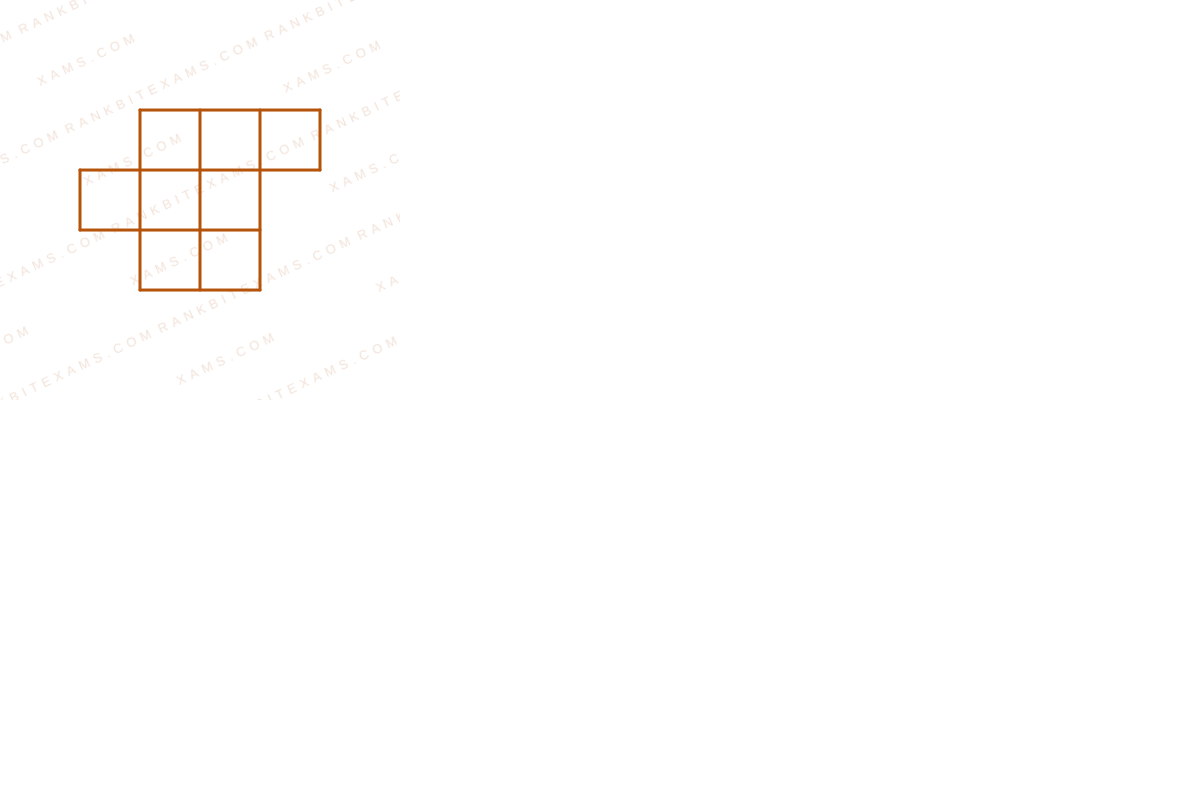
The number of ways, in which the letters A, B, C, D, E can be placed in the 8 boxes of the figure below so that no row remains empty and at most one letter can be placed in a box, is:
Boxes layout diagram for Q66 - JEE Main 2025 Evening
The grid diagram shows 8 boxes arranged in three horizontal rows of sizes 3, 2, and 3.

Solution & Explanation

Related Formula
Number of arrangements of r items in n boxes = nr · r!
Core Logic

This is a permutations problem with row constraints. We compute the total arrangements of placing 5 distinct letters into 8 boxes and then subtract the invalid cases where one or more rows are left completely empty.

Step 1: Compute total unrestricted arrangements

The grid has a total of 8 boxes. We have 5 distinct letters (A, B, C, D, E):

Total unrestricted arrangements = 85 · 5! = 56 · 120 = 6720
Step 2: Identify and subtract the invalid empty-row cases

Let the rows be R₁, R₂, and R₃, with box counts 3, 2, and 3 respectively. Since we must distribute 5 letters, it is impossible for 2 rows to be empty simultaneously (as the remaining single row would have at most 3 boxes, which cannot fit 5 letters). Thus, we only subtract cases where exactly one row is empty:

  • Case 1: Row R₁ (3 boxes) is empty. The 5 letters must go to the remaining 5 boxes of R₂ and R₃:
Ways = 55 · 5! = 120
  • Case 2: Row R₃ (3 boxes) is empty. Same as Case 1, the 5 letters must go to the remaining 5 boxes of R₁ and R₂:
Ways = 55 · 5! = 120
  • Case 3: Row R₂ (2 boxes) is empty. The 5 letters must go to the remaining 6 boxes of R₁ and R₃:
Ways = 65 · 5! = 6 · 120 = 720
Step 3: Calculate the final valid arrangements

Subtracting all empty-row cases from the total arrangements:

Valid arrangements = 6720 - (120 + 120 + 720) = 6720 - 960 = 5760
Pattern Recognition

Inclusion-Exclusion Principle: For distribution problems with simple boundary exclusions, subtracting the complement set (invalid configurations) is mathematically much cleaner than calculating all possible partitions of row assignments.

Chapter Mix

Class 11 Mathematics: Permutations and Combinations

Reference Study Guides

More Permutations and Combinations Previous-Year Questions — Page 7

Q56 jee_main_2025_29_jan_morning Distribution into Groups
Let P be the set of seven digit numbers with sum of their digits equal to 11. If the numbers in P are formed by using the digits 1, 2 and 3 only, then the number of elements in the set P is :
  • A. 158
  • B. 173
  • C. 164
  • D. 161

Solution

Related Formula
Number of permutations of multinomial set = (n!)/(n₁! n₂! )
Core Logic

Let the 7 digits be formed using 1s, 2s, and 3s. We seek combinations whose sum is 11. Since minimum value for 7 digits using '1' is 7, we evaluate the distribution of surplus elements (11 - 7 = 4 remaining to add).

Case 1: Using five 1s and two 3s

Digits: 1, 1, 1, 1, 1, 3, 3

Total numbers = (7!)/(5! 2!) = 21
Case 2: Using four 1s, two 2s, and one 3

Digits: 1, 1, 1, 1, 2, 2, 3

Total numbers = (7!)/(4! 2! 1!) = 105
Case 3: Using three 1s and four 2s

Digits: 1, 1, 1, 2, 2, 2, 2

Total numbers = (7!)/(3! 4!) = 35
Step 1: Summing the Total Cases
Total elements = 21 + 105 + 35 = 161
Pattern Recognition

Always set a base state (e.g., all 1s) to compute the baseline sum, then distribute the remainder explicitly via integer partitions to verify all distinct permutation paths systematically.

Chapter Mix

Class 11 Mathematics: Permutations and Combinations

Q74 jee_main_2025_29_jan_morning Permutations with Repetition
The number of 6-letter words, with or without meaning, that can be formed using the letters of the word MATHS such that any letter that appears in the word must appear at least twice, is
Numerical Answer. Answer: 1405

Solution

Related Formula
Total Words = Σ Permutations of each selection partition distribution case
Core Logic

The word MATHS has 5 distinct letters: {M, A, T, H, S}. We need to form 6-letter words such that any chosen letter appears ≥ 2 \times. We analyze combinations by structural frequency cases.

Case 1: Single letter used 6 \times

Format: a a a a a a Choose 1 letter out of 5: 51 = 5 words.

Case 2: Two distinct letters used

Subcase 2a: One letter 4 \times, another 2 \times (aaaa bb)

Words = 52 × ( (6!)/(4! 2!) × 2! ) = 10 × (15 × 2) = 300

Subcase 2b: Both letters used 3 \times each (aaa bbb)

Words = 52 × (6!)/(3! 3!) = 10 × 20 = 200

Total for Case 2 = 300 + 200 = 500 words.

Case 3: Three distinct letters used

Format: Each letter appears exactly 2 \times (aa bb cc)

Words = 53 × (6!)/(2! 2! 2!) = 10 × 90 = 900 words.
Step 1: Calculate Total Words
Total Words = 5 + 500 + 900 = 1405
Pattern Recognition

When constraints enforce frequencies ≥ 2, organize calculations strictly by number of distinct letters to cover all possibilities without overcounting.

Chapter Mix

Class 11 Mathematics: Permutations and Combinations

Q5 jee_main_2024_01_february_morning Partitioning of Objects
If n is the number of ways five different employees can sit into four indistinguishable offices where any office may have any number of persons including zero, then n is equal to:
  • A. 47
  • B. 53
  • C. 51
  • D. 43

Solution

Related Formula

The number of ways to distribute m distinct items into k indistinguishable groups is given by the sum of Stirling numbers of the second kind:

Σr=1k S(m, r)
Core Logic

Since the offices are indistinguishable, we look at partitions of the number 5 into at most 4 parts. Let's analyze each case based on distribution patterns:

Step 1: Calculate Case Combinations
  • Case 1: 5, 0, 0, 0
  • All employees in one office: (5!)/(5!) = 1 way

  • Case 2: 4, 1, 0, 0
  • Four employees in one office, one in another: (5!)/(4!1!) = 5 ways

  • Case 3: 3, 2, 0, 0
  • Three employees in one office, two in another: (5!)/(3!2!) = 10 ways

  • Case 4: 3, 1, 1, 0
  • Three in one, and one each in two other offices. Since the two single-person offices are identical:

(5!)/(3!1!1! · 2!) = 10 ways
  • Case 5: 2, 2, 1, 0
  • Two groups of two, and one group of one. Since the two two-person offices are identical:

(5!)/(2!2!1! · 2!) = 15 ways
  • Case 6: 2, 1, 1, 1
  • One group of two, three groups of one. Since the three single-person offices are identical:

5!2!(1!)³ · 3! = 10 ways
Step 2: Total Sum

Summing all these distinct non-overlapping partition groups:

Total ways n = 1 + 5 + 10 + 10 + 15 + 10 = 51
Pattern Recognition

Sees: Distinct items placed into identical/indistinguishable containers. Trap: When dividing items into groups of equal sizes (like two groups of 2 or three groups of 1), you must divide by the factorial of the frequency of those groups (2! and 3!) to avoid overcounting permutations.

Chapter Mix

Class 11 Mathematics: Permutations and Combinations

Q22 jee_main_2024_01_february_morning Integral Solutions of Equations
The number of elements in the set S = (x, y, z): x,y,z in Z, x + 2y + 3z = 42, x, y, z ≥ 0 equals
Numerical Answer. Answer: 169 to 169

Solution

Related Formula

For a linear equation x + 2y = k, where x, y ≥ 0 are non-negative integers, the number of distinct integral pairs (x,y) is equal to the number of possible non-negative values that y can take, which is given by:

(k)/(2) + 1
Core Logic

We need to find the number of non-negative integer solutions to:

x + 2y + 3z = 42

Rearranging the equation to analyze values branch-by-branch based on z:

x + 2y = 42 - 3z

Since x, y ≥ 0, the maximum value z can attain corresponds to x=0, y=0, so 3z ≤ 42 z ≤ 14.

Step 1: Enumerate Values across all z configurations

Let's count the possible solutions for each integer value of z from 0 to 14:

  • z = 0 x + 2y = 42 42/2 + 1 = 22 solutions
  • z = 1 x + 2y = 39 39/2 + 1 = 20 solutions
  • z = 2 x + 2y = 36 36/2 + 1 = 19 solutions
  • z = 3 x + 2y = 33 33/2 + 1 = 17 solutions
  • z = 4 x + 2y = 30 30/2 + 1 = 16 solutions
  • z = 5 x + 2y = 27 27/2 + 1 = 14 solutions
  • z = 6 x + 2y = 24 24/2 + 1 = 13 solutions
  • z = 7 x + 2y = 21 21/2 + 1 = 11 solutions
  • z = 8 x + 2y = 18 18/2 + 1 = 10 solutions
  • z = 9 x + 2y = 15 15/2 + 1 = 8 solutions
  • z = 10 x + 2y = 12 12/2 + 1 = 7 solutions
  • z = 11 x + 2y = 9 9/2 + 1 = 5 solutions
  • z = 12 x + 2y = 6 6/2 + 1 = 4 solutions
  • z = 13 x + 2y = 3 3/2 + 1 = 2 solutions
  • z = 14 x + 2y = 0 0/2 + 1 = 1 solution
Step 2: Total Sum Computation

Summing all the calculated distribution counts:

Total solutions = 22 + 20 + 19 + 17 + 16 + 14 + 13 + 11 + 10 + 8 + 7 + 5 + 4 + 2 + 1 = 169
Pattern Recognition

Sees: Linear multi-variable diophantine solution constraints. Shortcut: Grouping into alternating arithmetic sequences can expedite the total calculation step instead of adding each discrete integer row manually.

Chapter Mix

Class 11 Mathematics: Permutations and Combinations

Q2 jee_main_2024_29_january_evening Partitioning of Identical Objects
Number of ways of arranging 8 identical books into 4 identical shelves where any number of shelves may remain empty is equal to
  • A. 18
  • B. 16
  • C. 12
  • D. 15

Solution

Related Formula

Since both the objects (books) and the containers (shelves) are identical, this problem is equivalent to finding the number of partitions of the integer 8 into at most 4 parts.

Core Logic

Let us systematically list out all the possible distributions based on the number of empty shelves:

  • 3 Shelves empty:
  • (8, 0, 0, 0) arrow 1 way
  • 2 Shelves empty:
  • (7, 1, 0, 0)
  • (6, 2, 0, 0)
  • (5, 3, 0, 0)
  • (4, 4, 0, 0) arrow 4 ways
  • 1 Shelf empty:
  • (6, 1, 1, 0)
  • (5, 2, 1, 0)
  • (4, 3, 1, 0)
  • (4, 2, 2, 0)
  • (3, 3, 2, 0) arrow 5 ways
  • 0 Shelves empty:
  • (5, 1, 1, 1)
  • (4, 2, 1, 1)
  • (3, 3, 1, 1)
  • (3, 2, 2, 1)
  • (2, 2, 2, 2) arrow 5 ways
Step 1: Total Computations

Summing all these cases together:

Total ways = 1 + 4 + 5 + 5 = 15 ways
Pattern Recognition

Be very careful to identify if containers/objects are identical or distinct. Identical into identical means simple partition of integers. Listing them in descending order ensures no partition is missed or duplicated.

Chapter Mix

Class 11 Mathematics: Permutations and Combinations

More Permutations and Combinations Questions — jee_main_2025_02_april_evening

Practice all Permutations and Combinations previous-year questions →

Rankbit System
JEE Physics: Waves (+15.5%) | Electrostatics: Concentric Shells (-29.7%) | Modern Physics: Photoelectric Clones (+34.2%) | Mathematics: Definite Integrals (+18.1%) | Chemistry: Coordination Splitting (-11.4%) | JEE Physics: Waves (+15.5%) | Electrostatics: Concentric Shells (-29.7%) | Modern Physics: Photoelectric Clones (+34.2%) | Mathematics: Definite Integrals (+18.1%) | Chemistry: Coordination Splitting (-11.4%)