Consider the following sequence of reactions:
CH₃-CH₂-CH₂-CH(Br)-CH₃ alcoholic KOH P (Major Product) Br₂ Q$$\mathrm{CH_3-CH_2-CH_2-CH(Br)-CH_3} \xrightarrow{\text{alcoholic KOH}} \mathrm{P} \text{ (Major Product)} \xrightarrow{\mathrm{Br_2}} \mathrm{Q}$$
Consider the above sequence of reactions. 151~g$151~\mathrm{g}$ of 2-bromopentane is made to react. Yield of major product P$\mathrm{P}$ is 80%$80\%$ whereas Q$\mathrm{Q}$ is 100%$100\%$.
Mass of product Q$\mathrm{Q}$ obtained is _______ g.
Given molar mass in g~mol⁻¹$\mathrm{g~mol^{-1}}$ H: 1, C: 12, O: 16, Br: 80
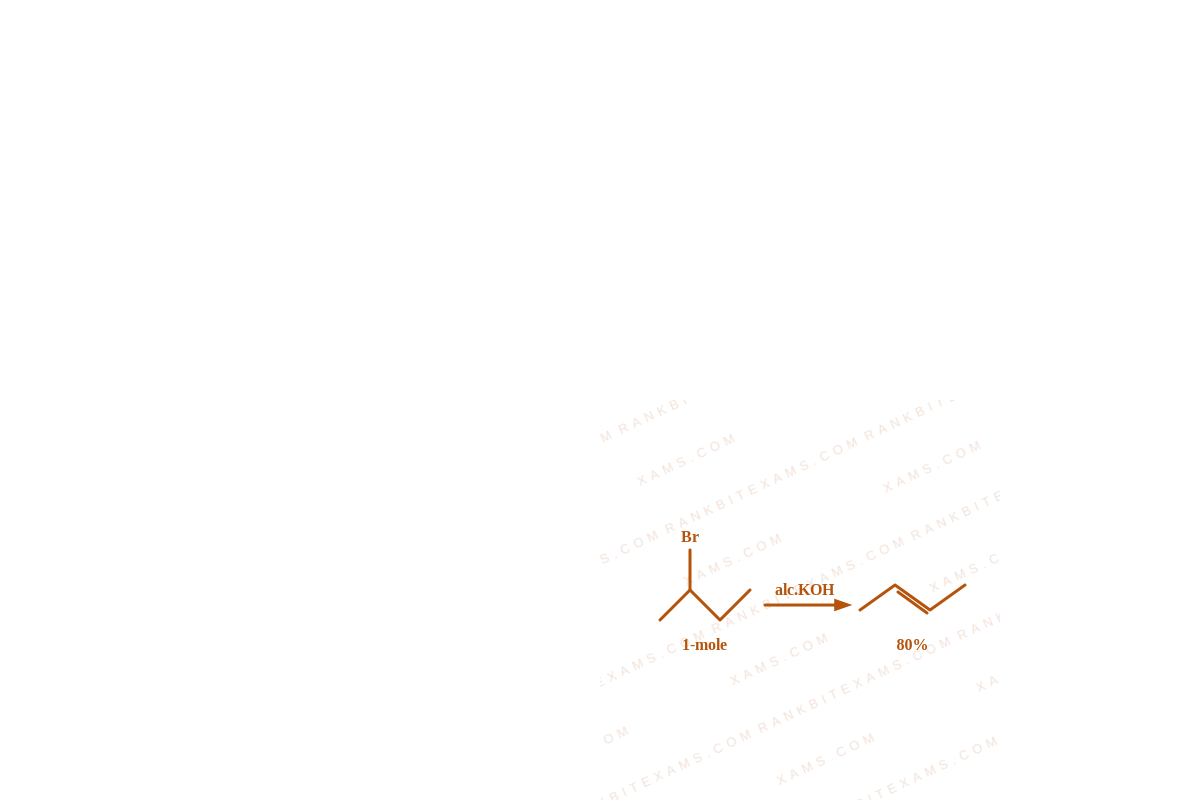
Step 1: 2-bromopentane undergoes dehydrohalogenation via an E2 mechanism using alcoholic KOH$\mathrm{KOH}$. According to Saytzeff's rule, the more substituted alkene is the major product. Thus, pent-2-ene is the major product P$\mathrm{P}$.
Chemical reaction showing elimination of 2-bromopentane to form pent-2-ene
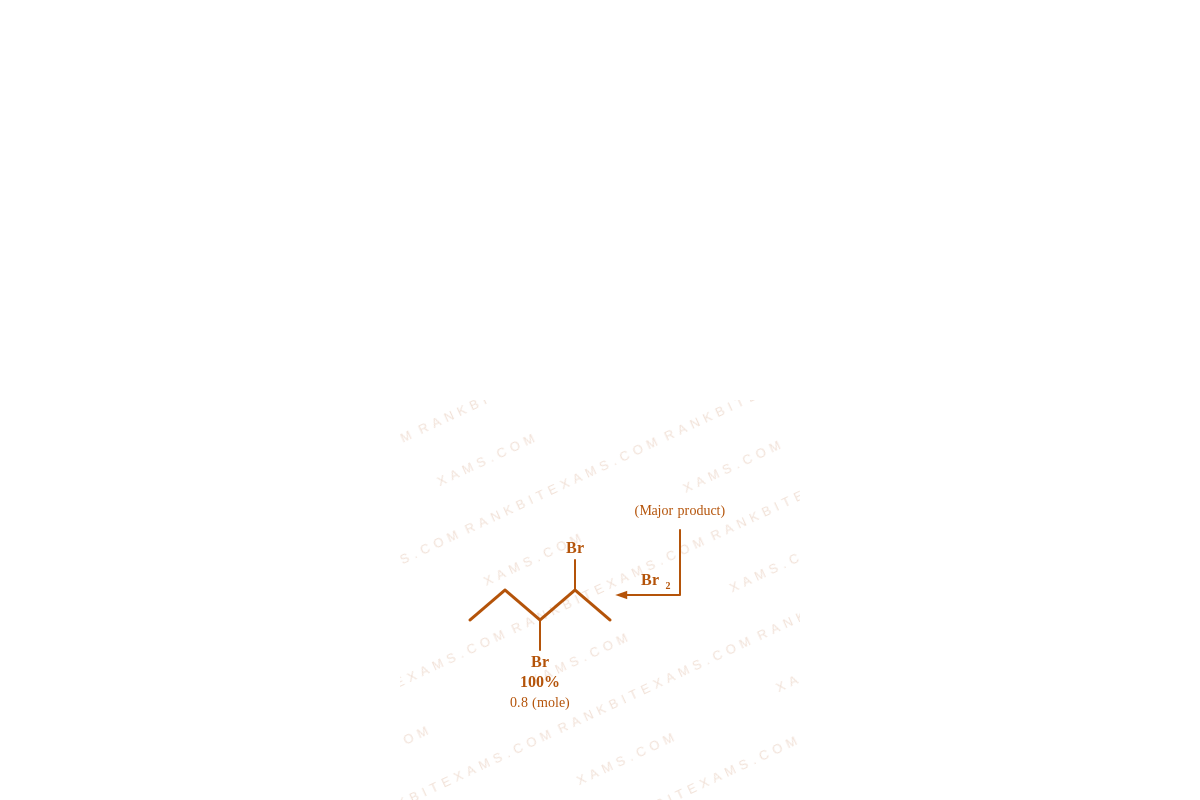
Step 2: Pent-2-ene undergoes electrophilic bromination with liquid bromine (Br₂$\mathrm{Br_2}$) to give 2,3-dibromopentane (product Q$\mathrm{Q}$):
Chemical reaction showing elimination of 2-bromopentane to form pent-2-ene
Step 1: Calculate Initial Moles of Reactant
Calculate the molar mass of 2-bromopentane (C₅H₁₁Br$\mathrm{C_5H_{11}Br}$):
Moles of P formed = 1 × 0.80 = 0.8~mol$$\text{Moles of P formed} = 1 \times 0.80 = 0.8~\mathrm{mol}$$
Since the conversion of P arrow Q$\mathrm{P} \rightarrow \mathrm{Q}$ has a yield of 100%$100\%$, the mole count remains stoichiometric:
Moles of Q formed = 0.8 × 1.00 = 0.8~mol$$\text{Moles of Q formed} = 0.8 \times 1.00 = 0.8~\mathrm{mol}$$
Step 3: Calculate Mass of Q
Product Q$\mathrm{Q}$ is 2,3-dibromopentane (C₅H₁₀Br₂$\mathrm{C_5H_{10}Br_2}$).
Calculate its molar mass:
Molar mass of Q = 5(12) + 10(1) + 2(80) = 60 + 10 + 160 = 230~ g~mol⁻¹$$\text{Molar mass of Q} = 5(12) + 10(1) + 2(80) = 60 + 10 + 160 = 230~\mathrm{g~mol^{-1}}$$Mass of Q = 0.8 × 230 = 184~g$$\text{Mass of Q} = 0.8 \times 230 = 184~\mathrm{g}$$
Pattern Recognition
Saytzeff vs Hofmann: Alcoholic KOH$\mathrm{KOH}$ is a small, non-bulky base, which selectively targets the internal secondary proton to yield the thermodynamic trans-alkene (pent-2-ene) as the major product rather than the terminal 1-alkene.
More Haloalkanes and Haloarenes Previous-Year Questions — Page 8
Q74jee_main_2024_30_jan_morningClassification
Given below are two statement one is labeled as Assertion (A) and the other is labeled as Reason (R).
Assertion (A): CH₂=CH-CH₂-Cl$CH_2=CH-CH_2-Cl$ is an example of allyl halide
Reason (R): Allyl halides are the compounds in which the halogen atom is attached to sp²$sp^2$ hybridised carbon atom.
In the light of the two above statements, choose the most appropriate answer from the options given below:
A.(A) is true but (R) is false$\text{(A) is true but (R) is false}$
B.Both (A) and (R) are true but (R) is not the correct explanation of (A)$\text{Both (A) and (R) are true but (R) is not the correct explanation of (A)}$
C.(A) is false but (R) is true$\text{(A) is false but (R) is true}$
D.Both (A) and (R) are true and (R) is the correct explanation of (A)$\text{Both (A) and (R) are true and (R) is the correct explanation of (A)}$
Solution
Core Logic
Assertion (A): CH₂=CH-CH₂-Cl$CH_2=CH-CH_2-Cl$ is an allyl halide. This statement is True. The halogen is attached to the carbon adjacent to the double bond (allylic position).
Reason (R): Allyl halides are compounds in which the halogen atom is attached to an sp²$sp^2$ hybridized carbon atom. This statement is False. In allyl halides, the halogen is attached to an sp³$sp^3$ hybridized carbon atom which is next to an sp²$sp^2$ hybridized carbon (C=C double bond).
Step 1: Conclusion
Therefore, (A) is true but (R) is false.
Pattern Recognition
Allylic = sp³$sp^3$ C adjacent to C=C.
Vinylic = sp²$sp^2$ C of the C=C itself.
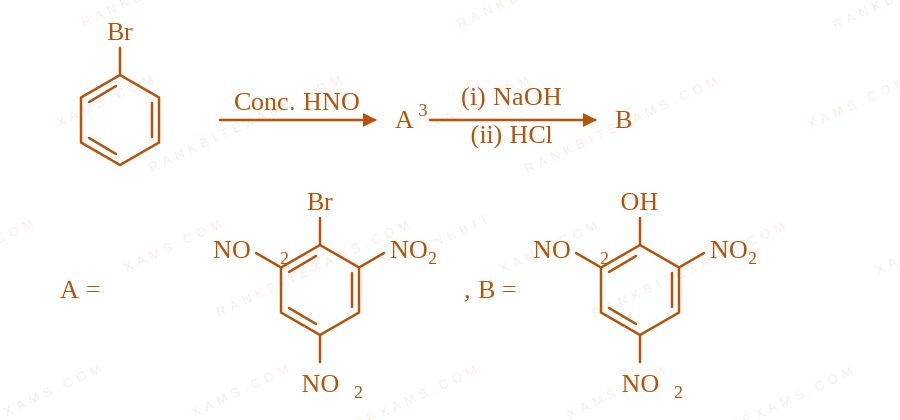
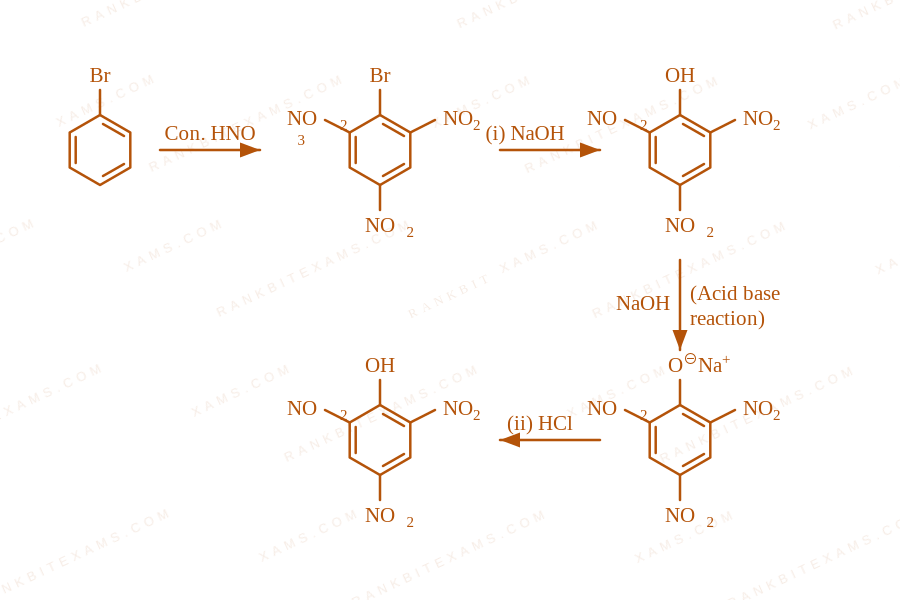
Identify A and B in the following reaction sequence.
The image shows a reaction scheme starting from bromobenzene undergoing nitration followed by substitution.
A.
B.
C.
D.
Solution
Core Logic
When bromobenzene reacts with concentrated HNO₃$HNO_3$ (nitration), the bromine atom is ortho/para directing. However, under drastic conditions with excess concentrated nitrating mixture, 1-bromo-2,4,6-trinitrobenzene is formed (Compound A).
When 1-bromo-2,4,6-trinitrobenzene (Compound A) is treated with NaOH$NaOH$, the presence of three strong electron-withdrawing -NO₂$-NO_2$ groups activates the aromatic ring toward Nucleophilic Aromatic Substitution (SNAr$S_NAr$). The -Br$-Br$ is easily replaced by -OH$-OH$ to form 2,4,6-trinitrophenol (picric acid).
Subsequent acidification with HCl$HCl$ yields the neutral picric acid (Compound B).
The image shows a reaction scheme starting from bromobenzene undergoing nitration followed by substitution.
Pattern Recognition
Multiple NO₂$NO_2$ groups drastically increase the susceptibility of halobenzenes to SNAr$S_NAr$. Bromine is replaced completely by OH^-$OH^-$ under alkaline conditions.
Chapter Mix
Class 12 Chemistry: Haloalkanes and Haloarenes
Class 12 Chemistry: Alcohols, Phenols and Ethers
Qjee_main_2024_31_jan_eveningIUPAC Nomenclature of Haloalkanes
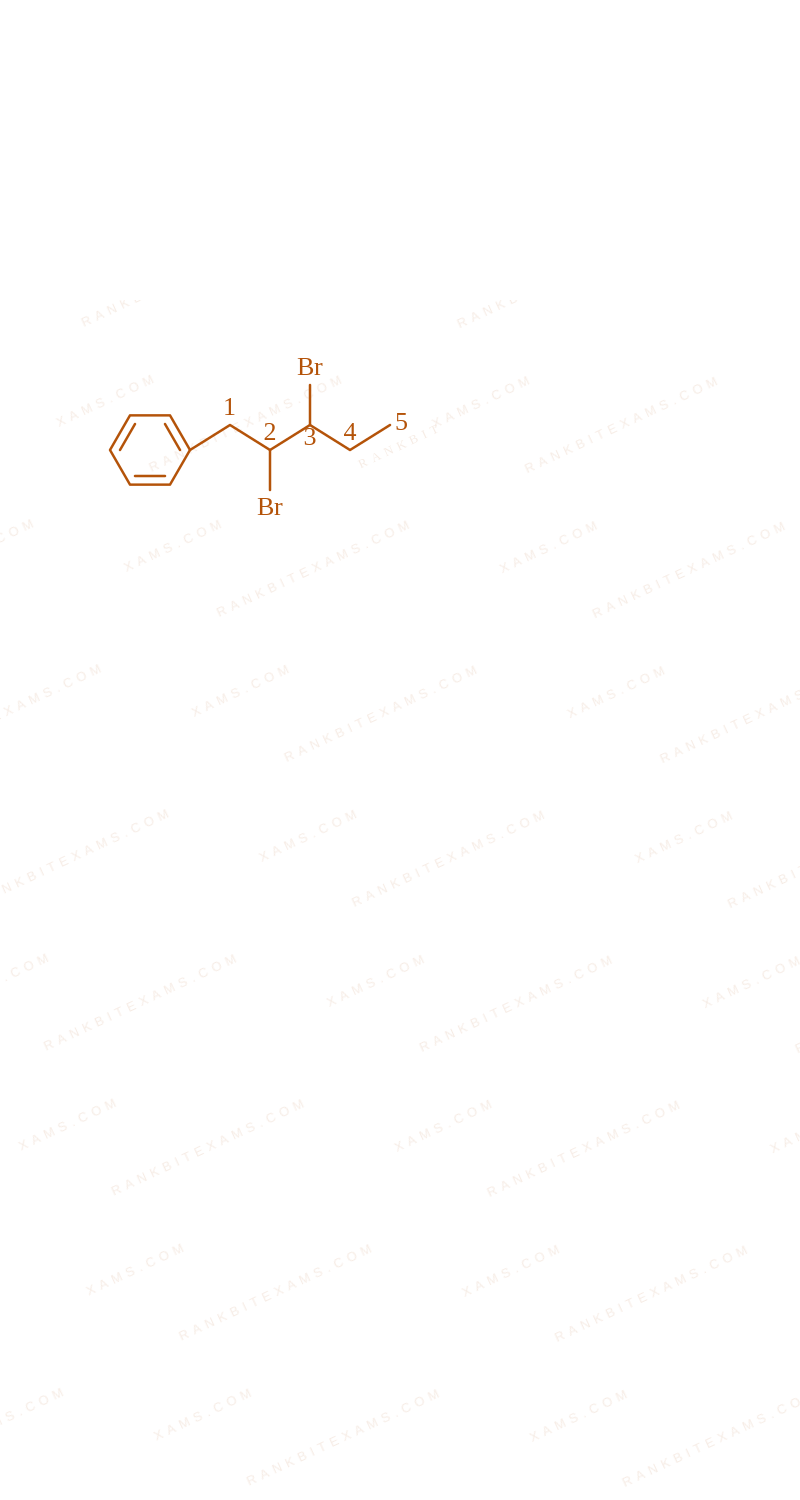
Identify structure of 2,3-dibromo-1-phenylpentane.
A.
B.
C.
D.
Solution
Core Logic
Decode the IUPAC name: 2,3-dibromo-1-phenylpentane.
Parent chain is pentane (5 carbon chain: C1-C2-C3-C4-C5).
Substituents:
Phenyl group at position 1.
Bromo groups at positions 2 and 3.
Option (3) correctly displays a 5-carbon straight chain. The first carbon attaches to the benzene ring (phenyl group), and the second and third carbons each hold a bromine atom.
IUPAC Nomenclature of Haloalkanes diagram for Q67 - JEE Main 2024 Evening
Chapter Mix
Class 12 Chemistry: Haloalkanes and Haloarenes
Qjee_main_2024_31_jan_morningElimination and Addition Reactions
The product (C) in the below mentioned reaction is:
CH₃-CH₂-CH₂-Br [Δ]KOH(alc) A [Δ]HBr B [Δ]KOH(aq) C$$CH_3-CH_2-CH_2-Br \xrightarrow[\Delta]{KOH_{(alc)}} A \xrightarrow[\Delta]{HBr} B \xrightarrow[\Delta]{KOH_{(aq)}} C$$
Q86jee_main_2024_31_jan_morningElimination and Substitution
CH₃CH₂Br + NaOH arrow Product A$$CH_3CH_2Br + NaOH \rightarrow \text{Product A}$$CH₃CH₂Br + NaOH / H₂O arrow Product B$$CH_3CH_2Br + NaOH / H_2O \rightarrow \text{Product B}$$
The total number of hydrogen atoms in product A and product B is
Numerical Answer.Answer: 10 to 10
Solution
Core Logic
Reaction 1:
If the reagent is alcoholic NaOH (implied due to formation of a distinct product A to contrast B), elimination occurs:
Practice past-year questions one chapter at a time. Pick an exam → subject → chapter and get every PYQ for that topic — pulled together from all past papers — with the chapter's key formulas alongside.