JEE Main · Chemistry → Steady

Chemical Kinetics appeared 43 times across 3 years — 5% of Chemistry. This question is from Reaction Mechanism and Energy Profiles.

Year 2026 2025 2024 Total
Questions 14 21 8 43

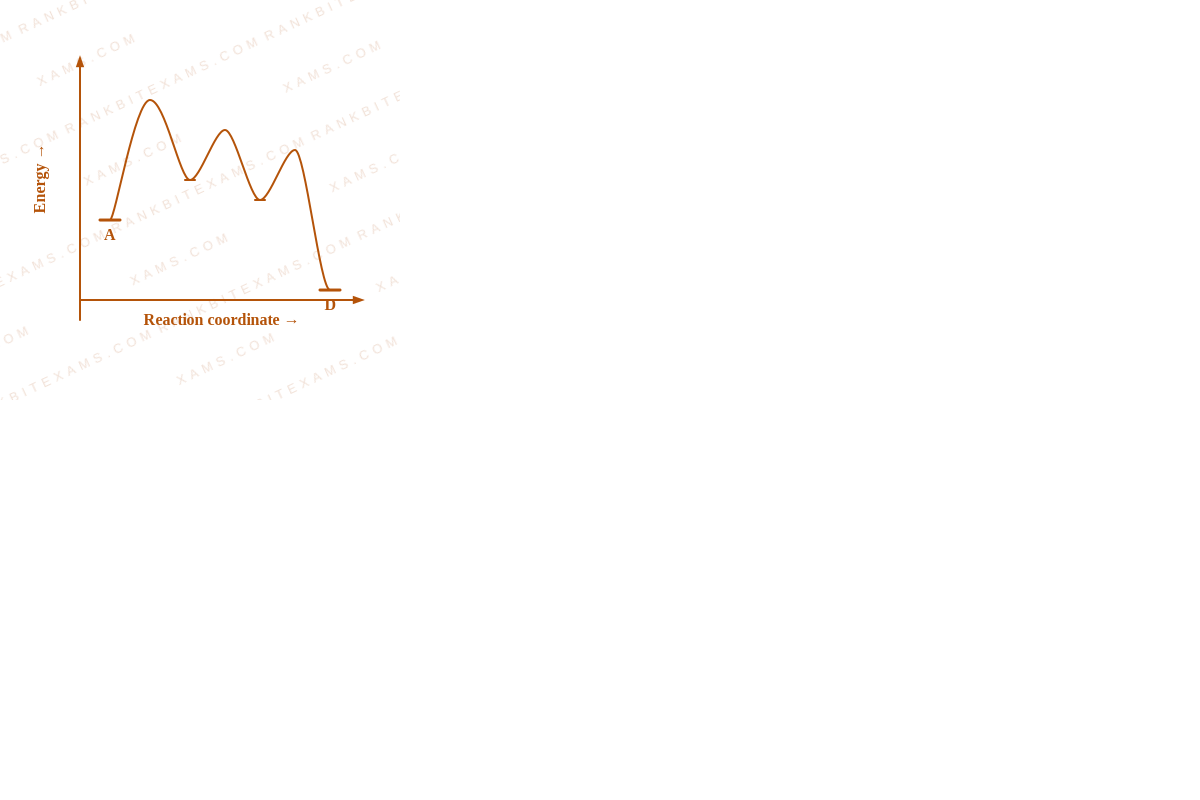
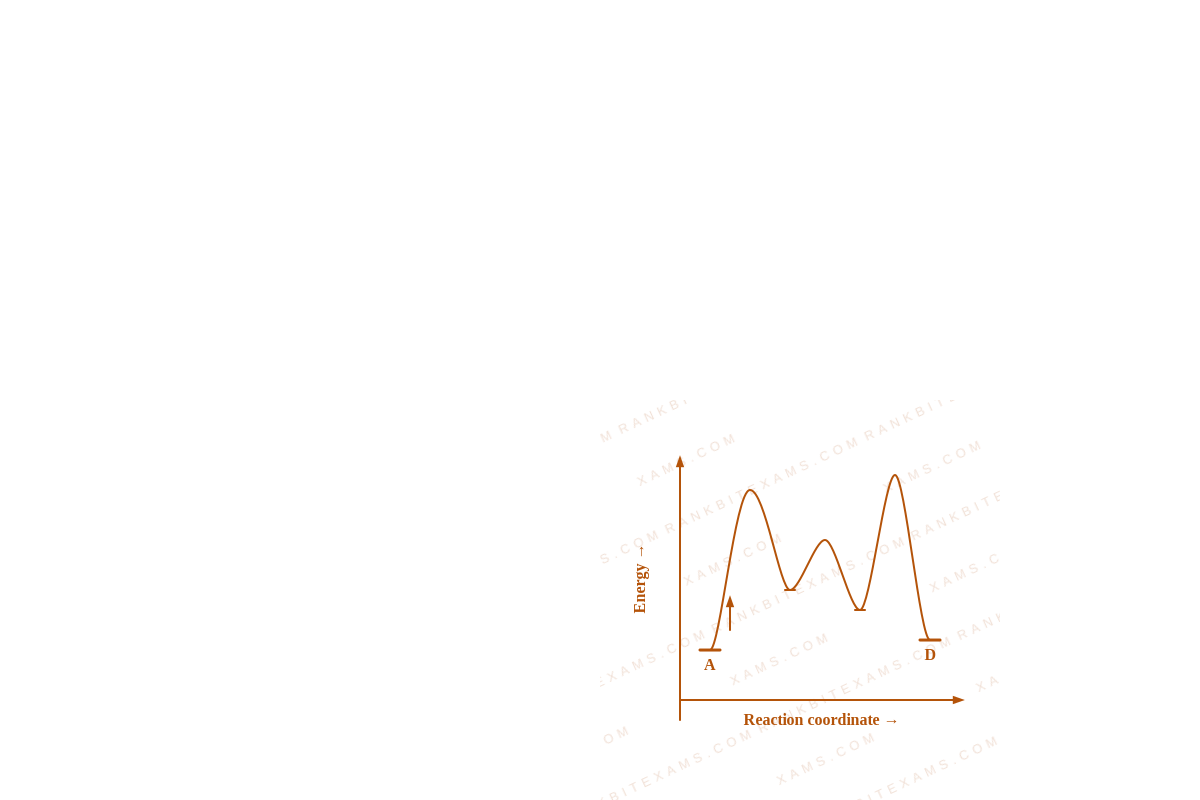
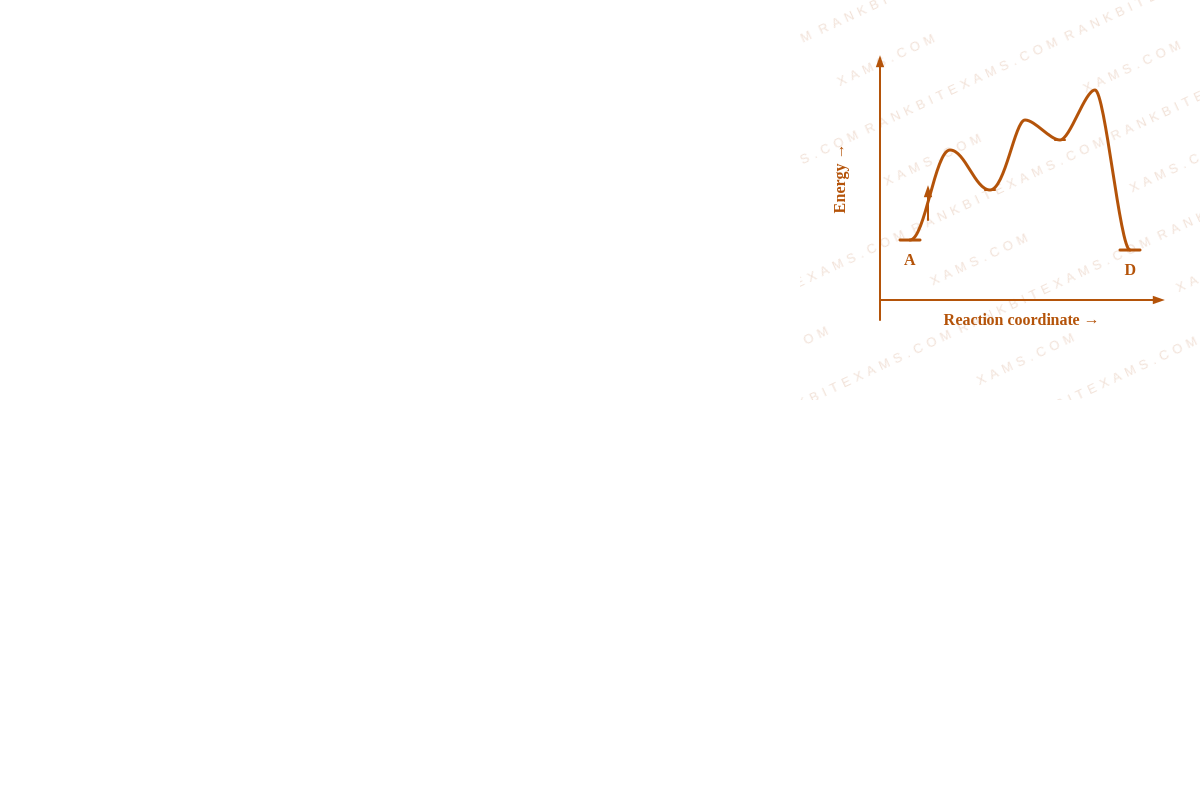
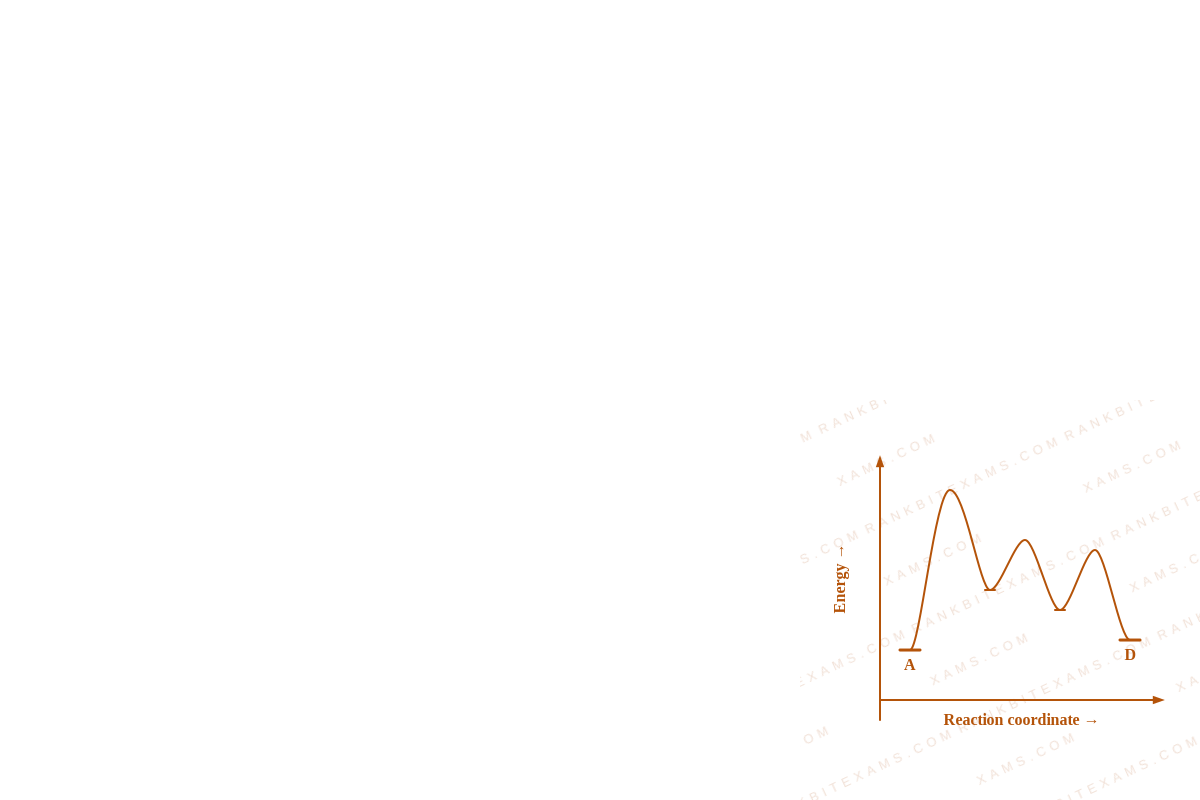
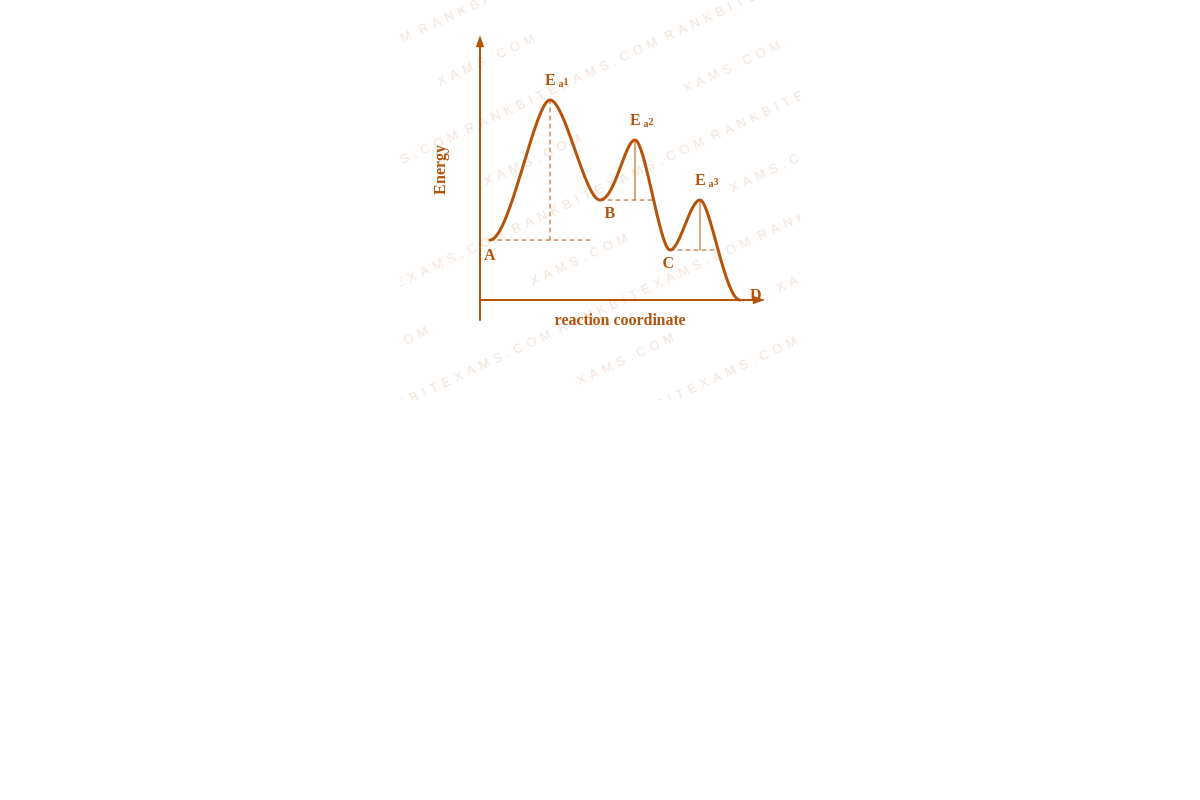
Reactant A converts to product D through the given mechanism (with the net evolution of heat): A arrow B slow; Δ H = +ve B arrow C fast; Δ H = -ve C arrow D fast; Δ H = -ve Which of the following represents the above reaction mechanism?

Solution & Explanation

Related Formula
k = A e^-Eₐ/RT Rate ∝ 1Eₐ
Core Logic

Let us break down each step of the mechanism:

  • Step 1: A arrow B is slow.
  • Being the rate-determining step, it must have the highest activation energy barrier (Eₐ₁).
  • Since Δ H = +ve (endothermic), the energy level of intermediate state B must be higher than the reactant state A.
  • Step 2: B arrow C is fast.
  • It has a much lower activation energy barrier (Eₐ₂).
  • Since Δ H = -ve (exothermic), the energy level of intermediate C is lower than state B.
  • Step 3: C arrow D is fast.
  • It has a low activation energy barrier (Eₐ₃).
  • Since Δ H = -ve (exothermic), the energy level of final state D is lower than state C.
  • Net Reaction: Exothermic with "net evolution of heat".
  • The potential energy of the final product D is lower than the initial potential energy of reactant A.
Step 1: Check Potential Energy Profile

Evaluating the transition states and relative energy levels in Graph (1):

  • The first peak (transition state 1) is clearly the highest (Eₐ₁ > Eₐ₂, Eₐ₃) Step 1 is the slowest.
  • The intermediate B is higher in energy than A.
  • Intermediates C and product D are progressively lower in energy.
  • Product D has lower energy than reactant A (net exothermic).
  • Annotated reaction mechanism coordinate graph showing relative activation energies
    Annotated reaction mechanism coordinate graph showing relative activation energies

    This perfectly corresponds to Graph (1).

Pattern Recognition

Kinetics shortcut: Slow step = tallest peak. Exothermic step = drop in energy levels of products/intermediates. Endothermic step = climb in energy levels. Use these rules to visually scan energy profiles in under 5 seconds.

Chapter Mix

Class 12 Chemistry: Chemical Kinetics

Reference Study Guides

More Chemical Kinetics Previous-Year Questions — Page 9

Q81 jee_main_2024_30_jan_morning First Order Reactions
The rate of first order reaction is 0.04 mol L⁻¹s⁻¹ at 10 minutes and 0.03 mol L⁻¹s⁻¹ at 20 minutes after initiation. Half life of the reaction is ________ minutes. (Given 2=0.3010, 3=0.4771)
Numerical Answer. Answer: 24 to 24.1

Solution

Related Formula

Rate = k[A]

[A] = [A]₀ e-kt t1/2 = (ln 2)/(k)
Core Logic

For a first order reaction, rate is directly proportional to concentration.

R₁ = k[A]₁₀ = k[A]₀ e-k(10 × 60) R₂ = k[A]₂₀ = k[A]₀ e-k(20 × 60)
Step 1: Setting up equations
0.04 = k[A]₀ e-600k (1) 0.03 = k[A]₀ e-1200k (2)
Step 2: Solving for k

Dividing equation (1) by (2):

(0.04)/(0.03) = e-600ke-1200k (4)/(3) = e600k

Take natural log on both sides:

ln((4)/(3)) = 600k k = (ln(4/3))/(600) s⁻¹
Step 3: Calculating half life
t1/2 = (ln 2)/(k) = (ln 2)/((ln(4/3))/(600)) = (600 ln 2)/(ln 4 - ln 3) seconds

Convert to minutes by dividing by 60:

t1/2 = (10 ln 2)/(ln 4 - ln 3) minutes

Substitute log values (since ln x = 2.303 x, the 2.303 cancels out):

t1/2 = 10 × ( 2)/( 4 - 3) minutes t1/2 = 10 × (0.3010)/(2(0.3010) - 0.4771) t1/2 = 10 × (0.3010)/(0.6020 - 0.4771) = 10 × (0.3010)/(0.1249) t1/2 = 24.099 ≈ 24 minutes
Chapter Mix

Class 12 Chemistry: Chemical Kinetics

Q82 jee_main_2024_31_jan_evening First Order Kinetics
r = k[A] for a reaction, 50% of A is decomposed in 120 minutes. The time taken for 90% decomposition of A is ________ minutes.
Numerical Answer. Answer: 398.5 to 399.5

Solution

Related Formula
k = 0.693t1/2 t = (2.303)/(k) ( (a)/(a - x) )
Core Logic

Since r = k[A], the reaction follows first-order kinetics. The half-life (50% decomposition) is t1/2 = 120 minutes.

Step 1: Calculating for 90% decomposition

For 90% completion of the reaction, [A]₀ = 100 and [A]ₜ = 100 - 90 = 10.

t = (2.303)/(k) (100)/(10) t = 2.303( 0.693t1/2 ) (10) t = (2.303 × 120)/(0.693) × 1 t = 398.78 minutes

Rounding off to the nearest integer, we get 399 minutes.

Pattern Recognition

For a first order reaction, t90% ≈ 3.32 × t50%. 120 × 3.32 = 398.4, so roughly 399.

Chapter Mix

Class 12 Chemistry: Chemical Kinetics

Q73 jee_main_2024_31_jan_morning First Order Reactions
Integrated rate law equation for a first order gas phase reaction is given by (where Pᵢ is initial pressure and Pₜ is total pressure at time t)
  • A. k = (2.303)/(t) × (Pᵢ)/((2Pᵢ - Pₜ))
  • B. k = (2.303)/(t) × (2Pᵢ)/((2Pᵢ - Pₜ))
  • C. k = (2.303)/(t) × ((2Pᵢ - Pₜ))/(Pᵢ)
  • D. k = (2.303)/(t) × (Pᵢ)/((2Pᵢ - Pₜ))

Solution

Core Logic

Consider a general gas phase reaction: A arrow B + C

Initial (t=0): Pᵢ 0 0 At time t: Pᵢ - x x x

Total pressure at time t:

Pₜ = (Pᵢ - x) + x + x = Pᵢ + x

x = Pₜ - Pᵢ

Partial pressure of A at time t (PA): PA = Pᵢ - x

PA = Pᵢ - (Pₜ - Pᵢ) = 2Pᵢ - Pₜ

For a first-order reaction:

k = (2.303)/(t) (P₀)/(Pₜ)

Here, P₀ = Pᵢ and the pressure of the reactant at time t is PA.

k = (2.303)/(t) (Pᵢ)/(2Pᵢ - Pₜ)
Chapter Mix

Class 12 Chemistry: Chemical Kinetics

More Chemical Kinetics Questions — jee_main_2025_02_april_evening

Practice all Chemical Kinetics previous-year questions →

Rankbit System
JEE Physics: Waves (+15.5%) | Electrostatics: Concentric Shells (-29.7%) | Modern Physics: Photoelectric Clones (+34.2%) | Mathematics: Definite Integrals (+18.1%) | Chemistry: Coordination Splitting (-11.4%) | JEE Physics: Waves (+15.5%) | Electrostatics: Concentric Shells (-29.7%) | Modern Physics: Photoelectric Clones (+34.2%) | Mathematics: Definite Integrals (+18.1%) | Chemistry: Coordination Splitting (-11.4%)