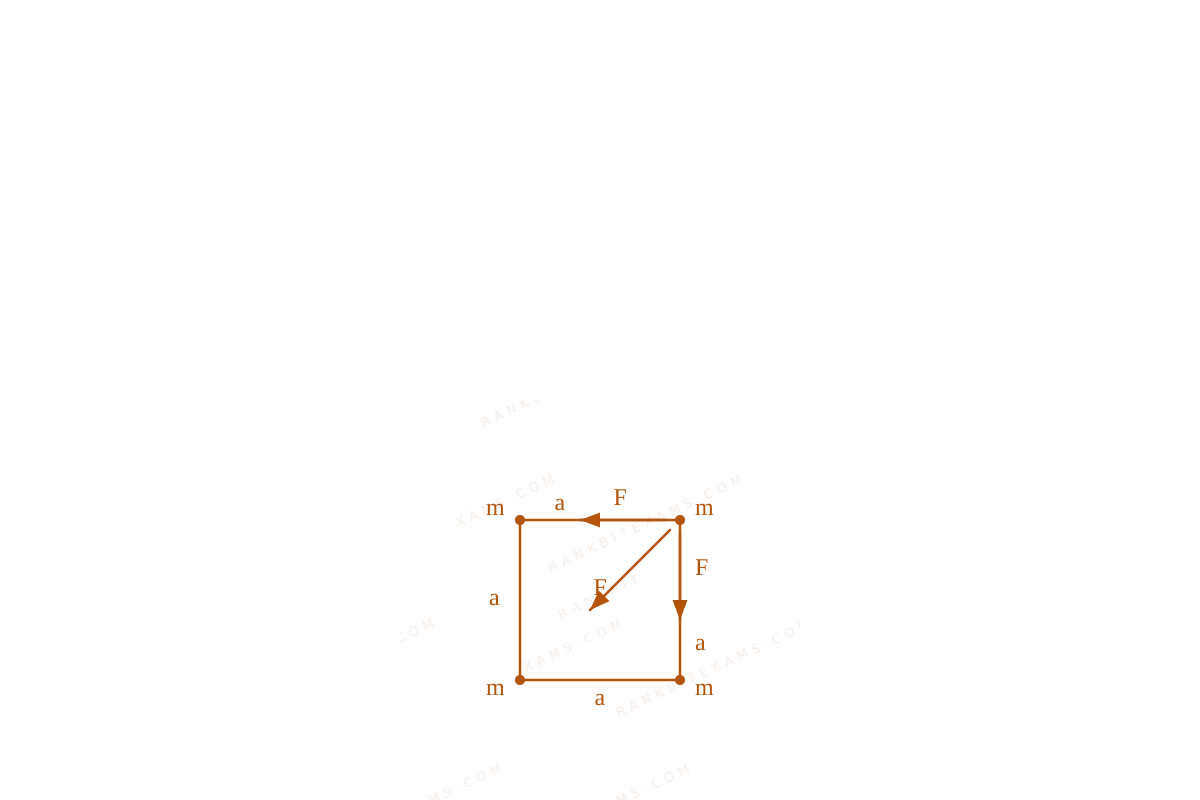
Four identical particles of mass m$m$ are kept at the four corners of a square. If the gravitational force exerted on one of the masses by the other masses is ( 2√(2) + 132) Gm²L²$\left(\frac{2\sqrt{2} + 1}{32}\right)\frac{\mathrm{Gm}^2}{\mathrm{L}^2}$, the length of the sides of the square is
A.L2$\frac{\mathrm{L}}{2}$
B.4 L$4 L$
C.3L$3L$
D.2 L$2 L$
Solution & Explanation
Related Formula
F = (G m₁ m₂)/(r²)$$F = \frac{G m_1 m_2}{r^2}$$
Core Logic
Superposition Principle diagram for Q37 - JEE Main 2024 Morning
Let the side length of the square be a$a$. Considering one corner mass, it experiences forces from the adjacent two masses (distance a$a$) and the diagonally opposite mass (distance √(2)a$\sqrt{2}a$).
The forces from the two adjacent masses are at 90^°$90^\circ$ to each other:
F = (Gm²)/(a²)$$F = \frac{Gm^2}{a^2}$$
The resultant of these two is √(2)F = √(2) (Gm²)/(a²)$\sqrt{2}F = \sqrt{2} \frac{Gm^2}{a^2}$, directed along the diagonal.
Step 2: Total Force Equation
The force from the diagonal mass is:
F' = Gm²(√(2)a)² = (Gm²)/(2a²)$$F' = \frac{Gm^2}{(\sqrt{2}a)^2} = \frac{Gm^2}{2a^2}$$
Total resultant force Fₙₑₜ = √(2)F + F'$F_{\text{net}} = \sqrt{2}F + F'$:
Q44jee_main_2024_29_january_eveningKepler's Laws of Planetary Motion
A planet takes 200 days$200\text{ days}$ to complete one revolution around the Sun. If the distance of the planet from Sun is reduced to one fourth of the original distance, how many days will it take to complete one revolution?
A.25$25$
B.50$50$
C.100$100$
D.20$20$
Solution
Related Formula
According to Kepler's Third Law (Law of Periods):
T² ∝ r³$T^2 \propto r^3$
where:
T$T$ is the time period of revolution.
r$r$ is the orbital radius of the planet.
Core Logic
Using the proportionality relationship for two states:
If orbital distance scales by x$x$, the period scales by x3/2$x^{3/2}$. Here, distance scales by (1)/(4)$\frac{1}{4}$, so the period scales by ((1)/(4))3/2 = (1)/(8)$\left(\frac{1}{4}\right)^{3/2} = \frac{1}{8}$. Thus, 200 × (1)/(8) = 25 days$200 \times \frac{1}{8} = 25\text{ days}$.
Chapter Mix
Class 11 Physics: Gravitation
Q35jee_main_2024_27_jan_morningAcceleration due to Gravity
Inverse square dependence means halving the distance scale amplifies the surface field metric by a factor of 2² = 4$2^2 = 4$ matching constant mass bounds.
Chapter Mix
Class 11 Physics: Gravitation
Qjee_main_2024_29_jan_morningAcceleration due to Gravity
At what distance above and below the surface of the earth a body will have same weight, (take radius of earth as R.)
A.√(5) R - R$\sqrt{5} \mathrm{R} - \mathrm{R}$
B.√(3) R - R2$\frac{\sqrt{3} \mathrm{R} - \mathrm{R}}{2}$
C.(R)/(2)$\frac{R}{2}$
D.√(5) R - R2$\frac{\sqrt{5} \mathrm{R} - \mathrm{R}}{2}$
Solution
Related Formula
Acceleration due to gravity at a height h$h$ above the Earth's surface:
Therefore, the required distance is √(5)R - R2$\frac{\sqrt{5}R - R}{2}$.
Pattern Recognition
Do not use the linear approximation formula gh ≈ g(1 - (2h)/(R))$g_h \approx g(1 - \frac{2h}{R})$ unless the problem explicitly states h ll R$h \ll R$. Equating the approximated form to depth gives hheight = (1)/(2) hdepth$h_{\text{height}} = \frac{1}{2} h_{\text{depth}}$, which fails when looking for a single unified distance value h$h$.
Escape velocity of a body from earth is 11.2 km/s$11.2 \,\mathrm{km/s}$. If the radius of a planet be one-third the radius of earth and mass be one-sixth that of earth, the escape velocity from the planet is:
A.11.2 ~km / s$11.2 \mathrm{~km / s}$
B.8.4 ~km / s$8.4 \mathrm{~km / s}$
C.4.2 ~km / s$4.2 \mathrm{~km / s}$
D.7.9 ~km / s$7.9 \mathrm{~km / s}$
Solution
Related Formula
Vₑ = √((2GM)/(R))$$V_e = \sqrt{\frac{2GM}{R}}$$
Core Logic
For Earth: Vₑ = √((2GME)/(RE)) = 11.2 ~km/s$V_e = \sqrt{\frac{2GM_E}{R_E}} = 11.2 \mathrm{~km/s}$
For the planet:
RP = RE3$\mathrm{R}_{\mathrm{P}} = \frac{\mathrm{R}_{\mathrm{E}}}{3}$ and MP = ME6$\mathrm{M}_{\mathrm{P}} = \frac{\mathrm{M}_{\mathrm{E}}}{6}$
We can express the escape velocity of the planet Vₚ$V_p$ as a ratio of the Earth's escape velocity.
Any scaling of a planet's mass by factor α$\alpha$ and radius by factor β$\beta$ scales the escape velocity by a factor of √(α / β)$\sqrt{\alpha / \beta}$.
Chapter Mix
Class 11 Physics: Gravitation
Q42jee_main_2024_30_jan_morningGravitational Potential and Field
The gravitational potential at a point above the surface of earth is -5.12 × 10⁷ ~J / kg$-5.12 \times 10^{7} \mathrm{~J / kg}$ and the acceleration due to gravity at that point is 6.4 ~m/s²$6.4 \mathrm{~m/s^2}$. Assume that the mean radius of earth to be 6400 ~km$6400 \mathrm{~km}$. The height of this point above the earth's surface is:
The gravitational potential (V$V$) and acceleration due to gravity (g'$g'$) at a distance r = RE + h$r = R_E + h$ from the center of the earth can be related by dividing their magnitudes: |V| / g' = r$|V| / g' = r$.
Practice past-year questions one chapter at a time. Pick an exam → subject → chapter and get every PYQ for that topic — pulled together from all past papers — with the chapter's key formulas alongside.