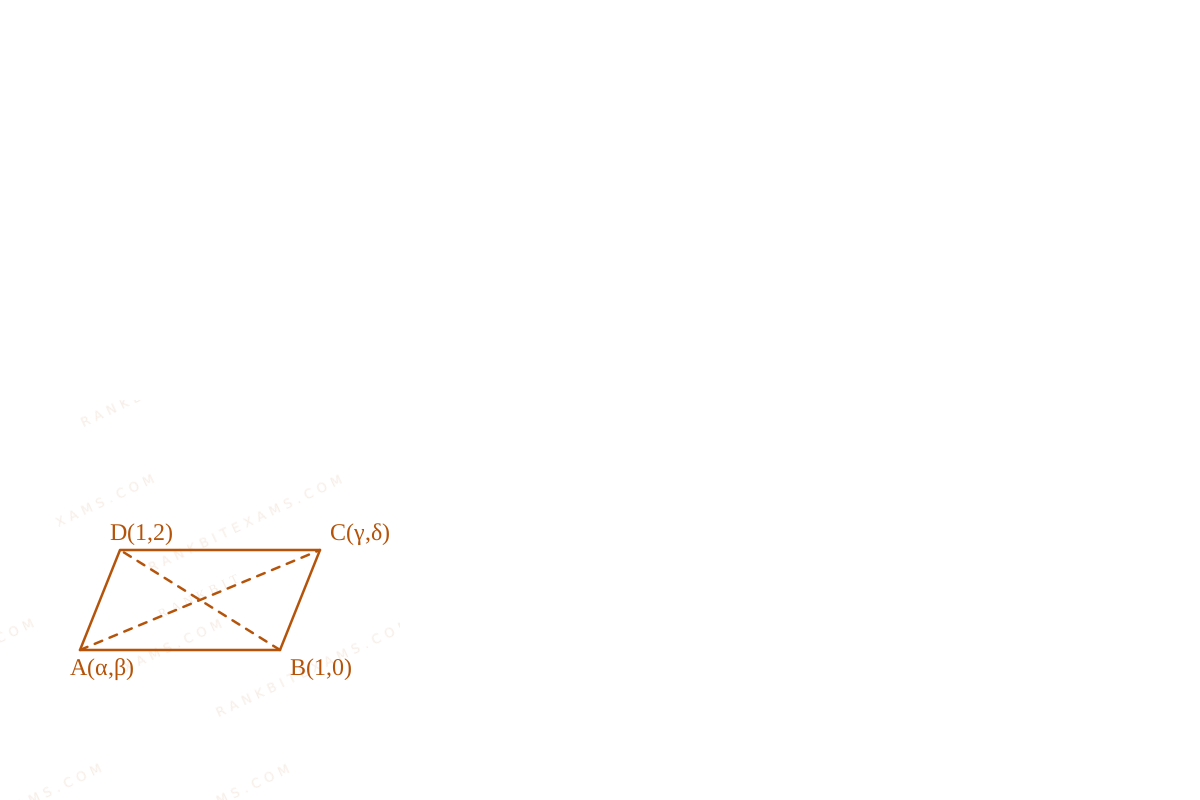
Let alpha, beta, gamma, delta in Z$\alpha, \beta, \gamma, \delta \in Z$ and let A (alpha, beta)$A (\alpha, \beta)$, B (1, 0)$B (1, 0)$, C (gamma, delta)$C (\gamma, \delta)$ and D (1, 2)$D (1, 2)$ be the vertices of a parallelogram ABCD$ABCD$. If AB = sqrt10$AB = \sqrt{10}$ and the points A$A$ and C$C$ lie on the line 3y = 2x + 1$3y = 2x + 1$, then 2(alpha + beta + gamma + delta)$2(\alpha + \beta + \gamma + \delta)$ is equal to
A.10$10$
B.5$5$
C.12$12$
D.8$8$
Solution & Explanation
### Core Logic
Let E$E$ be the midpoint of the diagonals AC$AC$ and BD$BD$.
Since ABCD$ABCD$ is a parallelogram, the diagonals bisect each other.
Properties of Parallelogram diagram for Q10 - JEE Main 2024 Morning
Midpoint E$E$ from BD$BD$: left( frac1+12, frac0+22 right) = (1, 1)$\left( \frac{1+1}{2}, \frac{0+2}{2} \right) = (1, 1)$.
### Step 1: Apply Midpoint on AC
Midpoint E$E$ from AC$AC$: left( fracalpha+gamma2, fracbeta+delta2 right)$\left( \frac{\alpha+\gamma}{2}, \frac{\beta+\delta}{2} \right)$.
Equating both:
fracalpha+gamma2 = 1 implies alpha + gamma = 2$\frac{\alpha+\gamma}{2} = 1 \implies \alpha + \gamma = 2$fracbeta+delta2 = 1 implies beta + delta = 2$\frac{\beta+\delta}{2} = 1 \implies \beta + \delta = 2$
### Step 2: Final Value
The expression requires 2(alpha + beta + gamma + delta)$2(\alpha + \beta + \gamma + \delta)$.
2(2 + 2) = 2(4) = 8$2(2 + 2) = 2(4) = 8$
*(Note: Additional conditions like AB = sqrt10$AB = \sqrt{10}$ and the line equation are extraneous data not needed to find the sum).*
### Evaluation Rubric / Model Answer
null
### Chapter Mix
Class 11 Maths: Straight Lines
Keywords:#midpoint formula#JEE Main 2024 Morning Q10#Straight Lines JEE Main 2024#Properties of Parallelogram JEE Main 2024
More Straight Lines Previous-Year Questions — Page 4
Q16jee_main_2024_27_jan_morningAngle Between Two Lines
The portion of the line 4x+5y=20$4x+5y=20$ in the first quadrant is trisected by the lines L_1$L_{1}$ and L_2$L_{2}$ passing through the origin. The tangent of an angle between the linesL_1$L_{1}$ and L_2$L_{2}$ is:
A.frac85$\frac{8}{5}$
B.frac2541$\frac{25}{41}$
C.frac25$\frac{2}{5}$
D.frac3041$\frac{30}{41}$
Solution
### Related Formula
tan theta = left| fracm_1 - m_21 + m_1 m_2 right|$\tan \theta = \left| \frac{m_1 - m_2}{1 + m_1 m_2} \right|$
### Core Logic
Find the intercepts of the line 4x + 5y = 20$4x + 5y = 20$ in the first quadrant.
Put y=0 Rightarrow x=5$y=0 \Rightarrow x=5$. Point X(5, 0)$X(5, 0)$.
Put x=0 Rightarrow y=4$x=0 \Rightarrow y=4$. Point Y(0, 4)$Y(0, 4)$.
The line segment XY$XY$ is trisected by two points, say A$A$ and B$B$.
Point A$A$ divides YX$YX$ in the ratio 2:1$2:1$, and B$B$ divides it in 1:2$1:2$.
### Step 1: Trisection Points Calculation
Using the section formula for A$A$ (closer to Y-axis, ratio 1:2 from Y to X):
A = left( frac1(5) + 2(0)3, frac1(0) + 2(4)3 right) = left( frac53, frac83 right)$A = \left( \frac{1(5) + 2(0)}{3}, \frac{1(0) + 2(4)}{3} \right) = \left( \frac{5}{3}, \frac{8}{3} \right)$
Using the section formula for B$B$ (closer to X-axis, ratio 2:1 from Y to X):
B = left( frac2(5) + 1(0)3, frac2(0) + 1(4)3 right) = left( frac103, frac43 right)$B = \left( \frac{2(5) + 1(0)}{3}, \frac{2(0) + 1(4)}{3} \right) = \left( \frac{10}{3}, \frac{4}{3} \right)$
### Step 2: Finding Line Slopes
The lines L_1$L_1$ and L_2$L_2$ pass through the origin (0,0)$(0,0)$ to points A$A$ and B$B$.
Slope of OA$OA$ (m_1$m_1$):
m_1 = frac8/3 - 05/3 - 0 = frac85$m_1 = \frac{8/3 - 0}{5/3 - 0} = \frac{8}{5}$
Slope of OB$OB$ (m_2$m_2$):
m_2 = frac4/3 - 010/3 - 0 = frac410 = frac25$m_2 = \frac{4/3 - 0}{10/3 - 0} = \frac{4}{10} = \frac{2}{5}$
### Step 3: Calculating Tangent of the Angle
Substitute the slopes into the angle formula:
tan theta = left| frac8/5 - 2/51 + (8/5)(2/5) right|$\tan \theta = \left| \frac{8/5 - 2/5}{1 + (8/5)(2/5)} \right|$tan theta = frac6/51 + 16/25$\tan \theta = \frac{6/5}{1 + 16/25}$tan theta = frac6/5(25+16)/25 = frac6/541/25$\tan \theta = \frac{6/5}{(25+16)/25} = \frac{6/5}{41/25}$tan theta = frac65 times frac2541 = frac3041$\tan \theta = \frac{6}{5} \times \frac{25}{41} = \frac{30}{41}$
### Pattern Recognition
For trisection or specific division of an intercepted segment, identify the axis intercepts first, rapidly apply the internal section formula, compute origin-centered slopes (which equal just the y/x ratio of the points), and pass them into the tan formula.
### Evaluation Rubric / Model Answer
null
### Chapter Mix
Class 11 Maths: Straight Lines
Q7jee_main_2024_29_jan_morningAngle Bisector and Reflection
In a Delta ABC$\Delta ABC$, suppose y=x$y=x$ is the equation of the bisector of the angle B and the equation of the side AC is 2x-y=2$2x-y=2$. If 2AB=BC$2AB=BC$ and the point A and B are respectively (4,6)$(4,6)$ and (alpha,beta)$(\alpha,\beta)$, then alpha+2beta$\alpha+2\beta$ is equal to
A.42$42$
B.39$39$
C.48$48$
D.45$45$
Solution
### Related Formula
Image of a point (x_1, y_1)$(x_1, y_1)$ across line y=x$y=x$ is (y_1, x_1)$(y_1, x_1)$.
**Angle Bisector Theorem:** The angle bisector of a triangle divides the opposite side into segments proportional to the lengths of the adjacent sides:
fracABBC = fracADDC$\frac{AB}{BC} = \frac{AD}{DC}$
### Core Logic
Given A(4,6)$A(4,6)$ and Angle bisector of B is y=x$y=x$.
Because y=x$y=x$ bisects angle B, the geometric reflection of vertex A across the bisector line y=x$y=x$ must lie exactly on the line containing the side BC$BC$.
Let the reflection of A(4,6)$A(4,6)$ be A'$A'$. Across y=x$y=x$, the coordinates swap:
A' = (6,4)$A' = (6,4)$
Next, find the intersection point D$D$ of the bisector y=x$y=x$ and side AC$AC$ (2x-y=2$2x-y=2$).
Substitute y=x$y=x$ into 2x-y=2$2x-y=2$:
2x - x = 2 Rightarrow x = 2 Rightarrow y = 2$2x - x = 2 \Rightarrow x = 2 \Rightarrow y = 2$
So, point D$D$ is (2,2)$(2,2)$.
Angle Bisector and Reflection
### Step 1: Utilize Section Formula
By the internal angle bisector theorem:
fracADDC = fracABBC$\frac{AD}{DC} = \frac{AB}{BC}$
Given 2AB = BC$2AB = BC$, so fracABBC = frac12$\frac{AB}{BC} = \frac{1}{2}$.
This means point D(2,2)$D(2,2)$ divides the segment AC$AC$ in the ratio 1:2$1:2$.
Let C$C$ have coordinates (x_c, y_c)$(x_c, y_c)$.
Applying the section formula for D(2,2)$D(2,2)$ dividing A(4,6)$A(4,6)$ and C(x_c, y_c)$C(x_c, y_c)$ in ratio 1:2$1:2$:
2 = frac1 cdot x_c + 2 cdot 41 + 2 Rightarrow 6 = x_c + 8 Rightarrow x_c = -2$2 = \frac{1 \cdot x_c + 2 \cdot 4}{1 + 2} \Rightarrow 6 = x_c + 8 \Rightarrow x_c = -2$2 = frac1 cdot y_c + 2 cdot 61 + 2 Rightarrow 6 = y_c + 12 Rightarrow y_c = -6$2 = \frac{1 \cdot y_c + 2 \cdot 6}{1 + 2} \Rightarrow 6 = y_c + 12 \Rightarrow y_c = -6$
So, C$C$ is (-2,-6)$(-2,-6)$.
### Step 2: Find Equation of BC
The line BC$BC$ passes through point C(-2,-6)$C(-2,-6)$ and the reflection point A'(6,4)$A'(6,4)$.
Find the slope of BC$BC$:
m_BC = frac4 - (-6)6 - (-2) = frac108 = frac54$m_{BC} = \frac{4 - (-6)}{6 - (-2)} = \frac{10}{8} = \frac{5}{4}$
Equation of BC$BC$:
y - 4 = frac54(x - 6)$y - 4 = \frac{5}{4}(x - 6)$4y - 16 = 5x - 30$4y - 16 = 5x - 30$5x - 4y - 14 = 0$5x - 4y - 14 = 0$
### Step 3: Solve for Vertex B
Vertex B(alpha, beta)$B(\alpha, \beta)$ is the intersection of line BC$BC$ and the angle bisector y=x$y=x$.
Substitute y=x$y=x$ into 5x - 4y - 14 = 0$5x - 4y - 14 = 0$:
5x - 4x - 14 = 0 Rightarrow x = 14$5x - 4x - 14 = 0 \Rightarrow x = 14$
Thus, y = 14$y = 14$.
Therefore, B$B$ is (14, 14)$(14, 14)$, implying alpha = 14$\alpha = 14$ and beta = 14$\beta = 14$.
Calculate alpha + 2beta$\alpha + 2\beta$:
alpha + 2beta = 14 + 2(14) = 42$\alpha + 2\beta = 14 + 2(14) = 42$
### Pattern Recognition
Reflection properties drastically simplify angle bisector questions. If you know the bisector equation, reflecting one vertex over it gives a coordinate on the opposing extended ray. This paired with the angle bisector proportion theorem locks the entire geometric frame.
### Evaluation Rubric / Model Answer
null
### Chapter Mix
Class 11 Mathematics: Straight Lines
Q7jee_main_2024_30_january_eveningAngle Bisectors
If x^2 - y^2 + 2hxy + 2gx + 2fy + c = 0$x^2 - y^2 + 2hxy + 2gx + 2fy + c = 0$ is the locus of a point, which moves such that it is always equidistant from the lines x + 2y + 7 = 0$x + 2y + 7 = 0$ and 2x - y + 8 = 0$2x - y + 8 = 0$ , then the value of g + c + h - f$g + c + h - f$ equals
A.14$14$
B.6$6$
C.8$8$
D.29$29$
Solution
### Related Formula
textDistance of (x, y) text from ax+by+c=0 text is d = frac|ax + by + c|sqrta^2 + b^2$\text{Distance of } (x, y) \text{ from } ax+by+c=0 \text{ is } d = \frac{|ax + by + c|}{\sqrt{a^2 + b^2}}$
### Core Logic
The locus of a point P(x, y)$P(x, y)$ equidistant from lines x + 2y + 7 = 0$x + 2y + 7 = 0$ and 2x - y + 8 = 0$2x - y + 8 = 0$ is the pair of angle bisectors:
frac|x + 2y + 7|sqrt1^2 + 2^2 = frac|2x - y + 8|sqrt2^2 + (-1)^2$\frac{|x + 2y + 7|}{\sqrt{1^2 + 2^2}} = \frac{|2x - y + 8|}{\sqrt{2^2 + (-1)^2}}$fracx + 2y + 7sqrt5 = pm frac2x - y + 8sqrt5$\frac{x + 2y + 7}{\sqrt{5}} = \pm \frac{2x - y + 8}{\sqrt{5}}$
### Step 1: Generating the Combined Equation
Squaring both sides eliminates the pm$\pm$ and generates the combined equation of the bisectors:
(x + 2y + 7)^2 - (2x - y + 8)^2 = 0$(x + 2y + 7)^2 - (2x - y + 8)^2 = 0$
Using a^2 - b^2 = (a - b)(a + b)$a^2 - b^2 = (a - b)(a + b)$:
[ (x + 2y + 7) - (2x - y + 8) ] [ (x + 2y + 7) + (2x - y + 8) ] = 0$[ (x + 2y + 7) - (2x - y + 8) ] [ (x + 2y + 7) + (2x - y + 8) ] = 0$(-x + 3y - 1)(3x + y + 15) = 0$(-x + 3y - 1)(3x + y + 15) = 0$(x - 3y + 1)(3x + y + 15) = 0$(x - 3y + 1)(3x + y + 15) = 0$
### Step 2: Expanding the Equation
Multiply out the terms:
3x^2 + xy + 15x - 9xy - 3y^2 - 45y + 3x + y + 15 = 0$3x^2 + xy + 15x - 9xy - 3y^2 - 45y + 3x + y + 15 = 0$3x^2 - 3y^2 - 8xy + 18x - 44y + 15 = 0$3x^2 - 3y^2 - 8xy + 18x - 44y + 15 = 0$
### Step 3: Comparing Coefficients
The standard form given is x^2 - y^2 + 2hxy + 2gx + 2fy + c = 0$x^2 - y^2 + 2hxy + 2gx + 2fy + c = 0$.
Divide our derived equation by 3 to match the leading coefficients:
x^2 - y^2 - frac83xy + 6x - frac443y + 5 = 0$x^2 - y^2 - \frac{8}{3}xy + 6x - \frac{44}{3}y + 5 = 0$
Now, compare coefficients:
2h = -frac83 Rightarrow h = -frac43$2h = -\frac{8}{3} \Rightarrow h = -\frac{4}{3}$2g = 6 Rightarrow g = 3$2g = 6 \Rightarrow g = 3$2f = -frac443 Rightarrow f = -frac223$2f = -\frac{44}{3} \Rightarrow f = -\frac{22}{3}$c = 5$c = 5$
### Step 4: Final Calculation
Substitute into the expression g + c + h - f$g + c + h - f$:
3 + 5 - frac43 - left(-frac223right) = 8 + frac183 = 8 + 6 = 14$3 + 5 - \frac{4}{3} - \left(-\frac{22}{3}\right) = 8 + \frac{18}{3} = 8 + 6 = 14$
### Pattern Recognition
Locus of equidistant points from two lines is their pair of angle bisectors. Equating squares d_1^2 = d_2^2$d_1^2 = d_2^2$ directly yields the joint equation of bisectors without needing explicit line separation.
### Evaluation Rubric / Model Answer
null
### Chapter Mix
Class 11 Maths: Straight Lines
Q1jee_main_2024_30_jan_morningRotation of Axes and Lines
A line passing through the point A(9,0)$A(9,0)$ makes an angle of 30^circ$30^{\circ}$ with the positive direction of x-axis. If this line is rotated about A through an angle of 15^circ$15^{\circ}$ in the clockwise direction, then its equation in the new position is
A.fracysqrt3 - 2 + x = 9$\frac{y}{\sqrt{3} - 2} + x = 9$
B.fracxsqrt3 - 2 + y = 9$\frac{x}{\sqrt{3} - 2} + y = 9$
C.fracxsqrt3 + 2 + y = 9$\frac{x}{\sqrt{3} + 2} + y = 9$
D.fracysqrt3 + 2 + x = 9$\frac{y}{\sqrt{3} + 2} + x = 9$
Solution
### Related Formula
y - y_1 = tan(theta)(x - x_1)$y - y_1 = \tan(\theta)(x - x_1)$
### Core Logic
Rotation of Axes and Lines diagram for Q1 - JEE Main 2024 Morning
The initial line makes an angle of 30^circ$30^{\circ}$ with the positive x-axis. It is rotated clockwise by 15^circ$15^{\circ}$ about the point A(9, 0)$A(9, 0)$.
The new angle made by the line with the positive direction of the x-axis is 30^circ - 15^circ = 15^circ$30^{\circ} - 15^{\circ} = 15^{\circ}$.
### Step 1: Equation of the new line
The equation of the line passing through A(9, 0)$A(9, 0)$ with a slope of tan 15^circ$\tan 15^{\circ}$ is:
textEq^n: y - 0 = tan 15^circ (x - 9)$\text{Eq}^n: y - 0 = \tan 15^{\circ} (x - 9)$
We know that tan 15^circ = 2 - sqrt3$\tan 15^{\circ} = 2 - \sqrt{3}$.
y = (2 - sqrt3) (x - 9)$y = (2 - \sqrt{3}) (x - 9)$
### Step 2: Rearranging to match options
Dividing by (2 - sqrt3)$(2 - \sqrt{3})$:
fracy2 - sqrt3 = x - 9$\frac{y}{2 - \sqrt{3}} = x - 9$
Notice that 2 - sqrt3 = -(sqrt3 - 2)$2 - \sqrt{3} = -(\sqrt{3} - 2)$. Thus:
frac-ysqrt3 - 2 = x - 9$\frac{-y}{\sqrt{3} - 2} = x - 9$fracysqrt3 - 2 + x = 9$\frac{y}{\sqrt{3} - 2} + x = 9$
### Pattern Recognition
A clockwise rotation decreases the angle of inclination. Calculate the new angle, find its tangent, and carefully algebraicize the denominator to match the given option forms.
### Evaluation Rubric / Model Answer
null
### Chapter Mix
Class 11 Maths: Straight Lines
Q2jee_main_2024_31_jan_eveningCentroid and Orthocentre
Let A (a, b)$A (a, b)$, B(3, 4)$B(3, 4)$ and (-6, -8)$(-6, -8)$ respectively denote the centroid, circumcentre and orthocentre of a triangle. Then, the distance of the point P(2a + 3, 7b + 5)$P(2a + 3, 7b + 5)$ from the line 2x + 3y - 4 = 0$2x + 3y - 4 = 0$ measured parallel to the line x - 2y - 1 = 0$x - 2y - 1 = 0$ is
A.frac15 sqrt57$\frac{15 \sqrt{5}}{7}$
B.frac17sqrt56$\frac{17\sqrt{5}}{6}$
C.frac17 sqrt57$\frac{17 \sqrt{5}}{7}$
D.fracsqrt517$\frac{\sqrt{5}}{17}$
Solution
### Related Formula
textCentroid divides the line joining Orthocentre and Circumcentre in 2:1$\text{Centroid divides the line joining Orthocentre and Circumcentre in } 2:1$
Distance in parametric form: x = x_1 + rcostheta, y = y_1 + rsintheta$x = x_1 + r\cos\theta, y = y_1 + r\sin\theta$
### Core Logic
Centroid and Orthocentre diagram for Q2 - JEE Main 2024 Evening
Let Orthocentre C(-6, -8)$C(-6, -8)$ and Circumcentre B(3, 4)$B(3, 4)$. Centroid A(a, b)$A(a, b)$ divides CB$CB$ in 2:1$2:1$.
a = frac2(3) + 1(-6)2+1 = 0$a = \frac{2(3) + 1(-6)}{2+1} = 0$b = frac2(4) + 1(-8)2+1 = 0$b = \frac{2(4) + 1(-8)}{2+1} = 0$
So, P(2a+3, 7b+5) = (3, 5)$P(2a+3, 7b+5) = (3, 5)$.
The line along which distance is measured is parallel to x - 2y - 1 = 0$x - 2y - 1 = 0$, giving slope m = tantheta = frac12$m = \tan\theta = \frac{1}{2}$.
Using parametric coordinates from P(3,5)$P(3,5)$:
x = 3 + rcostheta, quad y = 5 + rsintheta$x = 3 + r\cos\theta, \quad y = 5 + r\sin\theta$
Substitute into the target line 2x + 3y - 4 = 0$2x + 3y - 4 = 0$:
2(3 + rcostheta) + 3(5 + rsintheta) - 4 = 0$2(3 + r\cos\theta) + 3(5 + r\sin\theta) - 4 = 0$r(2costheta + 3sintheta) = -17$r(2\cos\theta + 3\sin\theta) = -17$
From tantheta = 1/2$\tan\theta = 1/2$, we get sintheta = frac1sqrt5$\sin\theta = \frac{1}{\sqrt{5}}$ and costheta = frac2sqrt5$\cos\theta = \frac{2}{\sqrt{5}}$.
rleft(2left(frac2sqrt5right) + 3left(frac1sqrt5right)right) = -17$r\left(2\left(\frac{2}{\sqrt{5}}\right) + 3\left(\frac{1}{\sqrt{5}}\right)\right) = -17$rleft(frac7sqrt5right) = -17 implies |r| = frac17sqrt57$r\left(\frac{7}{\sqrt{5}}\right) = -17 \implies |r| = \frac{17\sqrt{5}}{7}$
### Pattern Recognition
Standard Euler line property: O, G, C$O, G, C$ are collinear and G$G$ divides OC$OC$ in 2:1$2:1$. Use parametric equation to find intersection distance directly without finding the intersection point.
### Evaluation Rubric / Model Answer
null
### Chapter Mix
Class 11 Maths: Straight Lines
More Straight Lines Questions — jee_main_2024_31_jan_morning
We Map Every Repeating Question in Competitive Exams.
Say goodbye to generic mock test fatigue. RankBit uses smart analysis to group past exam questions into their foundational Repeating Question Types. Find chapter weightage, track repeating questions, and score higher with targeted practice.
Select Your Target Exam
Choose an exam track below to find formulas per chapter and patterns.
Syncing Exam Intelligence
Mapping formulas and patterns across all tracks…
PATH A — FULL LENGTH PRACTICE
Full Mock Test Hub
Simulate real NTA exam conditions with fully tracked mocks. Time yourself against past papers.
Under Development
PATH B — TARGETED PRACTICE
Topic-wise Practice Hub
Practice past-year questions one chapter at a time. Pick an exam → subject → chapter and get every PYQ for that topic — pulled together from all past papers — with the chapter's key formulas alongside.