The linear combination of atomic orbitals to form molecular orbitals takes place only when the combining atomic orbitals A. have the same energy B. have the minimum overlap C. have same symmetry about the molecular axis D. have different symmetry about the molecular axis Choose the most appropriate from the options given below:

Solution & Explanation

### Core Logic Conditions for the linear combination of atomic orbitals (LCAO) to form molecular orbitals: 1. The combining atomic orbitals must have the same or nearly the same energy. 2. The combining atomic orbitals must have the same symmetry about the molecular axis. 3. The combining atomic orbitals must overlap to the maximum extent (not minimum). ### Evaluation Rubric / Model Answer null ### Chapter Mix Class 11 Chemistry: Chemical Bonding and Molecular Structure
Reference Study Guides

More Chemical Bonding and Molecular Structure Previous-Year Questions — Page 2
Q50 jee_main_2025_29_jan_evening Lewis Structures and Valence Electrons
Total number of non bonded electrons present in NO2^- ion based on Lewis theory is ________.
Numerical Answer. Answer: 12 to 12

Solution

### Core Logic Let's compute the total valence electrons for the nitrite ion (NO_2^-): textValence electrons = 5text (from N) + 2 times 6text (from O) + 1text (negative charge) = 18text electrons In the valid Lewis structural representation: * The central nitrogen atom forms one single bond and one double bond with the terminal oxygens, consuming 2 + 4 = 6 bonding electrons. * Remaining non-bonded valence electrons = 18 - 6 = 12 electrons. ### Step 1: Account for Lone Pairs Distribution of non-bonded electrons across the individual atoms: * Central Nitrogen atom has 1 lone pair (2 electrons). * Single-bonded Oxygen atom has 3 lone pairs (6 electrons). * Double-bonded Oxygen atom has 2 lone pairs (4 electrons). textTotal non-bonded electrons = 2 + 6 + 4 = 12 ### Pattern Recognition Non-bonded electrons can always be obtained directly by subtracting total bonding electrons from total valence electrons. ### Evaluation Rubric / Model Answer null ### Chapter Mix Class 11 Chemistry: Chemical Bonding and Molecular Structure
Q31 jee_main_2025_28_jan_morning VSEPR Theory and d-Electron Configurations
Consider 'n' is the number of lone pair of electrons present in the equatorial position of the most stable structure of mathrmClF_3 . The ions from the following with 'n' number of unpaired electrons are : A. mathrmV^3 + B. mathrmTi^3+ C. mathrmCu^2 + D. mathrmNi^2+ E. mathrmTi^2+ Choose the correct answer from the options given below:
  • A. textA and C only
  • B. textA, D and E only
  • C. textB and C only
  • D. textB and D only

Solution

### Step 1: Determine 'n' mathrmClF_3 has a central Chlorine atom with 7 valence electrons, bound to 3 Fluorine atoms. This leaves 2 lone pairs. The geometry is trigonal bipyramidal (T-shaped molecule). In its most stable geometry, both lone pairs lie in the equatorial plane to minimize lone pair-bonding pair repulsions. Thus, n = 2. ### Step 2: Find ions with 2 unpaired electrons Let us compute the number of unpaired electrons for each configuration: - **A. mathrmV^3+:** [mathrmAr] 3d^2 rightarrow 2 unpaired electrons. - **B. mathrmTi^3+:** [mathrmAr] 3d^1 rightarrow 1 unpaired electron. - **C. mathrmCu^2+:** [mathrmAr] 3d^9 rightarrow 1 unpaired electron. - **D. mathrmNi^2+:** [mathrmAr] 3d^8 rightarrow 2 unpaired electrons. - **E. mathrmTi^2+:** [mathrmAr] 3d^2 rightarrow 2 unpaired electrons. Thus, A, D, and E have exactly n=2 unpaired electrons. ### Pattern Recognition Sees: Number of equatorial lone pairs linked to unpaired electrons. Shortcut: Remember mathrmClF_3 is T-shaped with 2 equatorial lone pairs. Look for d^2 or d^8 configurations among the transition metal ions. ### Evaluation Rubric / Model Answer null ### Chapter Mix Class 11 Chemistry: Chemical Bonding and Molecular Structure Class 12 Chemistry: The d-and f-Block Elements
Q35 jee_main_2025_28_jan_morning Molecular Geometry and VSEPR
  • A. mathrmBrF_5 text \& mathrmXeOF_4
  • B. mathrmSbF_5 text \& mathrmXeOF_4
  • C. mathrmSbF_5 text \& mathrmPCl_5
  • D. mathrmBrF_5 text \& mathrmPCl_5

Solution

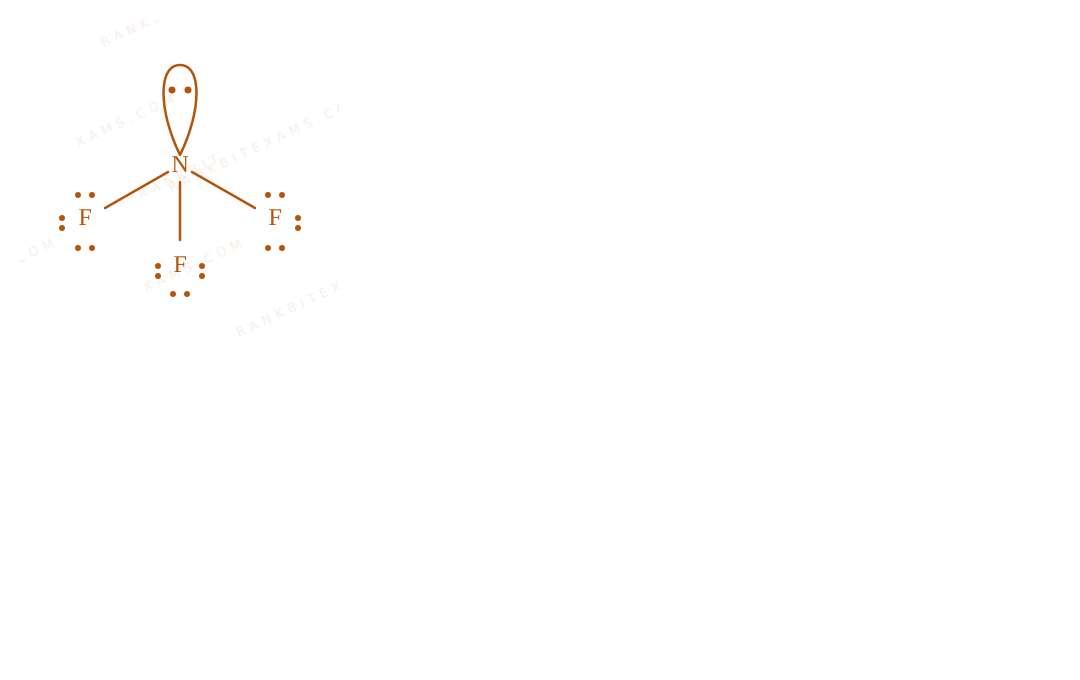
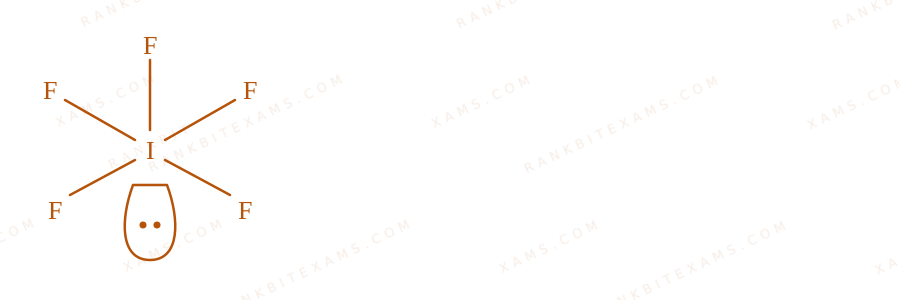
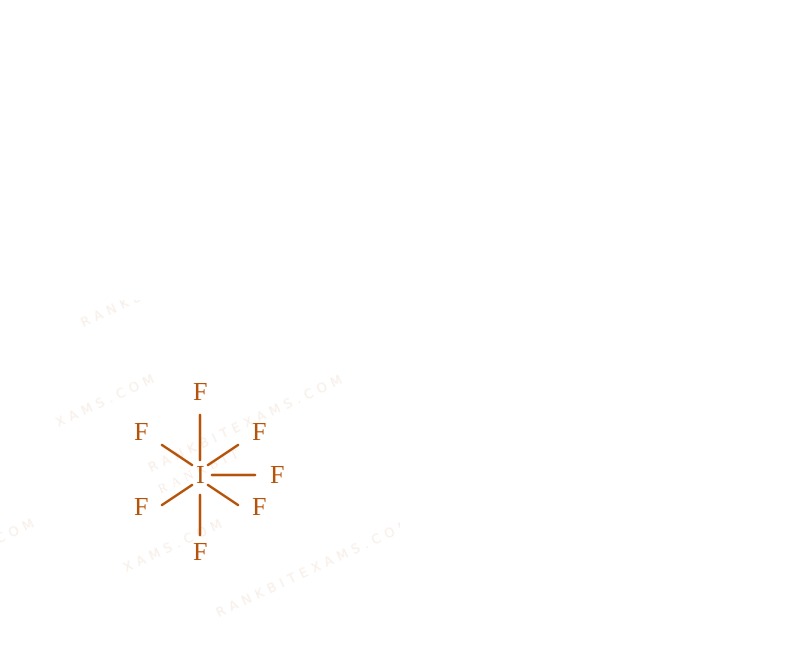
### Core Logic Let us check the steric details using VSEPR theory: - **mathrmBrF_5:** Bromine has 7 valence electrons. It forms 5 single bonds with Fluorine and retains 1 lone pair. Steric number = 6 (sp^3d^2), geometry is square pyramidal. - **mathrmXeOF_4:** Xenon has 8 valence electrons. It forms 1 double bond with Oxygen, 4 single bonds with Fluorine, and retains 1 lone pair. Steric number = 6 (sp^3d^2), geometry is square pyramidal. - **mathrmSbF_5 & mathrmPCl_5:** Central element has 5 valence electrons, forming 5 bonds with no lone pairs. Steric number = 5 (sp^3d), geometry is trigonal bipyramidal. Visual representations of geometries:
Geometry structure diagram 1 for Q35 - JEE Main 2025 Morning
### Pattern Recognition Sees: Steric count 6 with 5 bonded segments + 1 lone pair rightarrow always square pyramidal geometry. ### Evaluation Rubric / Model Answer null ### Chapter Mix Class 11 Chemistry: Chemical Bonding and Molecular Structure
Q43 jee_main_2025_03_april_morning Hybridisation
Match the LIST-I with LIST-II.
LIST-I (Molecules/ion)LIST-II (Hybridisation of central atom)A. PF*5I. dsp^2B. SF*6II. sp^3dC. Ni(CO)*4III. sp^3d^2D. [PtCl*4]^2-IV. sp^3
Choose the correct answer from the options given below:
  • A. A-II, B-III, C-IV, D-I
  • B. A-IV, B-I, C-II, D-III
  • C. A-I, B-II, C-III, D-IV
  • D. A-III, B-I, C-IV, D-II

Solution

### Core Logic Let us evaluate each central atom configuration systematically: * A. PF_5: Phosphorus has 5 valence electrons, forming 5sigma bonds with zero lone pairs. Steric number = 5 implies sp^3d hybridisation. * B. SF_6: Sulfur has 6 valence electrons, forming 6sigma bonds with zero lone pairs. Steric number = 6 implies sp^3d^2 hybridisation. * C. Ni(CO)_4: Nickel is in a 0 oxidation state (3d^8 4s^2). Carbon monoxide is a strong field ligand, forcing rearrangement into a filled 3d^10 state. The vacant 4s and three 4p orbitals hybridise to give an sp^3 configuration.
Orbital configuration matrix for Q43 - JEE Main 2025 Morning
* D. [PtCl_4]^2-: Platinum is in the +2 oxidation state (5d^8). Since it belongs to the 5d transition series, all ligands behave as strong field elements, leading to interior spin-pairing and an inner orbital square-planar dsp^2 hybridisation state.
Orbital configuration matrix for Q43 - JEE Main 2025 Morning
### Pattern Recognition Shortcut: Match structural main elements first: PF_5 ightarrow sp^3d (II), SF_6 ightarrow sp^3d^2 (III). This isolates option (1) instantly without checking d-block coordinate fields. ### Evaluation Rubric / Model Answer null ### Chapter Mix Class 11 Chemistry: Chemical Bonding and Molecular Structure Class 12 Chemistry: Coordination Compounds
Q jee_main_2025_04_april_evening VSEPR Theory
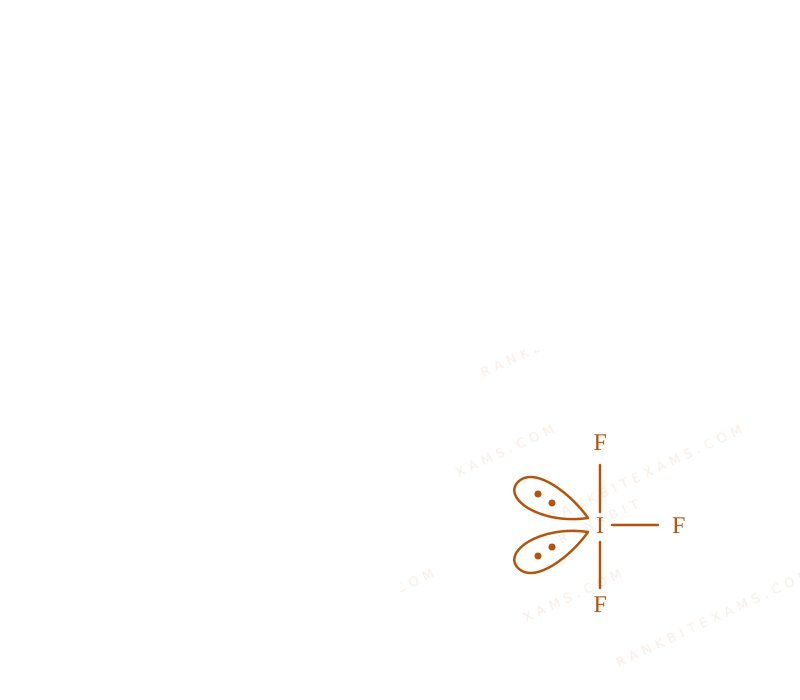
Given below are two statements: Statement (I) : for mathrmCell mathrmF_3 , all three possible structures may be drawn as follows.
ClF3 structure variant I for Q44
The prompt displays three configurations of chlorine trifluoride with differing spatial positions for its two lone electron pairs.
ClF3 structure variant I for Q44
The prompt displays three configurations of chlorine trifluoride with differing spatial positions for its two lone electron pairs.
ClF3 structure variant I for Q44
The prompt displays three configurations of chlorine trifluoride with differing spatial positions for its two lone electron pairs.
Statement (II) : Structure III is most stable, as the orbitals having the lone pairs are axial, where the ell mathfrakp- bp repulsion is minimum. In the light of the above statements, choose the most appropriate answer from the options given below:
ClF3 structure variant I for Q44
The prompt displays three configurations of chlorine trifluoride with differing spatial positions for its two lone electron pairs.
  • A. Statement I is incorrect but statement II is correct.
  • B. Statement I is correct but statement II is incorrect.
  • C. Both Statement I and statement II are correct.
  • D. Both Statement I and statement II are incorrect.

Solution

### Related Formula textSteric Number for ClF_3 = frac7+32 = 5 implies sp^3d text hybridization (Trigonal Bipyramidal geometry) ### Core Logic - **Statement I is correct:** The three structural arrangements represent the different ways to place three bond pairs and two lone pairs within a trigonal bipyramidal grid. - **Statement II is incorrect:** According to VSEPR theory and Bent's rule, in sp^3d hybridization, **lone pairs must occupy equatorial positions** to minimize strong 90^circ lone pair-bond pair (ell p-bp) repulsions. Placing them axially maximizes repulsions, making that structure the least stable, not the most stable. ### Pattern Recognition For sp^3d configurations (Trigonal Bipyramidal), lone pairs ALWAYS prefer equatorial sites where they experience 120^circ interactions, minimizing severe 90^circ structural strains. This results in the classic stable T-shaped configuration for ClF_3. ### Evaluation Rubric / Model Answer null ### Chapter Mix Class 11 Chemistry: Chemical Bonding and Molecular Structure

More Chemical Bonding and Molecular Structure Questions — jee_main_2024_31_jan_morning

Practice all Chemical Bonding and Molecular Structure previous-year questions →

Rankbit System
JEE Physics: Waves (+15.5%) | Electrostatics: Concentric Shells (-29.7%) | Modern Physics: Photoelectric Clones (+34.2%) | Mathematics: Definite Integrals (+18.1%) | Chemistry: Coordination Splitting (-11.4%) | JEE Physics: Waves (+15.5%) | Electrostatics: Concentric Shells (-29.7%) | Modern Physics: Photoelectric Clones (+34.2%) | Mathematics: Definite Integrals (+18.1%) | Chemistry: Coordination Splitting (-11.4%)