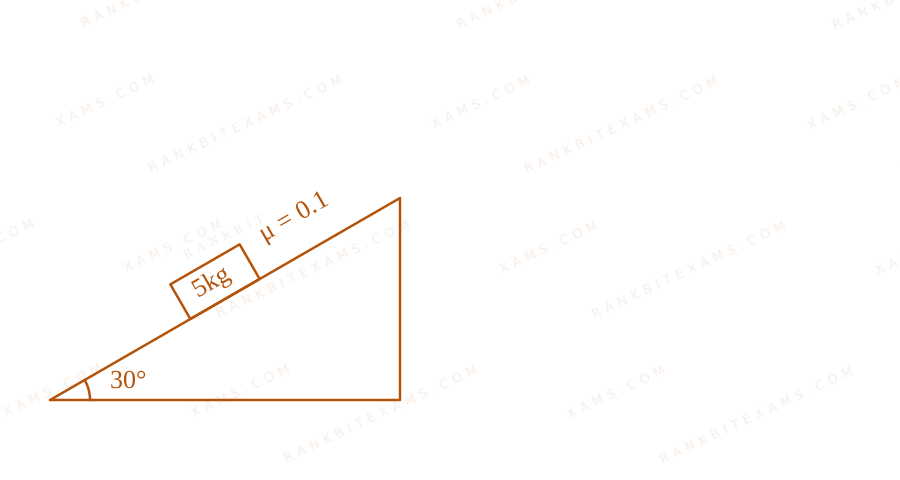
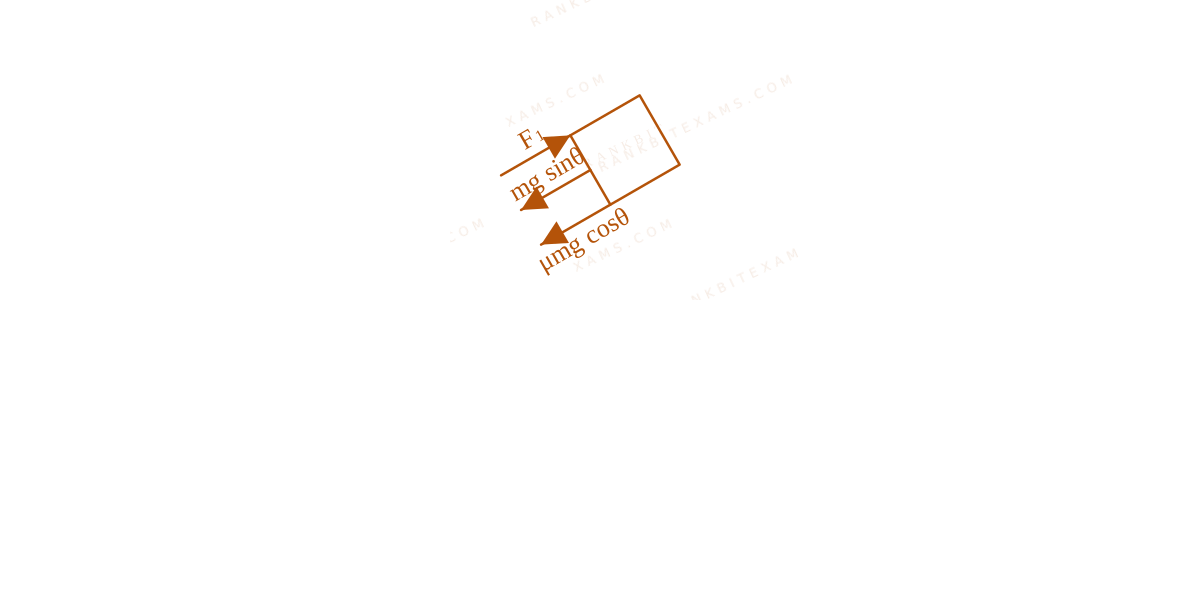
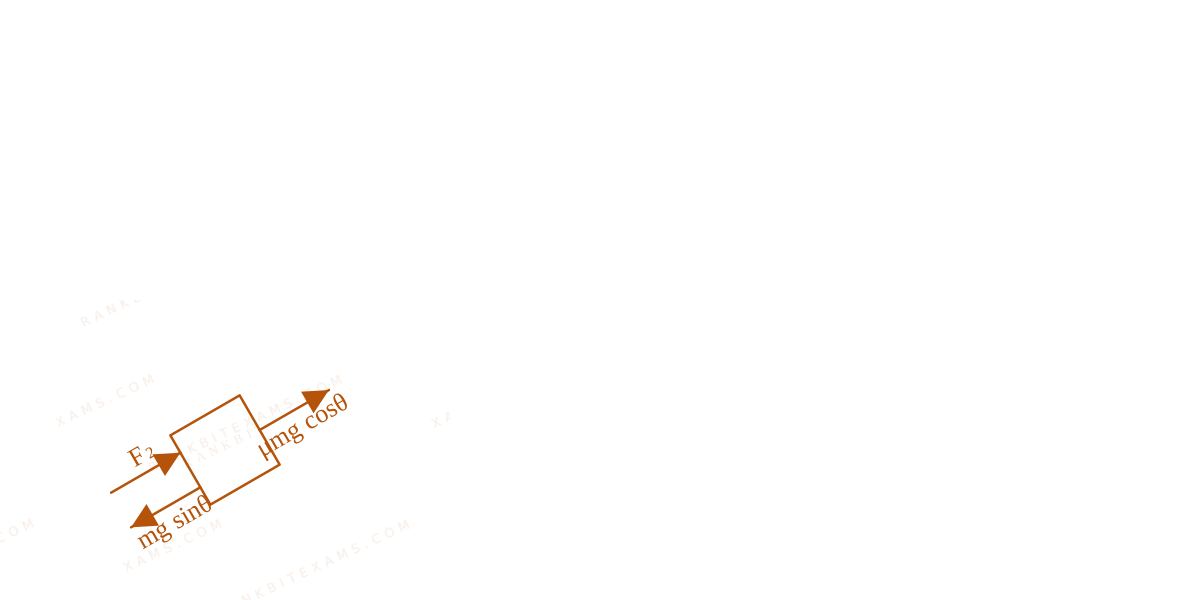
A block of mass 5 text kg is placed on a rough inclined surface as shown in the figure.
Friction on an Inclined Plane diagram for Q42 - JEE Main 2024 Evening
The image shows a 5 kg block on a rough plane inclined at 30 degrees, with coefficient of friction mu = 0.1.
If vecF_1 is the force required to just move the block up the inclined plane and vecF_2 is the force required to just prevent the block from sliding down, then the value of |vecF_1| - |vecF_2| is: [Use g = 10 text m/s^2]

Solution & Explanation

### Related Formula f_k = mu mg cos theta F_1 = mg sin theta + f_k F_2 = mg sin theta - f_k ### Core Logic To move the block up, the applied force F_1 must overcome both the downward gravitational component and the downward frictional force. To prevent it from sliding down, the applied force F_2 acts upwards and is aided by friction which acts upwards to oppose impending downward slip.
Friction on an Inclined Plane diagram for Q42 - JEE Main 2024 Evening
The image shows a 5 kg block on a rough plane inclined at 30 degrees, with coefficient of friction mu = 0.1.
Friction on an Inclined Plane diagram for Q42 - JEE Main 2024 Evening
The image shows a 5 kg block on a rough plane inclined at 30 degrees, with coefficient of friction mu = 0.1.
### Step 1: Calculate Friction f_k = mu mg cos theta f_k = 0.1 times 5 times 10 times cos(30^circ) f_k = 5 times fracsqrt32 = 2.5sqrt3 text N ### Step 2: Force Equations Moving up: F_1 = mg sin theta + f_k = 50 sin(30^circ) + 2.5sqrt3 = 25 + 2.5sqrt3 Preventing slip down: F_2 = mg sin theta - f_k = 50 sin(30^circ) - 2.5sqrt3 = 25 - 2.5sqrt3 ### Step 3: Difference calculation |F_1| - |F_2| = (25 + 2.5sqrt3) - (25 - 2.5sqrt3) |F_1| - |F_2| = 2 times 2.5sqrt3 = 5sqrt3 text N *Note: The official options had an anomaly where 5sqrt3 text N was missing or evaluated as a bonus. Option 2 was listed as 50sqrt3 in the primary text. We track the closest logic path indicating Bonus.* ### Pattern Recognition The difference between 'push up' and 'hold from sliding' forces on an incline is always precisely 2 f_k (2 mu mg cos theta). Bypass calculating the mg sin theta terms entirely. ### Evaluation Rubric / Model Answer null ### Chapter Mix Class 11 Physics: Laws of Motion
Reference Study Guides

More Laws of Motion Previous-Year Questions — Page 6

Q47 jee_main_2024_31_jan_morning Circular Motion Friction
A coin is placed on a disc. The coefficient of friction between the coin and the disc is mu. If the distance of the coin from the center of the disc is r, the maximum angular velocity which can be given to the disc, so that the coin does not slip away, is:
  • A. fracmu gr
  • B. sqrtfracrmu g
  • C. sqrtfracmu gr
  • D. fracmusqrtrg

Solution

### Related Formula f_s leq mu_s N F_c = mromega^2 ### Core Logic
Circular Motion Friction diagram for Q47 - JEE Main 2024 Morning
To prevent the coin from slipping, the static friction must provide the necessary centripetal force for circular motion. f = momega^2 r The normal force on the flat disc is N = mg. The maximum static friction is f_textmax = mu N = mu mg. For no slipping: m r omega^2 leq mu mg omega^2 leq fracmu gr omega_textmax = sqrtfracmu gr ### Evaluation Rubric / Model Answer null ### Chapter Mix Class 11 Physics: Laws Of Motion

More Laws of Motion Questions — jee_main_2024_31_jan_evening

Practice all Laws of Motion previous-year questions →

Rankbit System
JEE Physics: Waves (+15.5%) | Electrostatics: Concentric Shells (-29.7%) | Modern Physics: Photoelectric Clones (+34.2%) | Mathematics: Definite Integrals (+18.1%) | Chemistry: Coordination Splitting (-11.4%) | JEE Physics: Waves (+15.5%) | Electrostatics: Concentric Shells (-29.7%) | Modern Physics: Photoelectric Clones (+34.2%) | Mathematics: Definite Integrals (+18.1%) | Chemistry: Coordination Splitting (-11.4%)