
Rankbit System
JEE Physics: Waves (+15.5%) | Electrostatics: Concentric Shells (-29.7%) | Modern Physics: Photoelectric Clones (+34.2%) | Mathematics: Definite Integrals (+18.1%) | Chemistry: Coordination Splitting (-11.4%) | JEE Physics: Waves (+15.5%) | Electrostatics: Concentric Shells (-29.7%) | Modern Physics: Photoelectric Clones (+34.2%) | Mathematics: Definite Integrals (+18.1%) | Chemistry: Coordination Splitting (-11.4%)

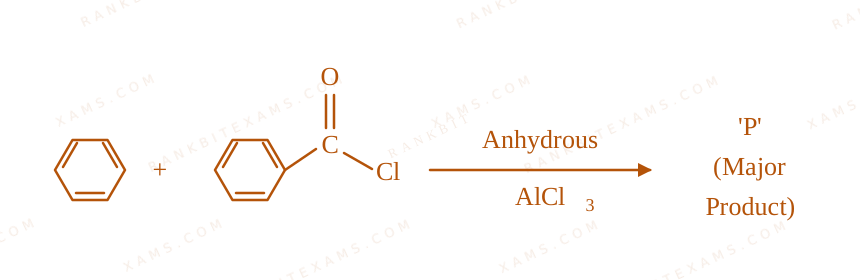
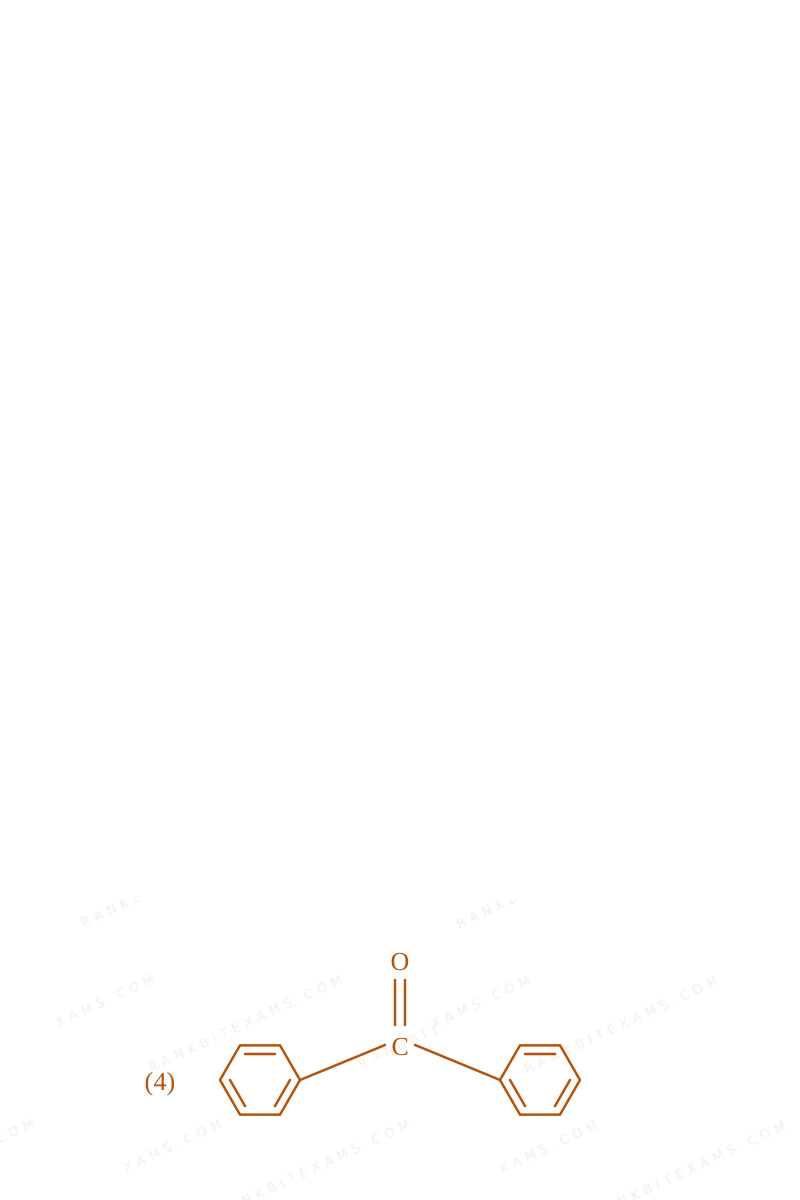
Identify major product 'P' formed in the following reaction.
Electrophilic Aromatic Substitution diagram for Q65 - JEE Main 2024 Evening
The image shows an aromatic ring undergoing a reaction with an alkyl halide in the presence of anhydrous AlCl3.

Solution & Explanation

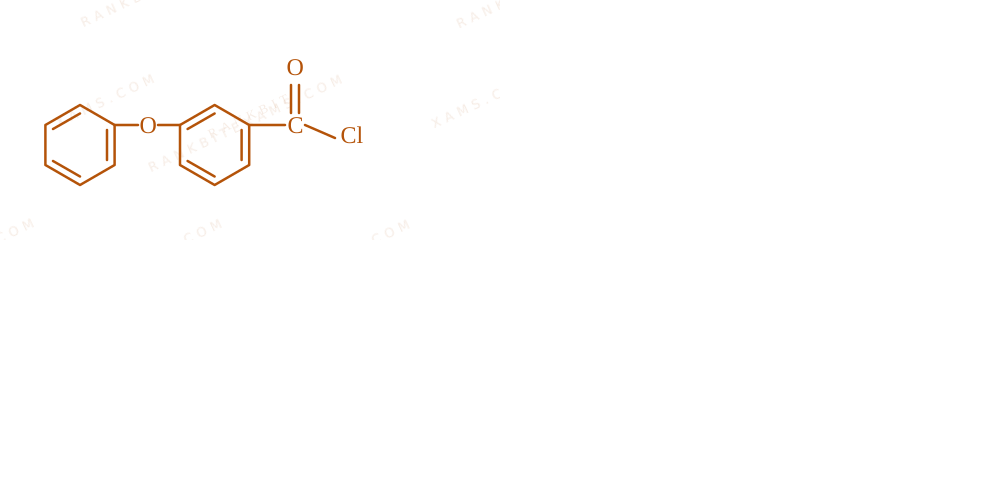
### Core Logic The given reaction is an intramolecular Friedel-Crafts alkylation. 1) The alkyl chloride reacts with anhydrous AlCl_3 to form a carbocation intermediate. 2) The carbocation generated will act as an electrophile and attack the adjacent phenyl ring. 3) The intermediate carbocation will undergo electrophilic aromatic substitution to form a new six-membered ring, as a 6-membered ring is highly stable and preferred over other ring sizes.
Electrophilic Aromatic Substitution diagram for Q65 - JEE Main 2024 Evening
The image shows an aromatic ring undergoing a reaction with an alkyl halide in the presence of anhydrous AlCl3.
### Pattern Recognition Intramolecular Friedel-Crafts usually prefers forming 5 or 6 membered rings due to lesser angle strain. Here, the tether length is perfect for closing into a 6-membered tetralin-like system. ### Evaluation Rubric / Model Answer null ### Chapter Mix Class 11 Chemistry: Hydrocarbons

Reference Study Guides

More Hydrocarbons Previous-Year Questions — Page 5

Q87 jee_main_2024_31_jan_morning Kolbe's Electrolysis
Number of alkanes obtained on electrolysis of a mixture of CH_3COONa and C_2H_5COONa is
Numerical Answer. Answer: 3 to 3

Solution

### Core Logic Kolbe's electrolytic method generates free radicals at the anode, which then combine to form alkanes. The given mixture yields two types of carboxylate radicals which decarboxylate to form alkyl radicals: CH_3COONa rightarrow dotCH_3 C_2H_5COONa rightarrow dotC_2H_5 These radicals can couple in three different ways: 1. Cross coupling: dotCH_3 + dotC_2H_5 rightarrow CH_3-CH_2-CH_3 (Propane) 2. Self-coupling 1: dotCH_3 + dotCH_3 rightarrow CH_3-CH_3 (Ethane) 3. Self-coupling 2: dotC_2H_5 + dotC_2H_5 rightarrow CH_3-CH_2-CH_2-CH_3 (Butane) Thus, a total of 3 different alkanes are formed. ### Evaluation Rubric / Model Answer null ### Chapter Mix Class 11 Chemistry: Hydrocarbons

More Hydrocarbons Questions — jee_main_2024_31_jan_evening

Practice all Hydrocarbons previous-year questions →

YOUR FIRST PREP STEP STARTS HERE

We Map Every Repeating Question in Competitive Exams.

Say goodbye to generic mock test fatigue. RankBit uses smart analysis to group past exam questions into their foundational Repeating Question Types. Find chapter weightage, track repeating questions, and score higher with targeted practice.

Select Your Target Exam

Choose an exam track below to find formulas per chapter and patterns.

Syncing Exam Intelligence

Mapping formulas and patterns across all tracks…

PATH A — FULL LENGTH PRACTICE

Full Mock Test Hub

Simulate real NTA exam conditions with fully tracked mocks. Time yourself against past papers.

Under Development
PATH B — TARGETED PRACTICE

Topic-wise Practice Hub

Practice past-year questions one chapter at a time. Pick an exam → subject → chapter and get every PYQ for that topic — pulled together from all past papers — with the chapter's key formulas alongside.

Loading Questions... Browse Topics
Latest from the Blog
View all →

Loading articles...