JEE Main · Physics ↑ Rising

Thermal Properties of Matter appeared 13 times across 3 years — 1.5% of Physics. This question is from Heating Curve of Water.

Year 2026 2025 2024 Total
Questions 5 7 1 13

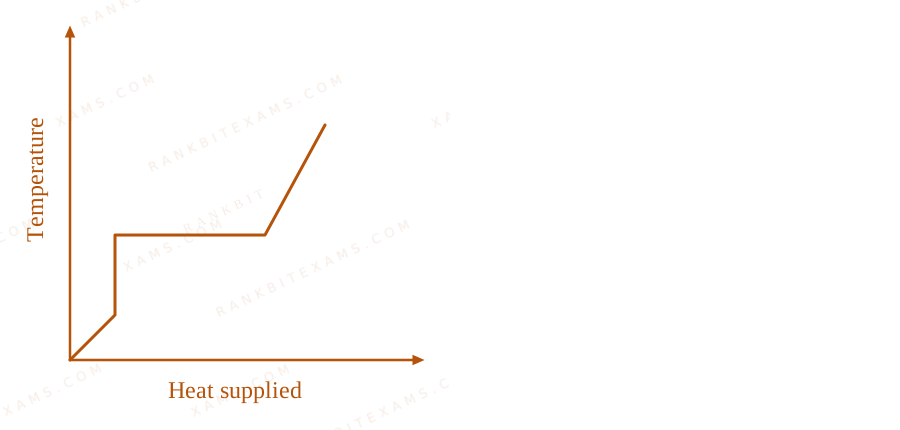
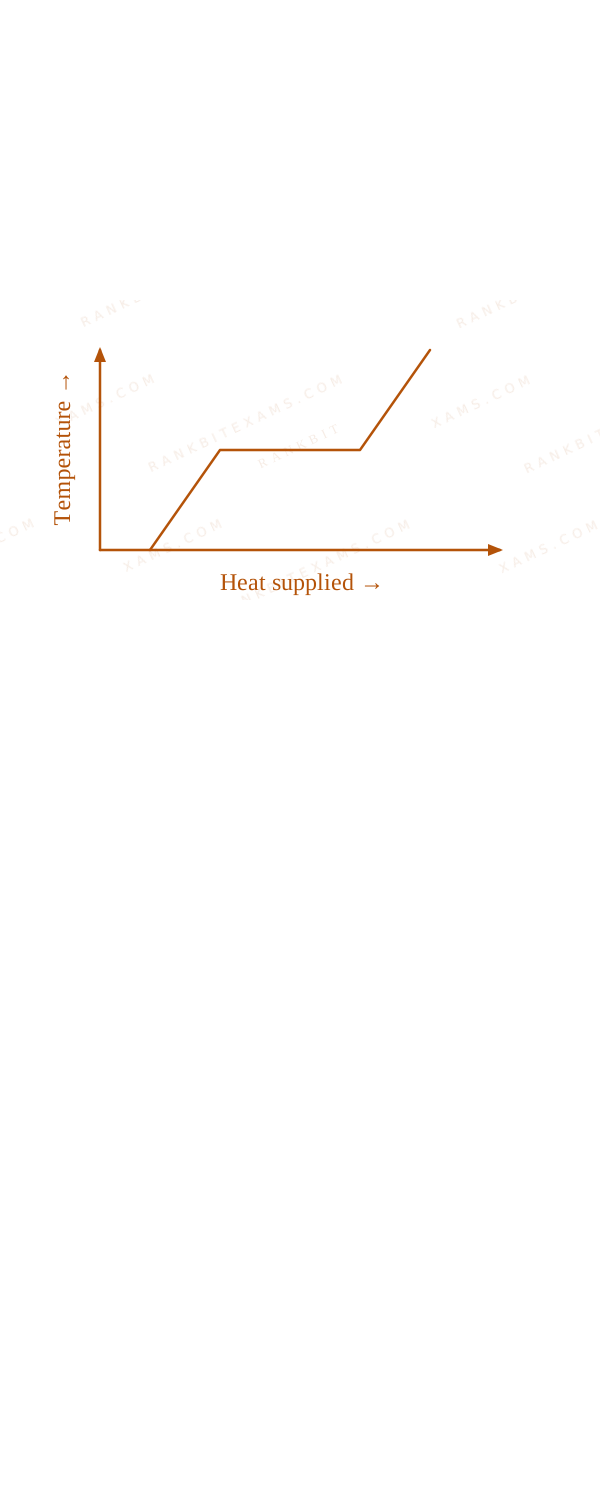
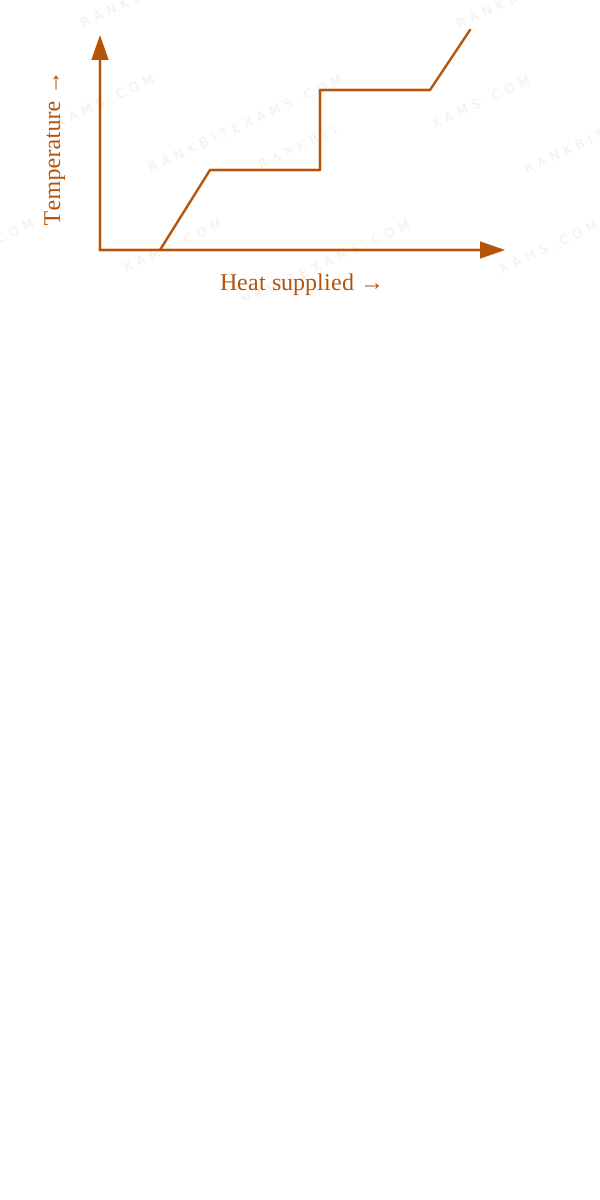
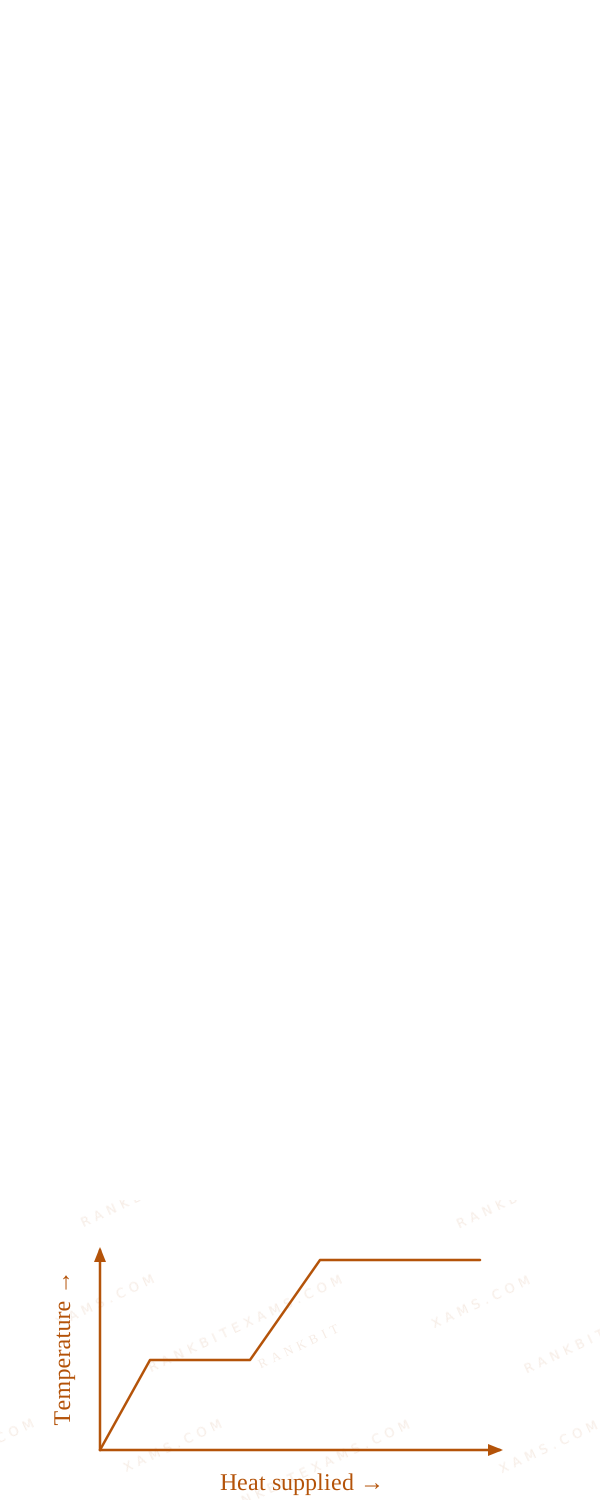
A block of ice at -10°C is slowly heated and converted to steam at 100°C. Which of the following curves represent the phenomenon qualitatively:

Solution & Explanation

Core Logic

The heating curve traces temperature vs heat supplied. Stage 1: Ice at -10°C is heated to 0°C (Temperature rises, solid phase). Stage 2: Ice melts at 0°C into water (Temperature remains constant until all ice melts). This is a horizontal plateau. Stage 3: Water is heated from 0°C to 100°C (Temperature rises, liquid phase). Stage 4: Water boils at 100°C into steam (Temperature remains constant). This is a second horizontal plateau.

Option (4) correctly shows this sequential step-like graph.

Pattern Recognition

Heating curves always exhibit horizontal segments during phase changes (latent heat) where temperature remains constant. The slopes of the inclined regions depend on the specific heat capacities of the respective phases.

Chapter Mix

Class 11 Physics: Thermal Properties of Matter

More Thermal Properties of Matter Previous-Year Questions — Page 2

Q19 jee_main_2025_02_april_evening Specific Heat Capacity and Thermal Conductivity
Match List-I with List-II. List-I: (A) Heat capacity of body (B) Specific heat capacity of body (C) Latent heat (D) Thermal conductivity List-II: (I) Jkg⁻¹ (II) JK⁻¹ (III) Jkg⁻¹K⁻¹ (IV) Jm⁻¹K⁻¹s⁻¹ Choose the correct answer from the options given below:
  • A. (A)-(III), (B)-(I), (C)-(II), (D)-(IV)
  • B. (A)-(IV), (B)-(III), (C)-(II), (D)-(I)
  • C. (A)-(III), (B)-(IV), (C)-(I), (D)-(II)
  • D. (A)-(II), (B)-(III), (C)-(I), (D)-(IV)

Solution

Related Formula

Governing mathematical equations for thermal properties:

  • Heat capacity: C' = (Δ Q)/(Δ T)
  • Specific heat capacity: s = (Δ Q)/(m Δ T)
  • Latent heat: L = (Δ Q)/(m)
  • Thermal conductivity: K = (Δ Q · L)/(A · Δ T · t)
Core Logic

Let's derive the SI units for each property:

  • (A) Heat capacity of body:
[C'] = JK = JK⁻¹ (II)
  • (B) Specific heat capacity of body:
[s] = Jkg · K = Jkg⁻¹K⁻¹ (III)
  • (C) Latent heat:
[L] = Jkg = Jkg⁻¹ (I)
  • (D) Thermal conductivity:
  • From heat transfer equation (dQ)/(dt) = K A (dT)/(dx):

K = (dQ/dt)/(A (dT/dx)) [K] = J/sm² · (K/m) = J · m⁻¹ · K⁻¹ · s⁻¹ (IV)
Step 1: Match values

Applying our mappings:

  • (A) → (II)
  • (B) → (III)
  • (C) → (I)
  • (D) → (IV)
  • This maps to Option (4).

Pattern Recognition

Sees: Dimensional unit matching of thermal parameters. Trap: Confusing Specific Heat Capacity (scaled per mass unit) with Heat Capacity (unscaled entire body parameter). Shortcut: Specific heat is normalized by mass, meaning its unit must contain kg in the denominator. Heat capacity has no mass constraint, meaning A maps directly to II.

Chapter Mix

Class 11 Physics: Thermal Properties of Matter

Q24 jee_main_2025_07_april_morning Radiation
A wire of length 10cm and diameter 0.5mm is used in a bulb. The temperature of the wire is 1727°C and power radiated by the wire is 94.2 W. Its emissivity is x8 where x = (Given σ = 6.0 × 10⁻⁸ ~W ~m⁻² ~K⁻⁴ , pi = 3.14 and assume that the emissivity of wire material is same at all wavelength.)
Numerical Answer. Answer: 5 to 5

Solution

Related Formula

Stefan-Boltzmann Law for radiated thermal power:

P = ε σ A T⁴

Surface area A of a cylindrical wire of diameter d and length L is:

A = π d L

Core Logic

Convert given parameters to standard SI units:

  • L = 10 ~cm = 0.1 ~m
  • d = 0.5 ~mm = 0.5 × 10⁻³ ~m
  • T = 1727 + 273.15 = 2000 ~K
  • P = 94.2 ~W
  • σ = 6.0 × 10⁻⁸ ~W · m⁻² · K⁻⁴
Step 1: Express Radiated Power and Emissivity

First, calculate the surface area A:

A = 3.14 × (0.5 × 10⁻³) × 0.1 = 1.57 × 10⁻⁴ ~m²

Substitute A, σ, and T into Stefan's formula:

94.2 = ε × (6.0 × 10⁻⁸) × [3.14 × (0.5 × 10⁻³) × (10 × 10⁻²)] × (2000)⁴

Calculate temperature term:

(2000)⁴ = 1.6 × 10¹² 94.2 = ε × (6 × 10⁻⁸) × (1.57 × 10⁻⁴) × (16 × 10¹²) 94.2 = ε × 6 × 1.57 × 16 × 1 = ε × 150.72 ε = (94.2)/(150.72) = (5)/(8)

Thus, (x)/(8) = (5)/(8) x = 5.

Pattern Recognition

Sees: Bulb filament heat radiation equation. Shortcut: Simplify the multiplication with factors of 10 first. T=2000 ~K has four zeros, so T⁴ adds 10¹² which cancels the 10⁻⁸ and 10⁻⁴ from area and constant. The coefficient equation directly yields the ratio ε = 5/8.

Chapter Mix

Class 11 Physics: Thermal Properties of Matter

Q19 jee_main_2025_29_jan_evening Newton's Law of Cooling
A cup of coffee cools from 90°C to 80°C in t minutes when the room temperature is 20°C . The time taken by the similar cup of coffee to cool from 80°C to 60°C at the same room temperature is :
  • A. (13)/(5) t
  • B. (10)/(13) t
  • C. (13)/(10) t
  • D. (5)/(13) t

Solution

Related Formula
(Tᵢ - Tf)/(Δ t) = K((Tᵢ + Tf)/(2) - T₀)
Core Logic

Case 1 (90°C arrow 80°C in time t):

(90 - 80)/(t) = K((90 + 80)/(2) - 20) (10)/(t) = K(85 - 20) = 65K (i)

Case 2 (80°C arrow 60°C in time t'):

(80 - 60)/(t') = K((80 + 60)/(2) - 20) (20)/(t') = K(70 - 20) = 50K (ii)

Dividing equation (i) by equation (ii):

(10/t)/(20/t') = (65K)/(50K) (t')/(2t) = (13)/(10) t' = (13)/(5)t
Pattern Recognition

Newton's law of cooling in average form uses the arithmetic mean of temperatures to approximate the driving temperature difference over the interval.

Chapter Mix

Class 11 Physics: Thermal Properties of Matter

Q3 jee_main_2025_04_april_evening Thermal Expansion
Consider a rectangular sheet of solid material of length =9 cm and width d=4 cm. The coefficient of linear expansion is α=3.1×10⁻⁵ K⁻¹ at room temperature and one atmospheric pressure. The mass of sheet m=0.1 kg and the specific heat capacity Cv=900 J kg⁻¹K⁻¹. If the amount of heat supplied to the material is 8.1×10² J then change in area of the rectangular sheet is :-
  • A. 2.0×10⁻⁶ m²
  • B. 3.0×10⁻⁷ m²
  • C. 6.0×10⁻⁷ m²
  • D. 4.0×10⁻⁷ m²

Solution

Related Formula
Δ Q = m Cv Δ T Δ A = A₀ β Δ T = A₀ (2α) Δ T
Core Logic

First, calculate the temperature change using heat supplied:

Δ T = (Δ Q)/(m Cv)

Substituting the values:

Δ T = (8.1 × 10²)/(0.1 × 900) = (810)/(90) = 9 K
Step 1: Calculate Change in Area

Initial area A₀ = × d = 9 cm × 4 cm = 36 cm² = 36 × 10⁻⁴ m². Now, substitute into the area expansion formula:

Δ A = 36 × 10⁻⁴ × 2 × (3.1 × 10⁻⁵) × 9 Δ A = 36 × 18 × 3.1 × 10⁻⁹ = 2008.8 × 10⁻⁹ m² ≈ 2.0 × 10⁻⁶ m²
Pattern Recognition

Always remember that areal expansion coefficient β = 2α. Convert geometry dimensions to standard units (1 cm² = 10⁻⁴ m²) cleanly before concluding arithmetic.

Chapter Mix

Class 11 Physics: Thermal Properties of Matter

Q23 jee_main_2025_07_april_evening Thermal Conduction
Two cylindrical rods A and B made of different materials, are joined in a straight line. The ratio of lengths, radii and thermal conductivities of these rods are: LALB = (1)/(2), rArB = 2 and KAKB = (1)/(2) . The free ends of rods A and B are maintained at 400~K, 200~K, respectively. The temperature of rods interface is ________ K, when equilibrium is established. [cite: 187, 188, 189, 190, 191, 192, 193]
Numerical Answer. Answer: 360 to 360

Solution

Related Formula

Rth = (L)/(KA) = (L)/(K(π r²)) [cite: 817]

(dQ)/(dt) = Δ TRth [cite: 818]

Core Logic

At steady state equilibrium, the rate of heat flow through both sections in series must be identical: [cite: 193, 819]

(400 - T)/(R₁) = (T - 200)/(R₂) (400 - T)/(T - 200) = (R₁)/(R₂) [cite: 192, 820]

Let's evaluate the resistance ratio (R₁)/(R₂) using the dimensional parameters: [cite: 820]

(R₁)/(R₂) = ((LA)/(LB)) · ((rB)/(rA))² · ((KB)/(KA)) [cite: 820]

Substitute the given values: (LA)/(LB) = (1)/(2), (rA)/(rB) = 2 (rB)/(rA) = (1)/(2), and (KA)/(KB) = (1)/(2) (KB)/(KA) = 2 [cite: 189, 190]:

(R₁)/(R₂) = (1)/(2) × ((1)/(2))² × 2 = (1)/(4) [cite: 821]

Now link this back into the temperature equation: [cite: 822]

(400 - T)/(T - 200) = (1)/(4) 1600 - 4T = T - 200 [cite: 822, 823]

5T = 1800 T = 360 K [cite: 824, 825]

Pattern Recognition

Thermal conduction processes behave exactly like electric current fields in series connections[cite: 818, 819]. Cross-sectional area scales squarely with radius parameters, which requires extra care during substitution.

Chapter Mix

Class 11 Physics: Thermal Properties of Matter

More Thermal Properties of Matter Questions — jee_main_2024_30_january_evening

Practice all Thermal Properties of Matter previous-year questions →

Rankbit System
JEE Physics: Waves (+15.5%) | Electrostatics: Concentric Shells (-29.7%) | Modern Physics: Photoelectric Clones (+34.2%) | Mathematics: Definite Integrals (+18.1%) | Chemistry: Coordination Splitting (-11.4%) | JEE Physics: Waves (+15.5%) | Electrostatics: Concentric Shells (-29.7%) | Modern Physics: Photoelectric Clones (+34.2%) | Mathematics: Definite Integrals (+18.1%) | Chemistry: Coordination Splitting (-11.4%)