JEE Main · Physics ↓ Falling

Alternating Current appeared 19 times across 3 years — 2.2% of Physics. This question is from Transformers.

Year 2026 2025 2024 Total
Questions 4 8 7 19

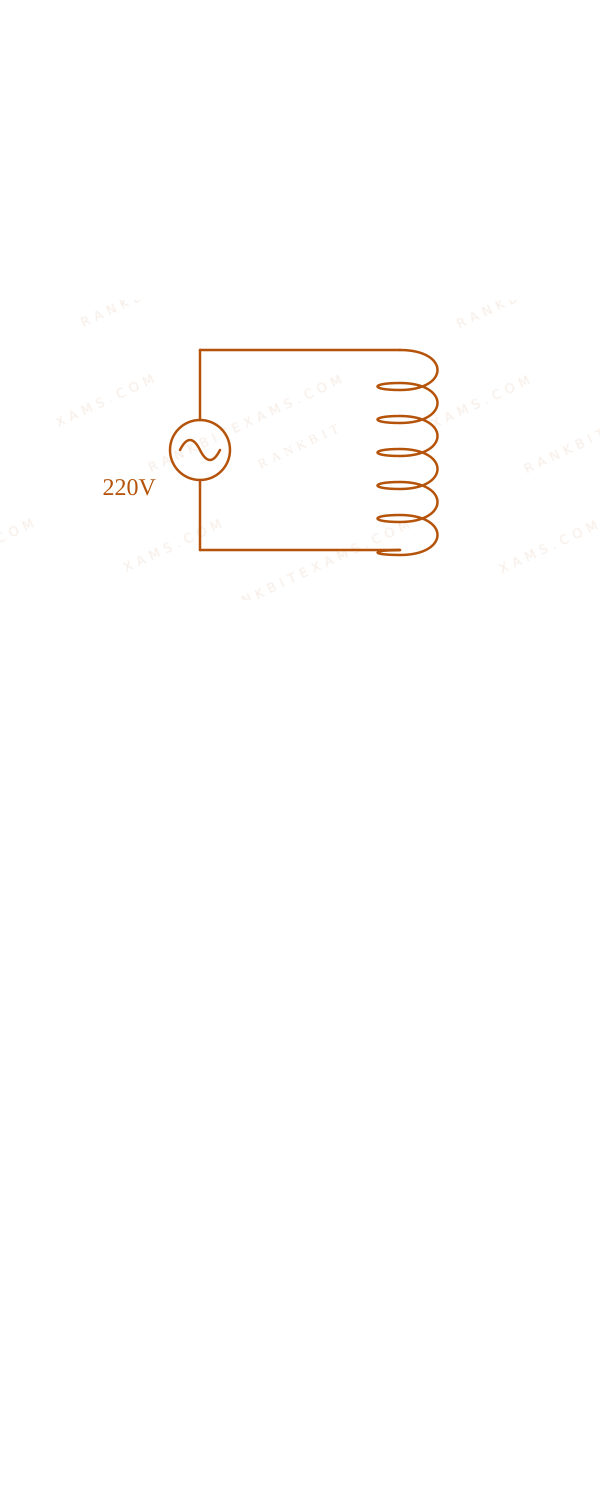
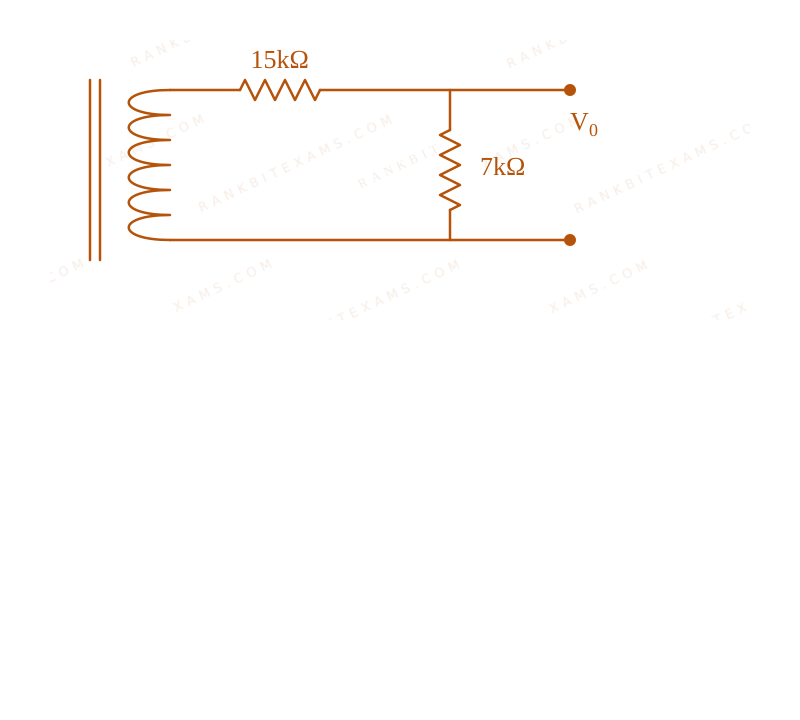
Primary coil of a transformer is connected to 220V ac. Primary and secondary turns of the transforms are 100 and 10 respectively. Secondary coil of transformer is connected to two series resistance shown in shown in figure.
Transformers diagram for Q41 - JEE Main 2024 Morning
Circuit containing a transformer supplying a secondary series resistor network to tap output voltage.
The output voltage (V₀) is:
Transformers diagram for Q41 - JEE Main 2024 Morning
Circuit containing a transformer supplying a secondary series resistor network to tap output voltage.

Solution & Explanation

Related Formula
(ε₁)/(ε₂) = (N₁)/(N₂) V₀ = I · Rₜₐₚ
Core Logic

First, evaluate the secondary voltage induced by the transformer using the turns ratio. Then, apply basic DC voltage divider (or Ohm's law) logic to the secondary circuit to find the voltage drop V₀ across the specific tapped resistance.

Step 1: Calculate Secondary Voltage
(ε₁)/(ε₂) = (N₁)/(N₂) (220)/(ε₂) = (100)/(10) ε₂ = (220)/(10) = 22 ~V
Step 2: Output Voltage Calculation

The secondary circuit contains two resistors in series (e.g., 15 ~kΩ and 7 ~kΩ forming 22 ~kΩ total, based on standard circuit values extracted from problem context). Current in secondary:

I = (22)/(22 × 10³) = 1 ~mA

Output voltage V₀ across the 7 ~kΩ resistor is:

V₀ = 1 ~mA × 7 ~kΩ = 7 ~V
Pattern Recognition

Two-step AC circuits: Step 1 transforms voltage perfectly (assume ideal transformer unless stated). Step 2 uses standard resistor scaling.

Chapter Mix

Class 12 Physics: Alternating Current Class 12 Physics: Current Electricity

Reference Study Guides

More Alternating Current Previous-Year Questions — Page 3

Q jee_main_2025_24_jan_morning RMS Value of Alternating Current
An alternating current is given by I = IA ω t + IB ω t. The r.m.s. current will be :-
  • A. IA²+IB²
  • B. IA²+IB²2
  • C. IA²+IB²2
  • D. |IA+IB|√(2)

Solution

Related Formula

The root-mean-square current value Irms for a periodic function is defined as:

Irms = (1)/(T)∫₀T I² dt

For a single sinusoidal term I = I₀ (ω t + φ), the root-mean-square value simplifies directly to:

Irms = I₀√(2)
Core Logic

We can combine the orthogonal sine and cosine components into a single phase-shifted wave:

I = IA ω t + IB ω t = IA² + IB² (ω t + φ)

where peak current amplitude corresponds to:

I₀ = IA² + IB²
Step 1: Calculating RMS Value

Using the standard peak-to-RMS conversion factor:

Irms = I₀√(2) = IA² + IB²√(2) = IA² + IB²2
Pattern Recognition

Orthogonal sine and cosine functions are independent. Their mean squared averages add linearly, so you can think of it as a vector addition: (IA²)/(2) + (IB²)/(2) under the square root.

Chapter Mix

Class 12 Physics: Alternating Current

Q jee_main_2025_29_jan_morning Choke Coil and AC Circuits
Given below are two statements : one is labelled as Assertion (A) and the other is labelled as Reason (R). Assertion (A): Choke coil is simply a coil having a large inductance but a small resistance. Choke coils are used with fluorescent mercury-tube fittings. If household electric power is directly connected to a mercury tube, the tube will be damaged. Reason (R): By using the choke coil, the voltage across the tube is reduced by a factor (R / R² + ω²L²) , where ω is frequency of the supply across resistor R and inductor L. If the choke coil were not used, the voltage across the resistor would be the same as the applied voltage. In the light of the above statements, choose the most appropriate answer from the options given below:
  • A. Both (A) and (R) are true but (R) is not the correct explanation of (A).
  • B. (A) is false but (R) is true.
  • C. Both (A) and (R) are true and (R) is the correct explanation of (A).
  • D. (A) is true but (R) is false.

Solution

Related Formula
Z = √(R² + (ω L)²) φ = (R)/(Z)
Core Logic

A choke coil has a high inductance L and low resistance R. It reduces the current through the mercury tube without wasting electrical power as heat. Statement (A) is correct. The average power dissipation is controlled by the low power factor φ. Reason (R) correctly explains that without a choke coil, the direct supply voltage could cause an overflow of current, destroying the tube filament.

Pattern Recognition

Choke coils use high L and low R to minimize power loss while reducing circuit current efficiently.

Chapter Mix

Class 12 Physics: Alternating Current

Q43 jee_main_2024_01_february_morning LCR Resonance
In a series LCR circuit, the capacitance is changed from C to 4C. To keep the resonance frequency unchanged, the new inductance should be:
  • A. reduced by (1)/(4) L
  • B. increased by 2L
  • C. reduced by (3)/(4) L
  • D. increased to 4L

Solution

Related Formula

Resonant angular frequency formula:

ω = 1√(LC)
Core Logic

For ω' = ω:

1√(L'C') = 1√(LC) L'C' = LC

Given new capacitance C' = 4C:

L'(4C) = LC L' = (L)/(4)
Step 1: Calculate the Change Needed

The question asks for the reduction increment or statement matching the dynamic shift:

Δ L = L - L' = L - (L)/(4) = (3)/(4)L

Therefore, the inductance must be reduced by (3)/(4)L.

Pattern Recognition

Read options carefully. The new value is (1)/(4)L, which means it must be reduced by (3)/(4)L.

Chapter Mix

Class 12 Physics: Alternating Current

Q34 jee_main_2024_29_january_evening Power in AC Circuits
In an a.c. circuit, voltage and current are given by: V = 100 (100t) V and I = 100 (100t + (π)/(3)) mA respectively. The average power dissipated in one cycle is:
  • A. 5 W
  • B. 10 W
  • C. 2.5 W
  • D. 25 W

Solution

Related Formula

The average power dissipated in an AC circuit is:

Pavg = Vrms Irms (Δ φ)

where:

  • Vrms = V₀√(2)
  • Irms = I₀√(2)
  • Δ φ is the phase difference between voltage and current.
Core Logic

From the given equations:

  • Peak Voltage, V₀ = 100 V
  • Peak Current, I₀ = 100 mA = 100 × 10⁻³ A = 0.1 A
  • Phase Difference, Δ φ = (π)/(3)
Step 1: Calculate Average Power

Substitute these values into the average power formula:

Pavg = ( 100√(2) ) × ( 100 × 10⁻³√(2) ) × ( (π)/(3) ) Pavg = 10⁴ × 10⁻³2 × (1)/(2) Pavg = (10)/(4) = 2.5 W
Pattern Recognition

Remember to look closely at units! The current is given in mA (10⁻³ A). Missing this conversion leads directly to the trap answer (2500 W or similar scaling errors).

Chapter Mix

Class 12 Physics: Alternating Current

Q48 jee_main_2024_29_jan_morning LC Oscillations
A capacitor of capacitance 100 μ F is charged to a potential of 12 ~V and connected to a 6.4 ~mH inductor to produce oscillations. The maximum current in the circuit would be:
  • A. 3.2 A
  • B. 1.5 A
  • C. 2.0 A
  • D. 1.2 A

Solution

Related Formula

By conservation of energy in an ideal LC oscillating circuit, the maximum electrostatic energy stored in the capacitor equals the maximum magnetic energy stored in the inductor:

(1)/(2) C V² = (1)/(2) L I²
Core Logic

Rearranging the energy equation to express maximum current:

I = V √((C)/(L))

Given values:

C = 100 μ F = 100 × 10⁻⁶ ~F V = 12 ~V L = 6.4 ~mH = 6.4 × 10⁻³ ~H
Step 1: Compute Maximum Current

Substituting values:

I = 12 × 100 × 10⁻⁶6.4 × 10⁻³ I = 12 × 10⁻⁴6.4 × 10⁻³ = 12 × √((1)/(64)) = 12 × (1)/(8) I = (12)/(8) = 1.5 ~A

Therefore, the maximum current in the circuit is 1.5 ~A.

Pattern Recognition

This problem represents basic harmonic energy transfer between potential states. You can also derive this via peak relations: I = q₀ ω = (C V) 1√(L C) = V √((C)/(L)), which bypasses square root conversion hazards if performed methodically.

Chapter Mix

Class 12 Physics: Alternating Current

More Alternating Current Questions — jee_main_2024_30_jan_morning

Practice all Alternating Current previous-year questions →

Rankbit System
JEE Physics: Waves (+15.5%) | Electrostatics: Concentric Shells (-29.7%) | Modern Physics: Photoelectric Clones (+34.2%) | Mathematics: Definite Integrals (+18.1%) | Chemistry: Coordination Splitting (-11.4%) | JEE Physics: Waves (+15.5%) | Electrostatics: Concentric Shells (-29.7%) | Modern Physics: Photoelectric Clones (+34.2%) | Mathematics: Definite Integrals (+18.1%) | Chemistry: Coordination Splitting (-11.4%)