JEE Main · Mathematics → Steady

Application of Integrals appeared 27 times across 3 years — 3.1% of Mathematics. This question is from Area under Curves.

Year 2026 2025 2024 Total
Questions 9 11 7 27

The area (in square units) of the region bounded by the parabola y² = 4(x - 2) and the line y = 2x - 8

Solution & Explanation

Related Formula
Area = ∫y₁y₂ (xR - xL) dy
Core Logic

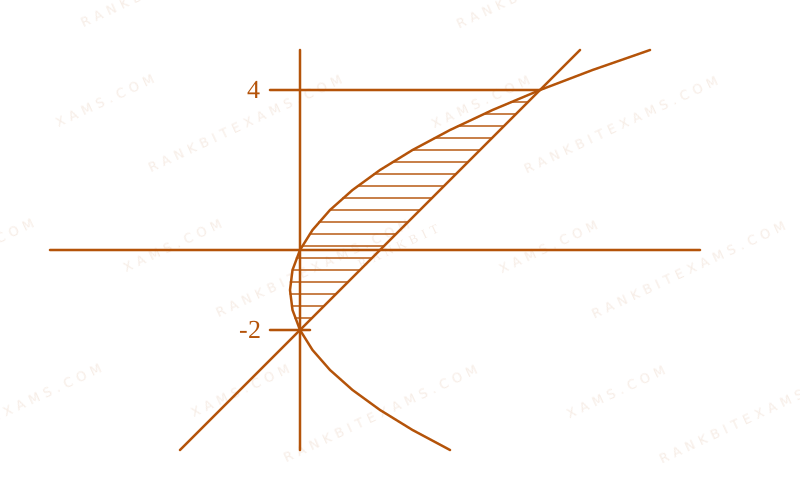
Area under Curves diagram for Q8 - JEE Main 2024 Morning

To simplify calculations, shift the origin. Let X = x - 2. The equations become: Parabola: y² = 4X ⇒ X = (y²)/(4) Line: y = 2(X + 2) - 8 ⇒ y = 2X - 4 ⇒ X = (y + 4)/(2)

Step 1: Finding points of intersection

Set the X values equal to find intersection points in terms of y:

(y²)/(4) = (y + 4)/(2)

y² = 2y + 8

y² - 2y - 8 = 0 (y - 4)(y + 2) = 0

The intersection points are at y = -2 and y = 4.

Step 2: Area Integration

Integrate with respect to y from -2 to 4:

A = ∫₋₂⁴ ( xR - xL ) dy A = ∫₋₂⁴ ( (y + 4)/(2) - (y²)/(4) ) dy A = [ (y²)/(4) + 2y - (y³)/(12) ]₋₂⁴

Upper limit (y=4): (16)/(4) + 8 - (64)/(12) = 4 + 8 - (16)/(3) = 12 - (16)/(3) = (20)/(3) Lower limit (y=-2): (4)/(4) - 4 - (-8)/(12) = 1 - 4 + (2)/(3) = -3 + (2)/(3) = -(7)/(3)

A = (20)/(3) - (-(7)/(3)) = (27)/(3) = 9

The solution simplifies it directly to 9 square units.

Pattern Recognition

For a horizontal parabola interacting with a line, integrating along the y-axis is always cleaner than splitting it into multiple integrals along the x-axis.

Chapter Mix

Class 12 Maths: Application of Integrals

Reference Study Guides

More Application of Integrals Previous-Year Questions — Page 4

Q71 jee_main_2025_04_april_morning Area Bounded by Multiple Curves
If the area of the region (x,y) : |x - 5| ≤ y ≤ 4√(x) is A, then 3A is equal to
Numerical Answer. Answer: 368 to 368

Solution

Related Formula

Area tracking equation via horizontal slices or split verticals:

Area = ∫x₁x₂ (yupper - ylower) dx
Core Logic

Find the intersections of y = |x - 5| and y = 4√(x): Branch 1: 5 - x = 4√(x) x + 4√(x) - 5 = 0 (√(x) + 5)(√(x) - 1) = 0 x = 1, y = 4. Branch 2: x - 5 = 4√(x) x - 4√(x) - 5 = 0 (√(x) - 5)(√(x) + 1) = 0 x = 25, y = 20.
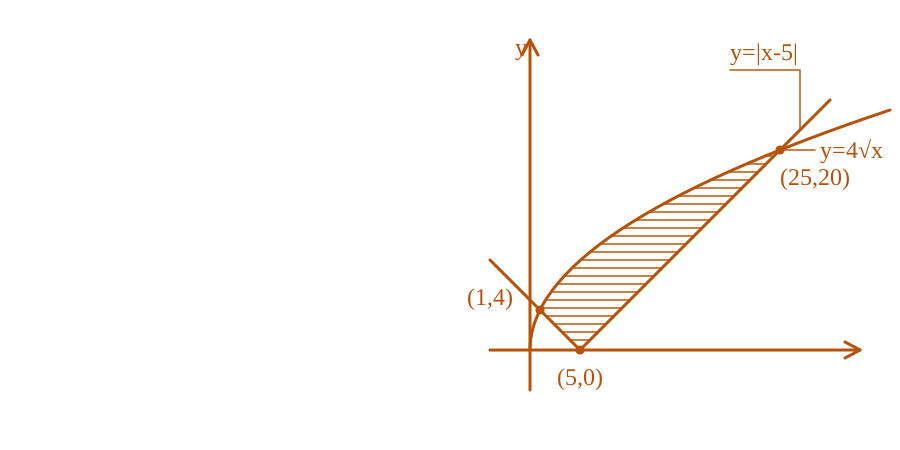
Area Bounded by Multiple Curves diagram for Q71 - JEE Main 2025 Morning

Step 1: Set Up Area Definite Integral

Split integration intervals around vertex x = 5 or compute via simple boundary differences:

A = ∫₁²⁵ 4√(x) dx - Area of Left Triangle - Area of Right Triangle Area of Left Triangle = (1)/(2) × (5 - 1) × 4 = 8 Area of Right Triangle = (1)/(2) × (25 - 5) × 20 = 200
Step 2: Complete Computations
∫₁²⁵ 4√(x) dx = [ (8)/(3)x3/2 ]₁²⁵ = (8)/(3)(125 - 1) = (8 × 124)/(3) = (992)/(3) A = (992)/(3) - 208 = (992 - 624)/(3) = (368)/(3)

3A = 368

Pattern Recognition

Subtracting standard geometric triangles beneath linear configurations from total absolute root curves saves significant time compared to managing multiple separate analytical integral pieces.

Chapter Mix

Class 12 Mathematics: Area Under Curves
Q67 jee_main_2025_24_jan_evening Area Under Curves
The area of the region enclosed by the curves y=ex, y=|ex-1| and y-axis is:
  • A. 1+ ₑ2
  • B. ₑ2
  • C. 2 ₑ2-1
  • D. 1- ₑ2

Solution

Related Formula

The area between two curves y₁(x) and y₂(x) from x = a to x = b is given by:

Area = ∫ₐb |y₁(x) - y₂(x)| dx
Core Logic

Analyze the curves to locate intersection points :

  • Curve 1: y = e^x
  • Curve 2: y = |e^x - 1|
  • Boundary: y-axis (x = 0)
  • For x < 0, e^x < 1 ⇒ |e^x - 1| = 1 - e^x .

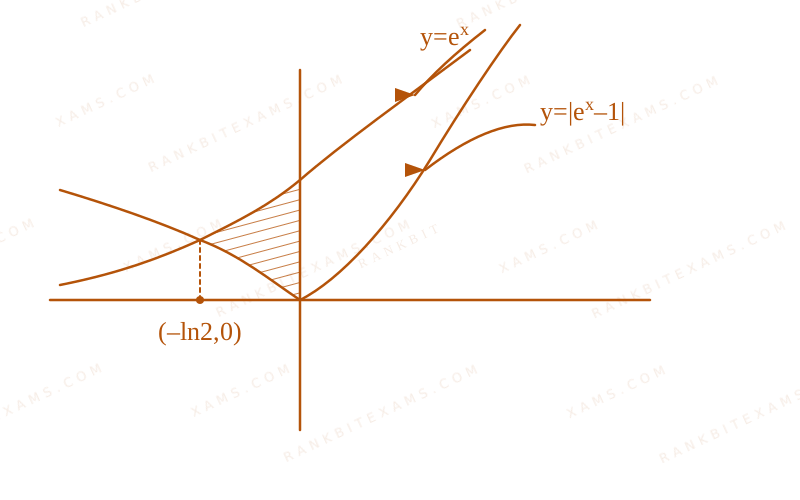
    Find intersection: e^x = 1 - e^x ⇒ 2e^x = 1 ⇒ e^x = (1)/(2) ⇒ x = -ln 2.

    Area bounded by exponential curves diagram for Q67 - JEE Main 2025 Evening
    Area bounded by exponential curves diagram for Q67 - JEE Main 2025 Evening

Step 1: Set up the Definite Integral

The integration spans from x = -ln 2 to x = 0. In this interval, e^x ≥ 1 - e^x:

Area = ∫-ln 2⁰ [ e^x - (1 - e^x) ] dx Area = ∫-ln 2⁰ (2e^x - 1) dx
Step 2: Integration Evaluation

Integrate term-by-term :

Area = [ 2e^x - x ]-ln 2⁰ = (2e⁰ - 0) - (2e-ln 2 - (-ln 2)) = 2 - (2((1)/(2)) + ln 2) = 2 - (1 + ln 2) = 1 - ln 2
Pattern Recognition

Modulus graphs split at their critical point (e^x = 1 ⇒ x = 0). Recognizing that the required segment lies strictly in the negative quadrant simplifies the definition of the upper and lower functions immediately.

Chapter Mix

Class 12 Mathematics: Application of Integrals

Q63 jee_main_2025_24_jan_morning Area Bounded by Multiple Curves
The area of the region (x,y) x² + 4x + 2 ≤ y ≤ |x + 2| is equal to :
  • A. 7
  • B. 24/5
  • C. 20/3
  • D. 5

Solution

Related Formula

The net area between two intersecting functions y₂(x) and y₁(x) from lower limit a to upper limit b is evaluated using the definite integral:

Area = ∫ₐb [y₂(x) - y₁(x)] dx
Core Logic

Let's perform a horizontal shift transformation by defining X = x + 2 to simplify the expressions:

  • Parabola: y = x² + 4x + 2 = (x+2)² - 2 y = X² - 2
  • Absolute curve: y = |x + 2| y = |X|
  • This coordinate translation preserves area completely while shifting the axis to the origin.

Step 1: Compute Points of Intersection

Find where the transformed curves intersect by equating the functions: |X|² - 2 = |X|

|X|² - |X| - 2 = 0 (|X| - 2)(|X| + 1) = 0

Since |X| ≥ 0, we discard |X| = -1. This gives |X| = 2 X = ± 2.

Step 2: Set up and Evaluate the Transformed Integral

Since both curves are symmetric about the vertical line X = 0, we can compute the area for the positive half and double it:

Area = 2 ∫₀² [ X - (X² - 2) ] dX = 2 ∫₀² ( 2 + X - X² ) dX

Integrate the polynomial row-by-row:

= 2 [ 2X + (X²)/(2) - (X³)/(3) ]₀² = 2 [ 2(2) + (4)/(2) - (8)/(3) ] = 2 [ 4 + 2 - (8)/(3) ] = 2 [ 6 - (8)/(3) ] = 2 · (10)/(3) = (20)/(3)
Pattern Recognition

Applying a horizontal variable substitution matching X = x + ± c shifts complex quadratic forms to centered formats, which avoids tedious arithmetic across asymmetrical integration limits.

Chapter Mix

Class 12 Mathematics: Application of Integrals

Q jee_main_2025_28_jan_evening Area Bounded by Algebraic and Rational Curves
The area of the region bounded by the curves x(1+y²)=1 and y²=2x is :
  • A. 2((π)/(2)-(1)/(3))
  • B. (π)/(4)-(1)/(3)
  • C. (π)/(2)-(1)/(3)
  • D. (1)/(2)((π)/(2)-(1)/(3))

Solution

Related Formula

Area integrating with respect to y:

A = ∫y₁y₂ (xright - xleft) dy

Standard integral:

∫ (1)/(1+y²) dy = ⁻¹(y)
Core Logic

The boundary curves are:

  • x = (1)/(1+y²)
  • x = (y²)/(2)
  • Find intersection points by setting x equal:

(1)/(1+y²) = (y²)/(2) 2 = y²(1+y²) y⁴ + y² - 2 = 0 (y² + 2)(y² - 1) = 0

Since y is real, y² = 1 y = ± 1. When y = ± 1, x = (1)/(2). Intersection points are ((1)/(2), 1) and ((1)/(2), -1).

Step 1: Set up and Compute Area Integral

Between y = -1 and y = 1, (1)/(1+y²) ≥ (y²)/(2).

Area = ∫₋₁¹ ( (1)/(1+y²) - (y²)/(2) ) dy

Since the integrand is an even function of y:

Area = 2 ∫₀¹ ( (1)/(1+y²) - (y²)/(2) ) dy Area = 2 [ ⁻¹(y) - (y³)/(6) ]₀¹ Area = 2 [ ⁻¹(1) - (1)/(6) - (0) ] = 2 ( (π)/(4) - (1)/(6) ) = (π)/(2) - (1)/(3)
Pattern Recognition

Whenever curves are functions of y², integrating along the y-axis avoids dealing with messy radical functions (square roots) and naturally accounts for symmetry across the x-axis.

Chapter Mix

Class 12 Mathematics: Application of Integrals

Q57 jee_main_2025_29_jan_morning Area Under Curves
Let the area of the region (x, y) : 2y ≤ x² + 3 , y + |x| ≤ 3 , y ≥ |x - 1| be A. Then 6A is equal to:
  • A. 16
  • B. 12
  • C. 18
  • D. 14

Solution

Related Formula
Area = ∫ₐb (yupper - ylower) dx
Core Logic

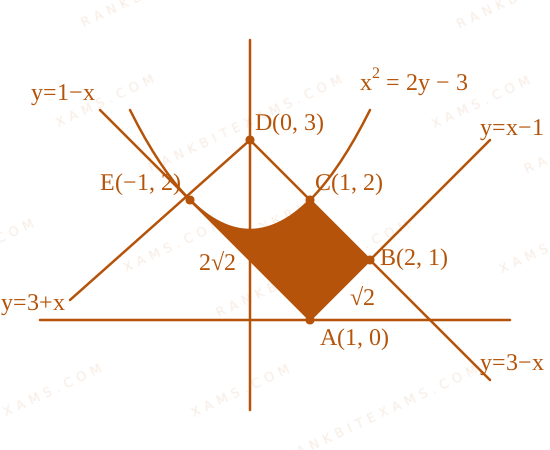
Plotting the boundary lines and tracking intersection points yields a composite geometric region bounding a central area.

Area Under Curves diagram for Q57 - JEE Main 2025 Morning

Step 1: Set up the integral pieces

The bounded region A can be conceptualized as a total bounding box/rectangle minus specific external integrals:

A = 4 - 2 ∫₀¹ [ (3 - x) - ( (x² + 3)/(2) ) ] dx
Step 2: Evaluate the Integral
A = 4 - 2 [ 3x - (x²)/(2) - (x³)/(6) - (3)/(2)x ]₀¹ A = 4 - 2 [ 3 - (1)/(2) - (1)/(6) - (3)/(2) ] = 4 - 2 [ (5)/(6) ] = 4 - (5)/(3) = (7)/(3)
Step 3: Calculate 6A

6A = 6 × (7)/(3) = 14

Pattern Recognition

When dealing with multiple absolute functions (|x|, |x-1|), check for coordinate mirror symmetry across vertical axes to slash total required calculus computations in half.

Chapter Mix

Class 12 Mathematics: Application of Integrals

More Application of Integrals Questions — jee_main_2024_30_jan_morning

Practice all Application of Integrals previous-year questions →

Rankbit System
JEE Physics: Waves (+15.5%) | Electrostatics: Concentric Shells (-29.7%) | Modern Physics: Photoelectric Clones (+34.2%) | Mathematics: Definite Integrals (+18.1%) | Chemistry: Coordination Splitting (-11.4%) | JEE Physics: Waves (+15.5%) | Electrostatics: Concentric Shells (-29.7%) | Modern Physics: Photoelectric Clones (+34.2%) | Mathematics: Definite Integrals (+18.1%) | Chemistry: Coordination Splitting (-11.4%)