A planet takes 200 days$200\text{ days}$ to complete one revolution around the Sun. If the distance of the planet from Sun is reduced to one fourth of the original distance, how many days will it take to complete one revolution?
A.25$25$
B.50$50$
C.100$100$
D.20$20$
Solution & Explanation
Related Formula
According to Kepler's Third Law (Law of Periods):
T² ∝ r³$T^2 \propto r^3$
where:
T$T$ is the time period of revolution.
r$r$ is the orbital radius of the planet.
Core Logic
Using the proportionality relationship for two states:
If orbital distance scales by x$x$, the period scales by x3/2$x^{3/2}$. Here, distance scales by (1)/(4)$\frac{1}{4}$, so the period scales by ((1)/(4))3/2 = (1)/(8)$\left(\frac{1}{4}\right)^{3/2} = \frac{1}{8}$. Thus, 200 × (1)/(8) = 25 days$200 \times \frac{1}{8} = 25\text{ days}$.
Keywords:#planet takes 200 days Kepler#JEE Main 2024 Evening Q44#Gravitation JEE Main 2024#Planetary Motion JEE Main 2024
More Gravitation Previous-Year Questions — Page 5
Q46jee_main_2024_31_jan_eveningEscape Velocity
The mass of the moon is 1/144$1/144$ times the mass of a planet and its diameter 1/16$1/16$ times the diameter of a planet. If the escape velocity on the planet is v, the escape velocity on the moon will be:
For the planet: v = √((2GMₚ)/(Rₚ))$v = \sqrt{\frac{2GM_p}{R_p}}$
For the moon: Mm = (Mₚ)/(144)$M_m = \frac{M_p}{144}$ and Rm = (Rₚ)/(16)$R_m = \frac{R_p}{16}$.
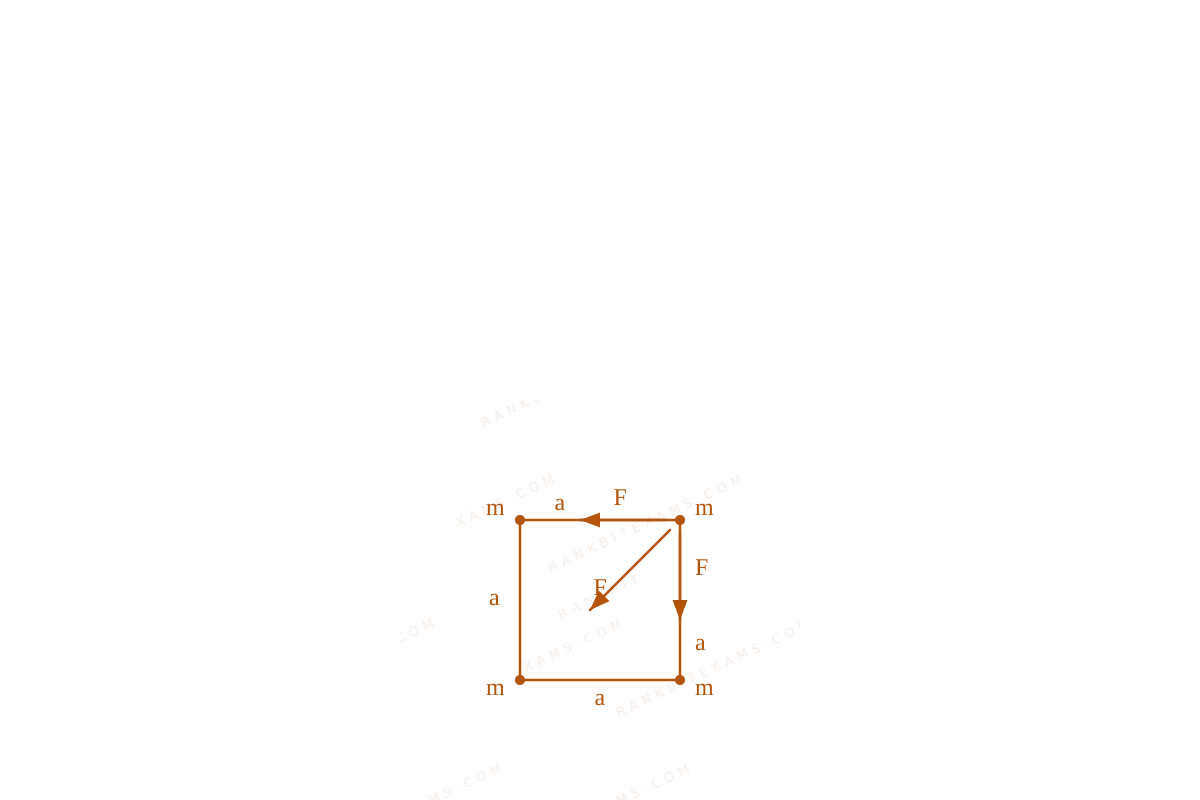
Four identical particles of mass m$m$ are kept at the four corners of a square. If the gravitational force exerted on one of the masses by the other masses is ( 2√(2) + 132) Gm²L²$\left(\frac{2\sqrt{2} + 1}{32}\right)\frac{\mathrm{Gm}^2}{\mathrm{L}^2}$, the length of the sides of the square is
A.L2$\frac{\mathrm{L}}{2}$
B.4 L$4 L$
C.3L$3L$
D.2 L$2 L$
Solution
Related Formula
F = (G m₁ m₂)/(r²)$$F = \frac{G m_1 m_2}{r^2}$$
Core Logic
Superposition Principle diagram for Q37 - JEE Main 2024 Morning
Let the side length of the square be a$a$. Considering one corner mass, it experiences forces from the adjacent two masses (distance a$a$) and the diagonally opposite mass (distance √(2)a$\sqrt{2}a$).
The forces from the two adjacent masses are at 90^°$90^\circ$ to each other:
F = (Gm²)/(a²)$$F = \frac{Gm^2}{a^2}$$
The resultant of these two is √(2)F = √(2) (Gm²)/(a²)$\sqrt{2}F = \sqrt{2} \frac{Gm^2}{a^2}$, directed along the diagonal.
Step 2: Total Force Equation
The force from the diagonal mass is:
F' = Gm²(√(2)a)² = (Gm²)/(2a²)$$F' = \frac{Gm^2}{(\sqrt{2}a)^2} = \frac{Gm^2}{2a^2}$$
Total resultant force Fₙₑₜ = √(2)F + F'$F_{\text{net}} = \sqrt{2}F + F'$:
Practice past-year questions one chapter at a time. Pick an exam → subject → chapter and get every PYQ for that topic — pulled together from all past papers — with the chapter's key formulas alongside.