In a Δ ABC$\Delta ABC$, suppose y=x$y=x$ is the equation of the bisector of the angle B and the equation of the side AC is 2x-y=2$2x-y=2$. If 2AB=BC$2AB=BC$ and the point A and B are respectively (4,6)$(4,6)$ and (α,β)$(\alpha,\beta)$, then α+2β$\alpha+2\beta$ is equal to
A.42$42$
B.39$39$
C.48$48$
D.45$45$
Solution & Explanation
Related Formula
Image of a point (x₁, y₁)$(x_1, y_1)$ across line y=x$y=x$ is (y₁, x₁)$(y_1, x_1)$.
Angle Bisector Theorem: The angle bisector of a triangle divides the opposite side into segments proportional to the lengths of the adjacent sides:
Given A(4,6)$A(4,6)$ and Angle bisector of B is y=x$y=x$.
Because y=x$y=x$ bisects angle B, the geometric reflection of vertex A across the bisector line y=x$y=x$ must lie exactly on the line containing the side BC$BC$.
Let the reflection of A(4,6)$A(4,6)$ be A'$A'$. Across y=x$y=x$, the coordinates swap:
A' = (6,4)$A' = (6,4)$
Next, find the intersection point D$D$ of the bisector y=x$y=x$ and side AC$AC$ (2x-y=2$2x-y=2$).
Substitute y=x$y=x$ into 2x-y=2$2x-y=2$:
2x - x = 2 ⇒ x = 2 ⇒ y = 2$$2x - x = 2 \Rightarrow x = 2 \Rightarrow y = 2$$
Given 2AB = BC$2AB = BC$, so (AB)/(BC) = (1)/(2)$\frac{AB}{BC} = \frac{1}{2}$.
This means point D(2,2)$D(2,2)$ divides the segment AC$AC$ in the ratio 1:2$1:2$.
Let C$C$ have coordinates (xc, yc)$(x_c, y_c)$.
Applying the section formula for D(2,2)$D(2,2)$ dividing A(4,6)$A(4,6)$ and C(xc, yc)$C(x_c, y_c)$ in ratio 1:2$1:2$:
Vertex B(α, β)$B(\alpha, \beta)$ is the intersection of line BC$BC$ and the angle bisector y=x$y=x$.
Substitute y=x$y=x$ into 5x - 4y - 14 = 0$5x - 4y - 14 = 0$:
Reflection properties drastically simplify angle bisector questions. If you know the bisector equation, reflecting one vertex over it gives a coordinate on the opposing extended ray. This paired with the angle bisector proportion theorem locks the entire geometric frame.
Keywords:#equation of the bisector#JEE Main 2024 Morning Q7#Straight Lines JEE Main 2024#Angle Bisector and Reflection JEE Main 2024
More Straight Lines Previous-Year Questions — Page 3
Qjee_main_2025_08_april_eveningRotation of Coordinate Axes / Distance from Origin
A line passing through the point P(a, 0)$P(a, 0)$ makes an acute angle α$\alpha$ with the positive x-axis. Let this line be rotated about the point P$\mathrm{P}$ through an angle (α)/(2)$\frac{\alpha}{2}$ in the clock-wise direction. If in the new position, the slope of the line is 2 - √(3)$2 - \sqrt{3}$ and its distance from the origin is 1√(2)$\frac{1}{\sqrt{2}}$, then the value of 3a² ²α - 2√(3)$3\mathrm{a}^2\tan^2\alpha - 2\sqrt{3}$ is
A.4$4$
B.6$6$
C.5$5$
D.8$8$
Solution
Related Formula
Distance from origin d = |C|√(A²+B²)$$\text{Distance from origin } d = \frac{|C|}{\sqrt{A^2+B^2}}$$
Core Logic
Decode slope angle fields to define vector shifts. Match variables to isolate focal root segments accurately as provided in the reference layout steps.
Recognizing standard trigonometric slopes (15^° = 2-√(3)$\tan 15^\circ = 2-\sqrt{3}$) bypasses computational bottlenecks instantly when working with line updates.
Chapter Mix
Class 11 Mathematics: Straight Lines
Q57jee_main_2025_08_april_eveningProperties of Square and Diagonals
Let a$a$ be the length of a side of a square OABC with O$O$ being the origin. Its side OA$OA$ makes an acute angle α$\alpha$ with the positive x-axis and the equations of its diagonals are
(√(3) + 1)x + (√(3) - 1)y = 0 and$$(\sqrt{3} + 1)x + (\sqrt{3} - 1)y = 0 \quad \text{and}$$(√(3) - 1)x - (√(3) + 1)y + 8√(3) = 0.$$(\sqrt{3} - 1)x - (\sqrt{3} + 1)y + 8\sqrt{3} = 0.$$
Then a²$a^2$ is equal to
A.48$48$
B.32$32$
C.16$16$
D.24$24$
Solution
Related Formula
Slope m = -(A)/(B)$$\text{Slope } m = -\frac{A}{B}$$
Core Logic
Identify which diagonal passes through the origin. Use its directional configuration slope to determine the exact angle orientation layout map of the geometric system elements.
Step 1: Determine Diagonal Orientation
The line passing through the origin is diagonal OB$OB$:
Slopes involving √(3) ± 1$\sqrt{3} \pm 1$ explicitly alert you to geometric orientations built on multiples of 15^circ$15^circ$ or 75^circ$75^circ$ configurations.
Chapter Mix
Class 11 Mathematics: Straight Lines
Q58jee_main_2025_29_jan_eveningArea of Triangles and Inscribed Shapes
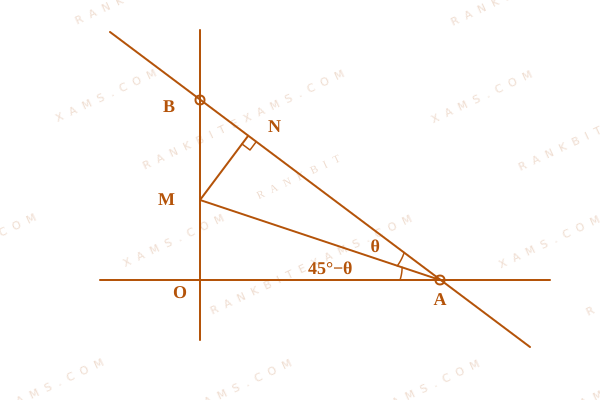
Let the line x + y = 1$x + y = 1$ meet the axes of x$x$ and y$y$ at A and B, respectively. A right angled triangle AMN is inscribed in the triangle OAB, where O is the origin and the points M and N lie on the lines OB and AB, respectively. If the area of the triangle AMN is (4)/(9)$\frac{4}{9}$ of the area of the triangle OAB and AN: NB = \lambda : 1, then the sum of all possible value(s) of λ$\lambda$ is :
A.(1)/(2)$\frac{1}{2}$
B.(13)/(6)$\frac{13}{6}$
C.(5)/(2)$\frac{5}{2}$
D.2$2$
Solution
Related Formula
Area of a right-angled triangle:
Area = (1)/(2) × base × height$$\text{Area} = \frac{1}{2} \times \text{base} \times \text{height}$$
Core Logic
The line equation is x + y = 1$x + y = 1$, giving intercept coordinates A(1, 0)$A(1, 0)$ and B(0, 1)$B(0, 1)$.
Area of Triangles and Inscribed Shapes diagram for Q58 - JEE Main 2025 Evening
Area of Δ OAB = (1)/(2) × 1 × 1 = (1)/(2)$\Delta OAB = \frac{1}{2} \times 1 \times 1 = \frac{1}{2}$.
Given area condition:
Area of Δ AMN = (4)/(9) × (1)/(2) = (2)/(9)$$\text{Area of } \Delta AMN = \frac{4}{9} \times \frac{1}{2} = \frac{2}{9}$$
Step 1: Set up Trigonometric Tracing
Let ∠ MAO = 45^° - θ$\angle MAO = 45^\circ - \theta$. Since Δ OAB$\Delta OAB$ is isosceles right-angled at O$O$, ∠ OAB = 45^°$\angle OAB = 45^\circ$.
This establishes:
Thus, the valid evaluation matches the option sequence value of 2.
Pattern Recognition
When dealing with inscribed right triangles inside symmetric linear bounds, parameterizing coordinates with angles matching the axis slope simplifies configuration variables dramatically.
Chapter Mix
Class 11 Mathematics: Straight Lines

Q72jee_main_2025_28_jan_morningDistance of a Point from a Line
If α = 1 + Σr=1⁶ (-3)r-1 ¹² C₂ᵣ₋₁$\alpha = 1 + \sum_{r=1}^{6} (-3)^{r-1} {}^{12} C_{2r-1}$, then the distance of the point (12, √(3))$(12, \sqrt{3})$ from the line α x - √(3) y + 1 = 0$\alpha x - \sqrt{3} y + 1 = 0$ is
Numerical Answer.Answer: 5 to 5
Solution
Related Formula
Perpendicular distance from a point (x₁, y₁)$(x_1, y_1)$ to a line Ax + By + C = 0$Ax + By + C = 0$:
Binomial series containing terms like √(3)2r-1$\sqrt{3}^{2r-1}$ collapse neatly into simple geometric forms using standard complex rotations (eiπ/3$e^{i\pi/3}$).
Chapter Mix
Class 11 Maths: Binomial Theorem
Class 11 Maths: Straight Lines
Q63jee_main_2025_03_april_morningDistance between Parallel Lines
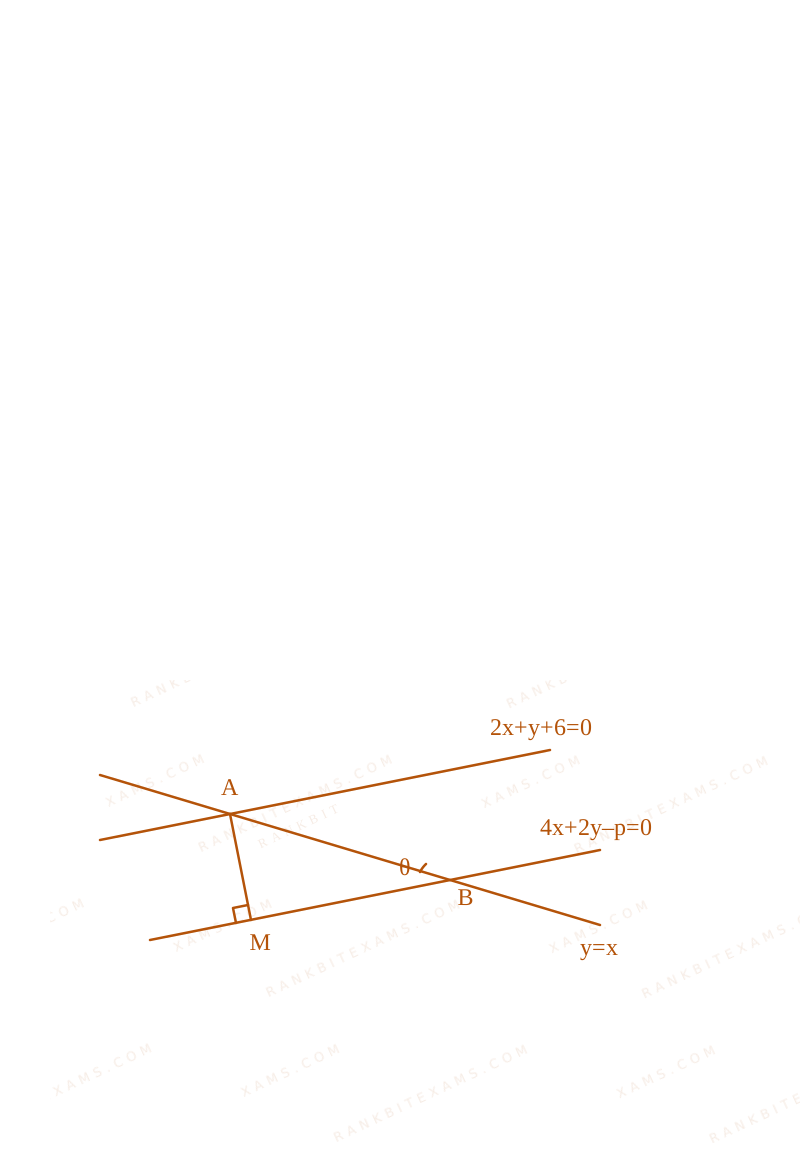
A line passes through the origin and makes equal angles with the positive coordinate axes. It intersects the lines L₁:2x+y+6=0$L_{1}:2x+y+6=0$ and L₂:4x+2y-p=0$L_{2}:4x+2y-p=0$, p>0$p>0$, at the points A$A$ and B$B$, respectively. If AB = 9√(2)$AB = \frac{9}{\sqrt{2}}$ and the foot of the perpendicular from the point A$A$ on the line L₂$L_{2}$ is M$M$, then (AM)/(BM)$\frac{AM}{BM}$ is equal to:
A. 5
B. 4
C. 2
D. 3
Solution
Related Formula
Slope angle interaction tracking: In right triangle AMB$\triangle AMB$, the tangent of inclination satisfies:
θ = (AM)/(BM)$$\tan \theta = \frac{AM}{BM}$$
Distance between Parallel Lines diagram for Q63 - JEE Main 2025 Morning
Core Logic
A line tracking equal angles through positive coordinate frames has equation y=x$y=x$.
Its slope parameter is m₁ = 1$m_1 = 1$.
The parallel boundary lines L₁$L_1$ and L₂$L_2$ have a uniform slope value of m₂ = -2$m_2 = -2$.
Let θ$\theta$ represent the precise geometric crossing angle matching the line y=x$y=x$ intersecting line L₂$L_2$.
Step 1: Finding the requested ratio
Using the slope interaction formula to calculate the tangent angle metric:
Ratios of side projections of lines intersecting parallel setups depend completely on direction orientations, bypassing raw variable solving steps entirely.
Chapter Mix
Class 11 Mathematics: Straight Lines
More Straight Lines Questions — jee_main_2024_29_jan_morning
Practice past-year questions one chapter at a time. Pick an exam → subject → chapter and get every PYQ for that topic — pulled together from all past papers — with the chapter's key formulas alongside.