Let f(x)=2^x-x²,xin R$f(x)=2^x-x^2,x\in R$. If m$m$ and n$n$ are respectively the number of points at which the curves y=f(x)$y=f(x)$ and y=f'(x)$y=f'(x)$ intersects the x-axis, then the value of m+n$m+n$ is
Numerical Answer Type:
Enter a numerical valueAnswer: 5 to 5+4 marks
Solution & Explanation
Related Formula
To find points where a curve intersects the x-axis, set y = 0$y = 0$.
Core Logic
First, evaluate m$m$, the number of roots for f(x) = 0$f(x) = 0$:
Plotting the exponential curve y = 2^x$y = 2^x$ against the parabola y = x²$y = x^2$:
At x = 2$x = 2$, 2² = 4$2^2 = 4$ and 2² = 4$2^2 = 4$ (Intersection 1).
At x = 4$x = 4$, 2⁴ = 16$2^4 = 16$ and 4² = 16$4^2 = 16$ (Intersection 2).
For x lt 0$x \lt 0$, y=2^x$y=2^x$ decays to 0 while y=x²$y=x^2$ grows to infinity. They strictly cross exactly once at x = α$x = \alpha$ (where α ≈ -0.76$\alpha \approx -0.76$).
Hence, the total number of intersections is 3.
Therefore, m = 3$m = 3$.
Graphing and Intersections
Step 1: Evaluate n for derivative roots
Now, evaluate n$n$, the number of roots for f'(x) = 0$f'(x) = 0$:
f'(x) = 2^x ln 2 - 2x$$f'(x) = 2^x \ln 2 - 2x$$
Set f'(x) = 0 ⇒ 2^x ln 2 = 2x$f'(x) = 0 \Rightarrow 2^x \ln 2 = 2x$Plotting the scaled exponential curve$
Plotting the scaled exponential curve $y = 2^x \ln 2against the line$ against the line $y = 2x:
The line$:
The line $
y=2xpasses through origin with slope 2.
The curve$ passes through origin with slope 2.
The curve $y = 2^x \ln 2has a y-intercept of$ has a y-intercept of $\ln 2(approx 0.693).
Because exponential growth eventually overtakes any linear function, it crosses the line twice for$ (approx 0.693).
Because exponential growth eventually overtakes any linear function, it crosses the line twice for $
x > 0. Since the line goes negative for$. Since the line goes negative for $x < 0and the exponential stays positive, they do not cross on the negative axis. Hence, the total number of intersections is 2. Therefore,$ and the exponential stays positive, they do not cross on the negative axis.
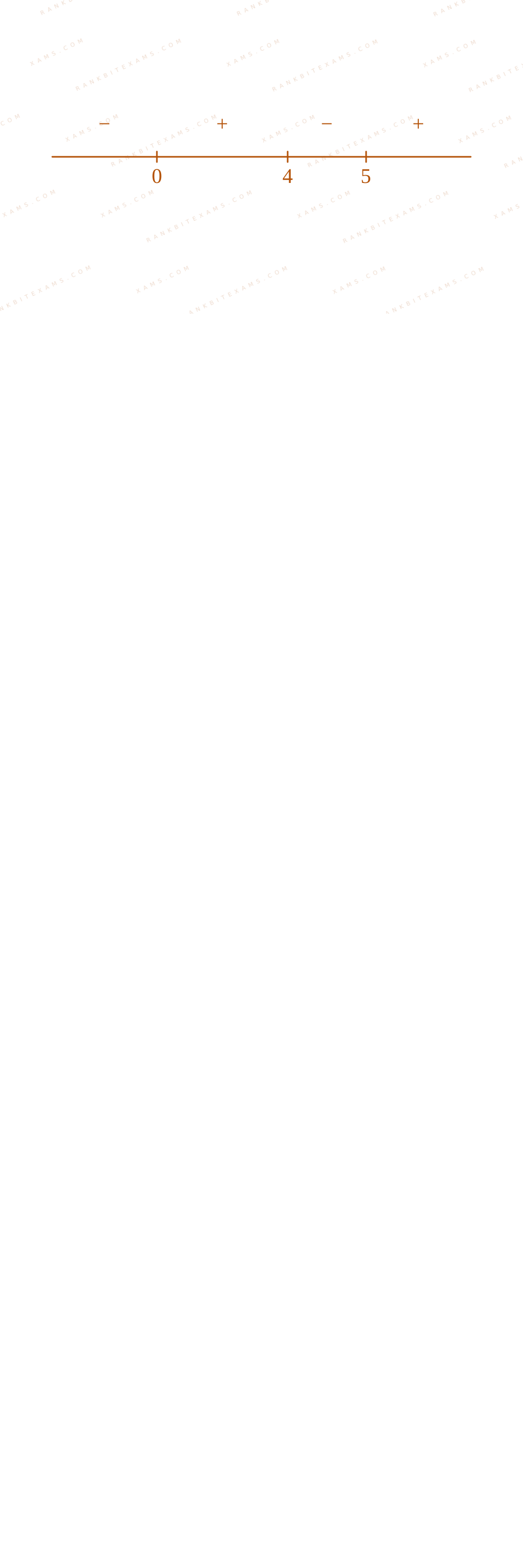
Hence, the total number of intersections is 2.
Therefore, $n = 2.
Graphing and Intersections
Step 2: Final Computation
Sum the variables:
$.
Graphing and Intersections
Step 2: Final Computation
Sum the variables:
$m + n = 3 + 2 = 5$m + n = 3 + 2 = 5$
Pattern Recognition
The transcendental equation
$
Pattern Recognition
The transcendental equation $
a^x = x^ptypically produces exactly 3 intersections if$ typically produces exactly 3 intersections if $a \gt 1, p \gt 1(two positive, one negative). When differentiating to$ (two positive, one negative). When differentiating to $a^x \ln a = px$, you strip away the left-sided negative quadratic wall, reducing it to a linear intersection which yields only 2 roots.
Chapter Mix
Class 12 Mathematics: Application of Derivatives
Class 11 Mathematics: Sets, Relations and Functions
Keywords:#curves intersects the x-axis#JEE Main 2024 Morning Q24#Application of Derivatives JEE Main 2024#Graphing and Intersections JEE Main 2024
More Application of Derivatives Previous-Year Questions — Page 2
Qjee_main_2025_02_april_morningMaxima and Minima
If the function f(x) = 2x³ - 9ax² + 12a²x + 1$f(x) = 2x^3 - 9ax^2 + 12a^2x + 1$, where a > 0$a > 0$, attains its local maximum and local minimum values at p$p$ and q$q$, respectively, such that p² = q$p^2 = q$, then f(3)$f(3)$ is equal to:
A.55$55$
B.10$10$
C.23$23$
D.37$37$
Solution
Related Formula
For local extrema of a differentiable function, set the first derivative to zero:
f'(x) = 0$f'(x) = 0$
Core Logic
Differentiate f(x)$f(x)$ to obtain its critical points p$p$ and q$q$ in terms of a$a$, use the constraint p² = q$p^2 = q$ to fix a$a$, and evaluate f(3)$f(3)$.
x = aand$ and $x = 2a. Since$. Since $a > 0, checking the sign change of$, checking the sign change of $f'(x)shows that the local maximum occurs at the smaller root ($ shows that the local maximum occurs at the smaller root ($p = a) and the local minimum at the larger root ($) and the local minimum at the larger root ($q = 2a).
For cubic equations with two distinct real critical roots, the smaller root is always the local maximum if the leading coefficient is positive (
$
Pattern Recognition
For cubic equations with two distinct real critical roots, the smaller root is always the local maximum if the leading coefficient is positive ($
2 > 0). This ensures$). This ensures $p=aand$ and $q=2a$ immediately without relying on secondary derivative checks.
Chapter Mix
Class 12 Mathematics: Application of Derivatives

Q53jee_main_2025_07_april_morningMaxima and Minima
Let x = -1$x = -1$ and x = 2$x = 2$ be the critical points of the function f(x) = x³ + ax² + b ₑ |x| + 1, x ≠ 0$f(x) = x^3 + ax^2 + b \log_e |x| + 1, x \neq 0$ . Let m$m$ and M$M$ respectively be the absolute minimum and the absolute maximum values of f$f$ in the interval [-2, -(1)/(2)]$\left[-2, -\frac{1}{2}\right]$ . Then |M + m|$|M + m|$ is equal to (Take ₑ 2 = 0.7$\log_e 2 = 0.7$ ):
A.21.1$21.1$
B.19.8$19.8$
C.22.1$22.1$
D.20.9$20.9$
Solution
Related Formula
Critical points occur where f'(x) = 0$f'(x) = 0$.
For absolute maximum and minimum on an interval [c, d]$[c, d]$, evaluate function values at the boundaries and at any local critical points falling inside the domain.
Core Logic
Given f(x) = x³ + ax² + bln|x| + 1$f(x) = x^3 + ax^2 + b\ln|x| + 1$
Differentiating with respect to x$x$:
Always verify whether the critical points lie inside the requested boundary interval before blindly testing all values. Here, x=2$x=2$ was an irrelevant trap for the interval valuation phase.
Chapter Mix
Class 12 Mathematics: Application of Derivatives

Q53jee_main_2025_08_april_eveningMonotonicity
Let the function f(x) = (x)/(3) + (3)/(x) + 3, x ≠ 0$f(x) = \frac{x}{3} + \frac{3}{x} + 3, x \neq 0$ be strictly increasing in (-∞, α₁) (α₂, ∞)$(-\infty, \alpha_1) \cup (\alpha_2, \infty)$ and strictly decreasing in (α₃, α₄) (α₄, α₅)$(\alpha_3, \alpha_4) \cup (\alpha_4, \alpha_5)$. Then Σi=1⁵ αᵢ²$\sum_{i=1}^{5} \alpha_i^2$ is equal to:
Differentiate the rational function and determine the critical intervals by assessing where the derivative flips signs around critical points and domain boundaries.
Functions of the form x + (k)/(x)$x + \frac{k}{x}$ always present localized extrema turning symmetric zones at ±√(k)$\pm\sqrt{k}$. Always include the asymptotes (x=0$x=0$) when stating precise disjoint decreasing intervals.
Chapter Mix
Class 12 Mathematics: Application of Derivatives
Q68jee_main_2025_29_jan_eveningMaxi-Mini of Functions
Let f(x) = ∫₀x t(t² - 9t + 20) dt$f(x) = \int_{0}^{x} t(t^2 - 9t + 20) \, \mathrm{d}t$, 1 ≤ x ≤ 5$1 \leq x \leq 5$. If the range of f$f$ is [α, β]$[\alpha, \beta]$, then 4(α + β)$4(\alpha + \beta)$ equals:
A.157$157$
B.253$253$
C.125$125$
D.154$154$
Solution
Related Formula
Leibniz Rule for differentiation under integral sign:
Always check boundary points along with interior critical values when finding the absolute range on a closed interval.
Chapter Mix
Class 12 Mathematics: Application of Derivatives
Class 12 Mathematics: Integral Calculus
Qjee_main_2025_28_jan_morningLocal Maxima and Minima
The sum of all local minimum values of the function
f(x) = cases 1 - 2x, & x < -1 (1)/(3)(7 + 2|x|), & -1 ≤ x ≤ 2 (11)/(18)(x - 4)(x - 5), & x > 2 cases$$f(x) = \begin{cases} 1 - 2x, & x < -1 \\ \frac{1}{3}(7 + 2|x|), & -1 \le x \le 2 \\ \frac{11}{18}(x - 4)(x - 5), & x > 2 \end{cases}$$
is:
A.(171)/(72)$\frac{171}{72}$
B.(131)/(72)$\frac{131}{72}$
C.(157)/(72)$\frac{157}{72}$
D.(167)/(72)$\frac{167}{72}$
Solution
Related Formula
Local minima occur at points where the derivative changes sign from negative to positive, or at sharp corners where the function reaches a local low point.
Core Logic
Analyze the piecewise sections across all transition domains: Local Maxima and Minima diagram for Q64 - JEE Main 2025 Morning
For x in [-1, 2]$x \in [-1, 2]$, f(x) = (1)/(3)(7 + 2|x|)$f(x) = \frac{1}{3}(7 + 2|x|)$. This curve has a sharp structural minimum at x = 0$x = 0$ since |x|$|x|$ decreases then increases.
Value at x = 0 f(0) = (7)/(3)$x = 0 \implies f(0) = \frac{7}{3}$.
Step 1: Analyzing the Quadratic Domain Boundaries
For x > 2$x > 2$, f(x) = (11)/(18)(x² - 9x + 20)$f(x) = \frac{11}{18}(x^2 - 9x + 20)$.
Finding the vertex point by setting the derivative to zero:
Since 4.5 > 2$4.5 > 2$, this vertex is within the valid domain and represents a local minimum.
Value at x = 4.5 f((9)/(2)) = (11)/(18)((1)/(2))(-(1)/(2)) = -(11)/(72)$x = 4.5 \implies f\left(\frac{9}{2}\right) = \frac{11}{18}\left(\frac{1}{2}\right)\left(-\frac{1}{2}\right) = -\frac{11}{72}$.
Step 2: Calculating Final Combined Summation
Summing both local minima:
Total Minima Sum = (7)/(3) + (-(11)/(72)) = (168 - 11)/(72) = (157)/(72)$$\text{Total Minima Sum} = \frac{7}{3} + \left(-\frac{11}{72}\right) = \frac{168 - 11}{72} = \frac{157}{72}$$
Pattern Recognition
For piecewise function systems, always verify if the quadratic vertices fall inside their restricted intervals before adding them to your solution path.
Chapter Mix
Class 12 Maths: Application of Derivatives
More Application of Derivatives Questions — jee_main_2024_29_jan_morning
Practice past-year questions one chapter at a time. Pick an exam → subject → chapter and get every PYQ for that topic — pulled together from all past papers — with the chapter's key formulas alongside.