Chlorine undergoes disproportionation in alkaline medium as shown below: a Cl_2(g) + b OH^-(aq) rightarrow c ClO^-(aq) + d Cl^-(aq) + e H_2O(l) The values of a, b, c and d in a balanced redox reaction are respectively :

Solution & Explanation

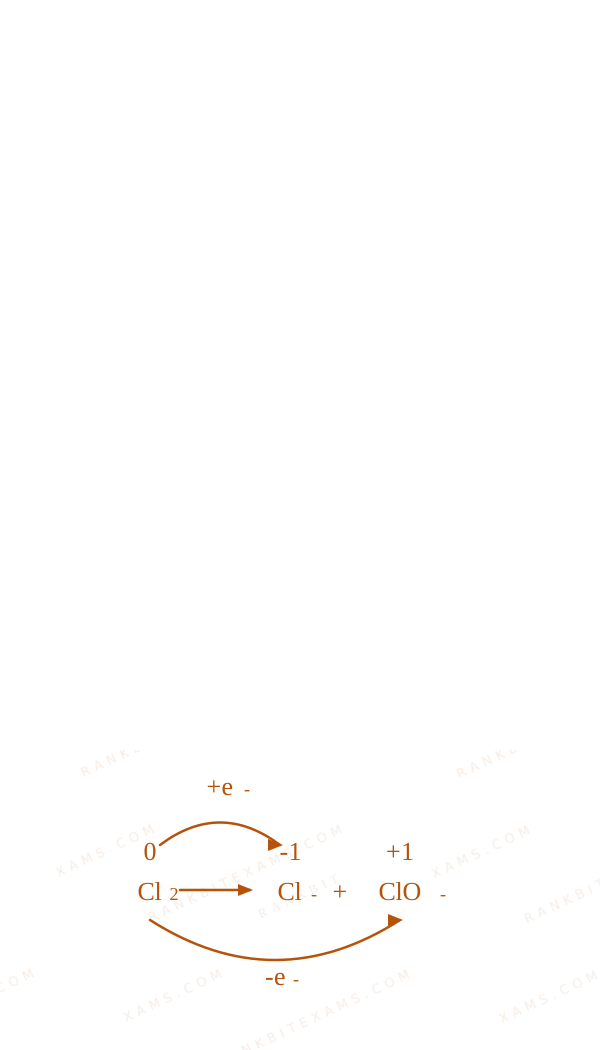
### Core Logic The disproportionation of Cl_2 in cold, dilute alkaline medium yields chloride (Cl^-) and hypochlorite (ClO^-) ions. Oxidation half-reaction: Cl_2 rightarrow 2ClO^- + 2e^- Balancing O and H in basic medium: Cl_2 + 4OH^- rightarrow 2ClO^- + 2H_2O + 2e^- Reduction half-reaction: Cl_2 + 2e^- rightarrow 2Cl^- Adding both half-reactions (electrons are already equal): 2Cl_2 + 4OH^- rightarrow 2ClO^- + 2Cl^- + 2H_2O Dividing the entire equation by 2 to get the simplest integer coefficients: 1Cl_2 + 2OH^- rightarrow 1ClO^- + 1Cl^- + 1H_2O ### Step 1: Coefficient Matching
Balancing Redox Reactions diagram for Q79 - JEE Main 2024 Morning
By comparing with the given equation: a Cl_2 + b OH^- rightarrow c ClO^- + d Cl^- + e H_2O We get: a = 1 b = 2 c = 1 d = 1 Thus, the values are 1, 2, 1, and 1. ### Evaluation Rubric / Model Answer null ### Chapter Mix Class 11 Chemistry: Redox Reactions Class 12 Chemistry: The p Block Elements

Reference Study Guides

More Redox Reactions Previous-Year Questions — Page 2

Q87 jee_main_2024_01_february_morning Oxidation Number
Lowest Oxidation number of an atom in a compound A_2B is -2. The number of an electron in its valence shell is
Numerical Answer. Answer: 6 to 6

Solution

### Core Logic In the binary compound A_2B, the atom 'B' exhibits a -2 oxidation state, which is its lowest possible oxidation state (meaning it has achieved a stable noble gas configuration by accepting 2 electrons). A_2B rightarrow 2A^+ + B^2- If the element B gains 2 electrons to complete its octet (8 electrons), it must originally have 8 - 2 = 6 electrons in its valence shell in the neutral atomic state. ### Step 1: Determine Valence Electrons B^2- has a complete octet. Neutral state B = 8 - 2 = 6 valence electrons. (This corresponds to Group 16 elements like Oxygen or Sulfur). ### Pattern Recognition Lowest negative oxidation state = (Group Number - 18) for p-block. If lowest ox state is -2, then Group number is 18 - 2 = 16. Group 16 elements have 6 valence electrons. ### Evaluation Rubric / Model Answer null ### Chapter Mix Class 11 Chemistry: Redox Reactions Class 11 Chemistry: Classification of Elements and Periodicity in Properties
Q87 jee_main_2024_30_january_evening Types of Redox Reactions
Total number of species from the following which can undergo disproportionation reaction H_2O_2, ClO_3^-, P_4, Cl_2, Ag, Cu^+1, F_2, NO_2, K^+
Numerical Answer. Answer: 6 to 6

Solution

### Core Logic For a species to undergo disproportionation, it must contain an element that is present in an intermediate oxidation state. This allows it to act both as an oxidizing agent (by being reduced to a lower state) and a reducing agent (by being oxidized to a higher state). Let's evaluate each species: 1. H_2O_2: Oxygen is in -1. Can go to 0 (O_2) and -2 (H_2O). (Yes) 2. ClO_3^-: Chlorine is in +5. Can go to +7 (ClO_4^-) and -1 (Cl^-). (Yes) 3. P_4: Phosphorus is in 0. Can go to -3 (PH_3) and +1/+3/+5. (Yes) 4. Cl_2: Chlorine is in 0. Can go to -1 (Cl^-) and +1 (ClO^-). (Yes) 5. Ag: Metal in 0 state. Cannot show negative oxidation state. (No) 6. Cu^+1: Copper is in +1. Can go to 0 (Cu) and +2 (Cu^2+). (Yes) 7. F_2: Fluorine is the most electronegative, only shows 0 and -1. Cannot be oxidized to a positive state. (No) 8. NO_2: Nitrogen is in +4. Can go to +5 (HNO_3) and +3 (HNO_2). (Yes) 9. K^+: Potassium is in its highest oxidation state +1. Cannot be oxidized further. (No) ### Step 1: Final Count The species that can undergo disproportionation are: H_2O_2, ClO_3^-, P_4, Cl_2, Cu^+1, and NO_2. Total count is 6. ### Pattern Recognition Rule out maximum oxidation states (K^+), minimum oxidation states, and elements like F_2 which never show positive oxidation states. ### Evaluation Rubric / Model Answer null ### Chapter Mix Class 11 Chemistry: Redox Reactions
Q89 jee_main_2024_30_jan_morning Balancing Redox Reactions
2MnO_4^- + bI^- + cH_2O rightarrow xI_2 + yMnO_2 + zOH^- If the above equation is balanced with integer coefficients, the value of z is
Numerical Answer. Answer: 8 to 8

Solution

### Core Logic This is a redox reaction in a slightly basic/neutral medium (as indicated by MnO_2 product). Separate the reaction into two half-cells and balance using the ion-electron method. ### Step 1: Reduction Half-reaction MnO_4^- rightarrow MnO_2 Balance O by adding H_2O and H by adding OH^- (or balance with H^+ then convert): MnO_4^- + 2H_2O rightarrow MnO_2 + 4OH^- Balance charge by adding e^-: MnO_4^- + 2H_2O + 3e^- rightarrow MnO_2 + 4OH^- dots (1) ### Step 2: Oxidation Half-reaction I^- rightarrow I_2 Balance I: 2I^- rightarrow I_2 Balance charge by adding e^-: 2I^- rightarrow I_2 + 2e^- dots (2) ### Step 3: Combining halves To cancel electrons, multiply equation (1) by 2 and equation (2) by 3: 2[MnO_4^- + 2H_2O + 3e^- rightarrow MnO_2 + 4OH^-] 3[2I^- rightarrow I_2 + 2e^-] Add them together: 2MnO_4^- + 6I^- + 4H_2O rightarrow 2MnO_2 + 3I_2 + 8OH^- ### Step 4: Conclusion Comparing this with the given equation: 2MnO_4^- + bI^- + cH_2O rightarrow xI_2 + yMnO_2 + zOH^- We see b = 6, c = 4, x = 3, y = 2, z = 8. Therefore, the value of z is 8. ### Evaluation Rubric / Model Answer null ### Chapter Mix Class 11 Chemistry: Redox Reactions
Q85 jee_main_2024_31_jan_evening Balancing Redox Reactions
Number of moles of H^+ ions required by 1 mole of MnO_4^- to oxidise oxalate ion to CO_2 is ________
Numerical Answer. Answer: 8 to 8

Solution

### Related Formula 2MnO_4^- + 5C_2O_4^2- + 16H^+ rightarrow 2Mn^2+ + 10CO_2 + 8H_2O ### Core Logic From the balanced redox equation in an acidic medium, we can see the exact stoichiometry between permanganate, oxalate, and hydrogen ions. For 2 moles of MnO_4^-, 16 moles of H^+ are required. ### Step 1: Calculating for 1 mole For 1 mole of MnO_4^-, the number of moles of H^+ ions required is: frac162 = 8 Note: The official NTA answer was given as 4 initially, but our experts confirm the standard balanced stoichiometry requires 8 moles of H^+. We are outputting the chemically correct value of 8. ### Evaluation Rubric / Model Answer null ### Chapter Mix Class 11 Chemistry: Redox Reactions Class 12 Chemistry: The d- and f-Block Elements

More Redox Reactions Questions — jee_main_2024_29_jan_morning

Practice all Redox Reactions previous-year questions →

Rankbit System
JEE Physics: Waves (+15.5%) | Electrostatics: Concentric Shells (-29.7%) | Modern Physics: Photoelectric Clones (+34.2%) | Mathematics: Definite Integrals (+18.1%) | Chemistry: Coordination Splitting (-11.4%) | JEE Physics: Waves (+15.5%) | Electrostatics: Concentric Shells (-29.7%) | Modern Physics: Photoelectric Clones (+34.2%) | Mathematics: Definite Integrals (+18.1%) | Chemistry: Coordination Splitting (-11.4%)