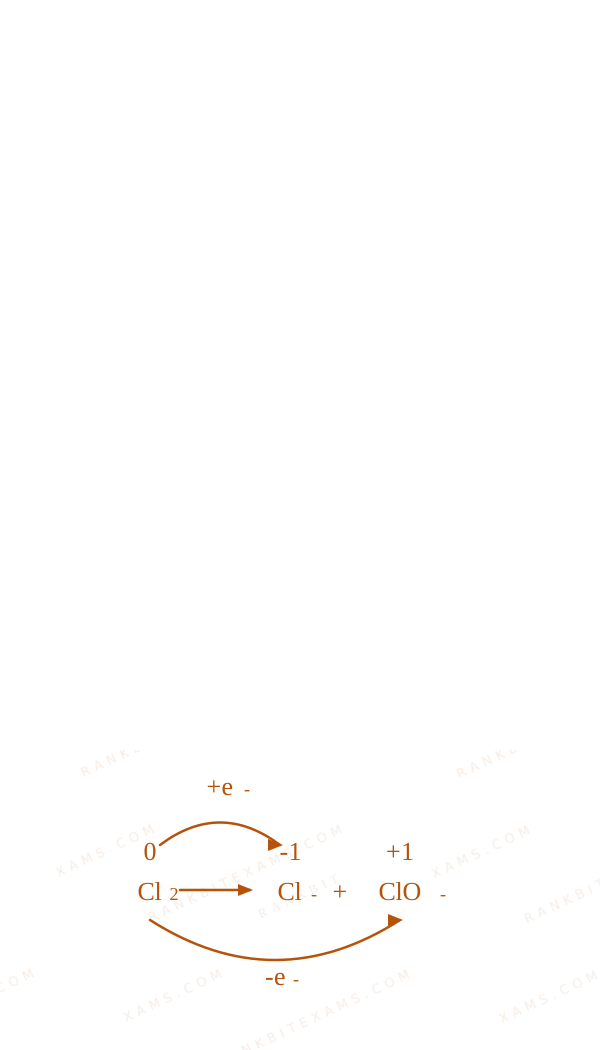
Chlorine undergoes disproportionation in alkaline medium as shown below:
a Cl₂(g) + b OH^-(aq) arrow c ClO^-(aq) + d Cl^-(aq) + e H₂O(l)$$a Cl_2(g) + b OH^-(aq) \rightarrow c ClO^-(aq) + d Cl^-(aq) + e H_2O(l)$$
The values of a, b, c and d in a balanced redox reaction are respectively :
A.1, 2, 1 and 1$1, 2, 1 \text{ and } 1$
B.2, 2, 1 and 3$2, 2, 1 \text{ and } 3$
C.3, 4, 4 and 2$3, 4, 4 \text{ and } 2$
D.2, 4, 1 and 3$2, 4, 1 \text{ and } 3$
Solution & Explanation
Core Logic
The disproportionation of Cl₂$Cl_2$ in cold, dilute alkaline medium yields chloride (Cl^-$Cl^-$) and hypochlorite (ClO^-$ClO^-$) ions.
Oxidation half-reaction:
Cl₂ arrow 2ClO^- + 2e^-$Cl_2 \rightarrow 2ClO^- + 2e^-$
Balancing O and H in basic medium:
Cl₂ + 4OH^- arrow 2ClO^- + 2H₂O + 2e^-$Cl_2 + 4OH^- \rightarrow 2ClO^- + 2H_2O + 2e^-$
Dividing the entire equation by 2 to get the simplest integer coefficients:
1Cl₂ + 2OH^- arrow 1ClO^- + 1Cl^- + 1H₂O$1Cl_2 + 2OH^- \rightarrow 1ClO^- + 1Cl^- + 1H_2O$
Step 1: Coefficient Matching
Balancing Redox Reactions diagram for Q79 - JEE Main 2024 Morning
By comparing with the given equation:
a Cl₂ + b OH^- arrow c ClO^- + d Cl^- + e H₂O$a Cl_2 + b OH^- \rightarrow c ClO^- + d Cl^- + e H_2O$
We get:
a = 1$a = 1$b = 2$b = 2$c = 1$c = 1$d = 1$d = 1$
Thus, the values are 1, 2, 1, and 1.
Chapter Mix
Class 11 Chemistry: Redox Reactions
Class 12 Chemistry: The p Block Elements
Keywords:#disproportionation in alkaline medium#JEE Main 2024 Morning Q79#Redox Reactions JEE Main 2024#Balancing Redox Reactions JEE Main 2024
More Redox Reactions Previous-Year Questions
Q54jee_main_2026_21_jan_eveningStoichiometry and Redox Titrations
Aqueous HCl$\text{HCl}$ reacts with MnO₂(s)$\text{MnO}_2(\text{s})$ to form MnCl₂(aq)$\text{MnCl}_2(\text{aq})$, Cl₂(g)$\text{Cl}_2(\text{g})$ and H₂O(l)$\text{H}_2\text{O}(\text{l})$. What is the weight (in g) of Cl₂$\text{Cl}_2$ liberated when 8.7 g of MnO₂(s)$\text{MnO}_2(\text{s})$ is reacted with excess aqueous HCl$\text{HCl}$ solution? (Given Molar mass in g mol⁻¹: Mn = 55, Cl = 35.5, O = 16, H = 1$\text{g mol}^{-1}: \text{Mn} = 55, \text{Cl} = 35.5, \text{O} = 16, \text{H} = 1$)
A.(1) 7.1$(1) \ 7.1$
B.(2) 71$(2) \ 71$
C.(3) 21.3$(3) \ 21.3$
D.(4) 14.2$(4) \ 14.2$
Solution
Related Formula
Moles = Given MassMolar Mass$$\text{Moles} = \frac{\text{Given Mass}}{\text{Molar Mass}}$$
From stoichiometry, 1 mole of MnO₂$\text{MnO}_2$ produces 1 mole of Cl₂$\text{Cl}_2$.
Therefore, moles of Cl₂$\text{Cl}_2$ produced = 0.1 mol$0.1 \text{ mol}$.
Sees: stoichiometry calculation with manganese dioxide and hydrochloric acid.
Trap: Forgetting stoichiometric coefficients for chlorine gas.
Chapter Mix
Class 11 Chemistry: Redox Reactions
Q73jee_main_2026_23_january_eveningTitration
200 cc$200 \text{ cc}$ of x × 10⁻³ M$x \times 10^{-3} \text{ M}$potassium dichromate is required to oxidise750 cc$750 \text{ cc}$ of 0.6 M$0.6 \text{ M}$ Mohr's salt solution in acidic medium.
Here x =
Numerical Answer.Answer: 375 to 375
Solution
Related Formula
Equivalents of Oxidizing Agent = Equivalents of Reducing Agent$$\text{Equivalents of Oxidizing Agent} = \text{Equivalents of Reducing Agent}$$N₁ V₁ = N₂ V₂$$N_1 V_1 = N_2 V_2$$Normality (N) = Molarity (M) × n-factor$$\text{Normality (N)} = \text{Molarity (M)} \times n\text{-factor}$$
Core Logic
In acidic medium, potassium dichromate (K₂Cr₂O₇$K_2Cr_2O_7$) reduces from Cr⁺⁶$Cr^{+6}$ to Cr⁺³$Cr^{+3}$.
Change in oxidation state = 3 per Cr atom.
For K₂Cr₂O₇$K_2Cr_2O_7$, n-factor = 2 × 3 = 6$n\text{-factor} = 2 \times 3 = 6$.
Normality of dichromate = 6 × (x × 10⁻³) N$6 \times (x \times 10^{-3}) \text{ N}$.
Mohr's salt is (NH₄)₂Fe(SO₄)₂ · 6H₂O$(NH_4)_2Fe(SO_4)_2 \cdot 6H_2O$. The active reducing species is Fe²⁺$Fe^{2+}$, which oxidizes to Fe³⁺$Fe^{3+}$.
Change in oxidation state = 1.
For Mohr's salt, n-factor = 1$n\text{-factor} = 1$.
Normality of Mohr's salt = 1 × 0.6 = 0.6 N$1 \times 0.6 = 0.6 \text{ N}$.
Step 1: Applying Law of Equivalence
Milliequivalents of K₂Cr₂O₇ = Milliequivalents of Mohr's salt$$\text{Milliequivalents of } K_2Cr_2O_7 = \text{Milliequivalents of Mohr's salt}$$(6 × x × 10⁻³ N) × (200 cc) = (0.6 N) × (750 cc)$$(6 \times x \times 10^{-3} \text{ N}) \times (200 \text{ cc}) = (0.6 \text{ N}) \times (750 \text{ cc})$$
1.2x = 450$1.2x = 450$
x = (450)/(1.2) = 375$$x = \frac{450}{1.2} = 375$$
Pattern Recognition
Memorize the n$n$-factors for redox titrations: K₂Cr₂O₇$K_2Cr_2O_7$ in acid is always n=6$n=6$. KMnO₄$KMnO_4$ in acid is n=5$n=5$. Mohr's salt (Fe²⁺$Fe^{2+}$) is always n=1$n=1$.
Chapter Mix
Class 11 Chemistry: Redox Reactions

Class 12 Chemistry: d and f Block Elements
X and Y are the number of electrons involved, respectively during the oxidation of I^-$I^-$ to I₂$I_2$ and S²⁻$S^{2-}$ to S by acidified K₂Cr₂O₇$K_2Cr_2O_7$. The value of X + Y is ____.
Numerical Answer.Answer: 12 to 12
Solution
Core Logic
Dichromate ion (Cr₂O₇²⁻$Cr_2O_7^{2-}$) in acidic medium acts as a strong oxidizing agent, getting reduced to Cr³⁺$Cr^{3+}$. This reduction process consumes 6$6$ electrons per dichromate ion:
Cr₂O₇²⁻ + 14H^+ + 6e^- arrow 2Cr³⁺ + 7H₂O$Cr_2O_7^{2-} + 14H^+ + 6e^- \rightarrow 2Cr^{3+} + 7H_2O$
Sum of X + Y = 6 + 6 = 12$X + Y = 6 + 6 = 12$.
Ad graphic
Pattern Recognition
Dichromate (Cr⁶⁺$Cr^{6+}$ to Cr³⁺$Cr^{3+}$, two atoms) always demands 6 electrons in a balanced equation block. The reducing agent must therefore supply exactly 6 electrons to match.
Chapter Mix
Class 11 Chemistry: Redox Reactions
Class 12 Chemistry: The d- and f-Block Elements
500~mL$500\mathrm{~mL}$ of 1.2~M~KI$1.2\mathrm{~M~KI}$ solution is mixed with 500~mL$500\mathrm{~mL}$ of 0.2~M~KMnO₄$0.2\mathrm{~M~KMnO}_{4}$ solution in basic medium. The liberated iodine was titrated with standard 0.1~M~Na₂S₂O₃$0.1\mathrm{~M~Na}_{2}\mathrm{S}_{2}\mathrm{O}_{3}$ solution in the presence of starch indicator till the blue color disappeared. The volume (in L$\mathrm{L}$) of Na₂S₂O₃$\mathrm{Na}_{2}\mathrm{S}_{2}\mathrm{O}_{3}$ consumed is _____.
Numerical Answer.Answer: 3 to 3
Solution
Related Formula
Equivalents of KMnO₄ = Equivalents of I₂ = Equivalents of Na₂S₂O₃$$\text{Equivalents of } KMnO_4 = \text{Equivalents of } I_2 = \text{Equivalents of } Na_2S_2O_3$$
Core Logic
In a basic medium, permanganate (MnO₄^-$MnO_4^-$) is reduced to MnO₂$MnO_2$, with an n-factor of 3. Iodide (I^-$I^-$) is oxidized to I₂$I_2$.\nThe liberated I₂$I_2$ is titrated with thiosulfate (S₂O₃²⁻$S_2O_3^{2-}$), which is oxidized to tetrathionate (S₄O₆²⁻$S_4O_6^{2-}$) with an n-factor of 1 per thiosulfate molecule.
Step 1: Determine the Limiting Reagent
Equivalents of KMnO₄ = M × V(L) × n-factor = 0.2 × 0.5 × 3 = 0.3~eq$KMnO_4 = M \times V(L) \times n\text{-factor} = 0.2 \times 0.5 \times 3 = 0.3\mathrm{~eq}$.\nEquivalents of KI = M × V(L) × n-factor = 1.2 × 0.5 × 1 = 0.6~eq$KI = M \times V(L) \times n\text{-factor} = 1.2 \times 0.5 \times 1 = 0.6\mathrm{~eq}$.\nKMnO₄$KMnO_4$ is the limiting reagent. It will completely react to liberate exactly 0.3$0.3$ equivalents of I₂$I_2$.
Step 2: Titration with Thiosulfate
Equivalents of Na₂S₂O₃$Na_2S_2O_3$ consumed = Equivalents of I₂$I_2$ liberated = 0.3~eq$0.3\mathrm{~eq}$.\n0.3 = M × V(L) × n-factor$$0.3 = M \times V(L) \times n\text{-factor}$$\n0.3 = 0.1 × V × 1$$0.3 = 0.1 \times V \times 1$$\nV = (0.3)/(0.1) = 3~L$$V = \frac{0.3}{0.1} = 3\mathrm{~L}$$
Pattern Recognition
In iodometric titrations, equivalents transfer sequentially 1:1. The n-factor of KMnO₄$KMnO_4$ shifts radically based on medium (5$5$ acidic, 3$3$ neutral/weakly basic, 1$1$ strongly basic). Here, basic medium means n=3$n=3$.
Chapter Mix
Class 11 Chemistry: Redox Reactions
Q34jee_main_2025_29_jan_eveningStoichiometry and Equivalents
0.1 M$0.1\text{ M}$ solution of KI reacts with excess of H₂SO₄$H_{2}SO_{4}$ and KIO₃$KIO_{3}$ solution according to the equation:
5I⁻ + IO₃⁻ + 6H⁺ arrow 3I₂ + 3H₂O$$5I^{-} + IO_{3}^{-} + 6H^{+} \rightarrow 3I_{2} + 3H_{2}O$$
Identify the correct statements:
(A) 200 mL$200\text{ mL}$ of KI solution reacts with 0.004 mol$0.004\text{ mol}$ of KIO₃$KIO_{3}$
(B) 200 mL$200\text{ mL}$ of KI solution reacts with 0.006 mol$0.006\text{ mol}$ of H₂SO₄$H_{2}SO_{4}$
(C) 0.5 L$0.5\text{ L}$ of KI solution produced 0.005 mol$0.005\text{ mol}$ of I₂$I_{2}$
(D) Equivalent weight of KIO₃$KIO_{3}$ is equal to Molecular weight5$\frac{\text{Molecular weight}}{5}$
Choose the correct answer from the options given below:
A. (A) and (D) only
B. (B) and (C) only
C. (A) and (B) only
D. (C) and (D) only
Solution
Core Logic
Let's find the moles of I⁻$I^{-}$ in 200 mL$200\text{ mL}$ of 0.1 M$0.1\text{ M}$ KI:
According to the stoichiometry:
* 5 moles I⁻ arrow 1 mole IO₃⁻$5\text{ moles } I^{-} \rightarrow 1\text{ mole } IO_{3}^{-}$
Therefore, 0.02 mol I⁻$0.02\text{ mol } I^{-}$ reacts with (0.02)/(5) = 0.004 mol$\frac{0.02}{5} = 0.004\text{ mol}$ of KIO₃$KIO_{3}$. Statement (A) is correct.
For Statement (D), Iodine goes from +5$+5$ state in IO₃⁻$IO_{3}^{-}$ to 0$0$ state in I₂$I_{2}$. The change in oxidation state per iodine atom is 5$5$.
Practice past-year questions one chapter at a time. Pick an exam → subject → chapter and get every PYQ for that topic — pulled together from all past papers — with the chapter's key formulas alongside.