If the shortest distance between the linesfracx-41=fracy+12=fracz-3$\frac{x-4}{1}=\frac{y+1}{2}=\frac{z}{-3}$ and fracx-lambda2=fracy+14=fracz-2-5$\frac{x-\lambda}{2}=\frac{y+1}{4}=\frac{z-2}{-5}$ is frac6sqrt5$\frac{6}{\sqrt{5}}$, then the sum of all possible values of lambda$\lambda$ is:
A.5$5$
B.8$8$
C.7$7$
D.10$10$
Solution & Explanation
### Related Formula
d = frac|(veca_2 - veca_1) cdot (vecb_1 times vecb_2)||vecb_1 times vecb_2|$d = \frac{|(\vec{a}_2 - \vec{a}_1) \cdot (\vec{b}_1 \times \vec{b}_2)|}{|\vec{b}_1 \times \vec{b}_2|}$
### Core Logic
Identify the positional vectors and direction ratios for both lines:
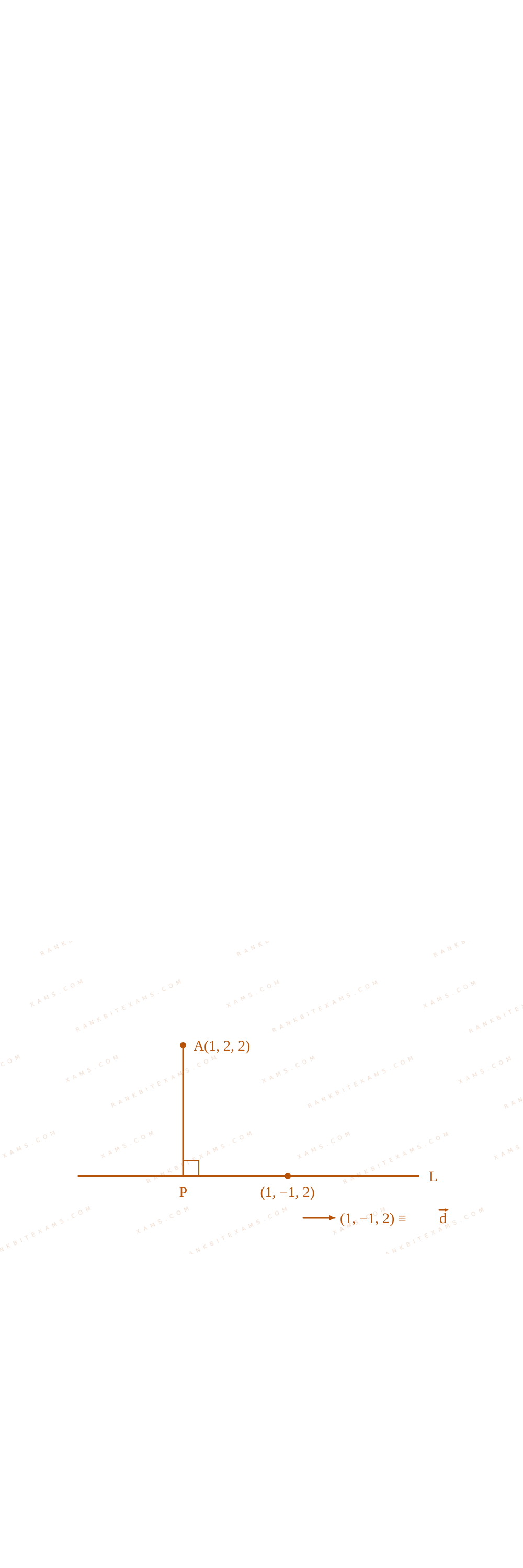
Line 1: veca_1 = (4, -1, 0)$\vec{a}_1 = (4, -1, 0)$, direction vecb_1 = (1, 2, -3)$\vec{b}_1 = (1, 2, -3)$
Line 2: veca_2 = (lambda, -1, 2)$\vec{a}_2 = (\lambda, -1, 2)$, direction vecb_2 = (2, 4, -5)$\vec{b}_2 = (2, 4, -5)$
Vector connecting lines: (veca_2 - veca_1) = (lambda - 4, 0, 2)$(\vec{a}_2 - \vec{a}_1) = (\lambda - 4, 0, 2)$
### Step 1: Cross Product and Magnitude
Find the normal vector vecn = vecb_1 times vecb_2$\vec{n} = \vec{b}_1 \times \vec{b}_2$:
vecb_1 times vecb_2 = beginvmatrix hati & hatj & hatk \\ 1 & 2 & -3 \\ 2 & 4 & -5 endvmatrix$\vec{b}_1 \times \vec{b}_2 = \begin{vmatrix} \hat{i} & \hat{j} & \hat{k} \\ 1 & 2 & -3 \\ 2 & 4 & -5 \end{vmatrix}$= hati(-10 - (-12)) - hatj(-5 - (-6)) + hatk(4 - 4)$= \hat{i}(-10 - (-12)) - \hat{j}(-5 - (-6)) + \hat{k}(4 - 4)$= 2hati - 1hatj + 0hatk = (2, -1, 0)$= 2\hat{i} - 1\hat{j} + 0\hat{k} = (2, -1, 0)$
Magnitude of the normal vector:
|vecb_1 times vecb_2| = sqrt2^2 + (-1)^2 + 0^2 = sqrt5$|\vec{b}_1 \times \vec{b}_2| = \sqrt{2^2 + (-1)^2 + 0^2} = \sqrt{5}$
### Step 2: Application of Shortest Distance Formula
Dot product of normal vector and positional difference vector:
(veca_2 - veca_1) cdot (vecb_1 times vecb_2) = (lambda - 4)(2) + (0)(-1) + (2)(0) = 2(lambda - 4)$(\vec{a}_2 - \vec{a}_1) \cdot (\vec{b}_1 \times \vec{b}_2) = (\lambda - 4)(2) + (0)(-1) + (2)(0) = 2(\lambda - 4)$
Using the shortest distance formula given as frac6sqrt5$\frac{6}{\sqrt{5}}$:
frac|2(lambda - 4)|sqrt5 = frac6sqrt5$\frac{|2(\lambda - 4)|}{\sqrt{5}} = \frac{6}{\sqrt{5}}$|2(lambda - 4)| = 6$|2(\lambda - 4)| = 6$|lambda - 4| = 3$|\lambda - 4| = 3$
### Step 3: Finding Unknown values
Solve the absolute value relation:
lambda - 4 = 3 Rightarrow lambda = 7$\lambda - 4 = 3 \Rightarrow \lambda = 7$lambda - 4 = -3 Rightarrow lambda = 1$\lambda - 4 = -3 \Rightarrow \lambda = 1$
Sum of possible values = 7 + 1 = 8$7 + 1 = 8$.
### Pattern Recognition
Standard Shortest Distance methodology between skew lines. Cross product of direction vectors forms the perpendicular frame normal, and dot-producting the difference of positional anchor points yields the direct orthogonal projection.
### Evaluation Rubric / Model Answer
null
### Chapter Mix
Class 12 Maths: Three Dimensional Geometry
Class 12 Maths: Vector Algebra
Keywords:#shortest distance between the lines#sum of all possible values#JEE Main 2024 Morning Q8#Three Dimensional Geometry JEE Main 2024#Shortest Distance Between Two Lines JEE Main 2024
More Three Dimensional Geometry Previous-Year Questions — Page 6
Q68jee_main_2025_24_jan_morningIntersection of Lines in 3D Space
Let the line passing through the points (-1, 2, 1)$(-1, 2, 1)$ and \parallel to the line fracx - 12 = fracy + 13 = fracz4$\frac{x - 1}{2} = \frac{y + 1}{3} = \frac{z}{4}$ intersect the line fracx + 23 = fracy - 32 = fracz - 41$\frac{x + 2}{3} = \frac{y - 3}{2} = \frac{z - 4}{1}$ at the point P$P$. Then the distance of P$P$ from the point Q(4, -5, 1)$Q(4, -5, 1)$ is :
A.5$5$
B.10$10$
C.5sqrt6$5\sqrt{6}$
D.5sqrt5$5\sqrt{5}$
Solution
### Related Formula
The line passing through veca$\vec{a}$ and \parallel to direction vector vecv = lhatmathbfi + mhatmathbfj + nhatmathbfk$\vec{v} = l\hat{\mathbf{i}} + m\hat{\mathbf{j}} + n\hat{\mathbf{k}}$ is written in symmetric form as:
fracx - x_al = fracy - y_am = fracz - z_an$\frac{x - x_a}{l} = \frac{y - y_a}{m} = \frac{z - z_a}{n}$
### Core Logic
Formulate the equation of the line passing through (-1, 2, 1)$(-1, 2, 1)$ with direction vector components (2, 3, 4)$(2, 3, 4)$:
L_1: fracx + 12 = fracy - 23 = fracz - 14 = lambda quad dots (1)$L_1: \frac{x + 1}{2} = \frac{y - 2}{3} = \frac{z - 1}{4} = \lambda \quad \dots (1)$Intersection of Lines in 3D Space
Any generic point on this line can be written as:
P = (2lambda - 1, \, 3lambda + 2, \, 4lambda + 1)$P = (2\lambda - 1, \, 3\lambda + 2, \, 4\lambda + 1)$
The second given line equation is:
L_2: fracx + 23 = fracy - 32 = fracz - 41 = mu quad dots (2)$L_2: \frac{x + 2}{3} = \frac{y - 3}{2} = \frac{z - 4}{1} = \mu \quad \dots (2)$
Any generic point on line L_2$L_2$ is:
P' = (3mu - 2, \, 2mu + 3, \, mu + 4)$P' = (3\mu - 2, \, 2\mu + 3, \, \mu + 4)$
### Step 1: Compute the Point of Intersection
At the point of intersection P$P$, equate the coordinates from both lines:
2lambda - 1 = 3mu - 2 implies 2lambda - 3mu = -1 quad dots (3)$2\lambda - 1 = 3\mu - 2 \implies 2\lambda - 3\mu = -1 \quad \dots (3)$3lambda + 2 = 2mu + 3 implies 3lambda - 2mu = 1 quad dots (4)$3\lambda + 2 = 2\mu + 3 \implies 3\lambda - 2\mu = 1 \quad \dots (4)$4lambda + 1 = mu + 4 implies 4lambda - mu = 3 quad dots (5)$4\lambda + 1 = \mu + 4 \implies 4\lambda - \mu = 3 \quad \dots (5)$
Solving equations (3) and (4) simultaneously gives:
lambda = 1, quad mu = 1$\lambda = 1, \quad \mu = 1$
Verify these values using equation (5):
4(1) - 1 = 3 quad (textSatisfied)$4(1) - 1 = 3 \quad (\text{Satisfied})$
Thus, substituting lambda = 1$\lambda = 1$ gives the coordinates of point P$P$:
P = (2(1) - 1, \, 3(1) + 2, \, 4(1) + 1) = (1, 5, 5)$P = (2(1) - 1, \, 3(1) + 2, \, 4(1) + 1) = (1, 5, 5)$
### Step 2: Calculate Euclidean Distance PQ
Find the distance between P(1, 5, 5)$P(1, 5, 5)$ and Q(4, -5, 1)$Q(4, -5, 1)$ using the 3D distance formula:
PQ = sqrt(4 - 1)^2 + (-5 - 5)^2 + (1 - 5)^2$PQ = \sqrt{(4 - 1)^2 + (-5 - 5)^2 + (1 - 5)^2}$PQ = sqrt3^2 + (-10)^2 + (-4)^2 = sqrt9 + 100 + 16$PQ = \sqrt{3^2 + (-10)^2 + (-4)^2} = \sqrt{9 + 100 + 16}$PQ = sqrt125 = 5sqrt5$PQ = \sqrt{125} = 5\sqrt{5}$
### Pattern Recognition
When finding the intersection point of two 3D lines, always use the third coordinate equation to verify the parameter values obtained from the first two equations to ensure consistency.
### Evaluation Rubric / Model Answer
null
### Chapter Mix
Class 12 Mathematics: Three Dimensional Geometry
Q58jee_main_2025_28_jan_eveningDistance from a Point to a Line
The square of the distance of the point (frac157,frac327,7)$(\frac{15}{7},\frac{32}{7},7)$ from the line fracx+13=fracy+35=fracz+57$\frac{x+1}{3}=\frac{y+3}{5}=\frac{z+5}{7}$ in the direction of the vector hati+4hatj+7hatk$\hat{i}+4\hat{j}+7\hat{k}$ is:
A.54$54$
B.41$41$
C.66$66$
D.44$44$
Solution
### Related Formula
Equation of a line passing through P(x_0, y_0, z_0)$P(x_0, y_0, z_0)$ along direction vector vecv = ahati+bhatj+chatk$\vec{v} = a\hat{i}+b\hat{j}+c\hat{k}$:
fracx-x_0a = fracy-y_0b = fracz-z_0c = lambda$\frac{x-x_0}{a} = \frac{y-y_0}{b} = \frac{z-z_0}{c} = \lambda$
### Core Logic
Let the given point be Pleft(frac157, frac327, 7right)$P\left(\frac{15}{7}, \frac{32}{7}, 7\right)$.
We need to find the distance measured along the line passing through P$P$ parallel to the vector vecv = hati+4hatj+7hatk$\vec{v} = \hat{i}+4\hat{j}+7\hat{k}$.
Equation of this line PQ$PQ$ is:
fracx - frac1571 = fracy - frac3274 = fracz - 77 = lambda$\frac{x - \frac{15}{7}}{1} = \frac{y - \frac{32}{7}}{4} = \frac{z - 7}{7} = \lambda$
Any general point Q$Q$ on this line can be written as:
Qleft(lambda + frac157, 4lambda + frac327, 7lambda + 7right)$Q\left(\lambda + \frac{15}{7}, 4\lambda + \frac{32}{7}, 7\lambda + 7\right)$
### Step 1: Find Intersection Point Q with Given Line
Point Q$Q$ must lie on the given target line L: fracx+13 = fracy+35 = fracz+57$L: \frac{x+1}{3} = \frac{y+3}{5} = \frac{z+5}{7}$.
Substitute coordinates of Q$Q$ into the first and third fractions:
fracleft(lambda + frac157right) + 13 = frac(7lambda + 7) + 57$\frac{\left(\lambda + \frac{15}{7}\right) + 1}{3} = \frac{(7\lambda + 7) + 5}{7}$fraclambda + frac2273 = frac7lambda + 127$\frac{\lambda + \frac{22}{7}}{3} = \frac{7\lambda + 12}{7}$frac7lambda + 2221 = frac7lambda + 127$\frac{7\lambda + 22}{21} = \frac{7\lambda + 12}{7}$
Multiplying by 21:
7lambda + 22 = 3(7lambda + 12)$7\lambda + 22 = 3(7\lambda + 12)$7lambda + 22 = 21lambda + 36$7\lambda + 22 = 21\lambda + 36$14lambda = -14 implies lambda = -1$14\lambda = -14 \implies \lambda = -1$
### Step 2: Calculate Coordinates of Q and Distance squared
Substituting lambda = -1$\lambda = -1$ into coordinates of Q$Q$:
Qleft(-1 + frac157, -4 + frac327, -7 + 7right) = Qleft(frac87, frac47, 0right)$Q\left(-1 + \frac{15}{7}, -4 + \frac{32}{7}, -7 + 7\right) = Q\left(\frac{8}{7}, \frac{4}{7}, 0\right)$
Now, compute the distance squared (PQ)^2$(PQ)^2$:
(PQ)^2 = left(frac157 - frac87right)^2 + left(frac327 - frac47right)^2 + (7 - 0)^2$(PQ)^2 = \left(\frac{15}{7} - \frac{8}{7}\right)^2 + \left(\frac{32}{7} - \frac{4}{7}\right)^2 + (7 - 0)^2$(PQ)^2 = left(frac77right)^2 + left(frac287
ight)^2 + 7^2 = 1^2 + 4^2 + 49 = 1 + 16 + 49 = 66$(PQ)^2 = \left(\frac{7}{7}\right)^2 + \left(\frac{28}{7}
ight)^2 + 7^2 = 1^2 + 4^2 + 49 = 1 + 16 + 49 = 66$
### Pattern Recognition
Instead of finding coordinates of Q$Q$, we could also use the vector form directly: vecPQ = lambda(hati + 4hatj + 7hatk)$\vec{PQ} = \lambda(\hat{i} + 4\hat{j} + 7\hat{k})$. Distance squared is PQ^2 = lambda^2(1^2 + 4^2 + 7^2) = (-1)^2(1 + 16 + 49) = 66$PQ^2 = \lambda^2(1^2 + 4^2 + 7^2) = (-1)^2(1 + 16 + 49) = 66$. This saves a lot of fractional coordinate subtraction arithmetic!
### Evaluation Rubric / Model Answer
null
### Chapter Mix
Class 12 Mathematics: Three Dimensional Geometry

Q64jee_main_2025_29_jan_morningIntersection of Lines
Let veca = hati + 2hatj + hatk$\vec{a} = \hat{i} + 2\hat{j} + \hat{k}$ and vecb = 2hati + 7hatj + 3hatk$\vec{b} = 2\hat{i} + 7\hat{j} + 3\hat{k}$ . Let mathrmL_1:vecmathrmr = left(-hatmathrmi +2hatmathrmj +hatmathrmkright) + lambda vecmathrma,lambda in mathbbR$\mathrm{L}_1:\vec{\mathrm{r}} = \left(-\hat{\mathrm{i}} +2\hat{\mathrm{j}} +\hat{\mathrm{k}}\right) + \lambda \vec{\mathrm{a}},\lambda \in \mathbb{R}$ and mathrmL_2:vecmathrmr = left(hatmathrmj +hatmathrmkright) + mu vecmathrmb,mu in mathbbR$\mathrm{L}_2:\vec{\mathrm{r}} = \left(\hat{\mathrm{j}} +\hat{\mathrm{k}}\right) + \mu \vec{\mathrm{b}},\mu \in \mathbb{R}$ be two lines. If the line mathrmL_3$\mathrm{L}_3$ passes through the point of intersection of mathrmL_1$\mathrm{L}_1$ and mathrmL_2$\mathrm{L}_2$ , and is \parallel to vecmathrma +vecb$\vec{\mathrm{a}} +\vec{\b}$, then mathrmL_3$\mathrm{L}_3$ passes through the point:
Let L_1: fracx - 11 = fracy - 2-1 = fracz - 12$L_1: \frac{x - 1}{1} = \frac{y - 2}{-1} = \frac{z - 1}{2}$ and mathrmL_2:fracmathrmx + 1-1 = fracmathrmy - 22 = fracmathrmz1$\mathrm{L}_2:\frac{\mathrm{x} + 1}{-1} = \frac{\mathrm{y} - 2}{2} = \frac{\mathrm{z}}{1}$ be two lines. Let mathrmL_3$\mathrm{L}_3$ be a line passing through the point (alpha, beta, gamma)$(\alpha, \beta, \gamma)$ and be perpendicular to both mathrmL_1$\mathrm{L}_1$ and mathrmL_2$\mathrm{L}_2$ . If mathrmL_3$\mathrm{L}_3$ intersects mathrmL_1$\mathrm{L}_1$ , then |5alpha - 11beta - 8gamma|$|5\alpha - 11\beta - 8\gamma|$ equals:
A. 18
B. 16
C. 25
D. 20
Solution
### Related Formula
textDirection ratios of a line perpendicular to both vectors: vecv = vecd_1 times vecd_2$\text{Direction ratios of a line perpendicular to both vectors: } \vec{v} = \vec{d}_1 \times \vec{d}_2$
### Core Logic
Compute direction ratios for L_3$L_3$ using cross product of direction vectors of L_1$L_1$ and L_2$L_2$:
vecv = left| beginarrayccc hati & hatj & hatk \\ 1 & -1 & 2 \\ -1 & 2 & 1 endarray right| = -5hati - 3hatj + hatk$\vec{v} = \left| \begin{array}{ccc} \hat{i} & \hat{j} & \hat{k} \\ 1 & -1 & 2 \\ -1 & 2 & 1 \end{array} \right| = -5\hat{i} - 3\hat{j} + \hat{k}$
### Step 1: Establish intersection constraints
Let A$A$ be a general point on L_3$L_3$ and B$B$ be a general point on L_1$L_1$:
A = (alpha - 5lambda, beta - 3lambda, gamma + lambda)$A = (\alpha - 5\lambda, \beta - 3\lambda, \gamma + \lambda)$B = (k+1, -k+2, 2k+1)$B = (k+1, -k+2, 2k+1)$
Since L_3$L_3$ intersects L_1$L_1$, at the point of intersection A equiv B$A \equiv B$:
alpha - 5lambda = k + 1 implies alpha = 5lambda + k + 1$\alpha - 5\lambda = k + 1 \implies \alpha = 5\lambda + k + 1$beta - 3lambda = -k + 2 implies beta = 3lambda - k + 2$\beta - 3\lambda = -k + 2 \implies \beta = 3\lambda - k + 2$gamma + lambda = 2k + 1 implies gamma = -lambda + 2k + 1$\gamma + \lambda = 2k + 1 \implies \gamma = -\lambda + 2k + 1$
### Step 2: Solve final algebraic target equation
Substitute expressions into the target mod expression:
5alpha - 11beta - 8gamma = 5(5lambda + k + 1) - 11(3lambda - k + 2) - 8(-lambda + 2k + 1)$5\alpha - 11\beta - 8\gamma = 5(5\lambda + k + 1) - 11(3\lambda - k + 2) - 8(-\lambda + 2k + 1)$= lambda(25 - 33 + 8) + k(5 + 11 - 16) + (5 - 22 - 8)$= \lambda(25 - 33 + 8) + k(5 + 11 - 16) + (5 - 22 - 8)$= 0lambda + 0k - 25 = -25$= 0\lambda + 0k - 25 = -25$
Taking absolute value yields |-25| = 25$|-25| = 25$.
### Pattern Recognition
The cancellation of internal variables (lambda$\lambda$ and k$k$) shows that the absolute expression describes a invariant geometric plane coordinate constraint, allowing simple baseline parameter values (like k=0, lambda=0$k=0, \lambda=0$) to evaluate the question instantly.
### Evaluation Rubric / Model Answer
null
### Chapter Mix
Class 12 Mathematics: Three Dimensional Geometry

Q20jee_main_2024_01_february_morningShortest Distance Between Skew Lines
If the shortest distance between the lines fracx-lambda-2=fracy-21=fracz-11$\frac{x-\lambda}{-2}=\frac{y-2}{1}=\frac{z-1}{1}$ and fracx-sqrt31=fracy-1-2=fracz-21$\frac{x-\sqrt{3}}{1}=\frac{y-1}{-2}=\frac{z-2}{1}$ is 1$1$, then the sum of all possible values of lambda$\lambda$ is:
A.0$0$
B.2sqrt3$2\sqrt{3}$
C.3sqrt3$3\sqrt{3}$
D.-2sqrt3$-2\sqrt{3}$
Solution
### Related Formula
The shortest distance between two skew lines vecr = veca_1 + svecb_1$\vec{r} = \vec{a}_1 + s\vec{b}_1$ and vecr = veca_2 + tvecb_2$\vec{r} = \vec{a}_2 + t\vec{b}_2$ is given by:
d = frac|(veca_2 - veca_1) cdot (vecb_1 times vecb_2)||vecb_1 times vecb_2|$d = \frac{|(\vec{a}_2 - \vec{a}_1) \cdot (\vec{b}_1 \times \vec{b}_2)|}{|\vec{b}_1 \times \vec{b}_2|}$
### Core Logic
Identify the vectors from the equations of the lines:
- Line 1 passes through veca_1 = lambdahati + 2hatj + hatk$\vec{a}_1 = \lambda\hat{i} + 2\hat{j} + \hat{k}$ with direction vecb_1 = -2hati + hatj + hatk$\vec{b}_1 = -2\hat{i} + \hat{j} + \hat{k}$.
- Line 2 passes through veca_2 = sqrt3hati + hatj + 2hatk$\vec{a}_2 = \sqrt{3}\hat{i} + \hat{j} + 2\hat{k}$ with direction vecb_2 = hati - 2hatj + hatk$\vec{b}_2 = \hat{i} - 2\hat{j} + \hat{k}$.
Calculate the coordinate difference vector:
veca_2 - veca_1 = (sqrt3 - lambda)hati - hatj + hatk$\vec{a}_2 - \vec{a}_1 = (\sqrt{3} - \lambda)\hat{i} - \hat{j} + \hat{k}$
### Step 1: Compute the Cross Product of the Direction Vectors
Find the cross product matrix:
vecb_1 times vecb_2 = beginvmatrix hati & hatj & hatk \\ -2 & 1 & 1 \\ 1 & -2 & 1 endvmatrix$\vec{b}_1 \times \vec{b}_2 = \begin{vmatrix} \hat{i} & \hat{j} & \hat{k} \\ -2 & 1 & 1 \\ 1 & -2 & 1 \end{vmatrix}$vecb_1 times vecb_2 = hati(1 - (-2)) - hatj(-2 - 1) + hatk(4 - 1) = 3hati + 3hatj + 3hatk$\vec{b}_1 \times \vec{b}_2 = \hat{i}(1 - (-2)) - \hat{j}(-2 - 1) + \hat{k}(4 - 1) = 3\hat{i} + 3\hat{j} + 3\hat{k}$
Compute its magnitude:
|vecb_1 times vecb_2| = sqrt3^2 + 3^2 + 3^2 = sqrt27 = 3sqrt3$|\vec{b}_1 \times \vec{b}_2| = \sqrt{3^2 + 3^2 + 3^2} = \sqrt{27} = 3\sqrt{3}$The figure details the spatial arrangement of the two skew lines along with their common perpendicular normal vector representing the shortest path.
### Step 2: Solve the Absolute Distance Equation for lambda
Substitute these values into the shortest distance formula:
1 = frac|((sqrt3 - lambda)hati - hatj + hatk) cdot (3hati + 3hatj + 3hatk)|3sqrt3$1 = \frac{|((\sqrt{3} - \lambda)\hat{i} - \hat{j} + \hat{k}) \cdot (3\hat{i} + 3\hat{j} + 3\hat{k})|}{3\sqrt{3}}$1 = frac|3(sqrt3 - lambda) - 3 + 3|3sqrt3 = frac3|sqrt3 - lambda|3sqrt3 = frac|sqrt3 - lambda|sqrt3$1 = \frac{|3(\sqrt{3} - \lambda) - 3 + 3|}{3\sqrt{3}} = \frac{3|\sqrt{3} - \lambda|}{3\sqrt{3}} = \frac{|\sqrt{3} - \lambda|}{\sqrt{3}}$
This gives:
|sqrt3 - lambda| = sqrt3$|\sqrt{3} - \lambda| = \sqrt{3}$
Unfolding the absolute value gives two cases:
- **Case A:** sqrt3 - lambda = sqrt3 implies lambda = 0$\sqrt{3} - \lambda = \sqrt{3} \implies \lambda = 0$
- **Case B:** sqrt3 - lambda = -sqrt3 implies lambda = 2sqrt3$\sqrt{3} - \lambda = -\sqrt{3} \implies \lambda = 2\sqrt{3}$
### Step 3: Calculate the Final Sum
The sum of all possible values of lambda$\lambda$ is:
textSum = 0 + 2sqrt3 = 2sqrt3$\text{Sum} = 0 + 2\sqrt{3} = 2\sqrt{3}$
### Pattern Recognition
Sees: Shortest distance setup between vector paths containing free variables.
Shortcut: In equations like |c - lambda| = d$|c - \lambda| = d$, the sum of the roots is simply equal to 2c$2c$, because the roots are symmetrically balanced around the center point c$c$. Thus, textSum = 2 times sqrt3 = 2sqrt3$\text{Sum} = 2 \times \sqrt{3} = 2\sqrt{3}$ holds instantly without calculating individual values.
### Evaluation Rubric / Model Answer
null
### Chapter Mix
Class 12 Mathematics: Three Dimensional Geometry
Class 12 Mathematics: Vector Algebra
More Three Dimensional Geometry Questions — jee_main_2024_27_jan_morning
We Map Every Repeating Question in Competitive Exams.
Say goodbye to generic mock test fatigue. RankBit uses smart analysis to group past exam questions into their foundational Repeating Question Types. Find chapter weightage, track repeating questions, and score higher with targeted practice.
Select Your Target Exam
Choose an exam track below to find formulas per chapter and patterns.
Syncing Exam Intelligence
Mapping formulas and patterns across all tracks…
PATH A — FULL LENGTH PRACTICE
Full Mock Test Hub
Simulate real NTA exam conditions with fully tracked mocks. Time yourself against past papers.
Under Development
PATH B — TARGETED PRACTICE
Topic-wise Practice Hub
Practice past-year questions one chapter at a time. Pick an exam → subject → chapter and get every PYQ for that topic — pulled together from all past papers — with the chapter's key formulas alongside.