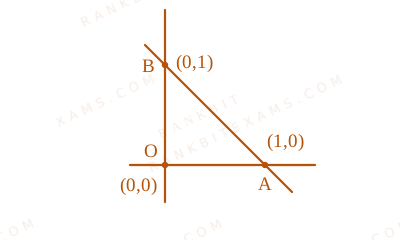
Four distinct points (2k, 3k), (1, 0), (0, 1) and (0, 0) lie on a circle for k equal to:

Solution & Explanation

### Related Formula (x-x_1)(x-x_2) + (y-y_1)(y-y_2) = 0 This is the equation of a circle passing through diametrically opposite endpoints (x_1, y_1) and (x_2, y_2). ### Core Logic Look at the three known points: A(1, 0), B(0, 1), and O(0, 0). The vectors vecOA and vecOB align with the x and y axes, meaning angle AOB = 90^circ. Since the angle subtended by AB at a point O on the circle is 90^circ, the segment AB must be the diameter of the circle. ### Step 1: Finding the Circle Equation Using the diametric form for points A(1,0) and B(0,1): (x-1)(x-0) + (y-0)(y-1) = 0 x^2 - x + y^2 - y = 0 ### Step 2: Solving for k Since the point (2k, 3k) also lies on this circle, substitute x = 2k and y = 3k into the equation: (2k)^2 - (2k) + (3k)^2 - (3k) = 0 4k^2 - 2k + 9k^2 - 3k = 0 13k^2 - 5k = 0 k(13k - 5) = 0 ### Step 3: Finding valid points This gives two possible values for k: k = 0 or k = frac513. If k=0, the fourth point becomes (0,0), which is already listed. The question specifies four *distinct* points. Thus, k = frac513. ### Pattern Recognition Whenever (0,0), (a,0), and (0,b) lie on a circle, they form a right triangle at the origin. The hypotenuse connecting (a,0) and (0,b) is ALWAYS the diameter. You can immediately write the circle's equation as x^2 + y^2 - ax - by = 0. ### Evaluation Rubric / Model Answer null ### Chapter Mix Class 11 Maths: Circles

Reference Study Guides

More Circles Previous-Year Questions — Page 3

Q4 jee_main_2024_31_jan_evening Equation of Tangent and Normal
Let a variable line passing through the centre of the circle x^2 + y^2 - 16x - 4y = 0, meet the positive co-ordinate axes at the point A and B. Then the minimum value of OA + OB, where O is the origin, is equal to
  • A. 12
  • B. 18
  • C. 20
  • D. 24

Solution

### Related Formula textIntercept form of line: fracxa + fracyb = 1 ### Core Logic Circle x^2 + y^2 - 16x - 4y = 0 has its centre at (8, 2). Let the line passing through (8, 2) have slope m. Its equation is: y - 2 = m(x - 8) x-intercept (A): set y=0 implies -2 = m(x-8) implies x = 8 - frac2m. y-intercept (B): set x=0 implies y = 2 - 8m. Sum of intercepts OA + OB = (8 - frac2m) + (2 - 8m) = 10 - frac2m - 8m. To minimize, let f(m) = 10 - frac2m - 8m. f'(m) = frac2m^2 - 8 = 0 implies m^2 = frac14 Since the line meets the positive coordinate axes, intercepts must be positive, which requires m < 0. Thus m = -1/2. Substitute m = -1/2: OA + OB = 10 - frac2-1/2 - 8(-1/2) = 10 + 4 + 4 = 18 ### Pattern Recognition AM-GM can also be applied: 8a + 2b = ab implies 1 = frac8a + frac2b. To minimize a+b, use Cauchy-Schwarz or standard differentiation. Differentiation directly yields intercept minima. ### Evaluation Rubric / Model Answer null ### Chapter Mix Class 11 Maths: Circles
Q4 jee_main_2024_31_jan_morning Intersection and Common Chords
If one of the diameters of the circle x^2 + y^2 - 10x + 4y + 13 = 0 is a chord of another circle C, whose center is the point of intersection of the lines 2x + 3y = 12 and 3x - 2y = 5, then the radius of the circle C is
  • A. sqrt20
  • B. 4
  • C. 6
  • D. 3sqrt2

Solution

### Core Logic Find the center of circle C by solving 2x + 3y = 12 and 3x - 2y = 5. Multiplying and subtracting yields 13x = 39 implies x = 3, y = 2. Center of C is (3, 2). ### Step 1: Properties of Given Circle Given circle: x^2 + y^2 - 10x + 4y + 13 = 0. Center M(5, -2). Radius r = sqrt25 + 4 - 13 = 4.
Intersection and Common Chords diagram for Q4 - JEE Main 2024 Morning
### Step 2: Radius Calculation The diameter of the first circle is a chord of circle C. Therefore, the distance between the two centers forms a right-angled triangle with the radius of C (CP) and the radius of the first circle (r = 4). Distance CM = sqrt(5-3)^2 + (-2-2)^2 = sqrt4 + 16 = sqrt20. Radius of circle C is CP = sqrtCM^2 + r^2 = sqrt20 + 16 = sqrt36 = 6. ### Pattern Recognition When a diameter of circle 1 is a chord of circle 2, the triangle formed by the centers and the point of intersection is a right-angled triangle at the center of circle 1. ### Evaluation Rubric / Model Answer null ### Chapter Mix Class 11 Maths: Circles Class 11 Maths: Straight Lines

More Circles Questions — jee_main_2024_27_jan_morning

Practice all Circles previous-year questions →

Rankbit System
JEE Physics: Waves (+15.5%) | Electrostatics: Concentric Shells (-29.7%) | Modern Physics: Photoelectric Clones (+34.2%) | Mathematics: Definite Integrals (+18.1%) | Chemistry: Coordination Splitting (-11.4%) | JEE Physics: Waves (+15.5%) | Electrostatics: Concentric Shells (-29.7%) | Modern Physics: Photoelectric Clones (+34.2%) | Mathematics: Definite Integrals (+18.1%) | Chemistry: Coordination Splitting (-11.4%)