JEE Main · Mathematics ↓ Falling

Application of Derivatives appeared 25 times across 3 years — 2.9% of Mathematics. This question is from Higher Order Derivatives.

Year 2026 2025 2024 Total
Questions 5 8 12 25

Let f(x)=x³+x²f'(1)+xf''(2)+f'''(3), xin R. Then f'(10) is equal to:

Numerical Answer Type:
Enter a numerical value Answer: 202 to 202 +4 marks

Solution & Explanation

Related Formula
(d)/(dx)(xⁿ) = nxⁿ⁻¹
Core Logic

Since f'(1), f''(2), and f'''(3) are evaluated at specific points, they act strictly as numerical constants. Let's differentiate the function sequentially:

f'(x) = 3x² + 2x f'(1) + f''(2) f''(x) = 6x + 2f'(1)

f'''(x) = 6

Step 1: Finding Unknown Constants

From the third derivative, evaluate it at x=3: f'''(3) = 6

Next, evaluate the second derivative at x=2:

f''(2) = 6(2) + 2f'(1) = 12 + 2f'(1)

Finally, evaluate the first derivative at x=1:

f'(1) = 3(1)² + 2(1)f'(1) + f''(2) f'(1) = 3 + 2f'(1) + f''(2)

Rearranging gives:

f'(1) + f''(2) = -3
Step 2: Solving the System

Substitute f''(2) = 12 + 2f'(1) into the rearranged equation:

f'(1) + (12 + 2f'(1)) = -3 3f'(1) = -15 ⇒ f'(1) = -5

Now find f''(2):

f''(2) = 12 + 2(-5) = 2
Step 3: Final Output Calculation

We now have the complete explicitly defined first derivative equation:

f'(x) = 3x² + 2x(-5) + 2 = 3x² - 10x + 2

Evaluate this at x=10:

f'(10) = 3(10)² - 10(10) + 2 f'(10) = 300 - 100 + 2 = 202
Pattern Recognition

Functional equations that contain derivatives evaluated at specific points are just polynomials with unknown coefficients. Treat those evaluations as scalar constants (A, B, C), differentiate systematically, and plug the anchors back in to build a basic system of linear equations.

Chapter Mix

Class 12 Maths: Application of Derivatives Class 11 Maths: Limits and Derivatives

Reference Study Guides

More Application of Derivatives Previous-Year Questions — Page 5

Q5 jee_main_2024_30_january_evening Maxima and Minima
Let f(x) = (x + 3)² (x - 2)³, x in [-4, 4] . If M and m are the maximum and minimum values of f , respectively in [-4, 4] , then the value of M - m is:
  • A. 600
  • B. 392
  • C. 608
  • D. 108

Solution

Related Formula
To find absolute extrema, evaluate f(x) at critical points and domain boundaries.
Core Logic

Calculate the derivative of f(x) using the product rule:

f'(x) = (d)/(dx) [(x + 3)²] · (x - 2)³ + (x + 3)² · (d)/(dx) [(x - 2)³] f'(x) = 2(x + 3)(x - 2)³ + 3(x + 3)²(x - 2)²

Factor out the common terms (x+3)(x-2)²:

f'(x) = (x + 3)(x - 2)² [2(x - 2) + 3(x + 3)] f'(x) = (x + 3)(x - 2)² [2x - 4 + 3x + 9] f'(x) = 5(x + 3)(x - 2)² (x + 1)

Setting f'(x) = 0 gives the critical points: x = -3, -1, 2

Step 1: Evaluating at Critical Points and Boundaries

Evaluate f(x) at x = -4, -3, -1, 2, 4:

Maxima and Minima diagram for Q5 - JEE Main 2024 Evening
For x = -4: f(-4) = (-4 + 3)²(-4 - 2)³ = (1)(-216) = -216 For x = -3: f(-3) = 0 For x = -1: f(-1) = (-1 + 3)²(-1 - 2)³ = (4)(-27) = -108 For x = 2: f(2) = 0 For x = 4: f(4) = (4 + 3)²(4 - 2)³ = 49 × 8 = 392

Step 2: Finding M and m

From the evaluated values, the maximum M = 392 and the minimum m = -216.

M - m = 392 - (-216) = 392 + 216 = 608
Pattern Recognition

For polynomials on a closed interval, critical points combined with boundary values reliably expose the absolute max and min.

Chapter Mix

Class 12 Maths: Application of Derivatives
Q5 jee_main_2024_30_jan_morning Maxima and Minima
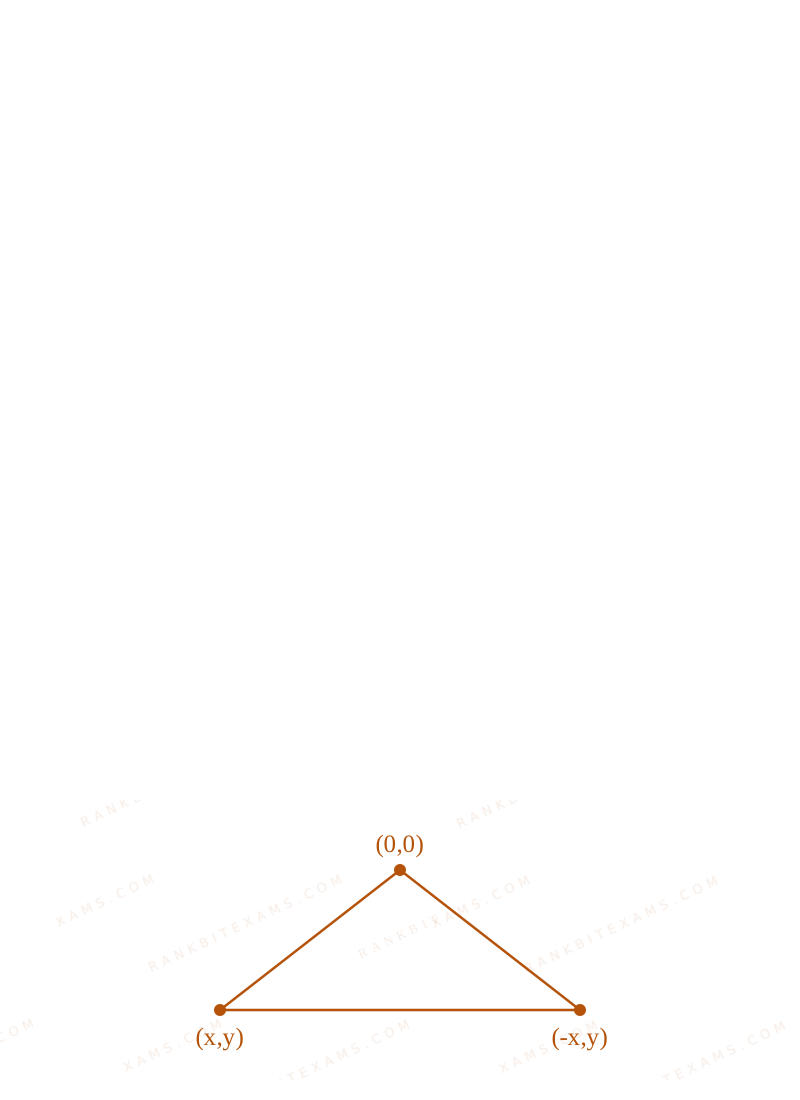
The maximum area of a triangle whose one vertex is at (0, 0) and the other two vertices lie on the curve y = -2x² + 54 at points (x, y) and (-x, y) where y > 0 is:
  • A. 88
  • B. 122
  • C. 92
  • D. 108

Solution

Related Formula
Area of Δ = (1)/(2) × base × height
Core Logic

Maxima and Minima diagram for Q5 - JEE Main 2024 Morning

The vertices of the triangle are (0, 0), (x, y), and (-x, y). The base of the triangle lies along the horizontal line segment joining (-x, y) and (x, y). Length of base = 2x. The height of the triangle from (0,0) to the line segment is y. So, Area Δ = (1)/(2) (2x) (y) = xy (Assuming x > 0).

Step 1: Setting up the area function

Substitute y = -2x² + 54 into the area function:

Area(Δ) = A(x) = x(-2x² + 54) = -2x³ + 54x
Step 2: Differentiating to find maximum area

To find the maximum area, take the derivative with respect to x and set it to zero:

A'(x) = (dA)/(dx) = -6x² + 54

Setting A'(x) = 0:

-6x² + 54 = 0 ⇒ 6x² = 54 ⇒ x² = 9

Since x represents half the base length, x = 3.

Step 3: Calculating maximum area

Substitute x = 3 back into the area function:

Amax = 3(-2(3)² + 54) = 3(-18 + 54) = 3(36) = 108
Pattern Recognition

For symmetric figures inscribed under a parabolic arch, the area function A(x) = x · y(x) is standard. Differentiate and find the critical point directly.

Chapter Mix

Class 12 Maths: Application of Derivatives
Q7 jee_main_2024_30_jan_morning Mean Value Theorems
Let g : R → R be a non-constant twice differentiable such that g'((1)/(2)) = g'((3)/(2)). If a real valued function f is defined as f(x) = (1)/(2)[g(x) + g(2 - x)], then
  • A. f'(x) = 0 for at least two x in (0,2)
  • B. f'(x) = 0 for exactly one x in (0,1)
  • C. f'(x) = 0 for no x in (0,1)
  • D. f((3)/(2)) + f((1)/(2)) = 1

Solution

Related Formula

Rolle's Theorem: If f(x) is continuous on [a, b], differentiable on (a, b), and f(a) = f(b), then there exists at least one c in (a, b) such that f'(c) = 0.

Core Logic

Given f(x) = (1)/(2)[g(x) + g(2 - x)]. Differentiating f(x) with respect to x:

f'(x) = (g'(x) - g'(2 - x))/(2)
Step 1: Evaluating the derivative at given points

Evaluate f'((3)/(2)):

f'((3)/(2)) = (g'((3)/(2)) - g'((1)/(2)))/(2)

Since g'((1)/(2)) = g'((3)/(2)), we get:

f'((3)/(2)) = 0

Also evaluate f'((1)/(2)):

f'((1)/(2)) = (g'((1)/(2)) - g'((3)/(2)))/(2) = 0

Additionally, observe that f'(1) = (g'(1) - g'(1))/(2) = 0.

Step 2: Applying Rolle's Theorem

We have f'((1)/(2)) = 0, f'(1) = 0, and f'((3)/(2)) = 0. By Rolle's Theorem on f'(x) (though we are asked about f'(x)=0 directly), we already found three distinct roots for f'(x) = 0: x = (1)/(2), 1, (3)/(2). Notice that x = 1/2 and x=1 are in (0, 2), and x=3/2 is in (0, 2). Thus f'(x) = 0 for at least three values in (0, 2), which satisfies the condition "at least two x in (0, 2)".

Pattern Recognition

Symmetry in function definition g(x) + g(a-x) guarantees a critical point at x = a/2. Additional critical points arise due to the given condition on g'(x), creating a scenario perfectly suited for Rolle's implications.

Chapter Mix

Class 12 Maths: Application of Derivatives
Q13 jee_main_2024_31_jan_evening Monotonicity and Distances
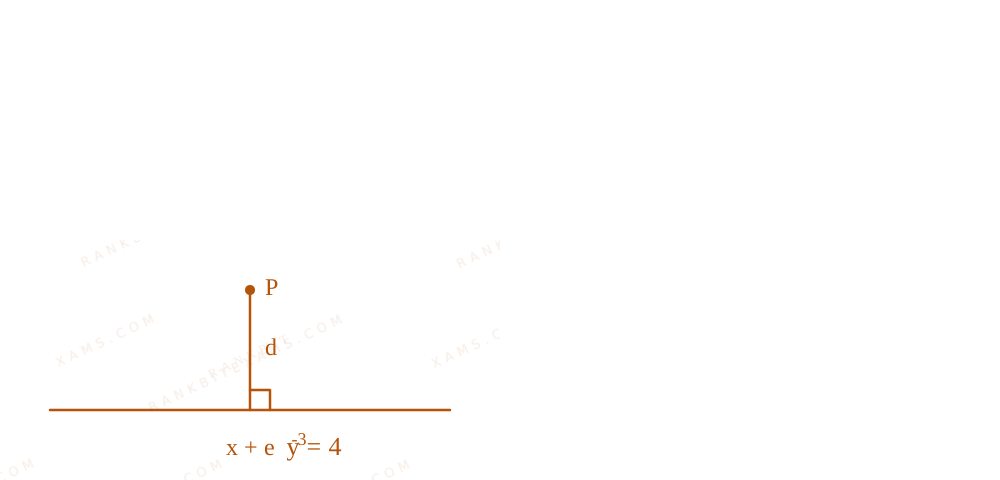
If the function f: (-∞, -1] → (a, b] defined by f(x) = ex³ - 3x + 1 is one-one and onto, then the distance of the point P(2b + 4, a + 2) from the line x + e⁻³y = 4 is :
  • A. 2 1 + e⁶
  • B. 4 1 + e⁶
  • C. 3 1 + e⁶
  • D. 1 + e⁶

Solution

Related Formula
Distance of point (x₁, y₁) from line Ax+By+C=0 is d = |Ax₁ + By₁ + C|√(A² + B²)
Core Logic

Monotonicity and Distances diagram for Q13 - JEE Main 2024 Evening

Given f(x) = ex³ - 3x + 1. Check monotonicity on (-∞, -1]:

f'(x) = ex³ - 3x + 1 · (3x² - 3) = 3(x-1)(x+1)ex³ - 3x + 1

For x ≤ -1, (x+1) ≤ 0 and (x-1) < 0, making f'(x) ≥ 0. Hence f(x) is strictly increasing. Since f is onto (a,b], the range is dictated by the domain boundaries:

a = x→-∞ f(x) = e-∞ = 0 b = f(-1) = e-1 + 3 + 1 = e³

Point P(2b + 4, a + 2) ≡ P(2e³ + 4, 2). Find distance from line x + e⁻³y - 4 = 0:

d = |2e³ + 4 + e⁻³(2) - 4| 1² + (e⁻³)² = 2e³ + 2e⁻³ 1 + e⁻⁶ d = 2e³(1 + e⁻⁶) 1 + e⁻⁶ = 2e³ 1 + e⁻⁶ = 2√(e⁶ + 1)
Chapter Mix

Class 12 Maths: Applications of Derivatives Class 11 Maths: Straight Lines

Q22 jee_main_2024_31_jan_morning Maxima and Minima
Let S = (-1, ∞) and f : S → R be defined as f(x) = ∫₋₁x (e^t - 1)¹¹ (2t - 1)⁵ (t - 2)⁷ (t - 3)¹² (2t - 10)⁶¹ dt. Let p = Sum of square of the values of x, where f(x) attains local maxima on S and q = Sum of the values of x, where f(x) attains local minima on S. Then, the value of p² + 2q is
Numerical Answer. Answer: 27 to 27

Solution

Related Formula
f'(x) = 0 for critical points. Change from + → - means local maxima, - → + means local minima.
Core Logic

Using Newton-Leibniz formula:

f'(x) = (e^x - 1)¹¹ (2x - 1)⁵ (x - 2)⁷ (x - 3)¹² (2x - 10)⁶¹

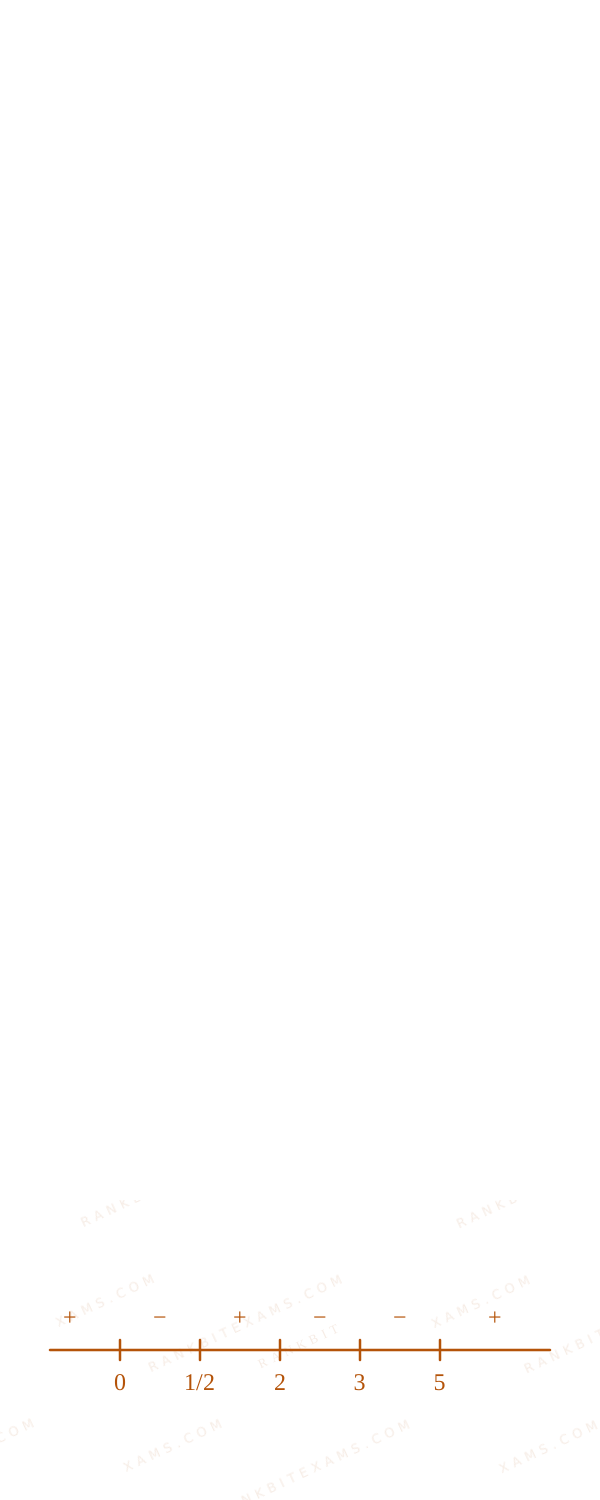
The critical points are roots of f'(x) = 0: x = 0, (1)/(2), 2, 3, 5.

Maxima and Minima diagram for Q22 - JEE Main 2024 Morning

Step 1: Sign Change Analysis

Perform the Wavy Curve Method for x in (-1, ∞): At x=5 (odd power 61): sign changes - → + (Local Minima) At x=3 (even power 12): sign doesn't change (Neither) At x=2 (odd power 7): sign changes + → - (Local Maxima) At x=1/2 (odd power 5): sign changes - → + (Local Minima) At x=0 (from e^x - 1, odd power 11): sign changes + → - (Local Maxima)

Step 2: Compute p and q

Local minima at x = 5, (1)/(2). Local maxima at x = 2, 0.

p = 0² + 2² = 4 q = 5 + (1)/(2) = (11)/(2)
Step 3: Final Computation
p² + 2q = 16 + 2((11)/(2)) = 16 + 11 = 27
Chapter Mix

Class 12 Maths: Application of Derivatives Class 12 Maths: Integrals

More Application of Derivatives Questions — jee_main_2024_27_jan_morning

Practice all Application of Derivatives previous-year questions →

Rankbit System
JEE Physics: Waves (+15.5%) | Electrostatics: Concentric Shells (-29.7%) | Modern Physics: Photoelectric Clones (+34.2%) | Mathematics: Definite Integrals (+18.1%) | Chemistry: Coordination Splitting (-11.4%) | JEE Physics: Waves (+15.5%) | Electrostatics: Concentric Shells (-29.7%) | Modern Physics: Photoelectric Clones (+34.2%) | Mathematics: Definite Integrals (+18.1%) | Chemistry: Coordination Splitting (-11.4%)