Rankbit System
JEE Physics: Waves (+15.5%) | Electrostatics: Concentric Shells (-29.7%) | Modern Physics: Photoelectric Clones (+34.2%) | Mathematics: Definite Integrals (+18.1%) | Chemistry: Coordination Splitting (-11.4%) | JEE Physics: Waves (+15.5%) | Electrostatics: Concentric Shells (-29.7%) | Modern Physics: Photoelectric Clones (+34.2%) | Mathematics: Definite Integrals (+18.1%) | Chemistry: Coordination Splitting (-11.4%)

Let for a differentiable function f:(0,infty)rightarrow R, f(x)-f(y)ge log_eleft(fracxyright)+x-y, forall x, y in (0,infty). Then sum_n=1^20f'left(frac1n^2right) is equal to:

Numerical Answer Type:
Enter a numerical value Answer: 2890 to 2890 +4 marks

Solution & Explanation

### Related Formula f'(x) = lim_y to x fracf(x)-f(y)x-y sum_n=1^k n^2 = frack(k+1)(2k+1)6 ### Core Logic Expand the given logarithmic inequality: f(x) - f(y) ge ln x - ln y + x - y Divide both sides by (x - y). The inequality sign will behave differently based on whether (x - y) is positive or negative. Case 1: Let x > y (so x - y > 0). fracf(x)-f(y)x-y ge fracln x - ln yx-y + 1 Taking the limit as y to x^-: f'(x) ge fracddx(ln x) + 1 Rightarrow f'(x) ge frac1x + 1 ### Step 1: Analyzing the second case Case 2: Let x < y (so x - y < 0). Dividing flips the inequality sign: fracf(x)-f(y)x-y le fracln x - ln yx-y + 1 Taking the limit as y to x^+: f'(x) le fracddx(ln x) + 1 Rightarrow f'(x) le frac1x + 1 ### Step 2: Squeeze Theorem deduction Since f is given as a differentiable function, both the left-hand and right-hand limits must yield the exact same derivative. Thus, it is sandwiched between the bounds: f'(x) = frac1x + 1 ### Step 3: Evaluating the Summation We need to compute sum_n=1^20 f'left(frac1n^2right). Substitute x = frac1n^2 into the derivative: f'left(frac1n^2right) = frac11/n^2 + 1 = n^2 + 1 Apply the summation: sum_n=1^20 (n^2 + 1) = sum_n=1^20 n^2 + sum_n=1^20 1 = frac20 times 21 times 416 + 20 = 2870 + 20 = 2890 ### Pattern Recognition Symmetric functional inequalities bounded by identical structural forms always compress down to an equality via the Sandwich/Squeeze theorem. Create the difference quotient limit to extract the derivative directly. ### Evaluation Rubric / Model Answer null ### Chapter Mix Class 12 Maths: Application of Derivatives Class 11 Maths: Sequences and Series Class 11 Maths: Limits and Derivatives

Reference Study Guides

More Application of Derivatives Previous-Year Questions — Page 2

Q51 jee_main_2025_04_april_evening Maxima and Minima
Let a > 0. If the function f(x) = 6x^3 - 45ax^2 + 108a^2x + 1 attains its local maximum and minimum values at the points x_1 and x_2 respectively such that x_1x_2 = 54, then a + x_1 + x_2 is equal to :-
  • A. 15
  • B. 18
  • C. 24
  • D. 13

Solution

### Related Formula For a function f(x) to have a local maximum or minimum at a point, its first derivative must vanish at that point: f'(x) = 0 ### Core Logic Differentiating the given function f(x) = 6x^3 - 45ax^2 + 108a^2x + 1 with respect to x: f'(x) = 18x^2 - 90ax + 108a^2 = 0 Dividing the entire equation by 18: x^2 - 5ax + 6a^2 = 0 Factoring the quadratic equation: (x - 2a)(x - 3a) = 0 Thus, the critical points are x = 2a and x = 3a. Since a > 0, we assign x_1 = 2a and x_2 = 3a. ### Step 1: Finding the value of a Given that the product of the roots x_1x_2 = 54: (2a)(3a) = 54 6a^2 = 54 implies a^2 = 9 Since a > 0, we have a = 3. ### Step 2: Calculating the final expression Substituting a = 3 back to find x_1 and x_2: x_1 = 2(3) = 6 x_2 = 3(3) = 9 Now, evaluating a + x_1 + x_2: a + x_1 + x_2 = 3 + 6 + 9 = 18 ### Pattern Recognition When critical points are expressed in terms of a parameter, relate the given root condition (x_1x_2 = 54) directly to the product of roots formula (fracca) of the simplified quadratic equation to save factoring time. ### Evaluation Rubric / Model Answer null ### Chapter Mix Class 12 Mathematics: Application of Derivatives
Q62 jee_main_2025_24_jan_evening Increasing and Decreasing Functions
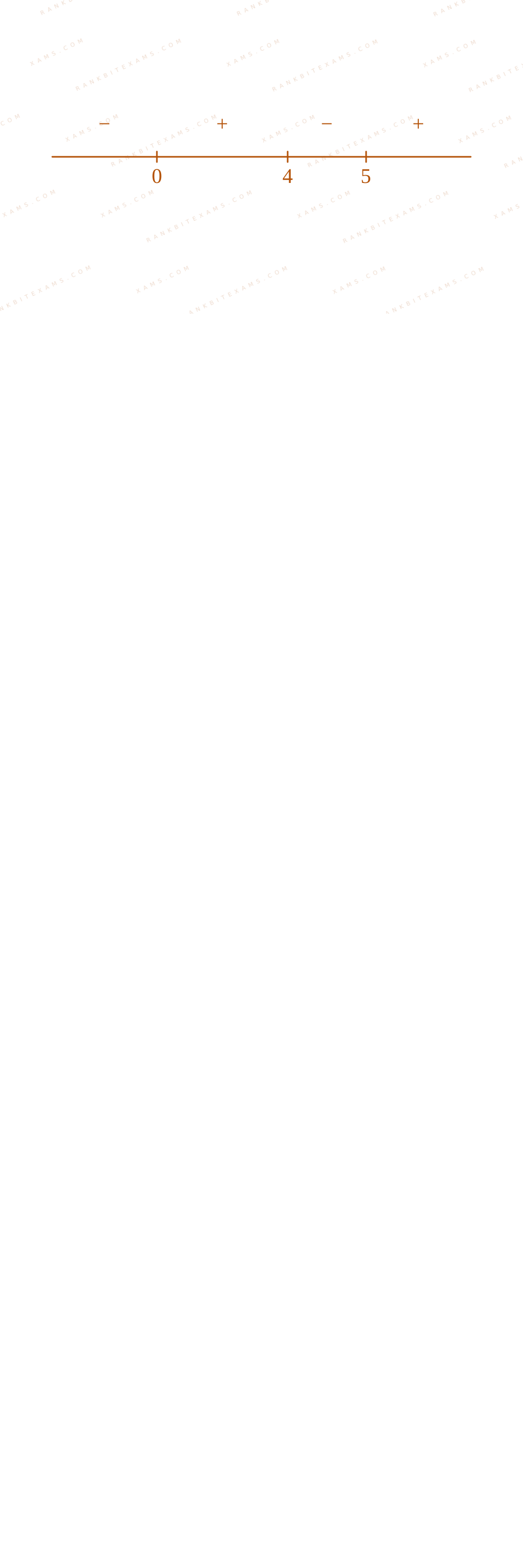
Let (2, 3) be the largest open interval in which the function f(x)=2log_e(x-2)-x^2+ax+1 is strictly increasing and (b, c) be the largest open interval, in which the function g(x)=(x-1)^3(x+2-a)^2 is strictly decreasing. Then 100(a+b-c) is equal to: [cite: 3335, 3336, 3337]
  • A. 280
  • B. 360
  • C. 420
  • D. 160

Solution

### Related Formula A differentiable function is strictly increasing where its first derivative is positive (f'(x) ge 0) and strictly decreasing where its first derivative is negative (g'(x) le 0). ### Step 1: Differentiate f(x) to solve for a Find f'(x) : f'(x) = frac2x-2 - 2x + a ge 0 Since (2,3) is the largest open interval of increasing behavior [cite: 3335, 3336], the transition root occurs at the upper boundary x=3 : f'(3) = 0 Rightarrow frac23-2 - 2(3) + a = 0 Rightarrow 2 - 6 + a = 0 Rightarrow a = 4 [cite: 3989, 3990, 3991] ### Step 2: Differentiate g(x) to solve for interval (b, c) Substitute a = 4 into g(x) [cite: 4002, 4003]: g(x) = (x-1)^3(x + 2 - 4)^2 = (x-1)^3(x-2)^2 Compute g'(x) using the product rule : g'(x) = 3(x-1)^2(x-2)^2 + (x-1)^3 cdot 2(x-2) g'(x) = (x-1)^2(x-2)left[3(x-2) + 2(x-1)right] = (x-1)^2(x-2)(5x - 8) [cite: 4005, 4006] For g(x) to be strictly decreasing, set g'(x) < 0 : Since (x-1)^2 ge 0, we require (x-2)(5x-8) < 0 Rightarrow x in left(frac85, 2right) [cite: 4006, 4007]. Thus, the interval is (b, c) = left(frac85, 2right), yielding b = frac85 = 1.6 and c = 2[cite: 3336, 4007]. ### Step 3: Compute Target Value Evaluate the objective expression [cite: 3337, 4008]: 100(a + b - c) = 100left(4 + frac85 - 2right) = 100(3.6) = 360 ### Pattern Recognition Boundary parameters of maximal monotonic intervals are always the exact zero-crossings of the derivative function. Setting f'(3) = 0 immediately establishes a=4 without secondary algebraic transformations. ### Evaluation Rubric / Model Answer null ### Chapter Mix Class 12 Mathematics: Application of Derivatives

Q62 jee_main_2025_24_jan_morning Maxima and Minima
Consider the region R = left\(x,y)colon x leq y leq 9 - frac113x^2, \, x geq 0right\. The area of the largest rectangle with sides parallel to the coordinate axes inscribed in R is :
  • A. frac625111
  • B. frac730119
  • C. frac567121
  • D. frac821123

Solution

### Related Formula The area of a rectangle bounded between an upper function curve y_2(x) and lower function curve y_1(x) spanning width x = t is formulated as: A(t) = t cdot [y_2(t) - y_1(t)] ### Core Logic The region is bounded below by the line y = x and above by the downward opening parabola y = 9 - frac113x^2 in the first quadrant:
Maxima and Minima
Maxima and Minima
Let a vertex of the rectangle lie on the upper parabolic boundary at x = t. The corresponding height span of the rectangle is bounded by the line y = t at the base:
Maxima and Minima
Maxima and Minima
Thus, the area equation as a function of variable parameter t is: A(t) = t cdot left( 9 - frac113t^2 - t right) = 9t - t^2 - frac113t^3 ### Step 1: Differentiate to Identify Critical Values Differentiate the area function with respect to t and equate to zero: fracdAdt = 9 - 2t - 11t^2 = 0 11t^2 + 2t - 9 = 0 11t^2 + 11t - 9t - 9 = 0 +(11t - 9)(t + 1) = 0 Since x \geq 0, we reject the negative root t = -1. This isolates the physical critical point at: t = frac911 ### Step 2: Evaluate Maximum Inscribed Area Substitute t = \frac{9}{11} back into the factored area equation formulation: A_textmax = frac911 cdot left( 9 - frac911 - frac113left(frac911right)^2 right) A_textmax = frac911 cdot left( 9 - frac911 - frac2711 right) A_textmax = frac911 cdot left( 9 - frac3611 right) = frac911 cdot frac6311 = frac567121$ ### Pattern Recognition For optimized area allocation inside custom functional borders, setting the optimization parameter strictly to the horizontal coordinates simplifies high-degree polynomials down to standard derivative templates. ### Evaluation Rubric / Model Answer null ### Chapter Mix Class 12 Mathematics: Application of Derivatives

Q19 jee_main_2024_01_february_morning Monotonicity of Functions
If 5f(x)+4fleft(frac1xright)=x^2-2, forall xne0 and y=9x^2f(x), then y is strictly increasing in:
  • A. left(0,frac1sqrt5right)cupleft(frac1sqrt5,inftyright)
  • B. left(-frac1sqrt5,0right)cupleft(frac1sqrt5,inftyright)
  • C. left(-frac1sqrt5,0right)cupleft(0,frac1sqrt5right)
  • D. left(-infty,-frac1sqrt5right)cupleft(0,frac1sqrt5right)

Solution

### Related Formula 1. Functional equations containing x and frac1x can be solved by substituting x to frac1x to create a system of simultaneous equations. 2. A function is strictly increasing in intervals where its first derivative is positive: fracdydx > 0. ### Core Logic Given the functional equation equation: 5f(x) + 4fleft(frac1xright) = x^2 - 2 quad implies (1) Substitute x to frac1x: 5fleft(frac1xright) + 4f(x) = frac1x^2 - 2 quad implies (2) ### Step 1: Solve for f(x) To eliminate fleft(frac1xright), multiply equation (1) by 5 and equation (2) by 4: 25f(x) + 20fleft(frac1xright) = 5x^2 - 10 16f(x) + 20fleft(frac1xright) = frac4x^2 - 8 Subtract the second equation from the first: 9f(x) = 5x^2 - frac4x^2 - 2 ### Step 2: Differentiate the Target Equation We are given y = 9x^2 f(x) = x^2 [9f(x)]. Substituting our equation for 9f(x): y = x^2 left( 5x^2 - frac4x^2 - 2 right) y = 5x^4 - 2x^2 - 4 Differentiating with respect to x: fracdydx = 20x^3 - 4x = 4x(5x^2 - 1) ### Step 3: Analyze the Monotonicity Intervals For the function to be strictly increasing, set fracdydx > 0: 4x(5x^2 - 1) > 0 implies xleft(x - frac1sqrt5right)left(x + frac1sqrt5right) > 0 Using the wavy curve method with critical roots -frac1sqrt5, \, 0, \, frac1sqrt5: - Positive regions occur where x in left(-frac1sqrt5, 0right) cup left(frac1sqrt5, inftyright). ### Pattern Recognition Sees: Symmetric reciprocal arguments inside a functional format. Shortcut: Recognizing that y = 9x^2 f(x) simplifies directly to an even polynomial (5x^4 - 2x^2 - 4) means the final derivative will be odd, ensuring a symmetric layout across the origin. ### Evaluation Rubric / Model Answer null ### Chapter Mix Class 12 Mathematics: Application of Derivatives Class 11 Mathematics: Relations and Functions
Q5 jee_main_2024_29_january_evening Maxima and Minima
The function f(x) = 2x + 3(x)^frac23, x in mathbbR, has
  • A. exactly one point of local minima and no point of local maxima
  • B. exactly one point of local maxima and no point of local minima
  • C. exactly one point of local maxima and exactly one point of local minima
  • D. exactly two points of local maxima and exactly one point of local minima

Solution

### Related Formula For local maxima or minima, check the sign flip of f'(x) across critical points. ### Core Logic Given f(x) = 2x + 3x^2/3. Differentiating with respect to x: f'(x) = 2 + 3 cdot frac23 x^-1/3 = 2 + 2x^-1/3 = 2 left(1 + frac1x^1/3right) = 2 left(fracx^1/3 + 1x^1/3right) Critical points occur where f'(x) = 0 or where f'(x) is undefined: * f'(x) = 0 implies x^1/3 + 1 = 0 implies x = -1 * f'(x) is undefined at x = 0 ### Step 1: Sign Scheme Analysis Let us check the sign changes of f'(x): * For x < -1: x^1/3+1 < 0 and x^1/3 < 0 implies f'(x) > 0 (+) * For -1 < x < 0: x^1/3+1 > 0 and x^1/3 < 0 implies f'(x) < 0 (-) * For x > 0: x^1/3+1 > 0 and x^1/3 > 0 implies f'(x) > 0 (+) Sign changes: * At x = -1: positive to negative rightarrow Local Maxima * At x = 0: negative to positive rightarrow Local Minima Thus, there is exactly one point of local maxima and exactly one point of local minima. ### Pattern Recognition Points where the derivative is undefined (cusps or vertical tangents) are equally valid critical point candidates for local extrema. Always include them in your sign scheme layout. ### Evaluation Rubric / Model Answer null ### Chapter Mix Class 12 Mathematics: Application of Derivatives

More Application of Derivatives Questions — jee_main_2024_27_jan_morning

Practice all Application of Derivatives previous-year questions →

YOUR FIRST PREP STEP STARTS HERE

We Map Every Repeating Question in Competitive Exams.

Say goodbye to generic mock test fatigue. RankBit uses smart analysis to group past exam questions into their foundational Repeating Question Types. Find chapter weightage, track repeating questions, and score higher with targeted practice.

Select Your Target Exam

Choose an exam track below to find formulas per chapter and patterns.

Syncing Exam Intelligence

Mapping formulas and patterns across all tracks…

PATH A — FULL LENGTH PRACTICE

Full Mock Test Hub

Simulate real NTA exam conditions with fully tracked mocks. Time yourself against past papers.

Under Development
PATH B — TARGETED PRACTICE

Topic-wise Practice Hub

Practice past-year questions one chapter at a time. Pick an exam → subject → chapter and get every PYQ for that topic — pulled together from all past papers — with the chapter's key formulas alongside.

Loading Questions... Browse Topics
Latest from the Blog
View all →

Loading articles...