If R$R$ is the radius of the earth and the acceleration due to gravity on the surface of earth is g = π² ~m/s²$g = \pi^2 \mathrm{~m/s^2}$, then the length of the second's pendulum at a height h = 2R$h = 2R$ from the surface of earth will be:
1 = 9l l = (1)/(9)~m$$1 = 9l \implies l = \frac{1}{9}\mathrm{~m}$$
Pattern Recognition
Second's pendulum always has T = 2~s$T = 2\mathrm{~s}$. Height 2R$2R$ from the surface means a total distance of 3R$3R$ from the center, which yields a (1)/(9)$\frac{1}{9}$ drop in gravity.
Chapter Mix
Class 11 Physics: Gravitation
Class 11 Physics: Oscillations
Keywords:#Second's pendulum length at height h#JEE Main 2024 Morning Q32#Gravitation acceleration variation#Oscillations simple pendulum
More Gravitation Previous-Year Questions — Page 5
Q46jee_main_2024_31_jan_eveningEscape Velocity
The mass of the moon is 1/144$1/144$ times the mass of a planet and its diameter 1/16$1/16$ times the diameter of a planet. If the escape velocity on the planet is v, the escape velocity on the moon will be:
For the planet: v = √((2GMₚ)/(Rₚ))$v = \sqrt{\frac{2GM_p}{R_p}}$
For the moon: Mm = (Mₚ)/(144)$M_m = \frac{M_p}{144}$ and Rm = (Rₚ)/(16)$R_m = \frac{R_p}{16}$.
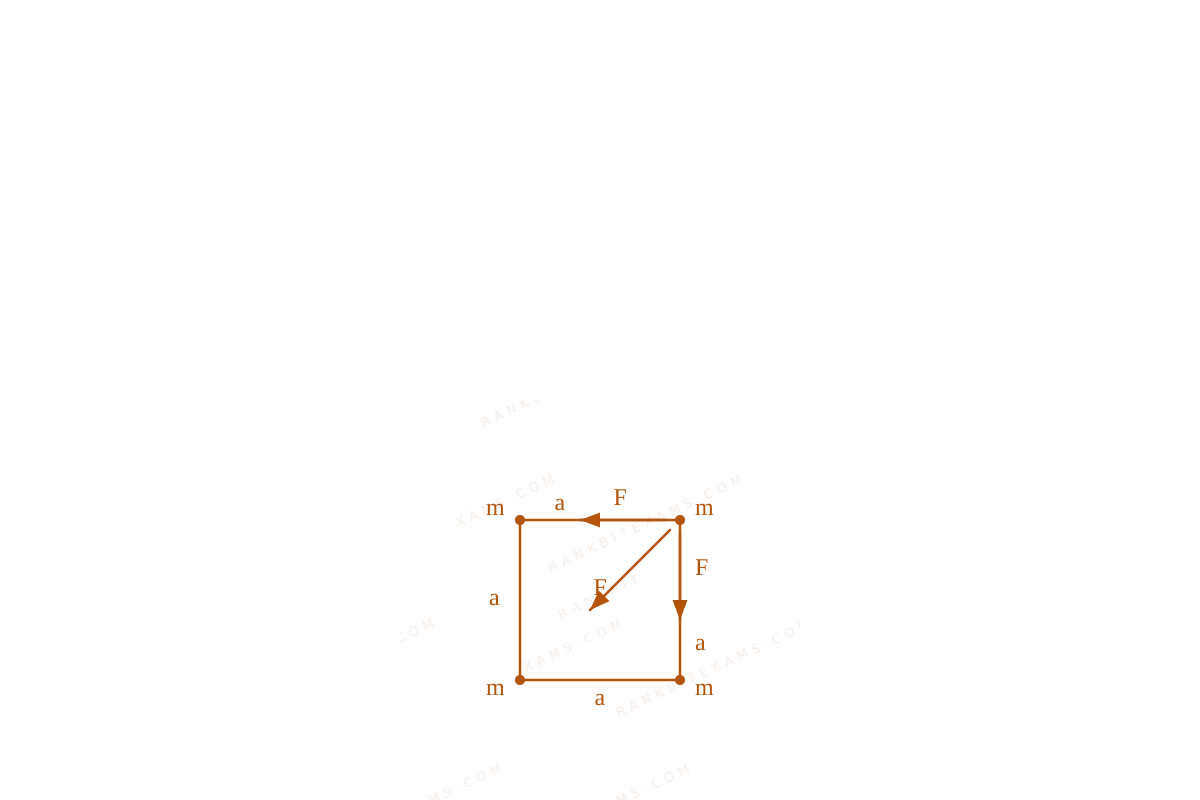
Four identical particles of mass m$m$ are kept at the four corners of a square. If the gravitational force exerted on one of the masses by the other masses is ( 2√(2) + 132) Gm²L²$\left(\frac{2\sqrt{2} + 1}{32}\right)\frac{\mathrm{Gm}^2}{\mathrm{L}^2}$, the length of the sides of the square is
A.L2$\frac{\mathrm{L}}{2}$
B.4 L$4 L$
C.3L$3L$
D.2 L$2 L$
Solution
Related Formula
F = (G m₁ m₂)/(r²)$$F = \frac{G m_1 m_2}{r^2}$$
Core Logic
Superposition Principle diagram for Q37 - JEE Main 2024 Morning
Let the side length of the square be a$a$. Considering one corner mass, it experiences forces from the adjacent two masses (distance a$a$) and the diagonally opposite mass (distance √(2)a$\sqrt{2}a$).
The forces from the two adjacent masses are at 90^°$90^\circ$ to each other:
F = (Gm²)/(a²)$$F = \frac{Gm^2}{a^2}$$
The resultant of these two is √(2)F = √(2) (Gm²)/(a²)$\sqrt{2}F = \sqrt{2} \frac{Gm^2}{a^2}$, directed along the diagonal.
Step 2: Total Force Equation
The force from the diagonal mass is:
F' = Gm²(√(2)a)² = (Gm²)/(2a²)$$F' = \frac{Gm^2}{(\sqrt{2}a)^2} = \frac{Gm^2}{2a^2}$$
Total resultant force Fₙₑₜ = √(2)F + F'$F_{\text{net}} = \sqrt{2}F + F'$:
Practice past-year questions one chapter at a time. Pick an exam → subject → chapter and get every PYQ for that topic — pulled together from all past papers — with the chapter's key formulas alongside.
