JEE Main · Mathematics → Steady

Conic Sections appeared 94 times across 3 years — 10.9% of Mathematics. This question is from Intersection of Circles.

Year 2026 2025 2024 Total
Questions 29 44 21 94

Let C:x²+y²=4 and C:x²+y²-4λ x+9=0 be two circles. If the set of all values of λ so that the circles C and C' intersect at two distinct points, is R - [a, b], then the point (8a+12,16b-20) lies on the curve:

Solution & Explanation

Related Formula

For two circles with centers C₁, C₂ and radii r₁, r₂ to intersect at two distinct real points, the distance between their centers must satisfy:

|r₁ - r₂| < C₁C₂ < r₁ + r₂
Core Logic

Extracting properties from the circle equations:

  • Circle C: x² + y² = 4 Center C₁ = (0,0), Radius r₁ = 2
  • Circle C': x² + y² - 4λ x + 9 = 0 Center C₂ = (2λ, 0), Radius r₂ = √((-2λ)² - 9) = √(4λ² - 9)
  • For real intersection conditions, the radius must be defined:

4λ² - 9 > 0 λ² > (9)/(4) (1)

Distance between centers: C₁C₂ = √((2λ - 0)² + 0²) = |2λ|.

Step 1: Formulate the Triangle Inequality Solutions

Applying the intersection condition:

|2 - √(4λ² - 9)| < |2λ| < 2 + √(4λ² - 9)

The right side inequality |2λ| < 2 + √(4λ² - 9) is always valid for real radii. Solving the left side inequality by squaring:

(2 - √(4λ² - 9))² < (2λ)² 4 + (4λ² - 9) - 4√(4λ² - 9) < 4λ² -5 - 4√(4λ² - 9) < 0 4√(4λ² - 9) > -5

Since a square root is always non-negative, square both sides to get the strict bound:

16(4λ² - 9) > 25 64λ² - 144 > 25 64λ² > 169 λ² > (169)/(64) (2)

Combining bounds (1) and (2), condition (2) is more restrictive, meaning:

λ in (-∞, -(13)/(8)) ((13)/(8), ∞)

This can be written as R - [-(13)/(8), (13)/(8)].

Step 2: Coordinate Analysis of the Target Point

Comparing our interval with R - [a, b], we identify:

a = -(13)/(8), b = (13)/(8)

Now, substitute these bounds to locate the coordinates of our target point (8a+12, 16b-20):

  • x-coordinate: 8(-(13)/(8)) + 12 = -13 + 12 = -1
  • y-coordinate: 16((13)/(8)) - 20 = 26 - 20 = 6
  • Hence, the point is (-1, 6).

Step 3: Test Point against the Options

Substitute (-1, 6) into the given curves to find a match: Testing Option (4): 6x² + y² = 42

6(-1)² + (6)² = 6(1) + 36 = 42

Since LHS = RHS, the point satisfies the curve in Option (4).

Pattern Recognition

Sees: Dynamic variable interval limits forming loci requirements. Shortcut: When checking inequalities like |2 - √(z)| < 2λ, algebraic squaring helps simplify the terms quickly by eliminating the parameter 4λ² from both sides.

Chapter Mix

Class 11 Mathematics: Conic Sections (Circles) Class 11 Mathematics: Linear Inequalities
Reference Study Guides

More Conic Sections Previous-Year Questions — Page 3

Q11 jee_main_2026_22_january_evening Hyperbola Properties and Area of Triangle
Let P(10, 2√(15)) be a point on the hyperbola (x²)/(a²) - (y²)/(b²) = 1, whose foci are S and S'. If the length of its latus rectum is 8, then the square of the area of Δ PSS' is equal to:
  • A. 4200
  • B. 900
  • C. 1462
  • D. 2700

Solution

Related Formula

Latus rectum length = (2b²)/(a) = 8 b² = 4a. Focal length = 2ae = 2√(a² + b²).

Core Logic

Substitute P(10, 2√(15)) and b² = 4a into hyperbola equation:

(100)/(a²) - (60)/(4a) = 1 a² + 15a - 100 = 0 (a + 20)(a - 5) = 0 a = 5 (a > 0)

Thus, b² = 20 b = √(20).

Step 1: Calculate Focal Distance and Area

Focal distance SS' = 2ae = 2 √(a² + b²) = 2 √(25 + 20) = 6√(5). Area of Δ PSS' = (1)/(2) × base × height = (1)/(2) (6√(5)) (2√(15)) = 30√(3) = A.

Step 2: Square of Area
A² = (30√(3))² = 900 × 3 = 2700
Pattern Recognition

Use latus rectum relation to reduce hyperbola parameter to single variable quadratic.

Chapter Mix

Class 11 Maths: Conic Sections

Q16 jee_main_2026_22_january_evening Ellipse Focal Distances
Let S and S' be the foci of the ellipse (x²)/(25) + (y²)/(9) = 1 and P(α, β) be a point on the ellipse in the first quadrant. If (SP)² + (S'P)² - SP · S'P = 37, then α² + β² is equal to:
  • A. 15
  • B. 11
  • C. 17
  • D. 13

Solution

Related Formula

For ellipse (x²)/(a²) + (y²)/(b²) = 1: SP + S'P = 2a = 10, e = √(1 - b²/a²) = √(1 - 9/25) = 4/5. Focal distances: SP = a - eα = 5 - (4)/(5)α, S'P = a + eα = 5 + (4)/(5)α.

Core Logic

Using algebraic identity:

(SP + S'P)² - 3 SP · S'P = 37 100 - 3 SP · S'P = 37 SP · S'P = 21

Substitute focal distance formula:

25 - (16)/(25)α² = 21 (16)/(25)α² = 4 α² = (25)/(4)
Step 1: Calculate beta^2 and Sum

Substitute α² into ellipse equation (α²)/(25) + (β²)/(9) = 1:

(1)/(4) + (β²)/(9) = 1 β² = (27)/(4) α² + β² = (25)/(4) + (27)/(4) = (52)/(4) = 13
Pattern Recognition

Express (SP)² + (S'P)² - SP · S'P in terms of (SP+S'P) to determine SP · S'P instantly.

Chapter Mix

Class 11 Maths: Conic Sections

Q17 jee_main_2026_22_january_evening Locus of Midpoint of Chord
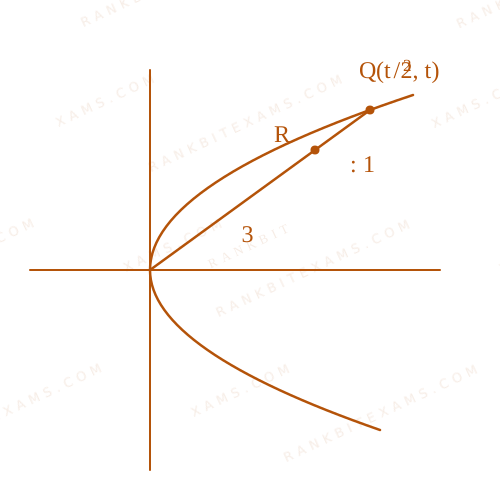
Let the locus of the mid-point of the chord through the origin O of the parabola y² = 4x be the curve S. Let P be any point on S. Then the locus of the point, which internally divides OP in the ratio 3:1, is:
  • A. 3y² = 2x
  • B. 2y² = 3x
  • C. 3x² = 2y
  • D. 2x² = 3y

Solution

Related Formula

Section formula for internal division in ratio m:n:

R(h,k) = ( (m x₂ + n x₁)/(m+n), (m y₂ + n y₁)/(m+n) )
Core Logic

Locus of midpoint diagram for Q17 - JEE Main 2026 Evening

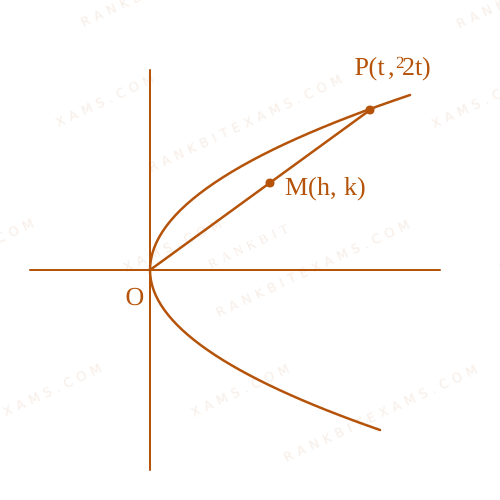
Let chord endpoint be Q(t², 2t). Midpoint M(h,k) of OQ:

h = (t²)/(2), k = t k² = 2h

So curve S is y² = 2x.

Now P lies on S: y² = 2x, so P = ((t²)/(2), t). Point R(h,k) divides OP in ratio 3:1:

Step 1: Section Formula Application

Locus of midpoint diagram for Q17 - JEE Main 2026 Evening

h = (3(t²/2) + 0)/(4) = (3t²)/(8), k = (3(t) + 0)/(4) = (3t)/(4)

From k = (3t)/(4) t = (4k)/(3). Substitute into h:

h = (3)/(8) ((4k)/(3))² = (3)/(8) · (16k²)/(9) = (2k²)/(3) 2k² = 3h 2y² = 3x
Pattern Recognition

Parametrize midpoint curve S, then re-apply section ratio to derive final locus equation.

Chapter Mix

Class 11 Maths: Conic Sections

Q1 jee_main_2026_23_january_morning Hyperbola
Let the domain of the function f(x) = ₃ ₅ ₇(9x - x² - 13) be the interval (m, n). Let the hyperbola (x²)/(a²) - (y²)/(b²) = 1 have eccentricity (n)/(3) and the length of the latus rectum (8m)/(3). Then b² - a² is equal to:
  • A. 5
  • B. 11
  • C. 9
  • D. 7

Solution

Related Formula
e = √(1 + (b²)/(a²)) L.R. = (2b²)/(a)
Core Logic

For the domain of the given logarithmic function, the argument of the innermost logarithm must be strictly greater than 1 because of the nested logs:

₅( ₇(9x-x²-13))>0 ⇒ ₇(9x-x²-13) > 1 ⇒ 9x-x²-13 > 7 ⇒ x²-9x+20 < 0 ⇒ (x-4)(x-5) < 0

Thus, 4 < x < 5. Therefore, the domain interval is (4, 5), yielding m = 4 and n = 5.

Step 1: Hyperbola Properties

Given eccentricity e = (n)/(3) = (5)/(3):

e = √(1 + (b²)/(a²)) = (5)/(3) ⇒ (b²)/(a²) = (25)/(9) - 1 = (16)/(9) ⇒ (b)/(a) = (4)/(3)

Given the length of the latus rectum is (8m)/(3):

(2b²)/(a) = (8(4))/(3) = (32)/(3) ⇒ 2b((b)/(a)) = (32)/(3) ⇒ 2b((4)/(3)) = (32)/(3) ⇒ 8b = 32 ⇒ b = 4

Since (b)/(a) = (4)/(3), we get a = 3.

Step 2: Final Calculation

We need to find b² - a²:

b² - a² = (4)² - (3)² = 16 - 9 = 7
Pattern Recognition

Nested logarithmic domains require unpacking from the outside in: ₐ(X) > 0 ⇒ X > 1. Linking function domains to coordinate geometry parameters is a standard JEE cross-topic pattern.

Chapter Mix

Class 11 Maths: Conic Sections Class 11 Maths: Relations and Functions

Q5 jee_main_2026_23_january_morning Ellipse
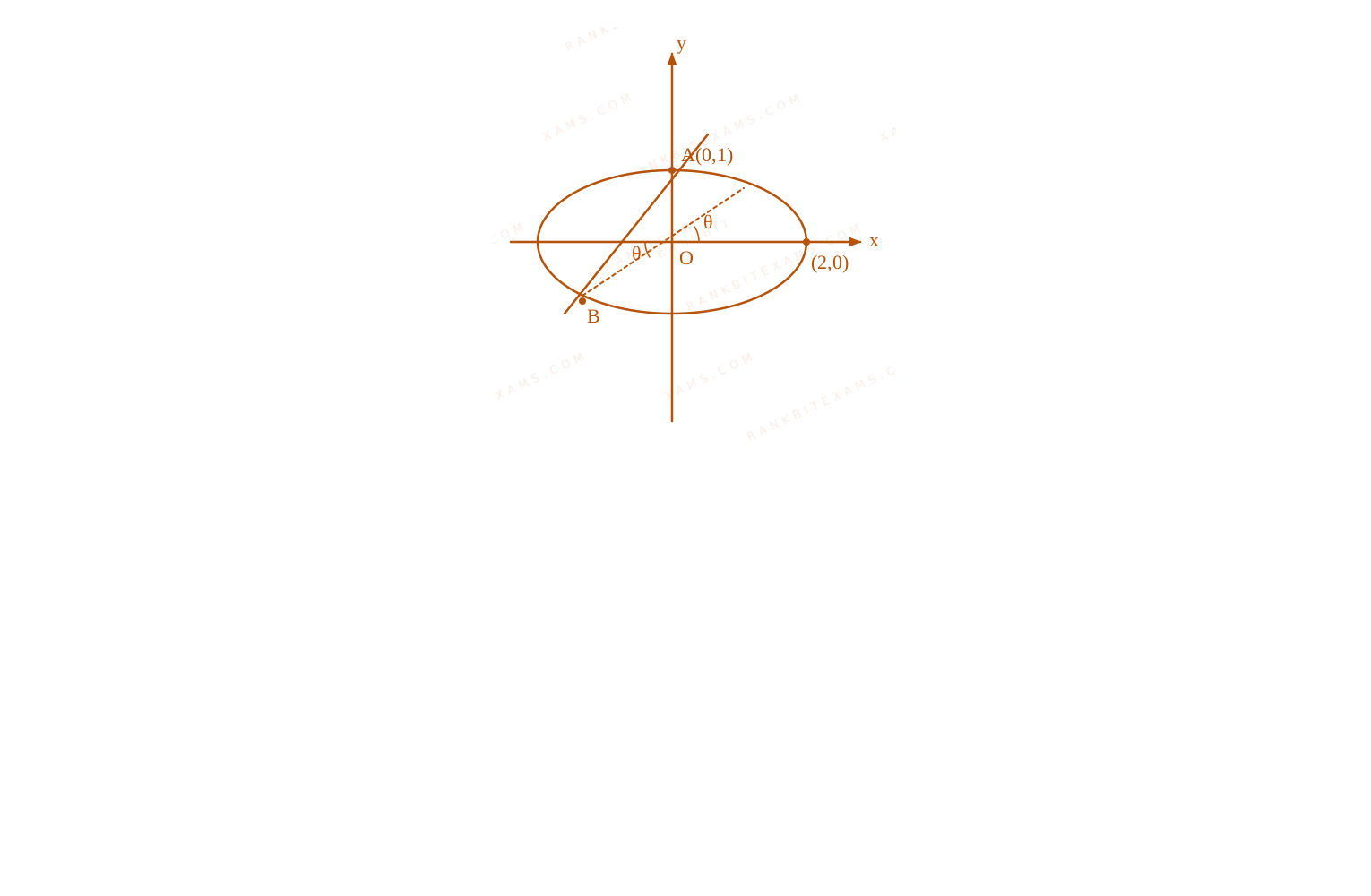
Let the line y - x = 1 intersect the ellipse (x²)/(2) + (y²)/(1) = 1 at the points A and B. Then the angle made by the line segment AB at the center of the ellipse is:
  • A. π - ⁻¹((1)/(4))
  • B. (π)/(2) + ⁻¹((1)/(4))
  • C. (π)/(2) + 2 ⁻¹((1)/(4))
  • D. (π)/(2) - ⁻¹((1)/(4))

Solution

Related Formula
θ = | (m₁ - m₂)/(1 + m₁ m₂) |
Core Logic

Find the intersection points of the line y = x + 1 and the ellipse (x²)/(2) + y² = 1.

Ellipse diagram for Q5 - JEE Main 2026 Morning
Substitute y = x + 1 into the ellipse equation:

(x²)/(2) + (x + 1)² = 1 x² + 2(x² + 2x + 1) = 2 3x² + 4x = 0 ⇒ x(3x + 4) = 0

This gives x = 0 or x = -(4)/(3).

Step 1: Calculate Intersection Points

For x = 0, y = 1 ⇒ A(0, 1). For x = -(4)/(3), y = -(4)/(3) + 1 = -(1)/(3) ⇒ B(-(4)/(3), -(1)/(3)).

Ellipse diagram for Q5 - JEE Main 2026 Morning

Step 2: Find Angle at the Origin

Let O(0,0) be the center of the ellipse. The angle made by segment AB at O is ∠ AOB. The slope of OA is m₁ = (1 - 0)/(0 - 0) = ∞ (which means OA is along the y-axis, angle is π/2). The slope of OB is m₂ = (-1/3 - 0)/(-4/3 - 0) = (1)/(4). The angle of OB with the positive x-axis is θ = ⁻¹((1)/(4)). The total angle ∠ AOB is (π)/(2) + θ = (π)/(2) + ⁻¹((1)/(4)).

Pattern Recognition

When solving line-conic intersection, explicit extraction of points (A, B) is often simpler than using homogenization if the intersection yields simple rational or integer coordinates.

Chapter Mix

Class 11 Maths: Conic Sections Class 11 Maths: Straight Lines

More Conic Sections Questions — jee_main_2024_01_february_morning

Practice all Conic Sections previous-year questions →

Rankbit System
JEE Physics: Waves (+15.5%) | Electrostatics: Concentric Shells (-29.7%) | Modern Physics: Photoelectric Clones (+34.2%) | Mathematics: Definite Integrals (+18.1%) | Chemistry: Coordination Splitting (-11.4%) | JEE Physics: Waves (+15.5%) | Electrostatics: Concentric Shells (-29.7%) | Modern Physics: Photoelectric Clones (+34.2%) | Mathematics: Definite Integrals (+18.1%) | Chemistry: Coordination Splitting (-11.4%)