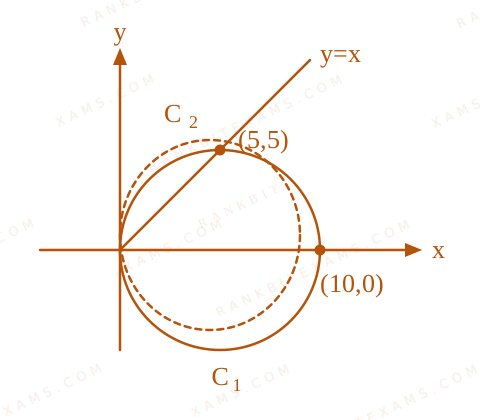
Let y = x be the equation of a chord of the circle C₁ (in the closed half-plane x ≥ 0) of diameter 10 passing through the origin. Let C₂ be another circle described on the given chord as its diameter. If the equation of the chord of the circle C₂, which passes through the point (2, 3) and is farthest from the center of C₂, is x + ay + b = 0, then a - b is equal to:

Solution & Explanation

Core Logic

Chord of a Circle
Chord of a Circle
Chord of a Circle
Chord of a Circle
Equation of circle C₂ with diameter along y=x passing through origin and having length 10. Wait, C₁ has diameter 10. The chord y=x passes through (0,0). For the chord to be a diameter of C₂, the points of intersection with C₁ must form the diameter. The center of C₂ is the midpoint of the chord. Let the ends of the chord be (0,0) and (5,5) (since length is √(50)? Wait, the problem implies the chord of C₁ is y=x. If C₁ is a circle in x ≥ 0 of diameter 10 through origin. Center of C₂ lies on the chord y=x. The equation of circle C₂ is:

x² + y² - 5x - 5y = 0

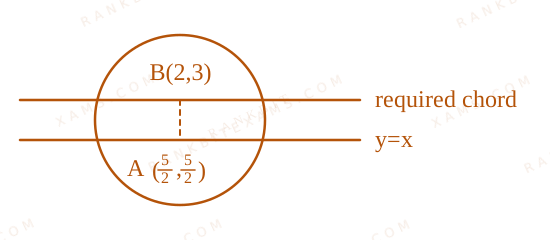
Its center is N((5)/(2), (5)/(2)).

Step 1: Find Farthest Chord

We need the chord of C₂ passing through B(2, 3) which is farthest from the center N((5)/(2), (5)/(2)). The farthest chord passing through a given point is always perpendicular to the line joining the center to that point. Slope of line NB:

mNB = (3 - (5)/(2))/(2 - (5)/(2)) = ((1)/(2))/(-(1)/(2)) = -1
Step 2: Chord Equation

The slope of the required chord is perpendicular to mNB:

Slope of required chord = 1

Equation of the required chord passing through (2,3):

y - 3 = 1(x - 2)

x - y + 1 = 0 Comparing this with x + ay + b = 0, we get:

a = -1, b = 1
Step 3: Final Calculation
a - b = -1 - 1 = -2
Pattern Recognition

The chord of a circle passing through a given internal point that is FARTHEST from the center is exactly the chord that is PERPENDICULAR to the radius (or line segment) connecting the center to that internal point.

Chapter Mix

Class 11 Mathematics: Circles Class 11 Mathematics: Straight Lines

Reference Study Guides

More Circles Previous-Year Questions — Page 9

Q jee_main_2025_07_april_morning Tangent and Normal to a Circle
Let C₁ be the circle in the third quadrant of radius 3, that touches both coordinate axes. Let C₂ be the circle with centre (1, 3) that touches C₁ externally at the point (α, β). If (β - α)² = (m)/(n), (m, n) = 1, then m + n is equal to:
  • A. 9
  • B. 13
  • C. 22
  • D. 31

Solution

Related Formula

For a circle in the third quadrant touching both coordinate axes, the center layout is (-r, -r) and equation looks like:

(x + r)² + (y + r)² = r²

For external contact between circles C₁ and C₂, the distance between centers equals the sum of their radii:

C₁C₂ = r₁ + r₂
Core Logic

Circle C₁ has radius r₁ = 3 and touches both axes in the third quadrant, so its center is A(-3, -3). Circle C₂ has center B(1, 3).

The distance between centers A and B is:

AB = √((1 - (-3))² + (3 - (-3))²) = √(4² + 6²) = √(16 + 36) = √(52) = 2√(13)
Step 1: Determine Radius of Circle 2

Tangent and Normal to a Circle diagram for Q59 - JEE Main 2025 Morning
Since the circles touch externally:

AB = r₁ + r₂ 2√(13) = 3 + r₂ r₂ = 2√(13) - 3
Step 2: Locate the Contact Point via Section Formula

The point of contact P(α, β) divides the line segment joining centers A(-3, -3) and B(1, 3) internally in the ratio r₁ : r₂ = 3 : (2√(13) - 3).

Using the internal section formula:

α = 3(1) + (2√(13) - 3)(-3)3 + (2√(13) - 3) = 3 - 6√(13) + 92√(13) = 12 - 6√(13) + 02√(13) = 6 - 3√(13)√(13) β = 3(3) + (2√(13) - 3)(-3)3 + (2√(13) - 3) = 9 - 6√(13) + 92√(13) = 18 - 6√(13)2√(13) = 9 - 3√(13)√(13)
Step 3: Calculate the Difference Value

Find (β - α)²:

β - α = 9 - 3√(13)√(13) - 6 - 3√(13)√(13) = 3√(13) (β - α)² = ( 3√(13))² = (9)/(13)

Comparing with (m)/(n) where (m, n) = 1 gives m = 9, n = 13.

m + n = 9 + 13 = 22
Pattern Recognition

Notice that computing (β - α) directly cancels out the irrational √(13) term from the numerator before squaring, saving a significant amount of tedious arithmetic expansion.

Chapter Mix

Class 11 Mathematics: Coordinate Geometry Class 11 Mathematics: Circles

Q73 jee_main_2025_07_april_morning Hyperbola
Consider the hyperbola (x²)/(a²) -(y²)/(b²) = 1 having one of its focus at P(-3,0) . If the latus rectum through its other focus subtends a right angle at P and a² b² = α √(2) -β ,α ,β in N , calculate α + β.
Numerical Answer. Answer: 1944 to 1944

Solution

Related Formula

For a standard hyperbola:

  • Focus positions are (± ae, 0).
  • Length of semi-latus rectum is (b²)/(a).
  • Eccentricity identity linkage: b² = a²(e² - 1) a²e² = a² + b².
Core Logic

Given focus F₁ ≡ (-ae, 0) ≡ P(-3, 0), so ae = 3. The other focus is F₂ ≡ (ae, 0) ≡ (3, 0).

The latus rectum passes vertically through F₂, with endpoints L₁(ae, (b²)/(a)) and L₂(ae, -(b²)/(a)). This segment subtends a right angle at P(-ae, 0). By symmetry, the top half angle at P must be exactly 45^°.

Step 1: Set Up Slope Relationship

Hyperbola diagram for Q73 - JEE Main 2025 Morning
Using the geometric slope relationship:

45^° = heightbase = (b²/a)/(2ae) 1 = (b²)/(2a²e) 2a²e = b² b² = 6a (since ae = 3)
Step 2: Solve the Quadratic Excentricity Equation

Substitute ae = 3 and b² = 6a into the eccentricity identity a²e² = a² + b²:

9 = a² + 6a a² + 6a - 9 = 0

Solving for a using the quadratic formula (taking the positive root since a > 0):

a = -6 ± √(36 - 4(1)(-9))2 = -6 + √(72)2 = -3 + 3√(2) = 3(√(2) - 1)
Step 3: Evaluate product and sum coefficients

Now compute a²b²:

a²b² = a²(6a) = 6a³ 6a³ = 6[3(√(2) - 1)]³ = 6 × 27 × (√(2) - 1)³ 6a³ = 162 × (2√(2) - 6 + 3√(2) - 1) = 162 × (5√(2) - 7) 6a³ = 810√(2) - 1134

Matching with α√(2) - β gives:

α = 810 and β = 1134

Calculate the final required sum:

α + β = 810 + 1134 = 1944
Pattern Recognition

Recognizing that the right angle subtended at the opposite focus implies a perfect (45^°) right triangle instantly yields the key linear constraint b² = 2a(ae), avoiding the need for lengthy distance-formula tracking.

Chapter Mix

Class 11 Mathematics: Conic Sections

Q60 jee_main_2025_08_april_evening Ellipse and Focal Distances
Let the ellipse 3x² + py² = 4 pass through the centre C of the circle x² + y² - 2x - 4y - 11 = 0 of radius r. Let f₁, f₂ be the focal distances of the point C on the ellipse. Then 6f₁f₂ - r is equal to
  • A. 74
  • B. 68
  • C. 70
  • D. 78

Solution

Related Formula
Focal Distance Product on Vertical Ellipse = b² - e² k²
Core Logic

Extract the coordinate center of the target circle, substitute it directly to locate the missing parameter p, and resolve eccentricity metrics.

Step 1: Extract Circle Metric Values

For circle x² + y² - 2x - 4y - 11 = 0:

Centre C(1, 2), Radius r = √(1 + 4 + 11) = 4
Step 2: Standardize Ellipse Formulation

Ellipse passes through point C(1,2):

3(1)² + p(2)² = 4 3 + 4p = 4 p = (1)/(4)

Standard model form: (x²)/(4/3) + (y²)/(16) = 1 (b > a, vertical configuration axis).

e = √(1 - (4/3)/(16)) = √(1 - (1)/(12)) = √((11)/(12))
Step 3: Evaluate Product Chain

Focal distance elements at ordinate coordinate height k=2 are bounded by b ± ek:

f₁ f₂ = b² - e² k² = 16 - ((11)/(12)) × 4 = 16 - (11)/(3) = (37)/(3)

Target evaluation expression response string:

6f₁ f₂ - r = 6 ((37)/(3)) - 4 = 74 - 4 = 70
Pattern Recognition

Pay attention to whether b > a or a > b when analyzing ellipse forms. Focal distance definitions swap directions immediately across major horizontal/vertical configurations.

Chapter Mix

Class 11 Mathematics: Conic Sections Class 11 Mathematics: Circles

Q75 jee_main_2025_08_april_evening Tangent to Parabola and Circle Properties
Let r be the radius of the circle, which touches x -axis at point (a, 0) , a < 0 and the parabola y² = 9x at the point (4, 6) . Then r is equal to
Numerical Answer. Answer: 30 to 30

Solution

Related Formula
Tangent line at point (x₁, y₁) yy₁ = 2a(x+x₁)
Core Logic

Establish the tangent vector expression at the parabola intersection mark. Since this path line functions as a shared contact tangent boundaries sheet for the circular arc, impose radius equations.

Step 1: Derive Shared Parabola Tangent Line

Tangent line profile for y² = 9x at coordinate indicator (4,6):

6y = 9 · ( (x+4)/(2) ) 3x - 4y + 12 = 0
Step 2: Build Geometric Metric Connections

Circle touches axis at (a,0), mapping coordinates center directly to C(a,r). Perpendicular boundary constraint steps require:

(3a - 4r + 12)/(5) = ± r 3a + 12 = 4r ± 5r
Step 3: Solve for Radius Matrix Bounds

Enforce circle equation intersection constraint profile (x-a)² + (y-r)² = r² at point (4,6):

a² - 8a - 12r + 52 = 0

Evaluating the target systems from structural logic tracks rejects positive value parameters, providing:

a = -14, r = 30

{{SOL_IMG_75}}

Pattern Recognition

Shared tangent elements connect independent conic fields. Locating circular center boundaries using axial coordinate tracking simplifies secondary equations.

Chapter Mix

Class 11 Mathematics: Conic Sections Class 11 Mathematics: Circles

Q59 jee_main_2025_29_jan_evening Chord with a Given Midpoint
If α x + β y = 109 is the equation of the chord of the ellipse (x²)/(9) +(y²)/(4) = 1, whose mid point is ((5)/(2),(1)/(2)), then α +β is equal to
  • A. 37
  • B. 46
  • C. 58
  • D. 72

Solution

Related Formula

Equation of a chord of a conic section with a given midpoint (x₁, y₁) is:

T = S₁

Core Logic

Given midpoint M((5)/(2), (1)/(2)) and ellipse (x²)/(9) + (y²)/(4) = 1.

Chord with a Given Midpoint diagram for Q59 - JEE Main 2025 Evening

Write T and S₁ terms:

T: (x((5)/(2)))/(9) + (y((1)/(2)))/(4) S₁: (((5)/(2))²)/(9) + (((1)/(2))²)/(4)

Equating both sides:

(5x)/(18) + (y)/(8) = (25)/(36) + (1)/(16)
Step 1: Simplify to Standard Form

Multiply the entire equation by 144 to eliminate fractions:

144((5x)/(18)) + 144((y)/(8)) = 144((25)/(36)) + 144((1)/(16)) 40x + 18y = 4(25) + 9(1)

40x + 18y = 109

Comparing this directly with α x + β y = 109 provides:

α = 40, β = 18 α + β = 40 + 18 = 58
Pattern Recognition

Whenever you see 'chord whose midpoint is given', write T = S₁ automatically. Match coefficients directly at the final step after equating constant integers.

Chapter Mix

Class 11 Mathematics: Conic Sections

More Circles Questions — jee_main_2026_28_january_morning

Practice all Circles previous-year questions →

Rankbit System
JEE Physics: Waves (+15.5%) | Electrostatics: Concentric Shells (-29.7%) | Modern Physics: Photoelectric Clones (+34.2%) | Mathematics: Definite Integrals (+18.1%) | Chemistry: Coordination Splitting (-11.4%) | JEE Physics: Waves (+15.5%) | Electrostatics: Concentric Shells (-29.7%) | Modern Physics: Photoelectric Clones (+34.2%) | Mathematics: Definite Integrals (+18.1%) | Chemistry: Coordination Splitting (-11.4%)