JEE Main · Chemistry ↓ Falling

Biomolecules appeared 36 times across 3 years — 4.2% of Chemistry. This question is from Peptide Sequencing.

Year 2026 2025 2024 Total
Questions 9 19 8 36

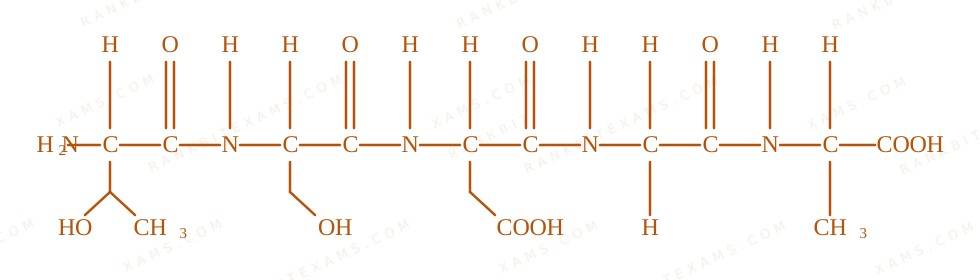
In the given pentapeptide, find out an essential amino acid (Y) and the sequence present in the pentapeptide:
Chemical structure of a pentapeptide
Full structural formula of a polypeptide chain for sequence deduction.
Choose the correct answer from the options given below:

Solution & Explanation

Core Logic

Breaking down the peptide sequence from the N-terminal (left) to C-terminal (right):

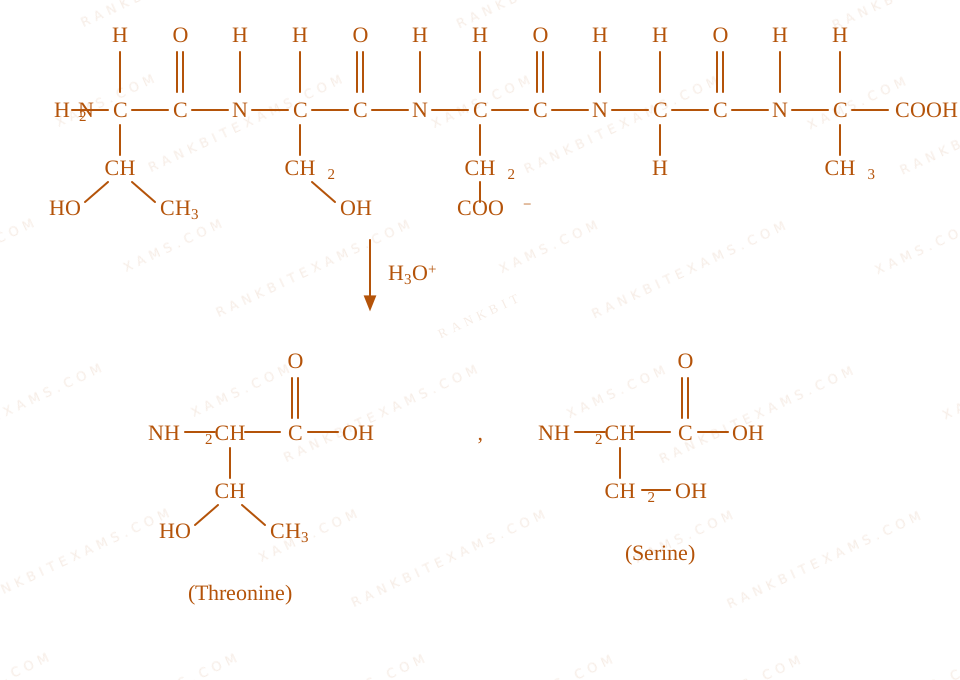
  • First amino acid side chain is -CH(OH)CH₃. This matches Threonine (Thr).
  • Second amino acid side chain is -CH₂OH. This matches Serine (Ser).
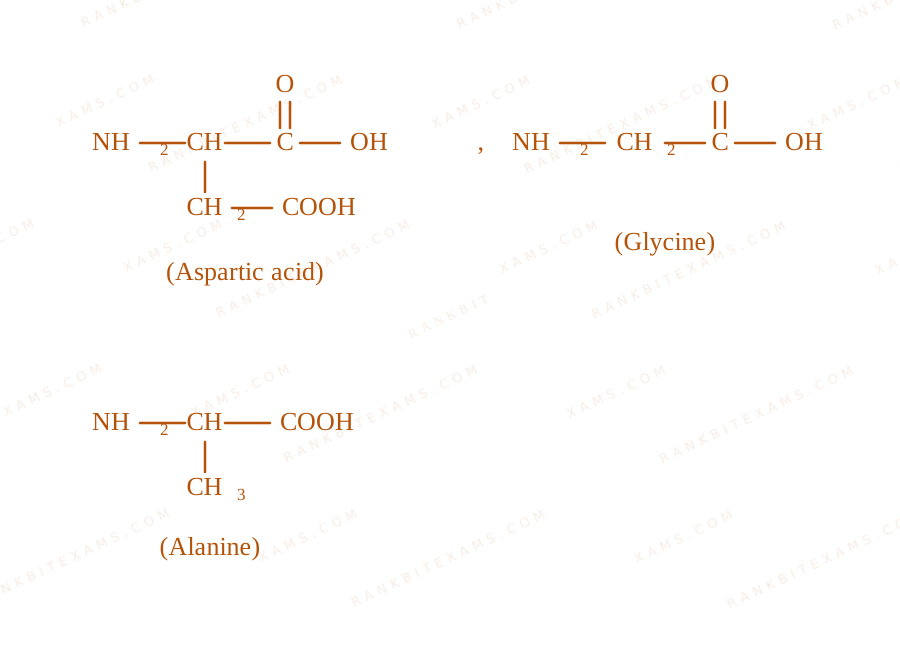
  • Third amino acid side chain is -CH₂COOH. This matches Aspartic Acid (Asp).
  • Fourth amino acid side chain is just -H. This matches Glycine (Gly).
  • Fifth amino acid side chain is -CH₃. This matches Alanine (Ala).
  • Sequence: Thr - Ser - Asp - Gly - Ala.

    Hydrolysis of pentapeptide into constituent amino acids
    Full structural formula of a polypeptide chain for sequence deduction.

Step 1: Identify the Essential Amino Acid

Among the constituents (Thr, Ser, Asp, Gly, Ala), Threonine is an essential amino acid (cannot be synthesized by the human body).

Final Conclusion

Essential Amino acid (Y) = Threonine. Sequence = Thr-Ser-Asp-Gly-Ala.

Pattern Recognition

N-terminal reading is standard left-to-right. Memory aid for essential amino acids: 'PVT TIM HALL' (Threonine is the 'T').

Chapter Mix

Class 12 Chemistry: Biomolecules

Hydrolysis of pentapeptide into constituent amino acids
Full structural formula of a polypeptide chain for sequence deduction.

Reference Study Guides

More Biomolecules Previous-Year Questions — Page 8

Q78 jee_main_2024_31_jan_morning Reactions of Glucose
Match List I with List II
LIST-ILIST-II
A. Glucose/NaHCO₃/ΔI. Gluconic acid
B. Glucose/HNO₃II. No reaction
C. Glucose/HI/ΔIII. n-hexane
D. Glucose/Bromine waterIV. Saccharic acid
Choose the correct answer from the options given below:
  • A. A-IV, B-I, C-III, D-II
  • B. A-II, B-IV, C-III, D-I
  • C. A-III, B-II, C-I, D-IV
  • D. A-I, B-IV, C-III, D-II

Solution

Core Logic

Matching the reactions of glucose: (A) Glucose does not react with NaHCO₃, so there is no reaction. (A arrow II) (B) Oxidation of glucose with strong oxidizing agents like HNO₃ yields a dicarboxylic acid called saccharic acid. (B arrow IV) (C) Prolonged heating of glucose with HI forms n-hexane, indicating a straight chain of six carbon atoms. (C arrow III) (D) Oxidation with mild agents like bromine water converts glucose to gluconic acid. (D arrow I)

Chapter Mix

Class 12 Chemistry: Biomolecules

More Biomolecules Questions — jee_main_2026_28_january_morning

Practice all Biomolecules previous-year questions →

Rankbit System
JEE Physics: Waves (+15.5%) | Electrostatics: Concentric Shells (-29.7%) | Modern Physics: Photoelectric Clones (+34.2%) | Mathematics: Definite Integrals (+18.1%) | Chemistry: Coordination Splitting (-11.4%) | JEE Physics: Waves (+15.5%) | Electrostatics: Concentric Shells (-29.7%) | Modern Physics: Photoelectric Clones (+34.2%) | Mathematics: Definite Integrals (+18.1%) | Chemistry: Coordination Splitting (-11.4%)