JEE Main · Physics → Steady

Waves appeared 22 times across 3 years — 2.5% of Physics. This question is from Beats.

Year 2026 2025 2024 Total
Questions 7 10 5 22

Two tuning forks A and B are sounded together giving rise to 8 beats in 2 s. When fork A is loaded with wax, the beat frequency is reduced to 4 beats in 2 s. If the original frequency of tuning fork B is 380 Hz, then the original frequency of tuning fork A is ____ Hz.

Numerical Answer Type:
Enter a numerical value Answer: 384 to 384 +4 marks

Solution & Explanation

Related Formula
fbeat = |fA - fB|
Core Logic

Initial beat frequency fbeat1 = 8 beats2 s = 4 Hz. Therefore, |fA - fB| = 4. Given fB = 380 Hz, the original frequency of A could be: fA = 380 + 4 = 384 Hz OR fA = 380 - 4 = 376 Hz.

Step 1: Check with Wax Loading

When fork A is loaded with wax, its frequency fA decreases. The new beat frequency fbeat2 = 4 beats2 s = 2 Hz.

Case 1: If fA = 384 Hz, loading wax drops it to say 382 Hz. The new beat frequency becomes |382 - 380| = 2 Hz. This matches the given condition.

Case 2: If fA = 376 Hz, loading wax drops it to say 374 Hz. The new beat frequency would become |374 - 380| = 6 Hz. This does NOT match the condition.

Step 2: Conclusion

The original frequency of tuning fork A must be 384 Hz.

Pattern Recognition

Loading wax always DECREASES the frequency. If decreasing the unknown frequency causes the beat frequency to DECREASE, the unknown frequency must have been initially higher than the known standard.

Chapter Mix

Class 11 Physics: Waves

Reference Study Guides

More Waves Previous-Year Questions — Page 5

Q37 jee_main_2024_31_jan_evening Speed of Sound in Gases
The speed of sound in oxygen at S.T.P. will be approximately: (Given, R = 8.3 J K⁻¹ , γ = 1.4)
  • A. 310 m/s
  • B. 333 m/s
  • C. 341 m/s
  • D. 325 m/s

Solution

Related Formula
v = √((γ RT)/(M))
Core Logic

For Oxygen (O₂) at standard temperature and pressure (S.T.P.): T = 273 K M = 32 g/mol = 32 × 10⁻³ kg/mol γ = 1.4 R = 8.3 J K⁻¹ mol⁻¹

Step 1: Calculate Velocity
v = 1.4 × 8.3 × 27332 × 10⁻³ v = 3172.2632 × 10⁻³ v = √(99.133 × 10³) v = √(99133) ≈ 314.85 m/s

Approximating to the closest given option yields 310 m/s.

Pattern Recognition

For diatomic gases around room temp or STP, velocities range roughly from 250 to 350 m/s depending on molar mass (N₂ ≈ 334, O₂ ≈ 315). Recognize 315 is closest to option (1) due to standard approximations taken in exams.

Chapter Mix

Class 11 Physics: Waves Class 11 Physics: Kinetic Theory of Gases
Q jee_main_2024_31_jan_morning Organ Pipes
The fundamental frequency of a closed organ pipe is equal to the first overtone frequency of an open organ pipe. If length of the open pipe is 60~cm, the length of the closed pipe will be:
  • A. 60~cm
  • B. 45~cm
  • C. 30~cm
  • D. 15~cm

Solution

Related Formula
fclosed, fundamental = (v)/(4Lc) fopen, 1st overtone = (2v)/(2Lₒ)
Core Logic

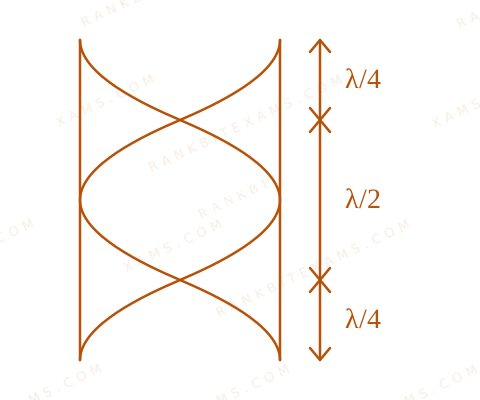
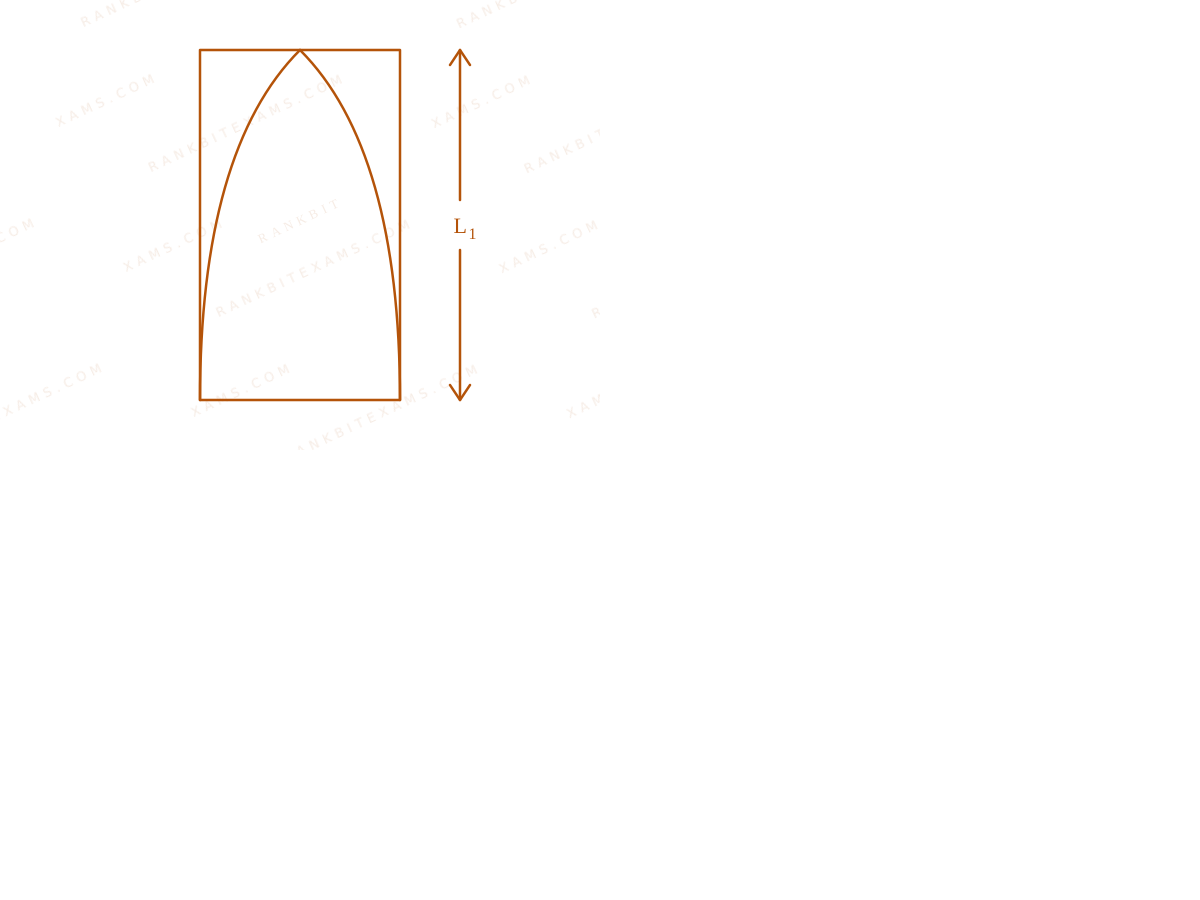
Organ Pipes diagram for Q45 - JEE Main 2024 Morning

Organ Pipes diagram for Q45 - JEE Main 2024 Morning

For a closed organ pipe, the fundamental frequency (1st harmonic) is:

f₁ = (v)/(λ) = (v)/(4L₁)

where L₁ is the length of the closed pipe.

For an open organ pipe, the first overtone (2nd harmonic) is:

f₂ = (2v)/(2L₂) = (v)/(L₂)

where L₂ is the length of the open pipe (L₂ = 60 cm).

Step 2: Equating Frequencies

Given f₁ = f₂:

(v)/(4L₁) = (v)/(L₂)

L₂ = 4L₁

60 = 4 × L₁ L₁ = 15 cm
Chapter Mix

Class 11 Physics: Waves

More Waves Questions — jee_main_2026_28_january_evening

Practice all Waves previous-year questions →

Rankbit System
JEE Physics: Waves (+15.5%) | Electrostatics: Concentric Shells (-29.7%) | Modern Physics: Photoelectric Clones (+34.2%) | Mathematics: Definite Integrals (+18.1%) | Chemistry: Coordination Splitting (-11.4%) | JEE Physics: Waves (+15.5%) | Electrostatics: Concentric Shells (-29.7%) | Modern Physics: Photoelectric Clones (+34.2%) | Mathematics: Definite Integrals (+18.1%) | Chemistry: Coordination Splitting (-11.4%)