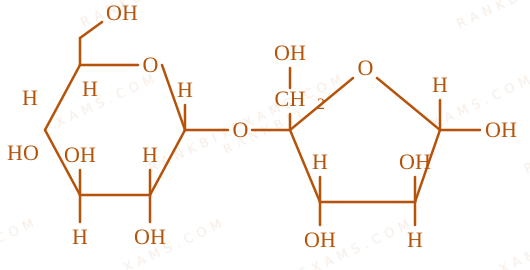
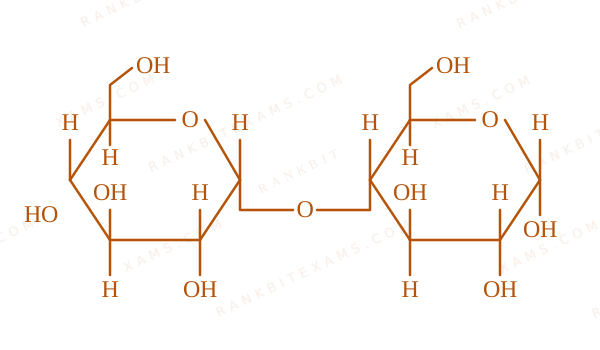
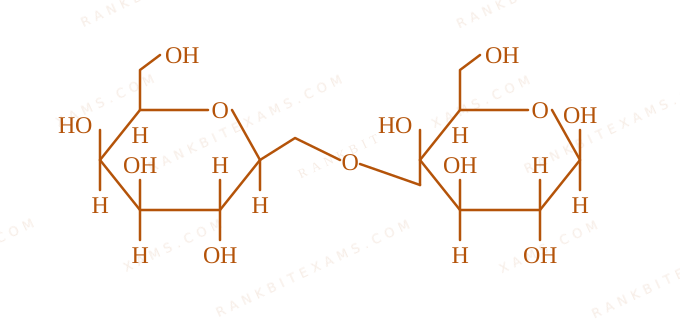
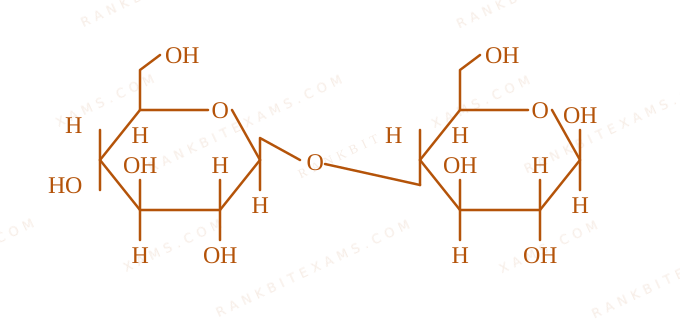

Structures of four disaccharides are given below. Among the given disaccharides, the non-reducing sugar is :
A.(1)$(1)$
Reducing And Non Reducing Sugars
B.(2)$(2)$
Reducing And Non Reducing Sugars
C.(3)$(3)$
Reducing And Non Reducing Sugars
D.(4)$(4)$
Reducing And Non Reducing Sugars
Solution & Explanation
Core Logic
For a sugar to be non-reducing, it must NOT possess a free hemiacetal or hemiketal group. The linkage connecting the monosaccharide units must consume both anomeric carbons via an acetal/ketal linkage.
Structure (1) represents Sucrose, which has an α, β -1,2$\alpha, \beta -1,2$-glycosidic bond. Both anomeric carbons are locked in the glycosidic linkage Reducing And Non Reducing Sugars and Reducing And Non Reducing Sugars.
Structures (2), (3), and (4) are maltose or lactose-type structures containing a free anomeric -OH, thus acting as reducing sugars.
Step 1: Final Conclusion
Structure (1) is sucrose, which lacks a hemiacetal linkage, making it a non-reducing sugar.
Pattern Recognition
Whenever asked for a non-reducing sugar among standard disaccharides, look for Sucrose (linked at C1 of glucose and C2 of fructose). Both anomeric carbons are tied up.
Keywords:#non-reducing sugar#JEE Main 2026 Evening Q61#Biomolecules JEE Main 2026#Reducing And Non Reducing Sugars JEE Main 2026
More Biomolecules Previous-Year Questions — Page 7
Qjee_main_2024_27_jan_morningNucleic Acids
Two nucleotides are joined together by a linkage known as:
A. Phosphodiester linkage
B. Glycosidic linkage
C. Disulphide linkage
D. Peptide linkage
Solution
Related Formula
Nucleotides bond phosphodiester linkage:
Nucleotide₁ - O - P(=O)(O^-) - O - Nucleotide₂$$\text{Nucleotide}_1 - \text{O} - \text{P}(=\text{O})(\text{O}^-) - \text{O} - \text{Nucleotide}_2$$
Core Logic
Two nucleotides are joined together by phosphodiester linkage between 5'$5'$ and 3'$3'$ carbon atoms of the pentose sugar. Phosphodiester linkage diagram for Q61 - JEE Main 2024 Morning
Proteins are natural biopolymers. The fundamental building blocks (monomers) of all naturally occurring proteins are α$\alpha$-amino acids. In these molecules, both the amino group (-NH₂$-NH_2$) and the carboxyl group (-COOH$-COOH$) are attached to the exact same carbon atom, designated as the α$\alpha$-carbon.
Because they are polymers of α$\alpha$-amino acids linked by peptide bonds, the hydrolysis of proteins (acidic, basic, or enzymatic) will cleave these peptide bonds to yield the constituent α$\alpha$-amino acids.
Chapter Mix
Class 12 Chemistry: Biomolecules
Q84jee_main_2024_30_january_eveningNucleic Acids (DNA and RNA)
The total number of correct statements, regarding the nucleic acids is
A. RNA is regarded as the reserve of genetic information.
B. DNA molecule self-duplicates during cell division
C. DNA synthesizes proteins in the cell.
D. The message for the synthesis of particular proteins is present in DNA
E. Identical DNA strands are transferred to daughter cells.
Numerical Answer.Answer: 3 to 3
Solution
Core Logic
A. RNA is regarded as the reserve of genetic information. (False - DNA is the reserve of genetic information).
B. DNA molecule self-duplicates during cell division. (True - through replication).
C. DNA synthesizes proteins in the cell. (False - RNA molecules synthesize proteins via translation, DNA only provides the code).
D. The message for the synthesis of particular proteins is present in DNA. (True - the genetic code lies in the base sequence of DNA).
E. Identical DNA strands are transferred to daughter cells. (True - through accurate replication and cell division, genetic continuity is maintained).
Step 1: Final Conclusion
The true statements are B, D, and E.
Total number of correct statements is 3.
Fehling's reagent is reduced by reducing sugars to give a reddish-brown precipitate of Cu₂O$Cu_2O$.
Reducing sugars must have a free aldehyde/ketone group or a hemiacetal linkage that can open to form an aldehyde.
Sucrose is a non-reducing sugar because its anomeric carbons (C1 of glucose and C2 of fructose) are tied up in a glycosidic linkage, leaving no free hemiacetal group.
Step 1: Analyzing the options
Lactose, glucose, and maltose are all reducing sugars and will give a positive Fehling's test. Sucrose does not.
Q89jee_main_2024_31_jan_eveningVitamins and their Classification
From the vitamins A, B₁$B_1$, B₆$B_6$, B₁₂$B_{12}$, C, D, E and K, the number vitamins that can be stored in our body is ________
Numerical Answer.Answer: 5 to 5
Solution
Core Logic
Vitamins are broadly classified into two groups based on solubility:
Fat-soluble vitamins: Vitamins A, D, E, and K. These are stored in the liver and adipose (fat-storing) tissues.
Water-soluble vitamins: B group vitamins and Vitamin C. These are readily excreted in urine and cannot be stored in the body (with the exception of Vitamin B₁₂$B_{12}$, which can be stored in the liver).
Step 1: Final List
The vitamins that can be stored in the body from the given list are A, D, E, K, and B₁₂$B_{12}$.
Total number = 5$5$.
Chapter Mix
Class 12 Chemistry: Biomolecules
More Biomolecules Questions — jee_main_2026_28_january_evening
Practice past-year questions one chapter at a time. Pick an exam → subject → chapter and get every PYQ for that topic — pulled together from all past papers — with the chapter's key formulas alongside.