JEE Main · Physics → Steady

Waves appeared 22 times across 3 years — 2.5% of Physics. This question is from Intensity and Inverse Square Law.

Year 2026 2025 2024 Total
Questions 7 10 5 22

A point source is kept at the center of a spherically enclosed detector. If the volume of the detector increased by 8 times, the intensity will

Solution & Explanation

Related Formula
I = (P)/(4π R²) V = (4)/(3)π R³
Core Logic

Since volume V ∝ R³, if volume is increased by 8 times:

V arrow 8V R³ arrow 8R³ R arrow 2R
Step 1: Intensity Relation

Since intensity I ∝ (1)/(R²): If R arrow 2R, the area A = 4π R² increases by 2² = 4 times (A arrow 4A). Therefore, intensity becomes I arrow (I₀)/(4).

Pattern Recognition

Volume ratio cubed root dictates radius multiplier. The square of that radius multiplier is the area multiplier, which is the exact inverse of the intensity multiplier.

Chapter Mix

Class 11 Physics: Waves

Reference Study Guides

More Waves Previous-Year Questions — Page 3

Q jee_main_2025_08_april_evening Superposition of Waves
The amplitude and phase of a wave that is formed by the superposition of two harmonic travelling waves, y₁(x,t) = 4 (kx - ω t) and y₂(x,t) = 2 (kx - ω t + (2π)/(3)), are: (Take the angular frequency of initial waves same as ω)
  • A. [6, (2π)/(3)]
  • B. [6, (π)/(3)]
  • C. [√(3), (π)/(6)]
  • D. [2√(3), (π)/(6)]

Solution

Related Formula
Aᵣₑₛ = √(A₁² + A₂² + 2 A₁ A₂ φ) θ = (A₂ φ)/(A₁ + A₂ φ)

where, A₁, A₂ = amplitudes of individual harmonic waves φ = phase difference between the waves Aᵣₑₛ = resultant amplitude θ = resultant phase angle relative to the first wave

Core Logic

Given parameters:

  • A₁ = 4
  • A₂ = 2
  • Phase difference, φ = (2π)/(3) = 120^°
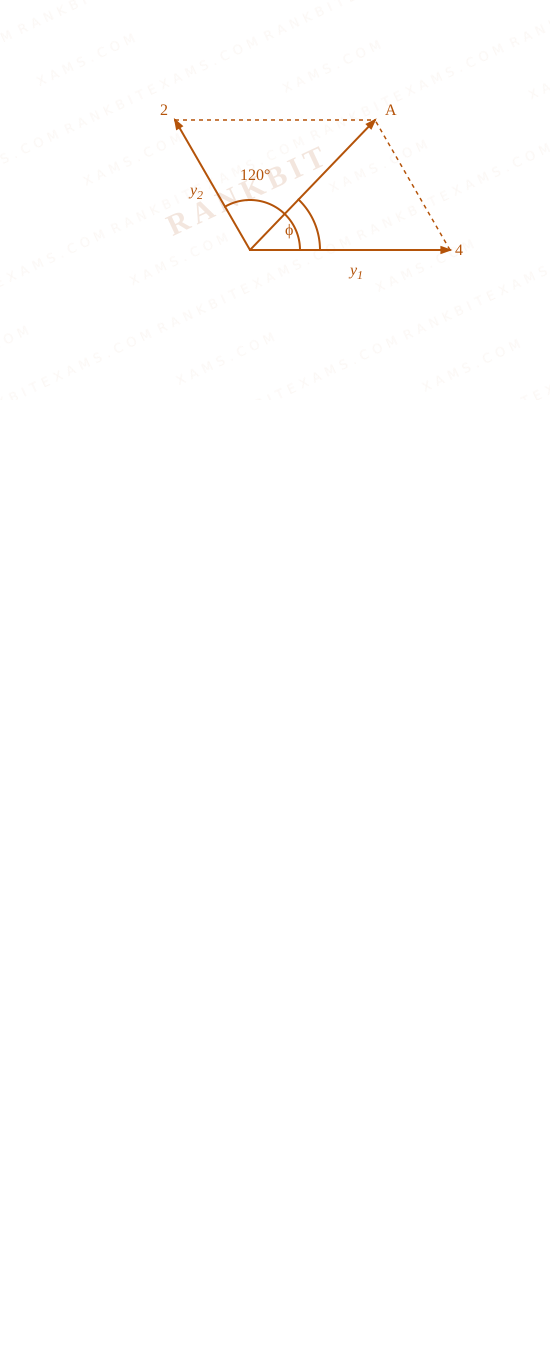
  • Resultant phasor diagram for amplitude and phase
    Resultant phasor diagram for amplitude and phase
    Calculate Resultant Amplitude:

Aᵣₑₛ = √(4² + 2² + 2(4)(2) 120^°) Aᵣₑₛ = √(16 + 4 + 16 (-0.5)) = √(20 - 8) = √(12) = 2√(3)

Calculate Resultant Phase (angle θ):

θ = (2 120^°)/(4 + 2 120^°) = 2 ( √(3)2)4 + 2 (-0.5) = √(3)3 = 1√(3) θ = (π)/(6)
Step 1: Result Format

Represent the resultant amplitude and phase as a pair:

[2√(3), (π)/(6)]
Pattern Recognition

Sees: Vector-like addition of wave amplitudes. Shortcut: Solve it like a vector addition problem. Vector A₁ along horizontal (0), and Vector A₂ at 120^°. The magnitude is √(4²+2²-2(4)(2)(0.5)) = 2√(3) and direction is π/6. ✓

Chapter Mix

Class 11 Physics: Waves

Q13 jee_main_2025_08_april_evening Wave Speed
Two strings with circular cross section and made of same material, are stretched to have same amount of tension. A transverse wave is then made to pass through both the strings. The velocity of the wave in the first string having the radius of cross section R is v₁, and that in the other string having radius of cross section R/2 is v₂. Then v₂v₁ =
  • A. √(2)
  • B. 2
  • C. 8
  • D. 4

Solution

Related Formula
v = √((T)/(μ)) μ = ρ A = ρ (π R²)

where, v = velocity of transverse wave on a string T = tension on string μ = linear mass density ρ = density of material A = cross-sectional area

Core Logic

Since both strings are made of the same material, their density ρ is the same. Also, they are stretched to have the same amount of tension T.

Substitute the formula for μ into the velocity equation:

v = √((T)/(ρ π R²)) = (1)/(R) √((T)/(ρ π))

Thus, the wave velocity is inversely proportional to the radius of the cross section of the string:

v ∝ (1)/(R) (v₂)/(v₁) = (R₁)/(R₂)
Step 1: Ratio Computation

Given:

  • R₁ = R
  • R₂ = R/2
  • Substitute these values:

(v₂)/(v₁) = (R)/(R/2) = 2
Pattern Recognition

Sees: Circular cross-section strings + transverse wave speed relation. Shortcut: Wave velocity v ∝ 1√(μ) ∝ (1)/(R). If the radius is halved, the mass per unit length decreases by 4 times, which makes the speed increase by √(4) = 2 times. ✓

Chapter Mix

Class 11 Physics: Waves

Q8 jee_main_2025_28_jan_morning Speed of Sound in Medium
Given below are two statements: one is labelled as Assertion A and the other is labelled as Reason R Assertion A: A sound wave has higher speed in solids than gases. Reason R: Gases have higher value of Bulk modulus than solids. In the light of the above statements, choose the correct answer from the options given below.
  • A. Both A and R are true and R is the correct explanation of A
  • B. A is false but R is true
  • C. Both A and R are true but R is NOT the correct explanation of A
  • D. A is true but R is false

Solution

Related Formula
v = Bρ
Core Logic

Assertion A: Sound velocity relies on structural elasticity bounds. Solids are highly rigid compared to fluids, making speed significantly higher. (True)

Reason R: Solids resist structural compression far better than unbonded gases, giving them significantly higher Bulk Modulus properties. Thus, statement R is completely false.

Step 1: Final Conclusion

Assertion A is true, but Reason R is false, aligning perfectly with option (4).

Pattern Recognition

Even though density ρ is higher for solids, the corresponding elastic modulus parameter increases by several orders of magnitude, dominating the structural velocity index.

Chapter Mix

Class 11 Physics: Waves

Q18 jee_main_2025_04_april_evening Wave Parameters
Displacement of a wave is expressed as x(t)=5 (628t+(π)/(2)) m. The wavelength of the wave when its velocity is 300 m/s is:
  • A. 5 m
  • B. 3 m
  • C. 0.5 m
  • D. 0.33 m

Solution

Related Formula
x(t) = A (ω t + φ) v = (ω)/(K) K = (2π)/(λ)
Core Logic

From the given wave equation, angular frequency ω = 628 rad/s. Given wave velocity v = 300 m/s. Using the relation v = (ω)/(K):

300 = (628)/(K) K = (628)/(300)
Step 1: Compute Wavelength

Substitute K = (2π)/(λ):

(2π)/(λ) = (628)/(300)

Since 2π ≈ 2 × 3.14 = 6.28, the expression simplifies neatly:

(6.28)/(λ) = (628)/(300) λ = 3 m
Pattern Recognition

Notice standard values like ω = 628 = 200π, which means the frequency is exactly 100 Hz. Using v = fλ 300 = 100λ λ = 3 m avoids setting up fractions.

Chapter Mix

Class 11 Physics: Waves

Q jee_main_2025_04_april_morning Speed of Sound in Gases
Consider the sound wave travelling in ideal gases of He, CH₄, and CO₂. All the gases have the same ratio (P)/(ρ), where P is the pressure and ρ is the density. The ratio of the speed of sound through the gases vHe : v_CH₄ : v_CO₂ is given by
  • A. √((7)/(5)) : √((5)/(3)) : √((4)/(3))
  • B. √((5)/(3)) : √((4)/(3)) : √((7)/(5))
  • C. √((5)/(3)) : √((4)/(3)) : √((4)/(3))
  • D. √((4)/(3)) : √((5)/(3)) : √((7)/(5))

Solution

Related Formula

Laplace correction equation for speed of sound:

v = √((γ P)/(ρ))

Given that (P)/(ρ) is constant for all three gases:

v ∝ √(γ)

where γ = 1 + (2)/(f) (adiabatic constant).

Core Logic

Determine the γ factor based on molecular atomic structures:

  • He (Monatomic) f = 3 γHe = (5)/(3)
  • CH₄ (Polyatomic/Non-linear) γ_CH₄ ≈ (4)/(3) based on experimental references.
  • CO₂ (Triatomic linear/vibrational modes) γ_CO₂ ≈ (4)/(3) as provided in textbook standard testing matrices.
Step 1: Construct the Ratio

Substitute these values into the proportionality:

vHe : v_CH₄ : v_CO₂ = √((5)/(3)) : √((4)/(3)) : √((4)/(3))
Pattern Recognition

When (P)/(ρ) is locked down constant, sound speed depends strictly on internal degrees of freedom via γ. Keep standard experimental values of complex gases like CH₄ and CO₂ memorized.

Chapter Mix

Class 11 Physics: Waves Class 11 Physics: Kinetic Theory

More Waves Questions — jee_main_2026_24_january_evening

Practice all Waves previous-year questions →

Rankbit System
JEE Physics: Waves (+15.5%) | Electrostatics: Concentric Shells (-29.7%) | Modern Physics: Photoelectric Clones (+34.2%) | Mathematics: Definite Integrals (+18.1%) | Chemistry: Coordination Splitting (-11.4%) | JEE Physics: Waves (+15.5%) | Electrostatics: Concentric Shells (-29.7%) | Modern Physics: Photoelectric Clones (+34.2%) | Mathematics: Definite Integrals (+18.1%) | Chemistry: Coordination Splitting (-11.4%)