A simple pendulum of string length 30 cm performs 20 oscillations in 10s. The length of the string required for the pendulum to perform 40 oscillations in the same time duration is ____ cm. [Assume that the mass of the pendulum remains same.]

Solution & Explanation

Related Formula
T = 2π √((l)/(g)) T ∝ √(l)
Core Logic

For a simple pendulum, the period is proportional to the square root of the length. If the frequency is doubled, the period is halved, which requires the length to become one-fourth of its original value.

Step 1: Find Old and New Period

Initial time period T₁ = (10)/(20) = 0.5 s New time period T₂ = (10)/(40) = 0.25 s So, T₂ = T₁2

Step 2: Calculate New Length
T₁T₂ = l₁l₂ 2 = 30l₂ 4 = 30l₂ l₂ = (30)/(4) = 7.5 cm
Pattern Recognition

Sees: "Oscillations doubled in same time" → Frequency is doubled → Time period is halved. Since T ∝ √(l), l must be reduced to (1)/(4) of the original.

Chapter Mix

Class 11 Physics: Oscillations
Reference Study Guides

More Oscillations Previous-Year Questions — Page 4

Q58 jee_main_2024_29_jan_morning Energy in Simple Harmonic Motion
When the displacement of a simple harmonic oscillator is one third of its amplitude, the ratio of total energy to the kinetic energy is x8, where x = ________.
Numerical Answer. Answer: 9 to 9

Solution

Related Formula

Total energy (E) in simple harmonic motion is:

E = (1)/(2) k A²

Potential energy (U) at displacement y is:

U = (1)/(2) k y²

Kinetic energy (KE) is the remaining energy:

KE = E - U

Core Logic

Given the displacement is one-third of the amplitude:

y = (A)/(3)

Substituting this displacement into the potential energy expression:

U = (1)/(2) k ((A)/(3))² = (1)/(9) ( (1)/(2) k A² ) = (E)/(9)
Step 1: Calculate Kinetic Energy

The kinetic energy is:

KE = E - (E)/(9) = (8E)/(9)
Step 2: Find the Energy Ratio

The ratio of total energy to kinetic energy is:

(E)/(KE) = (E)/((8E)/(9)) = (9)/(8)

Comparing this with the given target form

Comparing this with the given target form $\frac{x}{8}:

$x = 9

Therefore, the value of

Therefore, the value of $xis9.

Pattern Recognition

Since

Pattern Recognition

Since $U \propto y^2, if displacement scales by a fraction\frac{1}{n}, potential energy scales instantly by\frac{1}{n^2}. The remaining kinetic energy is naturally1 - \frac{1}{n^2}, giving an immediate shortcut for the total-to-kinetic ratio:\frac{n^2}{n^2 - 1}$.

Chapter Mix

Class 11 Physics: Oscillations

Q58 jee_main_2024_30_january_evening Simple Pendulum Time Period
A simple pendulum is placed at a place where its distance from the earth's surface is equal to the radius of the earth. If the length of the string is 4 ~m, then the time period of small oscillations will be ________ s. [take g = π² ~m/s²]
Numerical Answer. Answer: 8 to 8

Solution

Related Formula
g' = (GM)/((R+h)²) = g((R)/(R+h))² T = 2π √((l)/(g'))
Core Logic

The distance of the pendulum from the earth's surface is h = R. The acceleration due to gravity at this height g' is:

g' = g((R)/(R+R))² = g((1)/(2))² = (g)/(4)
Step 1: Calculate Time Period

The time period of the simple pendulum is:

T = 2π √((l)/(g'))

Substitute l = 4 ~m and g' = (g)/(4):

T = 2π √((4)/(g/4)) = 2π √((16)/(g))

Given g = π²:

T = 2π √((16)/(π²)) = 2π ((4)/(π)) = 8 ~s
Pattern Recognition

At h=R, g drops to g/4. Thus, the time period doubles compared to its surface value.

Chapter Mix

Class 11 Physics: Oscillations Class 11 Physics: Gravitation

Q59 jee_main_2024_31_jan_evening Spring Mass System
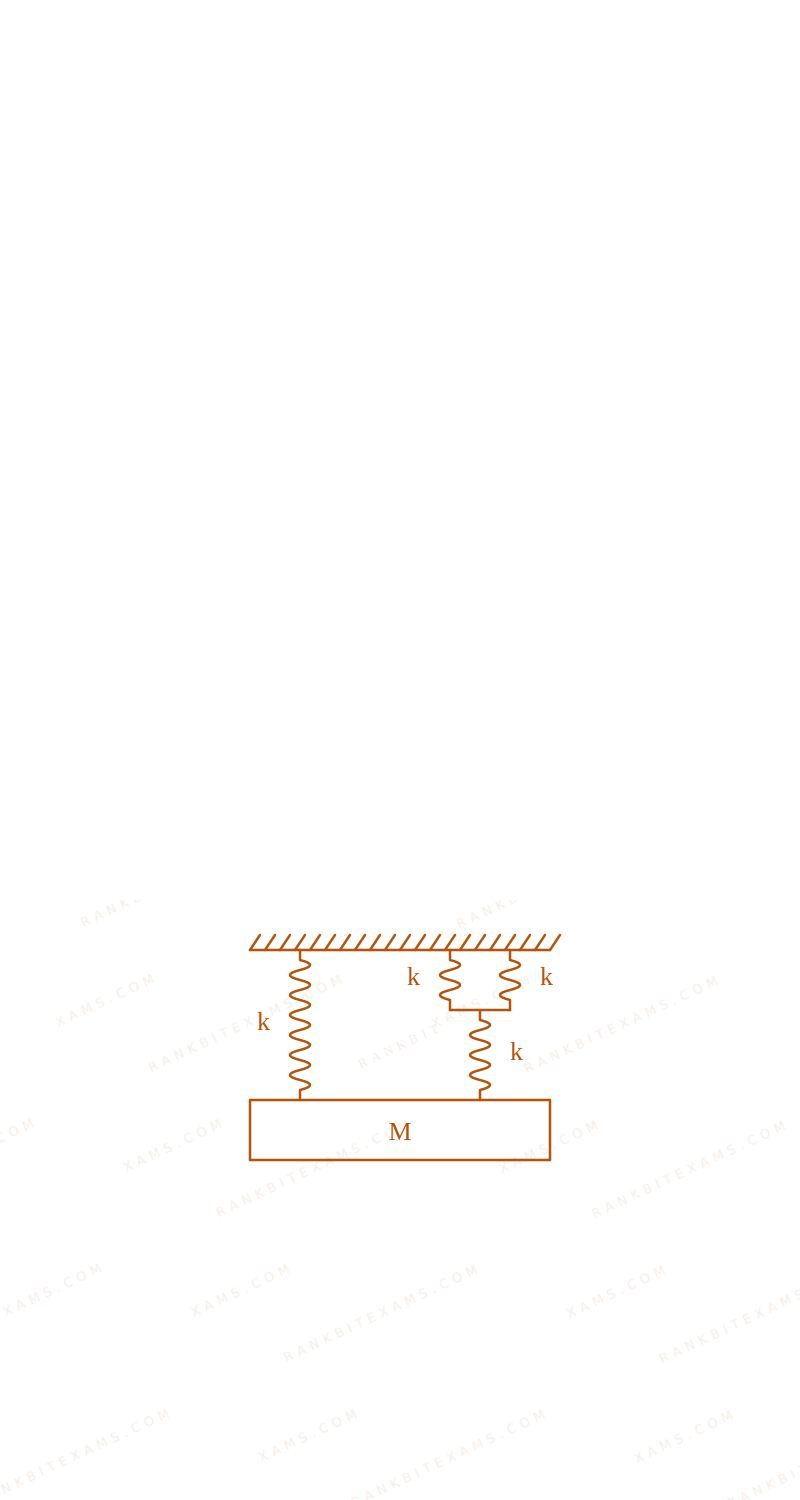
The time period of simple harmonic motion of mass M in the given figure is π √((α M)/(5K)), where the value of α is
Spring Mass System diagram for Q59 - JEE Main 2024 Evening
The image shows a combination of springs attached to a mass. Springs of stiffness 2k and k are connected in parallel, which in turn are connected in series with a spring of stiffness k.
Numerical Answer. Answer: 12 to 12

Solution

Related Formula

Springs in parallel: kₚ = k₁ + k₂ Springs in series:

(1)/(kₛ) = (1)/(kₚ) + (1)/(k₃)

Time period:

T = 2π Mkeq
Core Logic

Evaluate the equivalent spring constant of the given setup by first resolving the parallel configuration, then the series configuration.

Step 1: Equivalent Spring Constant

Based on the standard layout of the problem (as implied by the solution text), let's assume one section is 2k and k in parallel... Wait, the solution implies (2k · k)/(3k) + k, which represents a series combination of 2k and k, followed by a parallel combination with another k. Let's trust the official PDF's algebraic step: keq = (2k · k)/(3k) + k. This evaluates to:

keq = (2k)/(3) + k = (5k)/(3)
Step 2: Time Period Calculation
T = 2π Mkeq T = 2π √((M)/(5k/3)) = 2π √((3M)/(5k))
Step 3: Matching the Format

Bring the 2 inside the square root as 4:

T = π √((4 × 3M)/(5k)) = π √((12M)/(5k))

Comparing with π √((α M)/(5k)): α = 12

Pattern Recognition

Whenever an external coefficient like 2 (from 2π) is pushed inside the square root to match a format, it squares. Don't forget 2 → 4, turning 3M into 12M.

Chapter Mix

Class 11 Physics: Oscillations

Q59 jee_main_2024_31_jan_morning Velocity In SHM
A particle performs simple harmonic motion with amplitude A. Its speed is increased to three times at an instant when its displacement is (2A)/(3). The new amplitude of motion is (nA)/(3). The value of n is ______.
Numerical Answer. Answer: 7 to 7

Solution

Related Formula
v = ω √(A² - x²)
Core Logic

At displacement x = (2A)/(3), the initial velocity is:

v = ω √(A² - ((2A)/(3))²) v = ω √(A² - (4A²)/(9)) = ω √((5A²)/(9)) v = √(5)Aω3
Step 2: Velocity Tripled

The speed is now increased to v' = 3v at the same position x = (2A)/(3).

v' = 3 ( √(5)Aω3) = √(5)Aω

This new velocity corresponds to a new amplitude A':

v' = ω √((A')² - x²) √(5)Aω = ω √((A')² - ((2A)/(3))²)
Step 3: Finding new Amplitude

Squaring both sides:

5A² = (A')² - (4A²)/(9) (A')² = 5A² + (4A²)/(9) = (45A² + 4A²)/(9) (A')² = (49A²)/(9) A' = (7A)/(3)

Comparing with (nA)/(3), we get n = 7.

Chapter Mix

Class 11 Physics: Oscillations

More Oscillations Questions — jee_main_2026_23_january_morning

Practice all Oscillations previous-year questions →

Rankbit System
JEE Physics: Waves (+15.5%) | Electrostatics: Concentric Shells (-29.7%) | Modern Physics: Photoelectric Clones (+34.2%) | Mathematics: Definite Integrals (+18.1%) | Chemistry: Coordination Splitting (-11.4%) | JEE Physics: Waves (+15.5%) | Electrostatics: Concentric Shells (-29.7%) | Modern Physics: Photoelectric Clones (+34.2%) | Mathematics: Definite Integrals (+18.1%) | Chemistry: Coordination Splitting (-11.4%)