A simple pendulum of string length 30 cm performs 20 oscillations in 10s. The length of the string required for the pendulum to perform 40 oscillations in the same time duration is ____ cm. [Assume that the mass of the pendulum remains same.]

Solution & Explanation

Related Formula
T = 2π √((l)/(g)) T ∝ √(l)
Core Logic

For a simple pendulum, the period is proportional to the square root of the length. If the frequency is doubled, the period is halved, which requires the length to become one-fourth of its original value.

Step 1: Find Old and New Period

Initial time period T₁ = (10)/(20) = 0.5 s New time period T₂ = (10)/(40) = 0.25 s So, T₂ = T₁2

Step 2: Calculate New Length
T₁T₂ = l₁l₂ 2 = 30l₂ 4 = 30l₂ l₂ = (30)/(4) = 7.5 cm
Pattern Recognition

Sees: "Oscillations doubled in same time" → Frequency is doubled → Time period is halved. Since T ∝ √(l), l must be reduced to (1)/(4) of the original.

Chapter Mix

Class 11 Physics: Oscillations

Reference Study Guides

More Oscillations Previous-Year Questions — Page 3

Q13 jee_main_2025_24_jan_morning Simple Harmonic Motion
A particle is executing simple harmonic motion with time period 2s and amplitude 1 cm. If D and d are the total distance and displacement covered by the particle in 12.5 s, then (D)/(d) is:-
  • A. (15)/(4)
  • B. 25
  • C. 10
  • D. (16)/(5)

Solution

Related Formula

In Simple Harmonic Motion:

  • In one full oscillation period T, total distance = 4A, and net displacement = 0.
  • In a quarter period (T)/(4) starting from equilibrium, distance = A, and displacement = A.
Core Logic

Find the total number of cycles completed in the given time :

Cycles = (t)/(T) = 12.5 s2 s = 6.25 cycles = 6 full cycles + 0.25 cycle
Step 1: Evaluation of Distance and Displacement

Calculate the total distance D covered :

D = 6 × (4A) + 1A = 24A + A = 25A

Given amplitude A = 1 cm , we get D = 25 cm .

Calculate the net displacement d: The first 6 complete cycles return the particle to equilibrium with zero displacement. The remaining 0.25 cycle (which is a quarter period (T)/(4)) moves it from the center to its maximum amplitude value :

d = 1A = 1 cm

Taking their ratio:

(D)/(d) = (25)/(1) = 25
Pattern Recognition

Fractional cycles modulate ratios abruptly. Always break the path index down into integer full cycles plus the final residual interval.

Chapter Mix

Class 11 Physics: Oscillations
Q12 jee_main_2025_28_jan_evening Simple Harmonic Motion
Given below are two statements. One is labelled as Assertion (A) and the other is labelled as Reason (R). Assertion (A): Knowing initial position x₀ and initial momentum p₀ is enough to determine the position and momentum at any time t for a simple harmonic motion with a given angular frequency ω . Reason (R) : The amplitude and phase can be expressed in terms of x₀ and p₀ . In the light of the above statements, choose the correct answer from the options given below:
  • A. Both (A) and (R) are true but (R) is NOT the correct explanation of (A).
  • B. (A) is false but (R) is true.
  • C. (A) is true but (R) is false.
  • D. Both (A) and (R) are true and (R) is the correct explanation of (A).

Solution

Related Formula

The general solution tracking position in SHM is given by :

x(t) = A (ω t + φ)

Momentum formula:

p(t) = m v(t) = m A ω (ω t + φ)
Core Logic

At t = 0 :

  • x₀ = A φ
  • p₀ = m A ω φ
  • Dividing equation (1) by (2) reveals the phase \angle relationship :

φ = ((x₀)/(p₀)) m ω φ = ⁻¹((m ω x₀)/(p₀))

Squaring and combining both equations isolates amplitude A:

A = √((m ω x₀)² + p₀²)m ω

Since both amplitude A and phase constant φ are explicitly fixed by the initial conditions x₀ and p₀, the kinematic layout of the state space is completely specified for any future time parameter t. This validates that Reason (R) perfectly explains Assertion (A).

Pattern Recognition

SHM is a second-order differential equation. Any system of second-order equations requires exactly two independent boundary conditions (e.g., initial position and velocity/momentum) to completely specify unique path tracks.

Chapter Mix

Class 11 Physics: Oscillations

Q jee_main_2025_29_jan_morning Simple Pendulum
Given below are two statements : one is labelled as Assertion (A) and the other is labelled as Reason (R). Assertion (A) : Time period of a simple pendulum is longer at the top of a mountain than that at the base of the mountain. Reason (R) : Time period of a simple pendulum decreases with increasing value of acceleration due to gravity and vice-versa. In the light of the above statements, choose the most appropriate answer from the options given below:
  • A. Both (A) and (R) are true but (R) is not the correct explanation of (A).
  • B. Both (A) and (R) are true and (R) is the correct explanation of (A).
  • C. (A) is true but (R) is false.
  • D. (A) is false but (R) is true.

Solution

Related Formula
T = 2π√((l)/(g))
Core Logic

As altitude h increases at the top of a mountain, acceleration due to gravity g drops down according to :

g = (g₀ R²)/((R+h)²)

Since T ∝ 1√(g), a decreased g directly makes the time period T longer

Pattern Recognition

Higher altitude smaller gravity field slower pendulum oscillations longer period

Chapter Mix

Class 11 Physics: Oscillations Class 11 Physics: Gravitation

Q jee_main_2024_29_january_evening Simple Harmonic Motion
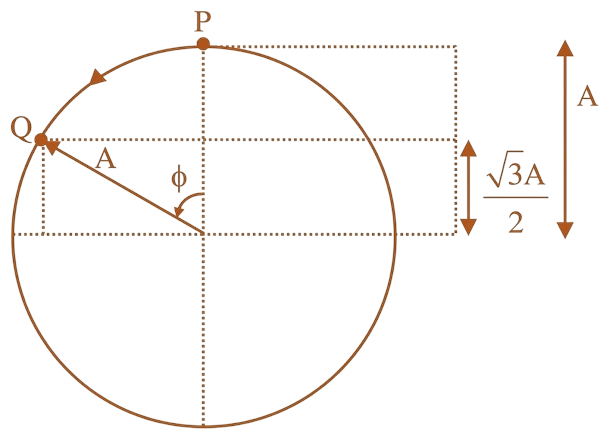
A simple harmonic oscillator has an amplitude A and time period 6π second. Assuming the oscillation starts from its mean position, the time required by it to travel from x = A to x = √(3)2A will be (π)/(x) s, where x = ________.
Numerical Answer. Answer: 2 to 2

Solution

Related Formula

For a simple harmonic oscillator starting from the mean position at t = 0:

x(t) = A (ω t)

where ω = (2π)/(T) is the angular frequency.

Core Logic

Given:

  • Time period, T = 6π s ω = (2π)/(6π) = (1)/(3) rad/s
  • We need to find the time taken to travel from x = A to x = √(3)2A. Let's calculate the times from the mean position (x=0) to both positions:

  • Time t₁ to reach x = A:
A = A (ω t₁) (ω t₁) = 1 ω t₁ = (π)/(2)
  • Time t₂ to reach x = √(3)2A:
√(3)2A = A (ω t₂) (ω t₂) = √(3)2 ω t₂ = (π)/(3)
Step 1: Calculate the Time Difference

The time required to travel between these two points is:

Δ t = t₁ - t₂ = (π/2)/(ω) - (π/3)/(ω) = (π)/(6ω)

Substitute ω = (1)/(3):

Δ t = (π)/(6 × (1/3)) = (π)/(2) seconds

Comparing this to (π)/(x) s, we find:

x = 2

Phasor diagram for SHM positions for Q55

Pattern Recognition

Alternatively, using a phasor diagram, the angle swept in moving from A to √(3)2A is φ = (π)/(6). Therefore, Δ t = (φ)/(ω) = (π/6)/(1/3) = (π)/(2) s.

Chapter Mix

Class 11 Physics: Oscillations

Q57 jee_main_2024_27_jan_morning Velocity in Simple Harmonic Motion
A particle executes simple harmonic motion with an amplitude of 4 cm. At the mean position, the velocity of the particle is 10 cm/s. The distance of the particle from the mean position when its speed becomes 5 cm/s is √(α) cm, where α = ______.
Numerical Answer. Answer: 12 to 12

Solution

Related Formula
vmax = Aω v = ω √(A² - x²)
Core Logic

From the mean position maximum criteria (vmax = 10 cm/s, A = 4 cm):

10 = 4ω ω = (10)/(4) = (5)/(2) rad/s
Step 1: Substitute parameters into speed equation

Set the target speed v = 5 cm/s:

5 = (5)/(2) √(4² - x²) 2 = √(16 - x²)

Squaring both sides:

4 = 16 - x² x² = 12 x = √(12) cm
Step 2: Compare to target format

Comparing √(12) to √(α) directly shows:

α = 12

Pattern Recognition

Halving the peak harmonic velocity maps spatial points directly to √(3)2A values through standard trigonometric projection balances.

Chapter Mix

Class 11 Physics: Oscillations

More Oscillations Questions — jee_main_2026_23_january_morning

Practice all Oscillations previous-year questions →

Rankbit System
JEE Physics: Waves (+15.5%) | Electrostatics: Concentric Shells (-29.7%) | Modern Physics: Photoelectric Clones (+34.2%) | Mathematics: Definite Integrals (+18.1%) | Chemistry: Coordination Splitting (-11.4%) | JEE Physics: Waves (+15.5%) | Electrostatics: Concentric Shells (-29.7%) | Modern Physics: Photoelectric Clones (+34.2%) | Mathematics: Definite Integrals (+18.1%) | Chemistry: Coordination Splitting (-11.4%)